

Can Your Lot Hold the Home, Pool, and Driveway You Want?
📌 Key Takeaways
A great custom home starts by testing whether the land can hold the whole lifestyle, not just the house.
Test Everything Together: The home, pool, driveway, views, and outdoor spaces must work as one connected plan.
Walk Before Drawing: A property walk helps reveal slope, access, utilities, drainage, and rule issues early.
Protect The Best Fit: The strongest layout may need tradeoffs between views, pool space, driveway comfort, and budget.
Keep Plans Flexible: Septic, permits, watershed rules, and HOA limits can affect where features truly belong.
Rank Priorities Early: Clear must-haves help the land shape the design before costly plans become fixed.
Read the land first, then draw the dream.
Spicewood and Hill Country homeowners planning a custom home will gain clearer site-planning confidence here, preparing them for the detailed overview that follows.
~ ~ ~ ~ ~ ~ ~ ~ ~ ~ ~ ~ ~ ~ ~ ~ ~ ~
Start with the land.
The gravel crunches under your shoes as your family stands where the pool might go, then turns to picture the driveway curving toward the front door.
You may already see the home in your mind. The real question is whether the lot can support the home, pool, driveway, views, outdoor living, utilities, drainage, and rules as one connected plan. What if the land changes the dream after we’ve already fallen in love with it?
Yes, a Spicewood lot can often hold the home, pool, driveway, and outdoor living plan you want. But those features have to be tested together against the real conditions of the property. A beautiful Hill Country lot is not automatically ready for every feature in the exact place your family imagines.
The lot has to hold the lifestyle, not just the house.
That is the calm way to think about site feasibility. It is not a reason to panic. It is the land’s reality check before the dream gets drawn in ink.
Can Your Lot Hold the Lifestyle, Not Just the House?
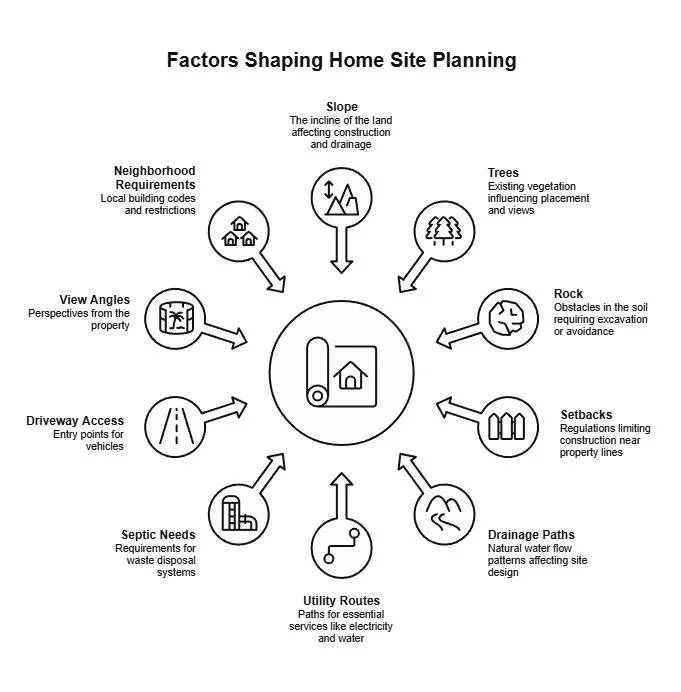
A custom home site is not a blank sheet of paper. It has slope, trees, rock, setbacks, drainage paths, utility routes, possible septic needs, driveway access, view angles, and neighborhood or permitting requirements. Each one can shape where the home sits and how the property feels day to day.
As a general planning principle, the house footprint should not be studied alone. The pool may need the same level area that makes sense for the driveway. The best view corridor may compete with the outdoor kitchen. A septic area may affect where patios, cabanas, or future additions can go.
This is where early online research reaches its limit. You can learn the vocabulary online, but the real planning moment happens on the property.
Riverbend Homes describes the first step of the Riverbend Homes building process as a Discovery Meeting at the property. During that meeting, the goal is to understand the homeowner’s vision, assess site feasibility, and identify infrastructure requirements that may affect budget and design.
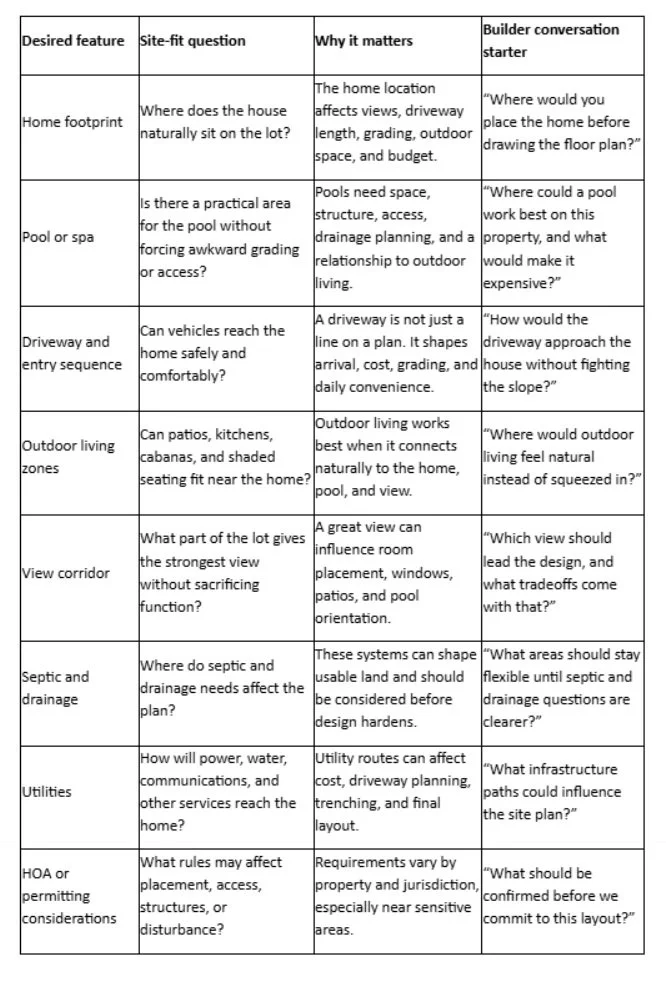
The Feature-Fit Decision Grid: Home, Pool, Driveway, Views, and Outdoor Living
Use this grid as a planning conversation tool. It is not a technical site assessment, and it does not replace a builder, surveyor, engineer, septic designer, HOA review, or permitting authority. It helps your household ask better questions before detailed plans become emotionally and financially fixed.
Walk your lot with a site-first builder before design gets locked in. That one step can turn vague worry into specific questions.
Why Pools, Driveways, and Views Compete for the Same Land
The most common planning mistake is treating each desired feature as separate. The home goes here. The pool goes there. The driveway comes later. The view will somehow work.
That approach can create conflict. A pool and cabana may want the same flat area as the most efficient driveway turn. A dramatic entry sequence may push the home farther from the best view. A large covered patio may work beautifully on paper but crowd the pool deck once drainage and utility paths are considered.
Hill Country properties reward careful planning. They also expose weak assumptions quickly.
In Spicewood and the Lake Travis area, it is sensible to ask about permitting, septic, and watershed considerations early. For official context, Travis County provides information on single-family development permits, TCEQ explains homeowner information related to on-site sewage facilities, and LCRA publishes guidance on the Highland Lakes Watershed Ordinance. These sources are public-authority references, not a substitute for property-specific review.
Ultimately, feature fit must be verified on-site before finalizing design documents.
What a Builder Looks for During a Property-Based Discovery Meeting
A strong property walk connects the dream to the dirt. It brings inspiration images, family priorities, and site realities into the same conversation.
Riverbend Homes is a second-generation family-owned business that has designed and built homes in the Texas Hill Country since 1996. This initial site visit establishes foundational infrastructure needs before the design phase accelerates. For homeowners searching for a Spicewood custom home builder, that site-first approach matters because Spicewood lots can involve views, acreage, terrain, lake-area considerations, and outdoor-lifestyle goals.
A builder may look at where the home naturally belongs, how cars will enter, where outdoor living will feel comfortable, what areas should remain flexible, and which unknowns need professional confirmation. That does not mean every answer appears in one visit. It means the right questions surface early.
That is how uncertainty becomes manageable.
Riverbend’s process also states that the team stays involved during design to help maintain the vision and budget, then pauses at bid-set completeness to estimate final construction costs before proceeding. That matters because design momentum can become expensive when site realities are discovered late.
How to Prioritize When the Lot Cannot Hold Everything Equally
Some lots can hold every desired feature comfortably. Others can support the full lifestyle only if the priorities are sequenced with care.
Start with daily life. If your family will use the pool four afternoons a week, it should not feel like an afterthought. If arrival experience matters, the driveway should not be treated as leftover space. If the view is the reason you love the property, the home and outdoor areas should protect that view instead of accidentally blocking it.
Then separate must-haves from nice-to-haves. One household member may care most about the pool. Another may focus on budget. Someone else may be thinking about guests, aging parents, teenagers, boats, pets, or a future detached structure. Put those priorities on the table early, before one floor plan starts making decisions for everyone.
A common pitfall is trying to preserve every idea equally. That rarely creates the best home. Better planning ranks the features, then lets the land help shape the final design.
Constraints are not dream-killers. They are design inputs.
Questions to Ask Before Paying for Detailed Plans
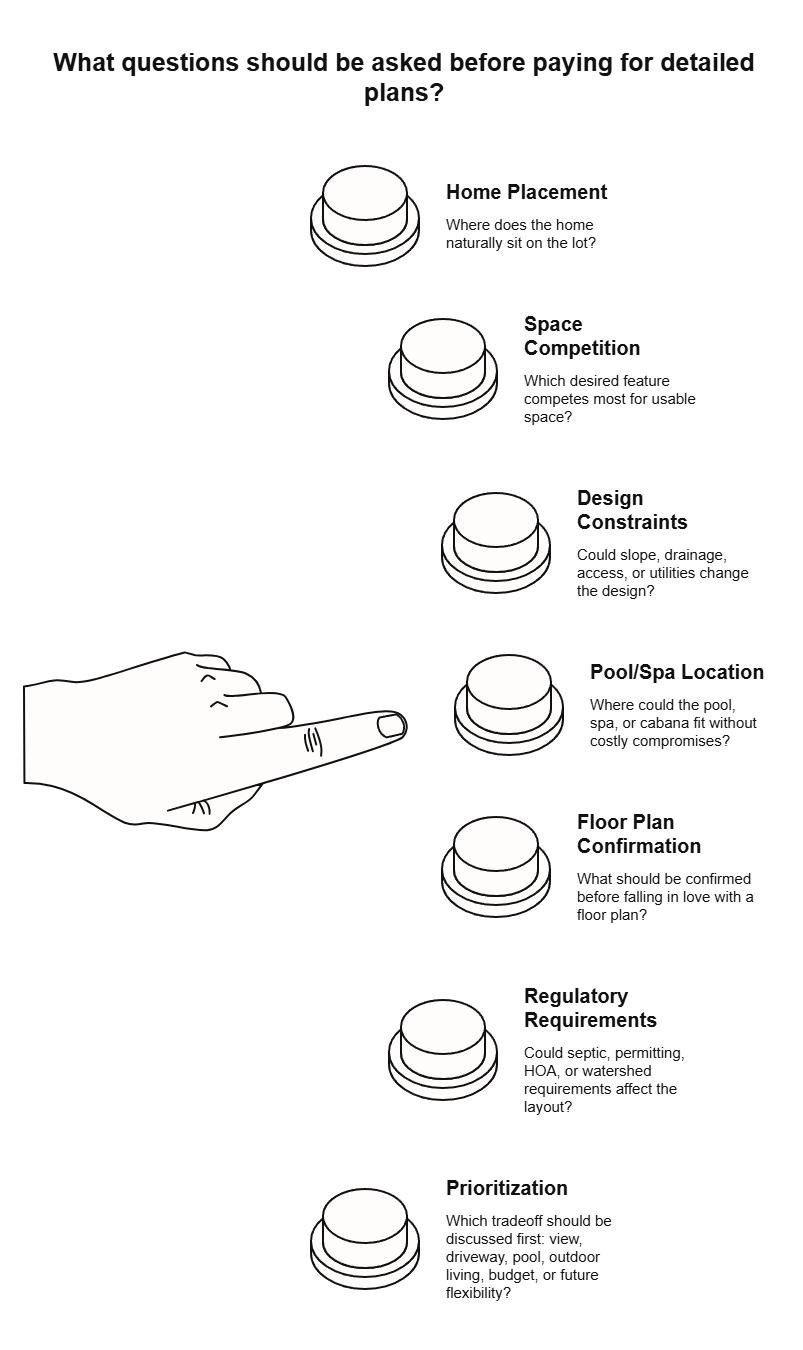
Before your household invests heavily in full architectural plans, bring these questions to a property-based builder conversation:
Where does the home naturally sit on this lot?
Which desired feature competes most for usable space?
Could slope, drainage, access, or utilities change the design?
Where could the pool, spa, or cabana fit without forcing costly compromises?
What should be confirmed before we fall in love with a floor plan?
Could septic, permitting, HOA, or watershed requirements affect the layout?
Which tradeoff should the household discuss first: view, driveway, pool, outdoor living, budget, or future flexibility?
These questions will not answer everything. They will reveal what needs professional review before the design becomes fixed.
That is the point.
The Calm Next Step: Read the Land Before the Design Is Locked
Return to the property in your mind. The pool is still there. The driveway still curves toward the entry. The outdoor living space still faces the view. Nothing about site-first planning takes that dream away.
It simply asks the land to join the conversation before the drawings get too far ahead.
That shift moves your household from uncertainty to grounded confidence. You are no longer asking whether a beautiful lot can somehow absorb every wish. You are asking how the home, pool, driveway, view, outdoor living, access, infrastructure, and rules can work together.
For a high-consideration custom home, that is a healthier starting point.
Explore the Riverbend Homes building process to see how a property-based Discovery Meeting fits before design and budgeting decisions harden. When your household is ready to talk through a specific lot, you can contact Riverbend Homes to start that conversation.
Read the land first. Then draw the dream.
Disclaimer: This content is for general educational planning only. Site feasibility, permitting, septic, drainage, engineering, HOA, and watershed requirements vary by property and should be reviewed with qualified professionals and the appropriate authorities before design or construction decisions are made.
Our expert team uses AI tools to help organize and structure our initial drafts. Every piece is then extensively rewritten, fact-checked, and enriched with first-hand insights and experiences by expert humans on our Insights Team to ensure accuracy and clarity.
Our Editorial Process:
Our content is developed from Riverbend Homes’ published process, brand materials, local building experience, and homeowner-facing educational resources. Each article is structured to help Texas Hill Country homeowners understand custom-home decisions in plain language, connect early planning questions to real site and budget considerations, and identify the next responsible conversation before design or construction commitments move forward.
About the Riverbend Homes Insights Team
The Riverbend Homes Insights Team is our dedicated engine for synthesizing complex topics into clear, helpful guides. While our content is thoroughly reviewed for clarity and accuracy, it is for informational purposes and should not replace professional advice.