

Survey Papers in Hand: 5 Lot Checks Before Your Dream Home Is Drawn
📌 Key Takeaways
A custom home plan works best when the land, not the dream sketch, leads the first decisions.
Walk Before Drawing: A property walk can reveal limits that a floor plan cannot solve later.
Check Usable Space: Lot size matters less than where the home, garage, pool, and patio can fit.
Read The Terrain: Slope, rock, and drainage can shape the foundation, driveway, budget, and timeline.
Verify Utilities Early: Water, septic, electric, and buried lines need answers before design choices become fixed.
Test The Dream: Views, privacy, sun, and outdoor living should match how the family will live daily.
Let the lot speak first, so the design can start with better facts and fewer costly surprises.
Luxury custom home buyers evaluating land in Spicewood will gain a clearer first-step checklist, preparing them for the detailed overview that follows.
~ ~ ~ ~ ~ ~ ~ ~ ~ ~ ~ ~ ~ ~ ~ ~ ~ ~
Start with the land.
The survey papers are spread across the hood of the car, the limestone is uneven under your boots, and the view across the Spicewood lot already has you picturing windows, a driveway, a pool, and a covered patio.
You have the dream in your head. You may even have inspiration photos on your phone. Still, before the floor plan is drawn, the land needs a careful first read. What if the lot changes the plan? That is a reasonable concern. The goal is not to shrink the dream. The goal is to understand what the land is asking the design to solve.
Start With the Land Before the Floor Plan
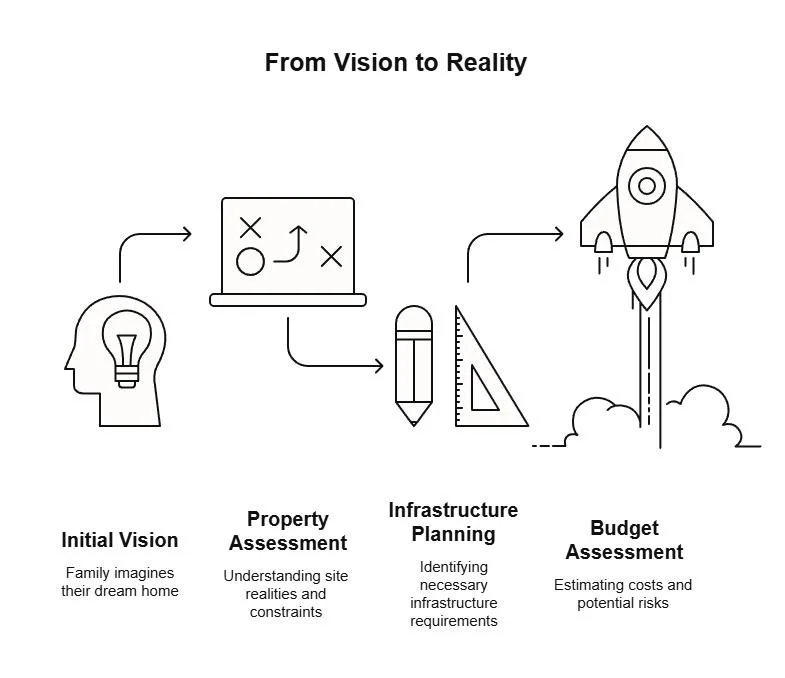
A luxury custom home should begin with the property, not a sketch. Inspiration images are useful, but they cannot answer the early site questions that shape design, infrastructure, timing, and budget.
That matters in Spicewood, where views, slope, rock, outdoor living, Lake Travis proximity, and county nuance can all affect the first conversation. Spicewood is Riverbend Homes’ home market and is often described as the Gateway to the Hill Country, but this article should not be read as a location rulebook. Depending on where your lot sits, different county, HOA, septic, floodplain, utility, or permitting questions may apply.
This is where a property-first conversation helps. Riverbend’s documented process begins with a Discovery Meeting at the property to understand your vision, assess site feasibility, and identify infrastructure requirements that may affect budget and design. You can learn more about the Riverbend Homes building process when you are ready to connect your notes to a builder-led conversation.
Site feasibility is the early process of understanding whether a property can support the home a family imagines. It includes site realities, infrastructure requirements, design implications, and budget risk.
Not everything is settled on the first walk. That is the point.
What Survey Papers Can Tell You—and What They Cannot
Your survey papers are a map. They are not yet a build plan.
A survey can help identify boundaries, easements, setbacks, existing features, and clues about the lot. It can show where the property begins and ends. It may also help you see where a driveway, home, pool, or outdoor living area could become more complicated.
What it cannot do by itself is translate the land into a full design decision. It does not automatically answer whether the best view works with the best driveway approach. It does not settle septic feasibility, drainage strategy, utility routing, HOA rules, or permitting requirements. Those items need professional review.
Your job is not to become a surveyor, engineer, septic designer, or permitting expert. Your job is to ask better first questions.
The 5 Lot Checks to Make Before Your Dream Home Is Drawn
Use this worksheet during your first property walk. It is not a professional feasibility determination. It is a first-pass conversation tool that helps you organize what to ask next.
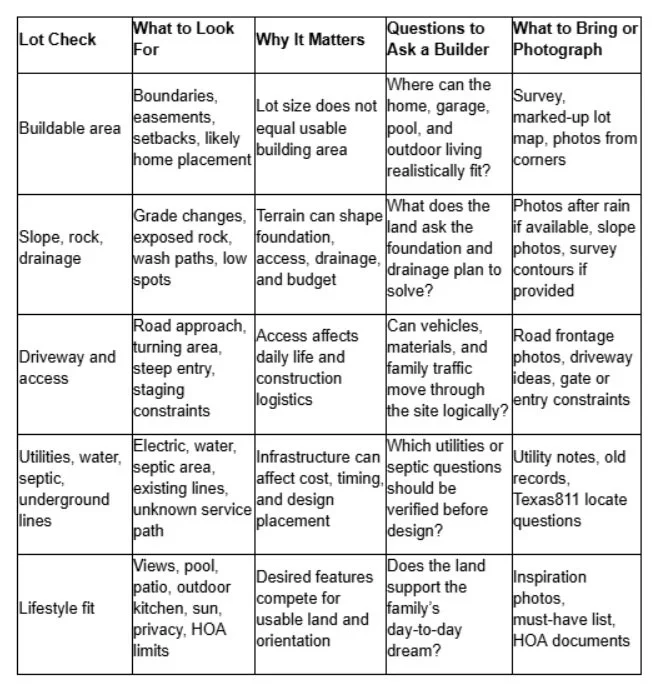
1. Check the Buildable Area, Not Just the Lot Size
A generous lot can still have a very specific best place to build.
Start by looking at the survey with one practical question in mind: where can the home realistically sit? Then widen the question. Where would the garage go? Where would the driveway arrive? Where could an in-ground pool, cabana, or outdoor kitchen fit without forcing the home into an awkward position?
The buildable area may be shaped by easements, setbacks, slope, protected areas, HOA requirements, driveway needs, or the relationship between indoor rooms and outdoor living. Some of those items are visible on paper. Others become clearer only when you stand on the land.
This is not a pass-fail check. It is a fit check.
2. Walk the Slope, Rock, and Drainage Patterns
Many beautiful Hill Country lots owe their character to terrain. The view may come from elevation. The privacy may come from a wooded slope. The outdoor living opportunity may come from how the home can sit into the land.
That same terrain can influence foundation strategy, drainage planning, retaining needs, driveway approach, and budget expectations. Look for exposed rock, low spots, wash paths, steep transitions, and places where water appears likely to move. Photos after rain can be useful if you have them.
A smart early question is simple: would the best view create a more complex foundation, access, or drainage question? For a deeper look at this topic, see Riverbend’s article on Navigating Lake Travis Topography.
3. Trace the Driveway and Construction Access
Access is not only about the finished driveway. It is also about construction deliveries, equipment, staging, guest parking, and daily life after move-in.
Stand near the road or entry point and picture 3 different moments: a concrete truck arriving, family pulling in after dinner, and guests finding the front door for the first time. The driveway has to work for all of them. A beautiful homesite can still become frustrating if the approach is steep, narrow, oddly curved, or in conflict with the best orientation for the house.
Photograph the road frontage, possible driveway entry, gate location, turning areas, and any trees or terrain that may affect the approach. Small access questions tend to grow once plans become emotionally fixed.
Better now than later.
4. Mark the Utility, Water, Septic, and Underground-Line Questions
Infrastructure questions are easier to address before the design assumes a specific home placement.
Start with what you know. Is there existing electric service? Is water available, or is another source being discussed? Is there prior septic documentation? Are there visible utility boxes, meters, easements, or old records? None of these details should be treated as final without verification, but each one can help shape the next professional conversation.
For digging or exploratory work, Texas811 homeowner guidance says Texas law requires you or your contractor to contact 811 two business days before digging, excluding weekends and holidays. The same page explains that Texas811 helps arrange utility locators to mark underground lines before digging. (Texas 811)
For septic, keep the language conditional. Depending on where the lot sits, on-site sewage requirements may involve local or regional authorities. The LCRA On-Site Sewage Facilities Program states that LCRA regulates on-site sewage facilities within a 2,000-foot zone around Lake Travis and a 2,200-foot zone around the upper Highland Lakes. (LCRA)
5. Test the Dream Features Against the Land
The question is not only, “Can the lot hold a house?” It is, “Can the lot support the life you are picturing?”
That means testing the dream features against the land. A pool may want sun, privacy, and enough usable area. A covered patio may need the right connection to the kitchen and living room. A sunset view may affect window placement, glare, and room orientation. A detached casita or separate primary wing may need more careful planning around circulation, utilities, and privacy.
This is where survey papers, photos, and inspiration images should come together. The dream is still welcome. It just needs to meet the property before the floor plan takes over.
If you are evaluating land in the area, Riverbend’s Spicewood custom home builder page offers more local context about building in Spicewood and the Lake Travis area.
What to Bring to a Builder-Led Discovery Meeting
Bring the materials that help a builder see both the dream and the constraints. You do not need a finished plan. You need enough information to start a grounded conversation.
Bring survey papers, parcel or plat documents, HOA materials if available, photos and videos from different parts of the lot, inspiration images, a must-have and nice-to-have list, rough budget expectations, and known questions about utilities, septic, access, drainage, views, and outdoor living.
Also bring your notes from the five-check worksheet. They show where you already see uncertainty.
This on-site evaluation naturally transitions into a formal Discovery Meeting. That setting matters because the conversation can connect your vision to site feasibility and infrastructure requirements before design and budget move too far forward. After that, the process can move into design and budget alignment with clearer assumptions.
Especially when project timelines begin to feel urgent, one careful property walk before design can prevent rushed assumptions.
When the Lot Needs a Professional Reality Check
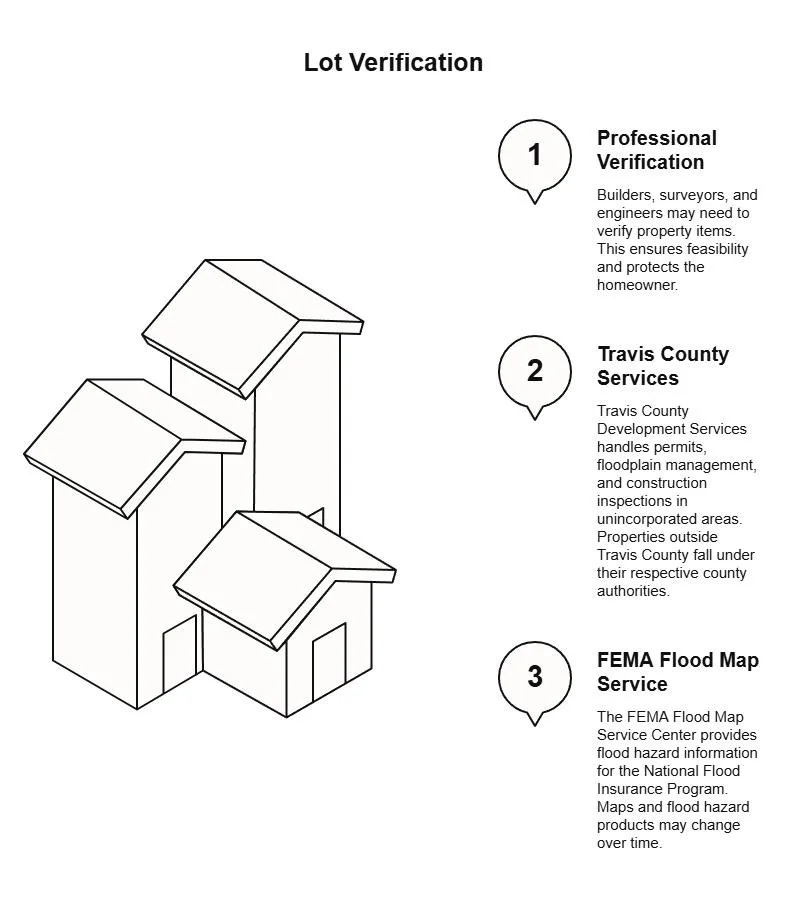
A homeowner worksheet can organize questions. It cannot determine feasibility.
That distinction protects you. A builder, surveyor, engineer, septic professional, utility locator, HOA, or permitting authority may need to verify the items that matter for your specific property. If a check raises uncertainty, the next step is not panic. It is a better conversation.
For relevant unincorporated-area situations, Travis County Development Services describes its role in development outside corporate city limits, including permits, floodplain management, construction activity inspections, and subdivision regulation. Because Spicewood spans multiple counties, properties located outside of Travis County will fall under the jurisdiction of their respective authorities—such as Burnet or Blanco counties—for similar requirements.
For flood questions, the FEMA Flood Map Service Center is the official public source for flood hazard information produced for the National Flood Insurance Program. FEMA notes that maps and flood hazard products may change over time, so current lookup and professional interpretation matter. (msc.fema.gov)
Let the Lot Shape the First Conversation
The survey papers are not the finish line. They are the start of a better property conversation.
Before the dream is drawn in ink, let the land speak first. Walk the boundaries. Notice the slope. Trace the driveway. Mark the utility and septic questions. Test the pool, patio, views, and outdoor living against the actual ground beneath your feet.
Aligning your vision with the lot's physical realities now prevents costly redesigns later. When the land is read early, the design conversation starts with better facts, calmer expectations, and a clearer path from vision to feasibility.
Save the five-check worksheet and bring it to your first builder conversation. Then use the Riverbend Homes building process to see how a property-based Discovery Meeting can turn those first notes into a more grounded path forward.
Our expert team uses AI tools to help organize and structure our initial drafts. Every piece is then extensively rewritten, fact-checked, and enriched with first-hand insights and experiences by expert humans on our Insights Team to ensure accuracy and clarity.
Our Editorial Process:
Our content is developed from Riverbend Homes’ published process, brand materials, local building experience, and homeowner-facing educational resources. Each article is structured to help Texas Hill Country homeowners understand custom-home decisions in plain language, connect early planning questions to real site and budget considerations, and identify the next responsible conversation before design or construction commitments move forward.
About the Riverbend Homes Insights Team
The Riverbend Homes Insights Team is our dedicated engine for synthesizing complex topics into clear, helpful guides. While our content is thoroughly reviewed for clarity and accuracy, it is for informational purposes and should not replace professional advice.