Beyond the Kitchen Table Sketches: How Custom Home Design-Build Stops Budget Overruns
📌 Key Takeaways
Custom home budgets blow up when design and construction teams work separately—unified design-build keeps costs visible from the start.
Separate Teams Create Surprise Bills: When your architect and builder don't talk until plans are done, you fall in love with a design before anyone checks what it actually costs to build.
Real-Time Cost Checks Prevent Heartbreak: Design-build teams calculate budget impact as you make decisions, not months later when changes are expensive.
Your Lot Hides Costs You Can't See: Rock, slopes, septic systems, and utility access in Hill Country terrain can add tens of thousands—a site walk before design catches these early.
Allowances Should Give You Control: Good contracts let you shop for finishes yourself and keep the savings, rather than locking you into builder-selected materials.
Daily Oversight Speeds Up Your Build: Builders who limit their projects and show up every day finish faster and catch problems before they become budget emergencies.
One team from start to finish means no finger-pointing and no surprise invoices.
Texas Hill Country homeowners planning custom builds will gain budget protection strategies here, preparing them for the detailed process overview that follows.
~ ~ ~ ~ ~ ~ ~ ~ ~ ~ ~ ~ ~ ~ ~ ~ ~ ~
The sketches are spread across the table. Inspiration photos glow on the laptop screen. Maybe there's a Pinterest board with 47 saved images of Hill Country great rooms and outdoor kitchens. The excitement is real. So is the knot in your stomach.
You and your partner have purchased the lot. You've imagined the sunrise view from a future primary suite. You've talked about where the kids will play, where guests will gather, how the house will finally feel like yours. Yet, beneath the anticipation lies a persistent financial anxiety.
That fear is not irrational. It's not a sign of cold feet or poor planning. It's the reasonable response of a thoughtful person facing one of the largest financial commitments of their life—and knowing that custom home projects have a reputation for spinning out of control.
The good news? Budget overruns are not inevitable. They follow a predictable pattern, and that pattern can be interrupted. Understanding where budget problems actually begin—and how a unified custom home design-build approach stops them—is the first step toward building your Texas Hill Country home with both your vision and your financial boundaries intact.
The Kitchen-Table Moment: Why Custom Home Budget Anxiety Starts So Early
Budget anxiety doesn't wait for construction to begin. It starts the moment you realize that the gap between "dream" and "done" is filled with decisions you don't yet know how to make.
If you're researching and budgeting this spring, the timing matters. Late winter through early spring is generally when many homeowners across the Hill Country begin preparing for major construction decisions, making it an ideal time to understand what causes overruns and what helps prevent them.
You may have already encountered a version of this tension. One partner gravitates toward the soaring ceilings and the chef's kitchen. The other keeps circling back to the spreadsheet, wondering how much contingency is really enough. Both concerns are valid. Both people are trying to protect the same thing: a home that works for your family without becoming a source of regret.
The fear isn't really about money. It's about control. Will you be the one making the hard calls, or will those calls be made for you—by contractors who didn't communicate, by site conditions no one anticipated, by a design that looked beautiful on paper but costs significantly more than anyone quoted?
Custom home projects carry an uncomfortable reputation. Stories circulate about budgets that doubled, timelines that stretched into years, and relationships between homeowners and builders that ended in lawyers' offices. Even if you've never personally experienced a build gone wrong, you've probably heard enough cautionary tales to wonder whether the dream is worth the risk.
Here's what those stories often have in common: the budget problem started long before anyone poured concrete. It started when design decisions were made without real-time cost feedback. It started when no one asked hard questions about the lot until permits were already in motion. It started when the architect and the builder operated in separate worlds, each assuming the other would catch the problem.
Why Custom Home Budgets Blow Up Before the House Is Even Built
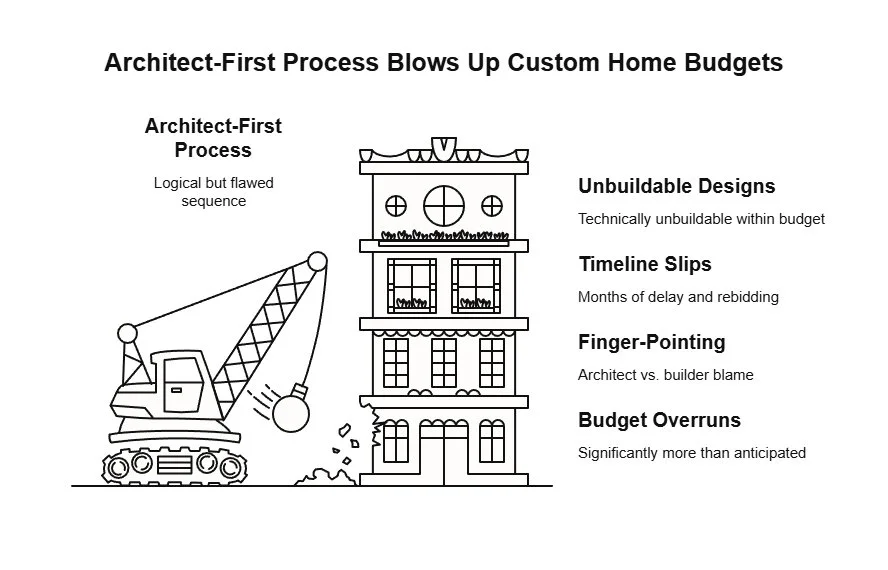
The traditional custom home process follows a sequence that feels logical but contains a structural flaw.
First, you hire an architect. The architect asks about your vision, your lifestyle, your aesthetic preferences. Together, you develop a set of plans. The architect may suggest features you hadn't considered, materials that would elevate the design, spatial arrangements that solve problems you didn't know you had. The plans grow more beautiful and more detailed.
Then, once the design is complete, you take those plans out to bid. Multiple builders review the drawings and submit their estimates. You compare the numbers, select a contractor, and prepare to break ground.
The problem? By the time you receive those bids, you've already fallen in love with the design. You've shown the renderings to friends and family. You've mentally moved into that house. And now a builder is telling you it will cost significantly more than you anticipated—or that certain features can't be built on your lot without expensive modifications.
This is the architect-first, bid-later trap. It's the moment when finger-pointing begins. The architect says the builder is overcharging. The builder says the architect designed something that ignores site realities. You're caught in the middle, trying to figure out who to trust while your budget stretches and your timeline slips.
The root cause is not bad intentions. It's disconnected workflows. When the person designing your home has no accountability for construction costs, and the person building your home had no input during design, misalignment is almost guaranteed. Beautiful ideas get approved without anyone calculating what they'll actually cost to execute. Site conditions—rock, slope, utility access, septic requirements—get discovered after the plans are locked.
Fragmented teams lead to designs that are technically unbuildable within the set budget. The redesign fees, the rebidding process, the months of delay—these are the hidden costs of a workflow that separates imagination from reality.
This is not a criticism of architects or builders as individuals. It's a recognition that the traditional sequence creates structural incentives for problems. And if you're planning to build in the Texas Hill Country, where site conditions are rarely simple, those problems multiply.
What Custom Home Design-Build Actually Means for a Homeowner
Custom home design-build is a unified project delivery system where a single entity assumes responsibility for both architectural design and construction.
That definition sounds straightforward, but the implications are significant. Instead of hiring an architect first and a builder later, you work with one integrated team from the beginning. Design decisions and construction realities stay in the same conversation. The people imagining your home are the same people who will build it—and who are accountable for delivering it within your budget.
Think of it this way: design-build puts the architect and the accountant at the same desk from day one.
When a design idea emerges, someone on the team immediately asks: What will this cost? What does it require from the site? What tradeoffs does it create elsewhere in the budget? Those questions don't wait until the design is finished. They happen in real time, while changes are still easy and inexpensive to make.
For you as a homeowner, this means something practical: you don't fall in love with a plan you can't afford. You don't discover six months into the process that your lot requires $80,000 in retaining walls that nobody mentioned. You don't find yourself choosing between gutting your design or blowing past your budget.
Design-build is not a magic wand. Challenges still arise. Costs still require tradeoffs. But the unified structure means those challenges surface early, when you have options—not late, when you're trapped.
The Design-Build Institute of America has documented that this approach works best when multiple disciplines are convened early and managed within a unified framework. The principle applies whether you're building a commercial facility or a custom home: when design and construction operate as partners rather than separate contractors, accountability stays clear and surprises stay manageable.
For a deeper look at what design-build means in the context of custom homes, Riverbend Homes has published a plain-language explanation that avoids contractor jargon.
Continuous Estimating: The Budget-Protection Engine Most Homeowners Never See
Continuous estimating means that budget impact is calculated throughout the design process, not just at the end. This practice is the real power of design-build—not just organizational, but operational.
Every significant design decision triggers a cost check. Want to add a second primary suite for visiting parents? The team calculates what that does to your total before you commit. Considering a switch from stucco to stone on the exterior? You see the number before the plans are finalized.
This sounds obvious, but it's surprisingly rare in traditional custom home projects. When the architect and builder are separate entities with separate contracts, there's often no mechanism for real-time cost feedback. The architect may not have access to current construction pricing. The builder may not be involved until the design is complete. The homeowner is left hoping that the final bid will somehow match the original vision.
Hope-based budgeting is the opposite of what you need when building a luxury home. You need continuous visibility. You need someone who will tell you the truth while you still have room to adjust.
A well-structured design-build process includes a specific checkpoint: when plans reach what's called "bid-set completeness," the team pauses. Before pushing forward into permitting and final documentation, they calculate a realistic final construction estimate. This is the moment to confirm alignment—or to make changes before costs are locked.
Riverbend Homes builds this pause into every project. The team stays involved throughout design specifically to prevent budget drift. When plans reach the bid-set level, they stop and present a clear estimate. If adjustments are needed, they happen before anyone breaks ground—not after.
National construction-cost research from the National Association of Home Builders confirms that site work represents a meaningful cost category in home construction. That's national context, not a local Texas luxury-home estimate, but it reinforces the same principle: visible finishes are only one part of the financial picture. Early feasibility testing and ongoing estimating matter precisely because costs hide in places most homeowners don't initially see.
This approach won't eliminate every hard decision. Budgets are finite, and tradeoffs are part of any custom build. But continuous estimating ensures that you're making those tradeoffs with full information, not discovering them as unpleasant surprises months into construction.
To understand how this workflow stops the finger-pointing that plagues traditional builds, the linked article explains the accountability structure in more detail.
The Hill Country Reality Check: Rock, Slope, Utilities and Permits Change Everything
If you've purchased a lot in the Texas Hill Country, you already know the land is not simple. The views are spectacular precisely because the terrain is dramatic. Limestone ridges, steep grades, and irregular topography create the character that draws people to this part of Central Texas.
That same character creates construction realities that must be addressed early—or paid for later.
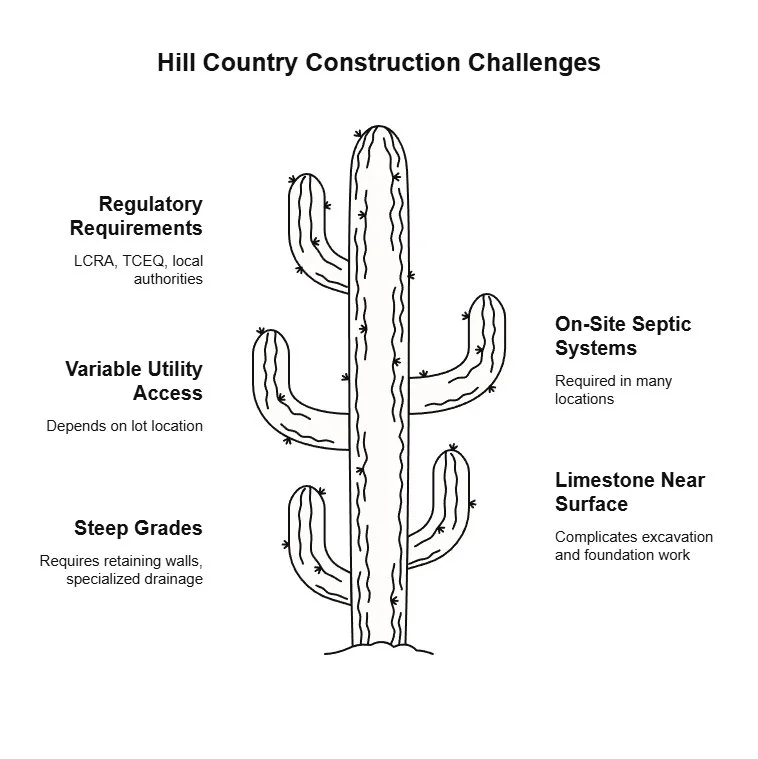
Slopes above a certain threshold often require retaining walls, stepped foundations, or specialized drainage systems. Limestone near the surface can complicate excavation and foundation work. Utility access varies widely depending on where your lot sits relative to existing infrastructure. And in many Hill Country locations, wastewater handling requires on-site septic systems rather than municipal sewer connections.
These are not reasons to avoid building. They're reasons to understand your site before custom home design locks in assumptions that don't match reality.
Septic planning is a particular concern near Lake Travis and throughout the Highland Lakes region. The Lower Colorado River Authority administers on-site sewage facilities programs for properties within its jurisdiction, regulating facilities within a 2,000-foot zone around the lake. The Texas Commission on Environmental Quality establishes statewide requirements for permits and approved plans, and advises arranging a preconstruction site evaluation by a licensed site evaluator or professional engineer. That evaluation typically includes a lot survey, soil analysis, and other suitability factors. Local authorities may impose additional restrictions beyond state minimums, particularly for lots close to waterways.
None of this is meant as legal or engineering advice. Every site is different, and specific requirements depend on your lot's location, soil conditions, and regulatory context. The point is that these factors affect both design and budget—and that a unified design-build team should be surfacing them early, during the Discovery Meeting, not discovering them after plans are finalized.
When site conditions are understood from the start, they become planning constraints rather than budget emergencies. A retaining wall that's designed into the project from day one is a feature. A retaining wall that gets added after foundation plans are complete is a crisis.
For more detail on how rock and slope impact custom builds in this region, the linked resource covers what to expect and how to plan accordingly.
From Discovery Meeting to Buildable Plan: How the Process Protects the Budget
A well-structured design-build process follows a clear sequence, and each phase serves a budget-protection function.
Discovery: Surface Reality Before Attachment
The process begins with a Discovery Meeting—not in an office, but on your property. Walking the lot together allows the team to assess site conditions firsthand: where the views are strongest, how the land slopes, where utilities connect, what infrastructure requirements will affect both design and budget.
This meeting is also the time to understand your vision. What are your must-haves? Do you have a preferred architectural style? How will you actually use the space? What's your budget for the project? The goal is alignment: making sure the team understands both what you want and what the site will support.
Riverbend Homes treats this Discovery Meeting as the essential first step. The team evaluates feasibility, identifies infrastructure needs, and begins connecting your vision to the realities of your specific lot. Problems that would otherwise surface months later get addressed before design work begins.
Design and Budget: Keep Decisions Tied to Costs
Once discovery is complete, the design phase begins—with the builder involved throughout. As plans develop, cost implications are calculated in real time. The team translates saved inspiration images, magazine clippings, or Pinterest boards into a design that fits both the site and the budget.
This is where continuous estimating does its work. Design choices don't outrun financial reality because someone is always asking what each decision costs. When plans reach bid-set completeness, the team pauses to present a realistic final construction estimate. If the number is right, permitting moves forward. If adjustments are needed, they happen now—not after contracts are signed.
Build: Faster Execution Through Daily Management
When construction begins, the unified accountability continues. Because the team that designed your home is the same team building it, there's no translation gap between plans and execution. Questions get answered quickly. Changes get evaluated against the original budget. Progress stays visible.
Riverbend Homes takes on a select number of projects at a time specifically to ensure close involvement. The commitment is to be on-site and managing the build every single day—not juggling dozens of projects with occasional check-ins. For homeowners, this translates to a faster timeline and fewer opportunities for miscommunication.
"Ben made it easy and fun to watch our designs come to life," one Austin-area client noted, describing the experience of staying informed and involved throughout construction.
For a complete walkthrough of this sequence, visit the process page on the Riverbend Homes website.
Budget Control Without Killing the Dream: Allowances, Selections and Autonomy
One of the fears that accompanies budget discipline is the loss of personal taste. If staying on budget means accepting whatever the builder chooses—generic finishes, builder-grade fixtures, no input on materials—then what's the point of building custom?
The right design-build partner understands that budget protection and design autonomy are not opposites. They work together.
Allowances are the mechanism. A well-structured contract includes allowances for categories like flooring, countertops, lighting, and fixtures. These allowances define how much is budgeted for each category, giving you clarity about what's included and what would constitute an upgrade.
But allowances are only useful if they're realistic and if you have genuine flexibility in how you use them. Some builders set allowances so low that overages are inevitable. Others restrict your ability to shop for better deals, requiring you to purchase through their vendors regardless of price.
A transparent design-build firm operates differently. Allowances are set at levels that genuinely support the finish quality appropriate for your project. And if you find a better price on a material you love—because you found a tile supplier running a promotion, or a lighting showroom with discontinued fixtures—you can capture those savings.
"He frequently found ways to save us money on our selections," one Riverbend Homes client reported, describing how the team actively helped identify value without sacrificing quality.
This approach respects your judgment. You're not a passive recipient of whatever the builder decides. You're a participant in the process, making informed choices about where to invest and where to economize—with full visibility into how those choices affect your overall budget.
For more on how shopping allowances work and what questions to ask, the linked article provides practical guidance.
The Budget Protection Checklist: 5 Questions to Ask Before You Approve Design Work
Before you commit to a design or sign a construction contract, these five questions will help you evaluate whether the process is set up to protect your budget—or whether you're walking into a structure that makes overruns likely.
This checklist is designed to be shared. If you and your partner have different priorities—one focused on the vision, one focused on the numbers—these questions give you common ground for evaluating any builder you're considering.
1. Who is responsible for both design decisions and construction budget alignment from day one?
If the answer is split across separate parties with no clear owner, expect gaps.
2. At what point do you stop design work and calculate a realistic final construction estimate?
The right answer should include a clear checkpoint, not just "later."
3. How do you surface site feasibility, rock, slope, utilities, and permit-related costs before final plans are approved?
A beautiful plan is not the same thing as a buildable one.
4. How do allowances work, and can I shop selections independently if I find better value?
This helps you protect both quality and flexibility.
5. How many projects are you actively managing at one time, and who is on site daily during construction?
Capacity discipline matters. Oversight is not a detail. It's part of the value.
These questions are not adversarial. They're clarifying. A builder confident in their process will answer them directly. Evasive responses or frustration at being asked are signals worth heeding.
For additional guidance on evaluating builders and avoiding common pitfalls, the article on how the right builder helps you avoid surprise bills covers what to look for and what to avoid. If you want to understand contract structures more deeply, Fixed-Price vs. Cost-Plus explains the tradeoffs in each approach.
When Design-Build Is the Right Fit for a Budget-Conscious Luxury Project
Design-build is the right fit when you want creativity, but not creative accounting.
Not every homeowner needs this approach. If your lot is flat and simple, your design preferences are standard, and you have deep experience managing construction projects, the traditional approach may work fine.
But if you're building in the Texas Hill Country—where site conditions are rarely straightforward—and if budget clarity matters as much as design creativity, design-build offers something the traditional approach cannot: unified accountability from vision to completion.
This is not about finding the cheapest build. It's about finding the clearest path to a buildable dream. It's about working with a team that will tell you the truth about costs while there's still time to adjust. It's about protecting both your investment and your peace of mind.
The right fit is someone who wants both creativity and boundaries. Someone who values transparency over pleasant surprises. Someone who recognizes that responsible planning is not small thinking—it's the smartest way to protect a significant vision.
Riverbend Homes has operated as a second-generation family-owned Texas Hill Country builder since 1996. The approach is straightforward: listen first, test ideas against site realities early, keep design and budget in the same conversation, and build with daily attention rather than occasional check-ins. For a clearer sense of how the company works and what it values, explore about Riverbend Homes and read what past clients say in the testimonials.
"He will keep you on budget and on time with no surprises," one client summarized after completing their custom home.
If you're in the spring planning phase—researching options, evaluating lots, trying to understand how to move from kitchen-table sketches to buildable plans—the next step is not a commitment. It's a conversation.
See the process to understand how Discovery, Design, and Build connect. When you're ready to talk about your specific lot and vision, schedule a Discovery Meeting to start the conversation on your property.
The dream doesn't have to outrun the budget. With the right structure, the right team, and the right questions, you can build exactly what you imagined—and know what it costs before you commit.
Our Editorial Process:
Our expert team uses AI tools to help organize and structure our initial drafts. Every piece is then extensively rewritten, fact-checked, and enriched with first-hand insights and experiences by expert humans on our Insights Team to ensure accuracy and clarity.
By: The Riverbend Homes Insights Team
The Riverbend Homes Insights Team is our dedicated engine for synthesizing complex topics into clear, helpful guides. While our content is thoroughly reviewed for clarity and accuracy, it is for informational purposes and should not replace professional advice.