

Navigating Lake Travis Topography: How Rock and Slope Impact Your Custom Build
📌 Key Takeaways
On Lake Travis lots, rock depth, slope, and drainage shape your budget and floor plan before any finish selection does.
Land Drives Cost More Than Finishes: Limestone bedrock, steep grades, and fast runoff often determine sitework scope—and sitework can exceed the cost of interior upgrades.
Get Site Data Before Locking In Plans: A survey and geotechnical report (when warranted) reveal whether excavation, foundation type, and utility routing will require specialized methods.
Slope Forces Early Tradeoffs: Driveway geometry, build pad location, and view orientation compete with each other—deciding priorities early prevents costly redesigns.
Drainage Planning Prevents Future Problems: Coordinating grading, swales, and retaining wall design before construction reduces erosion risk and water intrusion after move-in.
Sequence Matters for Budget Control: Walking the lot with a builder, then surveying, then designing keeps you from budgeting for a build that ignores half the scope.
Start with the land, not the floor plan.
Homeowners evaluating steep or rocky lots near Lake Travis will gain a clear framework for early feasibility decisions, preparing them for the detailed evaluation checklist and builder selection guidance that follows.
~ ~ ~ ~ ~ ~ ~ ~ ~ ~ ~ ~ ~ ~ ~ ~ ~ ~
The lot is quiet. You're standing on a steep hillside above Lake Travis, imagining where the porch should go to catch the evening breeze—and that panoramic view.
Then it hits you: the driveway has to get up here somehow. And where does the rainwater go during a Texas storm?
On a Lake Travis lot, the land isn't just scenery. It's the silent architect that writes the first draft of your budget and floor plan. Limestone bedrock, caliche layers, steep grades, and fast-moving runoff all shape what you can build, where you can place it, and how much the sitework will cost—often more than any single finish upgrade.
This guide walks through how rock and slope affect your custom home in the Texas Hill Country, what to look for during a lot walk, and how to get clear answers before you fall in love with a floor plan that doesn't fit the land.
What Makes Lake Travis Lots Challenging (and Why It Matters Early)
The Texas Hill Country sits atop limestone bedrock formed millions of years ago when a shallow sea covered Central Texas. That geology creates stunning views, spring-fed creeks, and the rolling terrain people move here for.
It also creates building sites that demand early investigation.
Three factors drive feasibility and cost on most Lake Travis lots. Rock type and depth determine whether you can dig a standard foundation trench or need specialized excavation. Slope controls where your home can sit, how you access it, and how much earth has to move. Drainage dictates how fast water moves across (and sometimes into) your building site during storms.
Ignore any of these until design is underway, and you're likely to see change orders, redesign loops, or worse—a plan that simply doesn't fit the property.
For a transparent, site-first approach, see how Riverbend's process begins with feasibility and early alignment.
Rock 101: Limestone, Caliche, and What They Do to Excavation and Foundations
Walk a Lake Travis lot and you may notice exposed rock shelves, limestone outcrops, or thin soil over white, powdery material called caliche. These are clues about what lies beneath.
Central Texas is known for limestone and karst geology—terrain shaped by dissolving rock over millennia. For a plain-language overview, see the USGS karst explainer. Caliche is also common across parts of Texas; for a detailed geological context, refer to the Bureau of Economic Geology at UT Austin.
Limestone provides stable support for foundations, while clay soils can move with seasonal moisture changes—sometimes shifting several inches. That stability sounds like good news, but building on limestone isn't without complications.
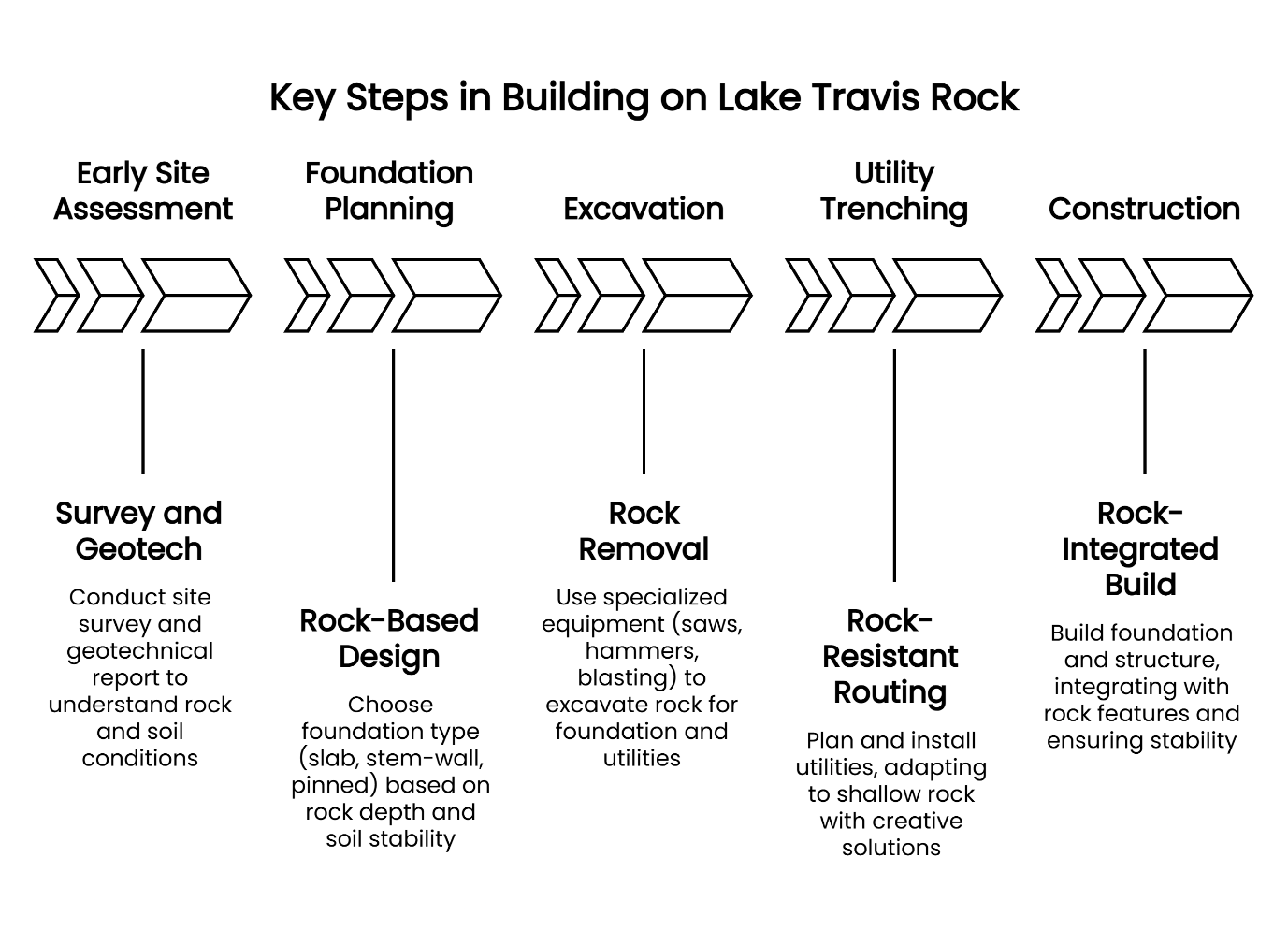
Excavation complexity increases when rock is shallow. Standard trenching equipment may not cut it. Depending on depth and hardness, crews might need rock saws, hydraulic hammers, or careful blasting—each adding time and cost.
Foundation options change based on rock depth. Slab-on-grade works well when soil is deep enough. When rock is close to the surface, a structural slab pinned directly to the rock or a stem-wall foundation often makes more sense. A geotechnical report tells you which approach fits your site.
Utility trenching gets harder in rock. Water lines, electrical conduits, and septic systems all need to be routed, and shallow rock can force creative solutions or longer runs.
The fix? Get site data early—survey plus geotech when warranted—before locking in a floor plan. Budget with clear allowances for unknowns until that data is in hand.
Slope 101: How Grade Affects Layout, Driveway Access, and Retaining
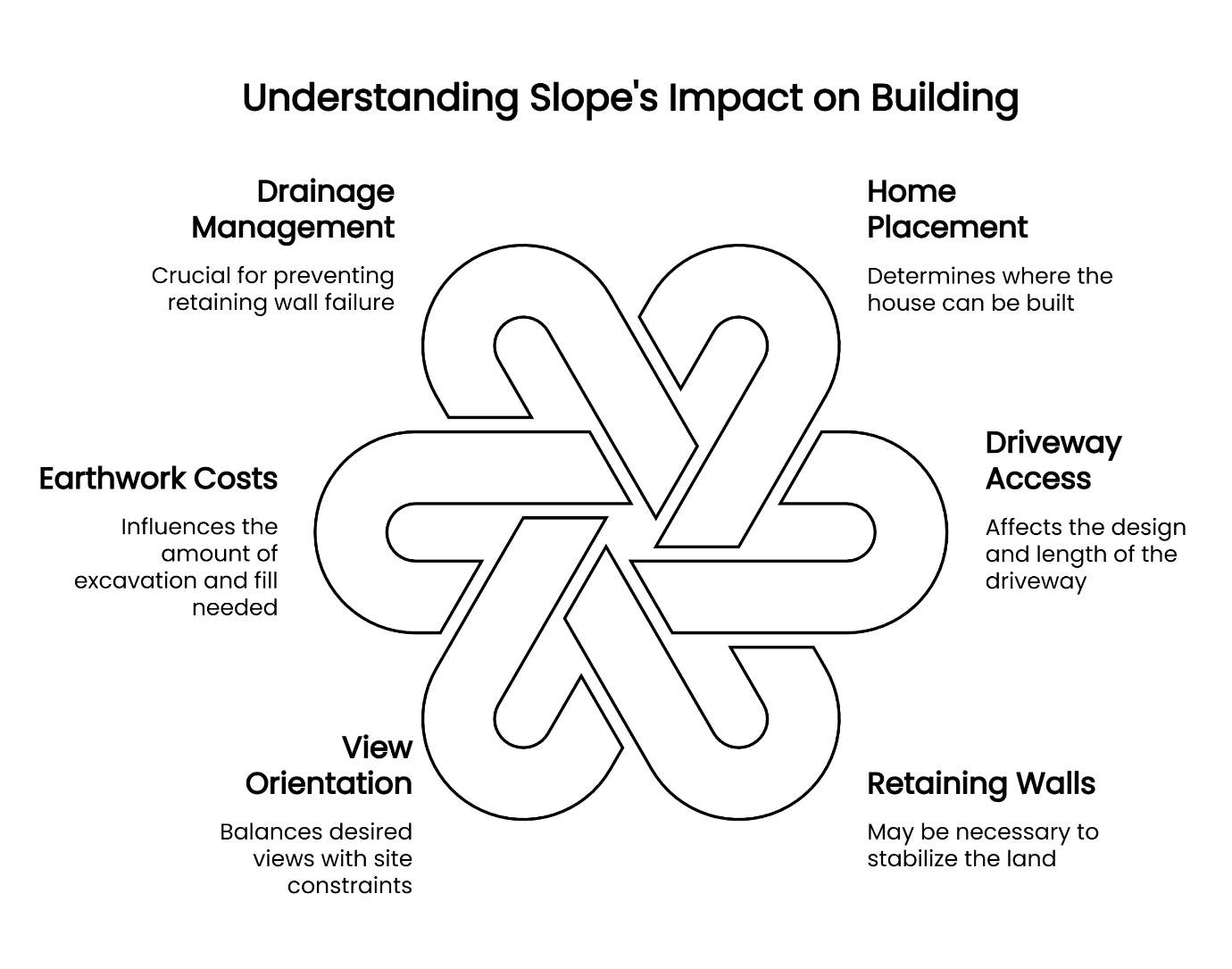
Slope controls three big decisions: where your home can sit, how you reach it, and how much earth has to be held in place.
Gentle grades of less than about 10 percent are easiest to build on. Between 15 and 20 percent, expect additional grading and foundation work. Above 20 percent, you may need retaining walls, stepped foundations, and more extensive sitework to create a stable building pad.
Driveway geometry matters. A steep lot can mean a steep driveway—or a longer, winding approach to keep the grade manageable. Both affect construction access, staging for materials, and your daily experience driving in.
Retaining walls are engineering decisions, not landscaping choices. Poor drainage is the primary cause of retaining wall failure. Water management—perforated pipes, gravel backfill, proper slopes—is the key to long-term stability. These walls need to be designed before final plans, not added later when someone notices the grade.
View orientation versus cut-and-fill tradeoffs present real choices. You want the living room facing the lake. The land may want your build pad somewhere else. Experienced builders help you find the balance—preserving the views you came for while minimizing the earthwork that drives costs.
A helpful mindset: slope is not inherently "bad"—it can create great views and interesting architecture. The key is to decide early whether the priority is preserving views, simplifying access, minimizing earthwork, or reducing long-term drainage risk.
Drainage and Erosion: The Hidden Cost Driver on Steep Lots
Water moves fast on a Hill Country slope. During a heavy rain, runoff concentrates in channels, picks up speed, and carries soil with it. If that water isn't managed, you get erosion at the construction site, sediment in the creek below, and potential water intrusion issues after move-in.
Good drainage planning addresses this before ground is broken. Grading plans shape the finished site so water flows away from the foundation, not toward it. Swales and surface channels direct runoff to safe outlets. Downspouts and gutters tie into the overall drainage system, not just empty onto the hillside. Soil stabilization protects exposed slopes during and after construction. For specific requirements in the Lake Travis area, builders must often adhere to the TCEQ Edwards Aquifer Protection Program (EAPP) best management practices regarding erosion and sedimentation control.
The engineer, builder, and landscape plan must align. A beautiful retaining wall that traps water behind it is a future problem. A drainage swale that ends at your neighbor's property line is a relationship problem. Coordination early prevents expensive fixes later.
A useful way to think about drainage planning: some elements can be verified early (observed runoff paths, visible channels, slope breaks), while the exact details of the drainage system remain variable until the final layout is set. Certainty should be staged, not assumed.
What Real Clients Say About Building on Challenging Land
In Riverbend Homes testimonials, clients consistently mention two themes that apply directly to complex lots.
First, the "possibility mindset": one client noted that after checking with several builders who said a project wasn't feasible, they found a team that aligned with their vision and showed them what was actually possible.
Second, budget discipline: that same build stayed on budget except for planned upgrades—not surprise sitework—because scope was clear from the start.
On challenging terrain, these aren't just nice-to-haves. They're the difference between a dream home and a budget nightmare.
Lot Evaluation Checklist: 5 Quick Signs a Lake Travis Lot Will Need Extra Engineering
Before you make an offer—or finalize plans on land you already own—walk the site with these questions in mind:
Steep grade breaks or limited flat areas. If you can't find an obvious spot for the house without moving a lot of earth, expect additional sitework scope.
Exposed limestone or very shallow soils. Rock at the surface means rock in the foundation trench. Plan for specialized excavation and potentially different foundation systems.
Visible runoff channels after rains. Look for rills, small gullies, or sediment fans. These show where water concentrates and where erosion control will be needed.
Tight access or limited staging room. Narrow roads, sharp turns, or constrained entry points affect what equipment can reach the site and where materials can be stored during construction.
Vegetation and rock patterns suggesting rapid drainage. Juniper and live oak clinging to thin soil, rock ledges stepping down the slope, or sparse ground cover all indicate challenging conditions.
Any of these signs points toward extra engineering—not necessarily a deal-breaker, but definitely a reason to get professional eyes on the site early. This checklist is not a substitute for professional evaluation; it's a fast way to identify whether a "simple plan and simple budget" assumption is risky.
How to De-Risk the Decision Before You Fall in Love With the Floor Plan
The sequence matters. Here's the order that prevents surprises:
Lot walk with a builder. Not a sales tour—a feasibility conversation on the actual property, looking at access, slope, rock, drainage, and build envelope constraints.
Survey and basic site constraints. Boundary lines, topography, setbacks, easements, and any HOA rules that affect where and how you can build.
Geotechnical report when warranted. Rock depth, soil bearing capacity, and any subsurface surprises. This is the data that tells your engineer which foundation approach fits.
Conceptual site plan with feasibility notes. Where the house can reasonably sit, how access works, where utilities run, and what sitework is required.
Early budget with clear assumptions. Fixed-price versus cost-plus, allowances for selections, and—critically—what triggers a change order if site conditions differ from assumptions.
This sequence keeps you from designing a house that doesn't fit the land or budgeting for a build that ignores half the scope.
For more on lot selection and feasibility, see Five Key Factors for Selecting the Perfect Lot in Spicewood, TX.
What Experienced Hill Country Builders Do Differently on Steep, Rocky Lots
Builders who know this terrain start with feasibility and infrastructure, not finishes.
Think of a capable builder as the project integrator—ensuring every excavator, engineer, and trade works in sequence to create a home that fits both the land and the vision. On a complex lot, that coordination matters more than on flat, easy ground.
They use integrated design-build cost feedback to catch scope problems before they become change orders. When the architect and builder work together from day one, design decisions get priced in real time—not after plans are finished and surprises start showing up.
They communicate tradeoffs clearly. Preserve that view angle, or minimize cut-and-fill? Simplify the driveway approach, or prioritize a specific building pad location? Every site involves choices, and experienced teams lay them out so you can decide with full information.
And they don't give you a "great price" that excludes rock excavation and retaining. Early lot walks and honest scoping prevent the low-bid trap that turns into high change orders later.
Frequently Asked Questions
Can a home be built on limestone near Lake Travis?
Often, yes—but limestone conditions vary by lot. A survey and (when appropriate) geotechnical input help determine foundation approach and excavation strategy.
What should I look for on a steep lot?
Slope breaks, limited flat pads, driveway feasibility, and where water flows after rain are critical indicators during a walk.
Is a geotechnical report always required?
Not always. It is commonly used when soil or rock uncertainty is likely to affect structural design or when the site conditions suggest higher risk.
How does slope affect driveway design?
Slope influences driveway alignment, transitions, and safe access. The best driveway line is often a key constraint on where a home can sit.
Why does drainage matter so much on sloped lots?
Because runoff concentrates and accelerates. Without a coordinated plan, erosion and water intrusion risks increase.
Next Step: Schedule a Discovery Meeting on the Lot
If you're evaluating a Lake Travis or Spicewood lot—or already own one and want clear answers about what you can build—the next step is a conversation on the property.
A Discovery Meeting is most productive with a short set of inputs: a rough wish list (must-haves versus nice-to-haves), inspiration photos, and any listing documents, survey, or HOA guidance you already have. The goal is not to solve everything on day one. The goal is to identify the major site drivers—rock, slope, drainage, access—and connect them to a realistic path for design and early budgeting.
Riverbend Homes has been building custom homes in Lake Travis and the surrounding Hill Country since 1996. The process starts with a Discovery Meeting on your property—no floor plans, no sales pressure, just an honest look at what the land allows and what it will cost to build your vision there.
Ready to get clear answers about your lot? Schedule a Discovery Meeting and start with the land, not the floor plan.
Disclaimer: This article is for general information only and is not engineering advice. Site conditions vary; consult qualified professionals for site-specific conclusions.
Our Editorial Process:
We aim to give homeowners clear, practical guidance based on site realities and reputable building science. We avoid guesswork with numbers, label assumptions, and encourage early feasibility checks so design decisions match budget and land constraints.
By: Ben @ Riverbend Homes.
Ben is a custom home builder in the Texas Hill Country. He works alongside clients, architects, and designers to create homes that honor the land and lifestyle of Central Texas. His approach emphasizes craftsmanship, transparency, and guiding homeowners through every part of the build with clear expectations and no surprises. Riverbend Homes is based in Spicewood, TX.