

Waterfront Restrictions Explained: Building on Lake LBJ and Lake Travis
📌 Key Takeaways
Lake Travis and Lake LBJ require different permits from different authorities, so verify which rules apply before closing on any waterfront lot.
Four Regulatory Layers Apply: Property lines, shoreline controls, floodplain boundaries, and HOA restrictions all limit your buildable area—you need approval from every layer.
Lake Travis Adds Watershed Rules: The Highland Lakes Watershed Ordinance regulates stormwater and impervious cover, and LCRA controls septic permits within 2,000 feet of the water.
Lake LBJ Permitting Starts Local: Cities like Horseshoe Bay and HOA architectural committees typically drive approvals, with LCRA standards applying mainly to docks and marinas.
Docks Under 1,500 Square Feet Skip LCRA Permits: However, you must still meet LCRA safety standards, local jurisdiction rules, and any HOA restrictions—whichever are most restrictive.
Request Seven Documents Before Closing: Survey, FEMA flood panel, HLWO boundary verification, septic feasibility, HOA guidelines, dock rules, and erosion requirements protect your budget from surprises.
Verify restrictions before you commit—understanding complexity upfront prevents costly redesigns.
Buyers evaluating waterfront lots on Lake Travis or Lake LBJ will gain clarity on which permits apply to their specific property, preparing them for the detailed compliance cheat sheet that follows.
~ ~ ~ ~ ~ ~ ~ ~ ~ ~ ~ ~ ~ ~ ~ ~ ~ ~
You have the contract in hand. You've secured the lot with the view you’ve visualized for months. Then comes the due diligence: What can I actually build here? suddenly, the excitement is tempered by a flood of acronyms. HLWO. OSSF. FEMA. HOA setbacks. And the sinking feeling that nobody mentioned any of this before you fell in love with the property.
If you're buying waterfront land on Lake Travis or Lake LBJ, understanding restrictions early isn't just smart—it's the difference between building your dream home and discovering mid-project that your design needs a costly overhaul. The two lakes are part of the same river chain and sit only a short drive apart—separated by just the 5-mile stretch of Lake Marble Falls—yet they operate under distinctly different regulatory frameworks. What works on Lake LBJ may trigger months of additional review on Lake Travis.
This guide breaks down exactly who regulates what on each lake, what triggers extra approvals, and what documents you should request before you close. You'll leave with a practical checklist and a side-by-side cheat sheet you can reference when evaluating any waterfront lot.
The Four Lines That Control What You Can Build
Waterfront building isn't governed by one rulebook—it's a stack of them. Think of it like a layered map: the same parcel can have a survey boundary, a floodplain overlay, a shoreline-control layer, and an HOA building envelope. The buildable area is what remains after all these layers are accounted for.
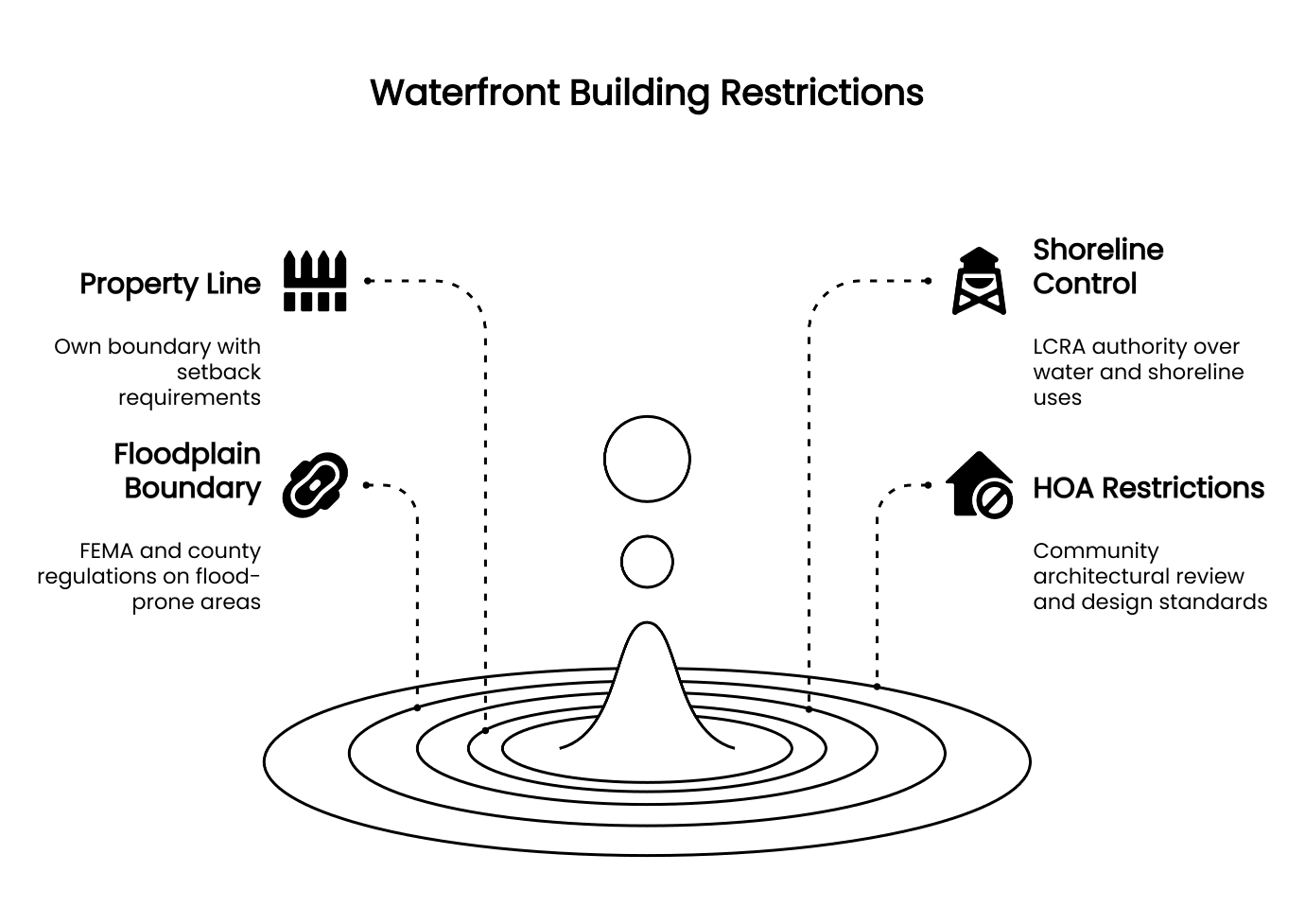
Line 1: Your Property Line and Building Line. This is the boundary you own, plus any setback requirements dictated by local zoning or your HOA.
Line 2: The Shoreline or Lakebed Control Line. LCRA (the Lower Colorado River Authority) manages the Highland Lakes, including both Travis and LBJ. Their authority extends over certain uses of the water and shoreline.
Line 3: The Floodplain Boundary. FEMA flood maps and county floodplain regulations determine where structures can be placed and what elevation requirements apply.
Line 4: HOA or POA Building Restrictions. Most waterfront communities have architectural review committees with their own setbacks, view corridors, and design standards.
When you're evaluating a lot, you need "yes" from every layer. A design that satisfies your HOA might still violate county floodplain rules. A dock that meets LCRA standards could still need city approval depending on your location. Miss one layer, and a plan that looked perfect on day one can trigger redesigns, budget revisions, or change orders later.
Lake Travis: Why the Rules Feel Stricter
Lake Travis often feels stricter because watershed protection requirements add layers of review, and multiple authorities may be involved depending on the site and scope.
Lake Travis operates under the Highland Lakes Watershed Ordinance, administered by LCRA. This ordinance regulates development to manage stormwater runoff, which LCRA identifies as the largest source of pollution in the Highland Lakes.
The ordinance applies to construction of buildings, roads, paved storage areas, and parking lots—as well as any land-disturbing and construction activities, including clearing. If your project creates more than 10,000 square feet of impervious cover or disturbs more than one acre of land, you'll typically need a permit from LCRA.
Here's where it gets layered: LCRA has interlocal agreements with several communities around Lake Travis, including Travis County, Lakeway, Bee Cave, and Lago Vista. These communities administer part or all of the ordinance. You'll need to check with your local government to determine whether a permit from LCRA is necessary or whether the city or county handles it directly.
Then there's septic. LCRA has regulated the installation and operation of on-site sewage facilities within a 2,000-foot zone around Lake Travis since 1971. If your lot falls within that zone, you're working with LCRA for your OSSF permit—not just Travis County. And Travis County itself requires development permits for construction in unincorporated areas through its permitting process.
What to do first: Treat Lake Travis as a "multiple yeses" environment. Before finalizing any design, confirm whether your lot is within the HLWO boundary and the LCRA OSSF zone. Pull your survey and check the watershed map at lcra.org. Then contact both LCRA and Travis County to understand which permits you need. Bringing your builder into the conversation before your architect finalizes plans is the easiest way to protect your budget, because the design can still flex without expensive redraw loops.
For more on working with a builder in this area, see custom home builders in Lake Travis.
Lake LBJ: The Local-Jurisdiction Puzzle
Around Lake LBJ, the primary permitting authority is often a city or a property owners' association—not a regional watershed ordinance. The path to approval can hinge on which city limits the property falls within, what the HOA requires, and how shoreline structures are handled locally.
Take Horseshoe Bay as an example. The Development Services Department of the City of Horseshoe Bay handles building construction, inspections, and land development needs, helping residents navigate rules designed to guide community growth and protect the character of the city.
As of July 1, 2025, all permits in Horseshoe Bay are issued exclusively using the iWorQ portal. The city requires permits for any project that adds, alters, repairs, removes, modifies, or replaces electrical, HVAC, plumbing, or structural elements.
But that's not the only approval you may need. Prior approval of the Horseshoe Bay Architectural Committee is required before any natural soil or vegetation is disturbed, and before construction or any improvement begins—including primary building or structure additions, swimming pools, irrigation systems, fences, and retaining walls. Following Committee approval, building permits are obtained at the City of Horseshoe Bay office.
LCRA still matters on Lake LBJ for certain activities. All boat docks and marinas on the Highland Lakes must be built and maintained to standards set out in the Safety Standards for Residential Docks on the Highland Lakes or the Highland Lakes Marina Ordinance (HLMO).
Your Due Diligence Pivot: Identify whether your lot is within city limits, county jurisdiction, or both. Then contact the relevant city's Development Services department and your HOA or POA architectural committee to understand the sequence of approvals.
For readers exploring a Lake LBJ build, see Lake LBJ custom builder.
Docks, Boathouses, Bulkheads, and Shoreline Work
On both lakes, docks and shoreline structures trigger specific reviews—often separate from the house permit itself.
While LCRA’s Safety Standards for Residential Docks allow for certain exemptions, most waterfront improvements require registration or permitting to ensure compliance with navigation and safety rules. For example, within WCID 17 jurisdiction on Lake Travis, a license is strictly required for all docks. Always verify the specific permitting tier for your dock size—don’t assume an automatic exemption, including those from local jurisdictions or property owner associations, regardless of which rules are more restrictive.
There are physical constraints too. Docks are only allowed if an additional 40 feet of lake access is available. If a cove is less than 40 feet wide (including existing docks on the opposite shore), only recessed docks can be built.
All marinas on lakes Buchanan, Inks, LBJ, Marble Falls, and Travis must be constructed, modified, and operated in compliance with the Highland Lakes Marina Ordinance (HLMO). and must have a permit from LCRA.
For bulkheads, retaining walls, and shoreline stabilization work, the permitting path varies by location. In some areas, these fall under city building permits. In others, they may require county approval or trigger floodplain review. Don't assume an existing structure is "grandfathered"—confirm before you plan to modify or expand it.
Shoreline Feasibility Check: Before designing any dock or shoreline work, check LCRA's dock safety standards at lcra.org, confirm cove width and setback requirements, and verify any additional HOA restrictions.
How Restrictions Hit Your Budget and Timeline
Regulatory complexity doesn't just create paperwork—it creates costs. Restrictions usually affect budget and schedule through redesign loops, sitework complexity, and review timing rather than one dramatic "deal breaker" rule.
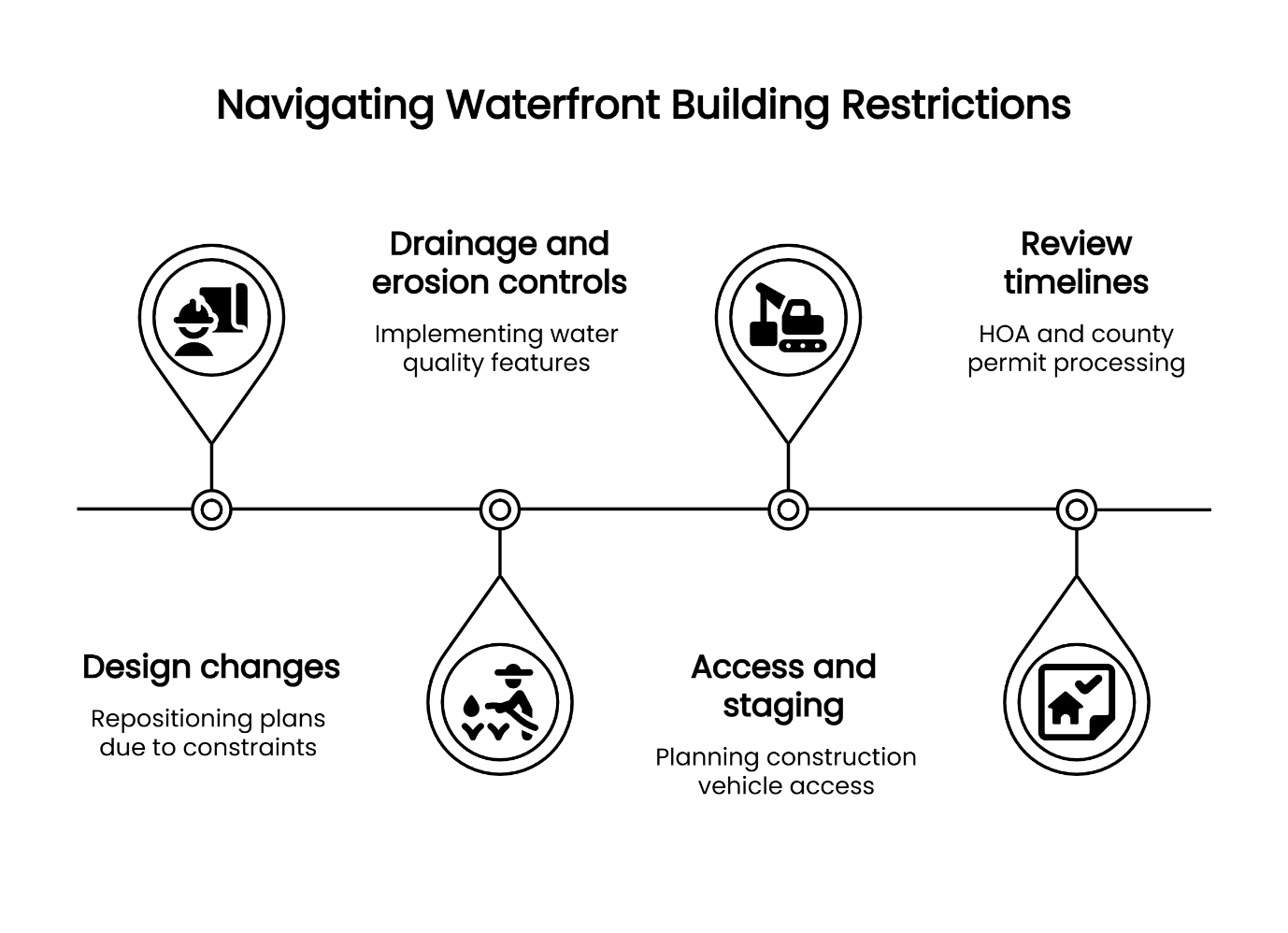
Design changes. When setbacks, septic feasibility, or floodplain constraints force repositioning after plans are underway, the redesign can cascade into structural and mechanical changes. If your architect finalizes plans before you've confirmed building envelopes, you may need to revise the design. That's not just an inconvenience; it's a change order and potentially months of delay.
Drainage and erosion controls. Lake Travis projects under the HLWO often require water quality management features, buffer zones, and erosion controls. These aren't optional add-ons—they're permit conditions. Tighter sites mean more planning and potentially more cost.
Access and staging. Waterfront lots frequently have challenging access. You'll need to plan for construction vehicle access without disturbing the shoreline, which may require temporary improvements or alternative staging.
Review timelines. HOA architectural committees often meet monthly. County permits have their own processing windows. In Horseshoe Bay, the permitting process is structured to keep projects moving, with target review windows often set by state statutory 'shot clocks' (typically 30–45 days for specific approvals). However, this clock only starts after a complete application is filed—which includes prior HOA approval and any required variances.
The most common surprise isn't any single fee—it's the compounding effect of discovering restrictions one at a time. A trust-oriented approach isn't about perfection; it's about reducing volatility. As one client in Horseshoe Bay put it: "During these times of volatility, they won't leave you hanging." — Robert & Dolores S.
If the only goal is the cheapest price-per-square-foot, the real risk is that waterfront unknowns become expensive surprises. A builder with local experience can help you sequence the right conversations and avoid the redesign loop. That's where early involvement protects both your vision and your budget.
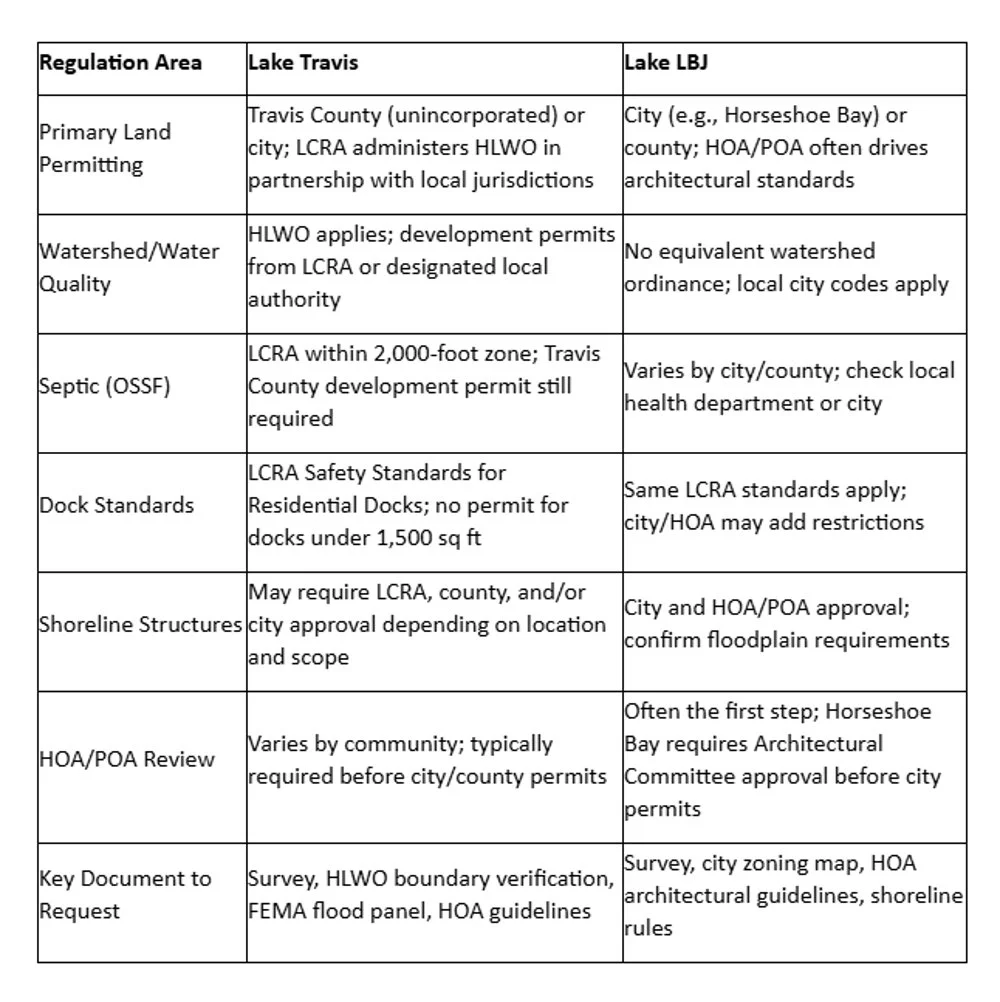
Waterfront Compliance Cheat Sheet: Lake Travis vs. Lake LBJ
The "Before You Buy" Waterfront Checklist
Before you close on any waterfront lot on Lake Travis or Lake LBJ, request and review:
Survey and topographic map. Confirms property boundaries, elevation changes, and any recorded easements.
FEMA flood panel number and determination. Identifies floodplain zones and base flood elevation requirements.
HLWO boundary verification (Lake Travis). Confirms whether your lot falls within the Highland Lakes Watershed Ordinance boundary.
Septic feasibility assessment. Determines whether the lot can support an on-site sewage facility and identifies the permitting authority (LCRA, county, or city).
HOA or POA architectural guidelines. Details setback requirements, building envelopes, view corridor restrictions, and approval timelines.
Dock and shoreline rules. Clarifies what structures are permitted, size limitations, and whether prior permits exist for any existing improvements.
Erosion and drainage requirements. Identifies what water quality measures may be required as permit conditions.
Getting these documents before you finalize a purchase—or before you invest in architectural plans—protects your vision and your budget.
Build the Dream Without the Surprises
The difference between a smooth build and a frustrating one often comes down to the questions you ask before you commit. Waterfront lots on Lake Travis and Lake LBJ offer incredible opportunities, but they come with regulatory complexity that rewards early homework.
Verify restrictions before you close. Bring your builder into the conversation before your architect finalizes plans. And remember that avoiding surprises isn't about avoiding complexity—it's about understanding it upfront so you can plan accordingly.
If you're evaluating a lot and want to understand how the restrictions might affect your build, explore the building process to see how feasibility checks work from the very first conversation. Ready to sanity-check a specific property? Contact us to schedule a Discovery Meeting.
Frequently Asked Questions
Do I need LCRA approval to build a house near the water?
It depends on the lake and what you're building. For land-based construction on Lake Travis, the Highland Lakes Watershed Ordinance may apply if you're creating significant impervious cover or disturbing land—though many communities administer this locally through interlocal agreements. LCRA directly regulates certain lake uses (docks, marinas) and septic systems within designated zones. For Lake LBJ, city and county permitting typically governs home construction, while LCRA standards still apply to docks.
Are Lake Travis rules the same as Lake LBJ rules?
No. Lake Travis falls under the Highland Lakes Watershed Ordinance, which focuses on stormwater management and water quality protection. Lake LBJ doesn't have an equivalent regional ordinance—permitting there is primarily handled by cities like Horseshoe Bay and by HOAs or POAs. Both lakes are subject to LCRA dock safety standards, but the land-side permitting process differs significantly.
Do I need a permit for a residential dock?
LCRA does not require permits for residential docks of 1,500 square feet or less on the Highland Lakes. However, you must still comply with LCRA's safety standards, local jurisdiction rules, and any HOA restrictions—whichever are more restrictive. Marinas require LCRA permits regardless of size.
What are the most common delays on waterfront builds?
The frequent culprits: septic feasibility surprises (especially on Lake Travis where LCRA has OSSF authority near the water), HOA architectural review timelines, floodplain elevation requirements that affect foundation design, and erosion control measures that add scope to site preparation. Many of these can be anticipated—and budgeted for—if you investigate before you finalize your design.
Disclaimer: This guide is intended as a comprehensive starting point. For decisions specific to your unique situation, we always recommend consulting a qualified professional.
Our Editorial Process:
Our expert team uses AI tools to help organize and structure our initial drafts. Every piece is then extensively rewritten, fact-checked, and enriched with first-hand insights and experiences by expert humans on our Insights Team to ensure accuracy and clarity.
By: The Riverbend Homes Insights Team
The Riverbend Homes Insights Team is our dedicated engine for synthesizing complex topics into clear, helpful guides. While our content is thoroughly reviewed for clarity and accuracy, it is for informational purposes and should not replace professional advice.