

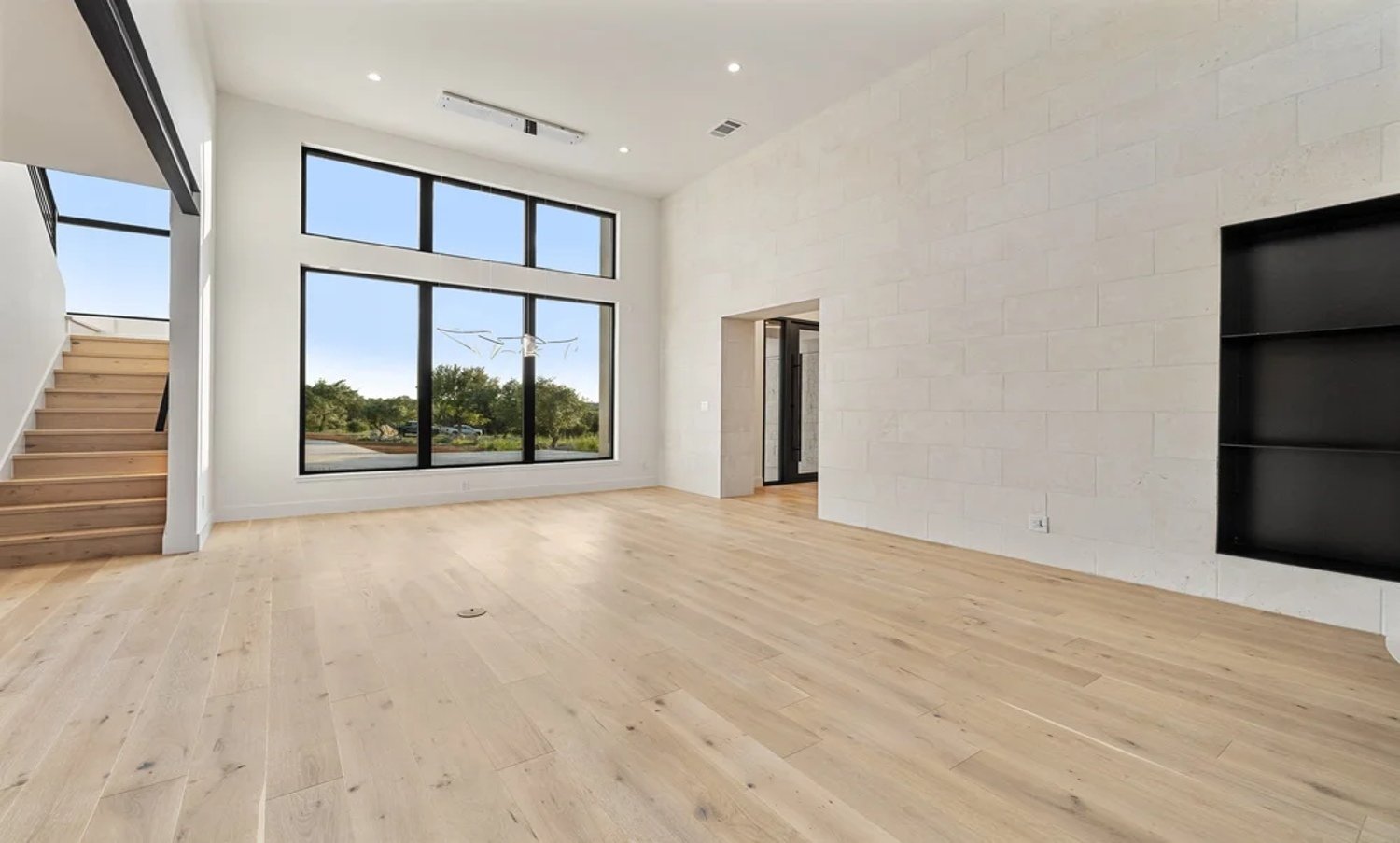
Rural Homesite Questions to Ask Before Building a Custom Home in Spicewood
📌 Key Takeaways
A rural parcel works only when verified access, usable space, infrastructure, and site conditions support your full building plan.
Define Your Full Plan: The author recommends listing your home, outdoor spaces, future additions, and upkeep limits before comparing properties.
Question Usable Acreage: Listing acreage can overstate usable space once setbacks, easements, slopes, drainage, wastewater, and construction needs overlap.
Verify Every System: The author recommends confirming legal access, utilities, and wastewater options through current records and responsible providers.
Trust Qualified Assessments: Surface clues cannot confirm drainage, soil, rock, flood risk, or grading needs; qualified experts must assess them.
Assign Every Unknown: Each unresolved question needs a named expert, clear evidence, and acceptable risk level before purchase or design.
Great views never replace parcel-specific proof.
Spicewood land buyers will avoid costly surprises by using the rural homesite questions and verification steps below.
~ ~ ~ ~ ~ ~ ~ ~ ~ ~ ~ ~ ~ ~ ~ ~ ~ ~
A rural listing near Spicewood can offer the acreage, privacy, and views you've been imagining—but acreage is not the same as a workable homesite. The parcel that looks perfect on a Saturday afternoon may carry access limitations, infrastructure gaps, or restrictions that reshape what you can build and what the project will cost.
Before you make an offer, you need a short set of questions and a clear picture of who can actually answer each one. Some answers come from the seller or listing. Others require a builder, surveyor, engineer, utility provider, title professional, or governing authority. Mixing up those roles is where surprises begin.
The framework below covers lifestyle fit, usable area, access, infrastructure, physical conditions, and verification responsibility. Use it during a property tour to separate what you can observe from what you need confirmed.
Start With the Life and Home the Property Must Support
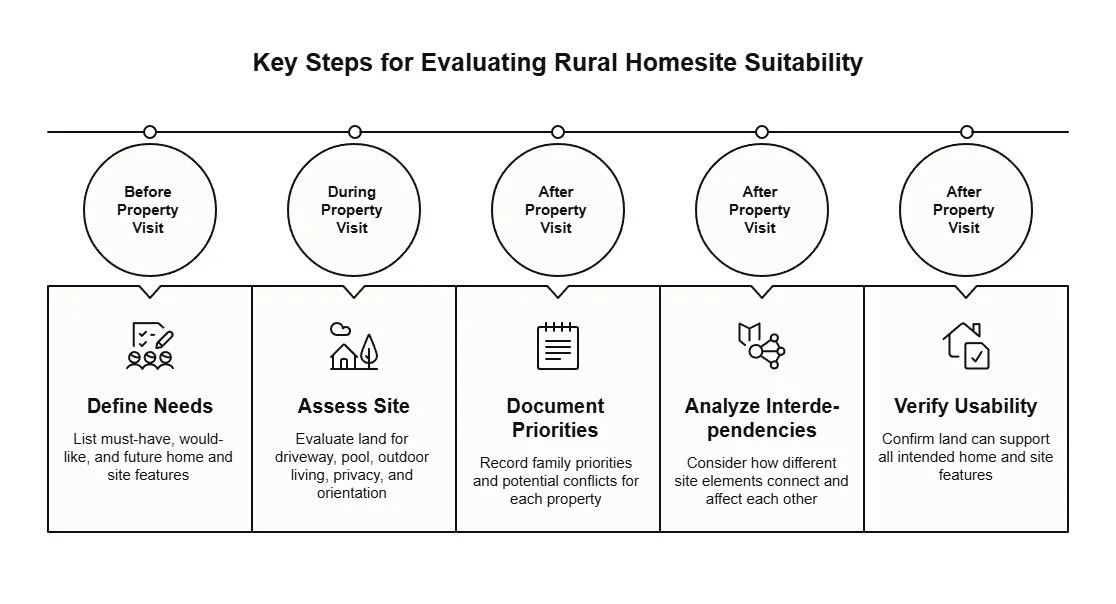
Before evaluating any parcel, define what the land needs to hold. A five-acre property that cannot accommodate your driveway approach, pool orientation, and future workshop is not five usable acres—it is an expensive compromise.
Must have: Approximate home size and layout, garage type and arrival sequence, primary outdoor living areas, privacy from neighbors or roads, and orientation preferences for light or views.
Would like: Pool and surrounding hardscape, covered outdoor kitchen, garden or orchard area, dedicated guest or equipment parking.
Future option: Detached guest house or casita, workshop or studio, additional storage, or a second driveway entrance.
Include future options now, even if you do not plan to build them immediately. Evaluating a property only against the home's first phase is how buyers discover two years later that the lot cannot support the addition they always intended.
Add daily upkeep to the list. Decide how much landscaping, driveway maintenance, acreage management, or slope navigation you are prepared to handle long-term, and whether the layout should reduce steps, travel distance, or grade changes between frequently used areas.
Write each item down before you visit another property. If two family members have different priorities, record both—a parcel that fits one program but not the other will surface that conflict after money has been spent on design.
Then consider how the elements connect. Garage orientation can change the home's approach, turning space, and driveway route. A pool needs more than its own footprint—it affects circulation, privacy screening, and outdoor living adjacency. A workshop or guest space may need separate access and supporting systems. These interdependencies mean that moving one piece on the site plan often moves several others.
This exercise is about knowing, before you fall in love with a view, whether the land has room for the life you intend to build. For a deeper look at how home footprint, pool, and driveway compete for space, see Can Your Lot Hold the Home, Pool, and Driveway You Want?
How Much of the Acreage Is Practically Usable?
Total acreage on a listing tells you the boundary—not how much of that area can support a home, driveway, outdoor features, wastewater system, and construction staging all at the same time. Usable site area means the portions of a property that may practically accommodate the intended layout after known physical, legal, and planning constraints are considered. Treat it as a question to investigate, not a confirmed label.
Several factors reduce usable space, and they stack. Easements—rights granted to others to use part of the property—may cross in locations that restrict building. Setbacks imposed by the governing jurisdiction or recorded restrictions push the buildable envelope inward from every boundary. Slopes, drainage paths, rock outcrops, and existing trees or structures occupy area and influence placement.
Now overlay your program: home footprint, garage and turnaround, pool and grade work, wastewater system area, outdoor structures, and a staging zone for construction vehicles, equipment, and materials. On an irregularly shaped parcel, those elements compete for the same portion of the land.
Imagine a buyer who wants a single-story home with a three-car garage, a pool, and a detached workshop. On a long, narrow parcel with a drainage swale through the center, the driveway, home, pool, and workshop may all need one side of the property while the wastewater system needs the other. That is a planning conversation, not a crisis—but it needs to happen before the offer.
A current survey is essential, but a survey alone does not answer every question about what will fit. It can establish boundaries and show certain features within its scope, yet it does not resolve utility, wastewater, engineering, title, or regulatory questions. Those require applicable official records, title materials, and qualified professional input. To understand how boundary geometries influence what you can actually build, review these lot-shape questions that affect design options.
What Will Legal and Practical Access Require?
Access has two sides. The first is legal: does the property have documented, recorded access—an easement, a dedicated right-of-way, or direct frontage on a public road? The second is physical: can the route support daily traffic, delivery vehicles, emergency response, and the heavy equipment needed during construction? A visible dirt track does not prove legal access, and a recorded easement does not guarantee the route is graded, drained, or wide enough for a concrete truck.
For the legal side, start with current title materials and recorded documents. Have a title resource and qualified legal professional address rights, restrictions, and obligations within their roles rather than relying on a seller's description alone.
For the physical side, examine the possible entrance and route to the home. Grade, sight distance, surface condition, drainage, width, turnaround space, gate placement, and emergency vehicle access all matter—and some may require input from a builder, engineer, or the applicable authority. Test garage orientation as part of this route: a side-entry, front-facing, or courtyard concept may change the approach and shift the home's position on the site.
Where the driveway enters the property affects more than circulation. It influences guest arrival, privacy from the road, and how service vehicles approach. If the entrance sits at the bottom of a slope, water management along the drive becomes a design factor. If a gate is planned, queuing distance between the gate and the road matters for safety and convenience. Maintenance expectations should also match what you are willing to manage over the long term—a steep gravel drive requires different upkeep than a paved, gently graded approach.
Construction access deserves its own question. Concrete trucks, excavation equipment, and material deliveries need a route that may be wider or stronger than the finished driveway. If the only access crosses a shared easement, confirm the terms before construction planning begins.
To explore how these approach routes dictate the rest of the site plan, see How Driveway Access Shapes Early Home Planning.
Which Utilities and Site Systems Are Actually Available?
"Utilities available" on a listing is a starting point, not a confirmation. For each system your home will need, follow a three-step sequence: ask the listing side for its basis, confirm with the relevant provider or authority for the exact parcel, and then discuss design implications with your builder.
Water. Determine whether the parcel is served by a provider or will require a private well. If a provider exists, request written confirmation of availability, capacity, and connection requirements. If a well is needed, permitting, drilling, testing, and equipment each carry their own timeline. Because groundwater depths and yields vary drastically in the Texas Hill Country, relying on a neighboring property's well performance is not a guarantee of your own.
Wastewater. First ask whether a sewer connection is possible—do not assume an onsite system is required. If the parcel does need an onsite wastewater system, approval depends on soil conditions, available area, setback compliance, and the applicable authority's current requirements. The system's location can affect where the home sits, so this is a placement question as much as a regulatory one. Confirm the process with the authority governing onsite wastewater for the specific parcel.
Electricity. Ask the provider whether power reaches the property boundary or requires an extension. Measure extension questions in actual route distance rather than accepting "nearby" as an answer. Extension distance, easements for lines, transformer placement, and associated costs should come directly from the provider.
Communications. Internet and phone service vary significantly between rural parcels. Contact the potential provider to confirm availability at the exact location.
For every system, request current written confirmation from the identified provider. A listing statement or area-wide assumption is not parcel-specific evidence. After documenting the underlying information, ask your builder how system locations, extension work, and installation requirements could affect layout, access, sequencing, and preliminary budget planning.
What Might Terrain, Drainage, Rock, or Vegetation Change?
A walk-through can reveal questions, but it cannot diagnose the site. Record observations for the appropriate professional rather than converting appearance into a conclusion.
Grade and orientation. Slope influences foundation type, driveway design, drainage management, and outdoor living placement. Note the direction the slope faces—orientation affects sun exposure, cooling loads, and which rooms receive morning or afternoon light.
Drainage. Walk the property after a rain if you can. Visible water paths, ponding, erosion, or silt deposits are observations, not conclusions—actual drainage behavior, flood exposure, and regulatory implications require official mapping and qualified professional assessment for the specific parcel.
Rock and soil. Subsurface conditions affect excavation, foundation design, wastewater feasibility, and utility trenching. What looks like solid ground may sit on shallow rock or soil that requires engineering. In the Spicewood and greater Texas Hill Country area, encountering shallow limestone or caliche is common, which can significantly increase excavation costs for a pool, utility trenching, or the home's foundation. These conditions are not visible from the surface and typically require professional evaluation.
Vegetation. Mature trees add character but occupy space and may be subject to removal restrictions. A tree grouping that defines the property's appeal might conflict with preferred home placement, driveway alignment, or the wastewater area.
Physical priorities can create trade-offs that cascade through the site plan. Consider a buyer who wants to preserve a cluster of oaks near the center of a parcel. That preference may shift the home footprint, change driveway geometry, or push the pool to a different side of the site. On another property, preserving a favored view corridor might alter the garage approach and outdoor layout entirely. These are planning trade-offs, not problems—as long as they are recognized before design begins.
Before checking rules on any of these conditions, determine the exact county, local authority, HOA/POA, or other jurisdiction that governs the parcel and each issue. Parcel-specific verification means confirming an answer through current records, the responsible provider or authority, and qualified professional input appropriate to that question.
Who Should Answer Each Question Before You Rely on It?
Assign every open question to the right source—and resist treating a preliminary answer as proof. A listing, seller statement, visual observation, or builder discussion may identify a likely issue or possible direction, but confirm the underlying legal, technical, utility, and approval facts with current records and the appropriate providers, professionals, and authorities.
| Question Area | Why It Matters | Preliminary Input | Confirmation Needed |
|---|---|---|---|
| Desired home, outdoor spaces, and future structures | Sets fit criteria, including maintenance and acceptable unknowns | Buyer's own program and priorities | Builder or designer to test fit against site |
| Boundaries, easements, and setbacks | Identifies land that may affect layout or use | Listing materials and older survey | Current survey, recorded documents, title review, and qualified legal input as needed |
| Legal access and recorded rights | Determines whether you can reach and use the property as planned | Listing or seller disclosure | Title materials, recorded easements, and qualified legal review |
| Driveway design and construction access | Connects entry point, garage orientation, circulation, and logistics | Builder's early site discussion | Appropriate engineer or authority input where grade, drainage, or permits apply |
| Water, electricity, and communications | Affects equipment locations, responsibilities, timing, and planning | Listing or area knowledge | Direct written confirmation from each provider for the exact parcel |
| Sewer connection or onsite wastewater | Either path can influence home placement and approvals | Seller, builder, or qualified professional | Parcel-specific professional evaluation and governing-authority confirmation |
| Drainage, flood exposure, and grading | Physical conditions can change design and construction choices | Visual observations during a walk | Current official mapping or records plus qualified analysis suited to the issue |
| Soil, rock, and subsurface conditions | Subsurface realities affect foundation, excavation, and system feasibility | Surface appearance | Geotechnical or other appropriate professional evaluation |
| Deed restrictions, HOA/POA rules, and permits | Rules and recorded obligations may limit or condition the plan | Listing summary or seller | Recorded governing documents and the applicable authority |
| Cost and design implications | Converts confirmed information into planning choices | Early builder discussion | Builder's estimate after verified site inputs are available |
A builder's early visit to the property can help connect your vision to the site's realities. Riverbend Homes, for example, describes its first step as a property-based Discovery Meeting where the client's vision, site feasibility, and infrastructure implications for budget and design are discussed. That kind of conversation is valuable—but it does not replace the surveyor, engineer, title professional, utility provider, onsite-wastewater authority, or governing jurisdiction. Each has a distinct role, and the checklist works only when every row has an owner.
For builder-specific questions to prepare before making an offer, see What Spicewood Land Buyers Should Ask a Custom Home Builder Before Making an Offer.
Turn Property Excitement Into a Verification Plan
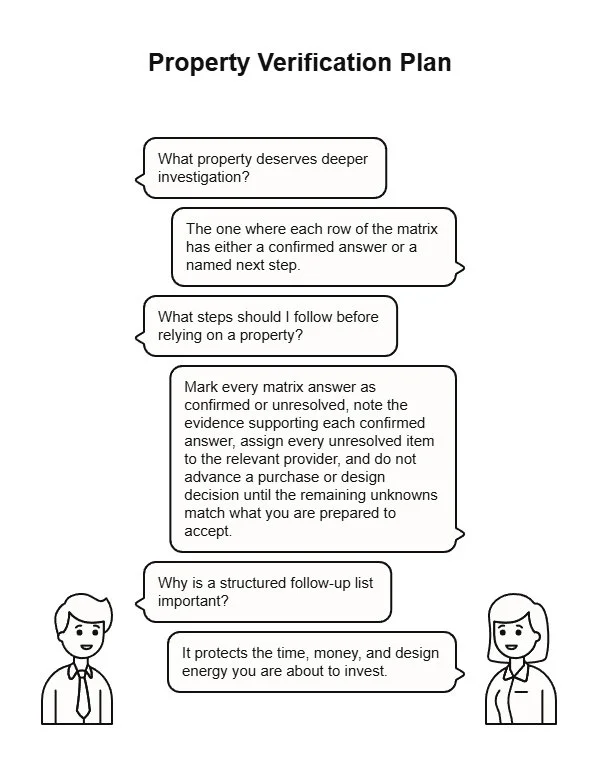
Rural land near Spicewood rewards buyers who ask better questions early. The property that deserves deeper investigation is the one where each row of the matrix above has either a confirmed answer or a named next step—not the one that simply felt right on a sunny afternoon.
Save this framework and follow these steps before relying on any property as a fit:
Mark every matrix answer as confirmed or unresolved.
Note the evidence supporting each confirmed answer.
Assign every unresolved item to the relevant provider, professional, authority, title resource, HOA/POA, or builder.
Do not advance a purchase or design decision until the remaining unknowns match what you are prepared to accept.
A structured follow-up list protects the time, money, and design energy you are about to invest.
Frequently Asked Questions
When should a custom home builder see a rural property?
Involve a builder while unresolved site questions can still inform the purchase decision and before the design becomes fixed. A builder can help identify how your intended home, access, and outdoor spaces relate to what the site can support—ideally before you commit to an offer or begin design. That conversation does not replace a current survey, title review, utility confirmation, onsite-wastewater evaluation, or other specialist and authority checks the parcel may require.
Who verifies whether a rural homesite has legal access and usable boundaries?
Legal access depends on recorded documents—easements, rights-of-way, or public road frontage—reviewed through current title materials and, where needed, qualified legal counsel. Usable boundaries require a current survey combined with recorded restrictions and applicable setbacks from the governing authority. A visual walk or listing map is a starting point, not a substitute.
How can I confirm utilities before buying land near Spicewood?
Identify the potential provider for each system—water, electricity, communications—and request direct written confirmation of availability, connection requirements, and any extension or capacity limitations for the exact parcel. Verify sewer, onsite wastewater, and water questions separately with the appropriate authority or professional for the property's location. Do not rely on a listing statement or area-wide assumption; conditions vary from one parcel to the next.
Disclaimer: This article is for general educational purposes only and does not constitute legal, surveying, engineering, environmental, financial, real-estate, or code-compliance advice. Conditions, requirements, and approvals vary by property and jurisdiction. Verify information for the specific parcel with the appropriate qualified professionals, service providers, title resources, HOA/POA, and governing authorities before making a purchase or design decision.
Our Editorial Process
Riverbend Homes content is created to help Texas Hill Country homeowners make clearer, calmer custom-home decisions. The editorial process begins with Riverbend's documented building process, local experience, client-facing materials, and verified internal resources. Drafts are reviewed for practical accuracy, plain-language usefulness, local relevance, and alignment with Riverbend Homes' site-first approach before publication.
About the Riverbend Homes Insights Team
The Riverbend Homes Insights Team is our dedicated engine for synthesizing complex topics into clear, helpful guides. While our content is thoroughly reviewed for clarity and accuracy, it is for informational purposes and should not replace professional advice.
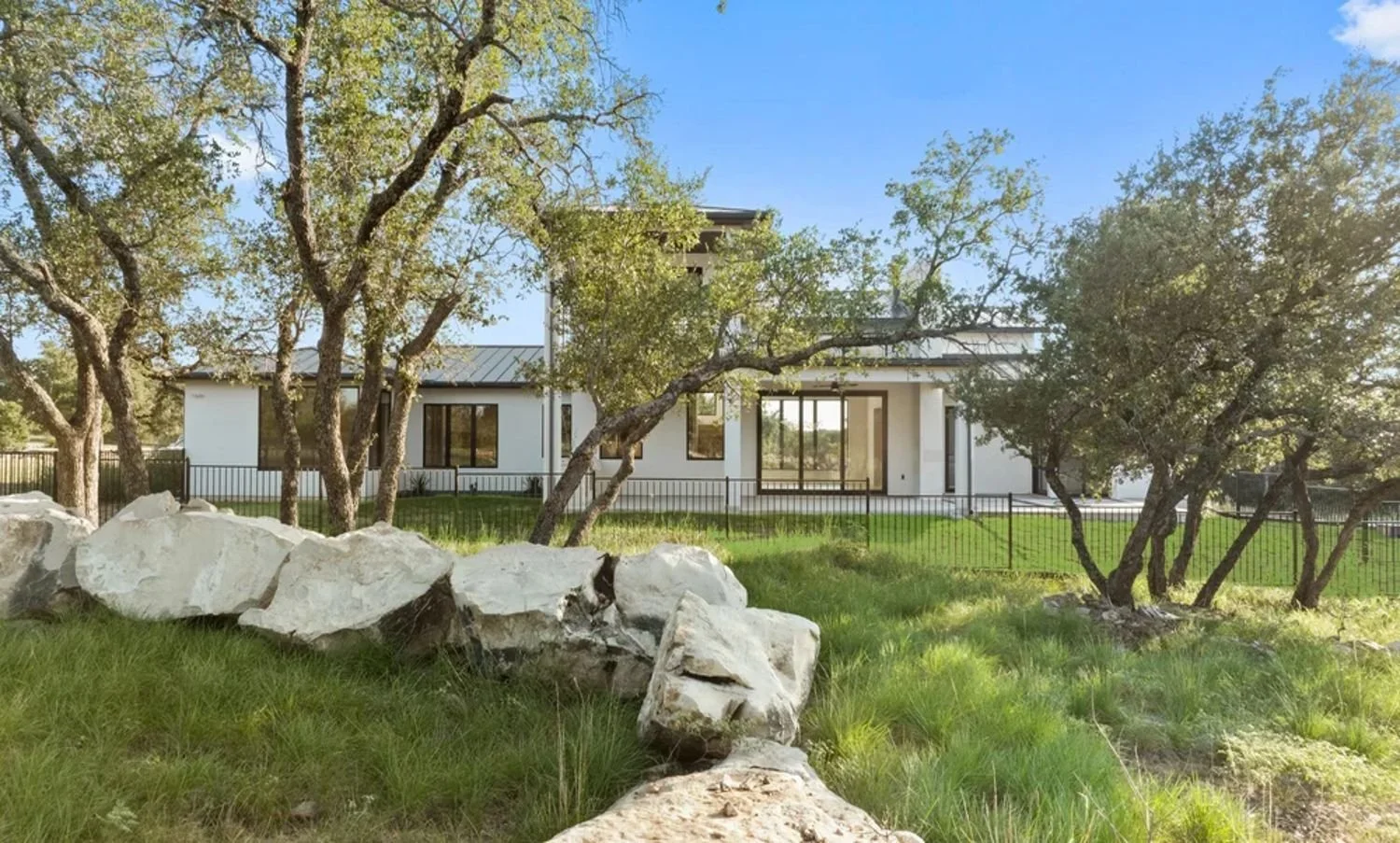
How to Balance Privacy and Practical Access When Choosing a Spicewood Custom Home Lot
📌 Key Takeaways
The author recommends choosing a Spicewood lot that balances daily privacy and access, then verifying legal rights and site conditions.
Set Priorities First: Clear household rankings keep privacy, daily access, outdoor living, and future needs central to every comparison.
Judge Each Parcel: Lot labels cannot predict privacy or access because shape, approach, surroundings, and verified conditions matter more.
Test Five Arrivals: Household drivers, guests, deliveries, service crews, and construction vehicles may face different access problems.
Link Access To Design: Driveway routes can shape home placement, garage direction, front entry, service zones, and outdoor privacy.
Verify Every Unknown: Documents, authorities, and qualified professionals can confirm easements, approvals, utilities, restrictions, and site limits before purchase.
The right lot balances privacy, access, and proof.
Spicewood custom-home buyers will compare shortlisted lots more clearly using the priority matrix and real-world access tests below.
~ ~ ~ ~ ~ ~ ~ ~ ~ ~ ~ ~ ~ ~ ~ ~ ~ ~
A Spicewood homesite can feel perfectly secluded during a weekend showing — oak canopy overhead, no neighboring roofline in sight, nothing but birdsong and a breeze off the hills. Then you start thinking about Tuesday morning. How does the delivery driver find the house? Where does the concrete truck stage during construction? Can your parents pull in without calling for directions?
Privacy and practical access are not opposing forces, but they compete for the same ground. The lot that maximizes one may quietly constrain the other. A single visit under ideal conditions can also create bias — the canopy that screens the building site today may sit on a neighboring parcel that could be cleared tomorrow. Before you narrow your search, you need a way to compare those trade-offs parcel by parcel using the same criteria every time, regardless of whether the property is labeled acreage, a cul-de-sac lot, or a rural homesite.
Here is that framework — plus a comparison matrix you can apply to every shortlisted parcel.
Start With the Balance You Want, Not the Lot Label
The most useful starting point is not "acreage versus cul-de-sac." It is a clear picture of what privacy and access mean to your household on an ordinary day.
Privacy may mean any combination of the following:
Visual separation from neighboring homes and the road
A controlled arrival experience — the feeling of entering your own space
Outdoor living that feels shielded from view
Reduced road noise and pass-through traffic
Practical access covers everything beyond the homeowner's own vehicle:
Everyday arrival and departure for every driver in the household
Guests arriving for the first time without confusion
Package and grocery deliveries
Lawn, pool, pest, and repair services
Construction vehicles and material deliveries during the build
If you are buying with a partner, rank these priorities independently before comparing answers. One person may value hidden outdoor entertaining while the other prioritizes simple guest access. To make that exercise concrete, have each decision-maker assign a low, medium, or high weight to these categories before visiting any property:
Screening from roads and neighboring properties
Simple everyday entry and departure
A clear, welcoming route for first-time guests
Separation between guest, delivery, and service activity
Privacy for patios, pools, and other outdoor living
Access that can be evaluated for construction needs
Usability as household needs change
Seeing those preferences side by side early prevents the kind of compromise that only surfaces after the offer is signed. If your household entertains occasionally but commutes daily, weight the matrix accordingly rather than forcing a universal hierarchy.
Use the Same Privacy-and-Access Criteria for Every Property
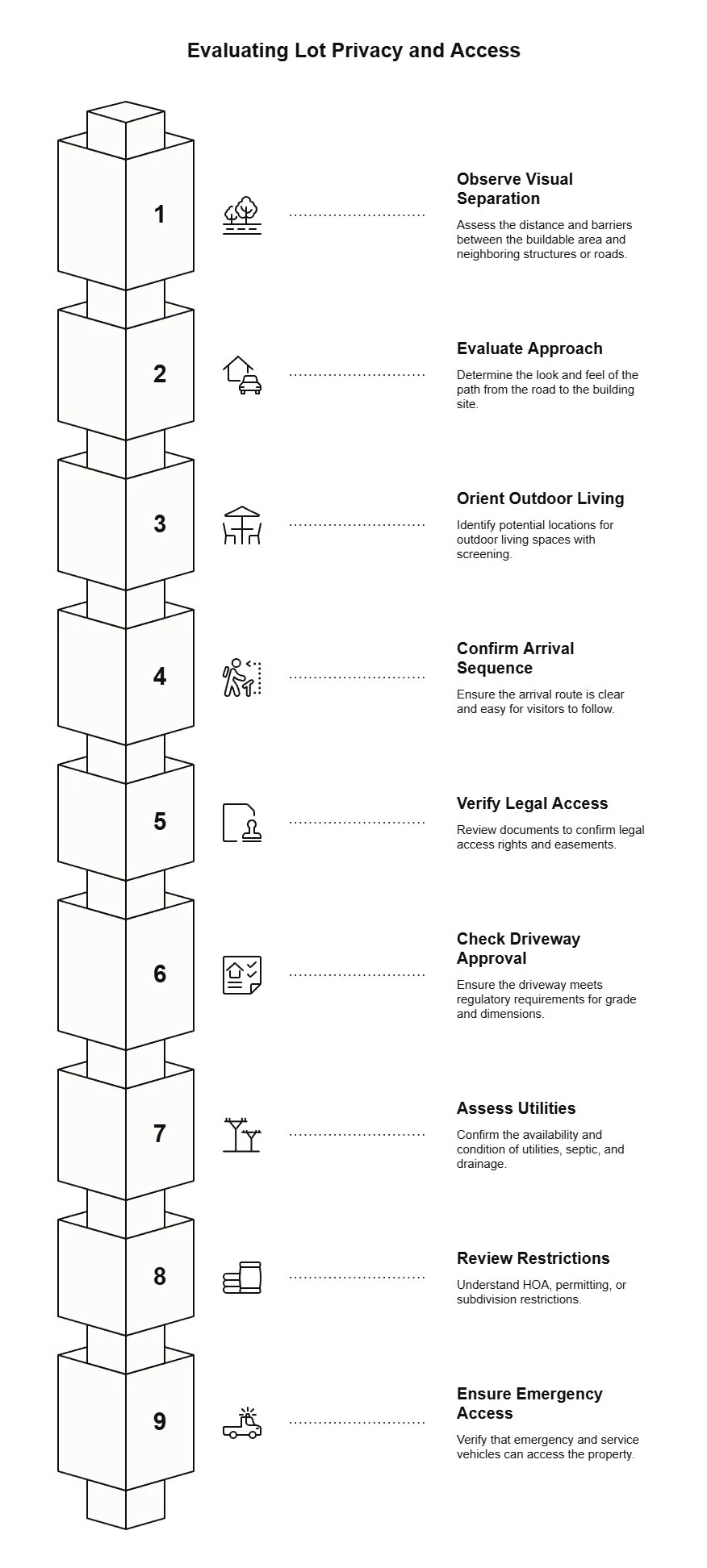
Comparing parcels is easier when you evaluate each one against consistent criteria rather than reacting to first impressions. Some can be observed during a site visit; others require documents, professional evaluation, or confirmation from the applicable authority. Keeping these categories separate prevents a visual impression from doing the work of a title search.
Criteria you can observe directly:
How much visual separation exists between the buildable area and neighboring structures or roads
What the approach looks and feels like from the road to the likely building site
Where outdoor living could be oriented for screening
Whether the arrival sequence seems clear enough for a first-time visitor
Criteria that require verification before relying on them:
Legal access rights and any recorded easements
Driveway approval, grade, and dimensional requirements from the controlling authority
Utility, septic, and drainage conditions
HOA, permitting, or subdivision restrictions that affect placement or use
Emergency and service-vehicle access requirements
Observation vs. Verification: Treat what you can see — tree cover, distance from the road, the feel of the approach — as useful signals, not settled facts. Current vegetation may sit on land you do not control. A neighboring parcel could be developed. Access that appears adequate may lack recorded legal rights. Before any observation becomes a reason to make an offer, confirm whether a document, authority, or qualified professional needs to verify it.
A few terms deserve precision here. An access easement is a documented right to use land for access — its existence and terms require document review, not a visual assumption. A buildable area is not simply any open-looking space; it is determined by setbacks, easements, topography, and applicable regulations. Site feasibility asks whether the parcel can support the intended project under its actual constraints, which cannot be established through a visual walkthrough alone.
Acreage, Cul-de-Sac, and Rural Homesites Can Create Different Trade-Offs
Each lot type presents a different mix of privacy and access considerations, but no label predicts the experience reliably. The parcel itself — its shape, approach, surroundings, and verified conditions — matters more than the category. Parcel shape may also affect the relationship among the approach, home, garage, and outdoor areas, so consider these lot-shape questions that can affect design options while comparing properties.
Acreage
Distance from a neighboring structure does not automatically produce separation. Ask where privacy actually originates: the setback from the road, the topography, the tree line, the home's eventual orientation, or some combination. A ten-acre tract with a buildable area near a county road may feel less private than a smaller lot tucked behind a ridge. And screening that depends on vegetation growing on adjacent land is an observation, not a guarantee — neighboring use can change.
A longer driveway extends the arrival sequence but also extends the path for every guest, delivery, and service call. That trade-off is worth examining before the property's size becomes the deciding factor.
Cul-de-Sac Property
A cul-de-sac reduces pass-through traffic, but the home's proximity to neighbors and the street still shapes the daily experience. Examine how the lot's width, depth, and orientation relate to the turning area, neighboring setbacks, and the backyard direction. Some positions offer surprisingly strong rear privacy; others place the outdoor-living area in full view of adjacent homes.
Look outward from possible home, patio, and yard areas, then reverse the view from the street and possible neighboring positions. Note how garage orientation and the front-door experience might interact. Guest arrival is often straightforward, and service vehicles typically have a clear path. The trade-off may appear in outdoor-living screening rather than in access logistics.
Rural Homesite
A rural property may combine acreage-level separation with a longer or less-maintained approach. Ask how the route handles rain, how clearly it can be identified by someone unfamiliar with the area, and whether service and construction vehicles can navigate it without special arrangements. These questions do not mean rural access is inherently difficult — but they reveal what the parcel still asks you to learn.
Lot-Type Comparison: Questions, Not Winners
| Criteria | Acreage | Cul-de-Sac | Rural Homesite |
|---|---|---|---|
| Where does visual separation come from? | Distance, topography, orientation, vegetation | Lot depth, backyard orientation, neighboring setbacks | Distance, terrain, surrounding land use |
| How does the arrival sequence feel? | Longer approach; may require wayfinding for visitors | Short, typically clear | Variable; may require directions or seasonal maintenance |
| How do service and delivery vehicles reach the site? | Depends on driveway length, width, grade, and surface | Usually straightforward | May need verification for weight, width, turning, or seasonal conditions |
| What construction-access questions arise? | Staging, material delivery route, temporary road surface | Neighborhood restrictions, staging space, street impact | Route capacity, seasonal access, staging distance |
| How might the lot affect home and outdoor-living placement? | More options but constrained by approach and infrastructure | Constrained by neighboring proximity and street exposure | Flexible placement but approach and utilities may limit orientation |
Test Access Through Five Real-World Arrivals
A property visited once under ideal conditions can look very different under routine use. Walk through each arrival type mentally — or physically — before deciding that access is adequate.
Household routine: Drive the route at the time of day you would actually commute. Note visibility at the road entry, driveway condition, turning clearance, and distance to the garage or parking area.
First-time guest: Could a friend find the entrance without a phone call? Is there a clear place to park or turn around without blocking the household?
Deliveries: Delivery drivers make fast decisions. If the entrance is unclear or hidden behind vegetation, packages may end up at the road or at a neighbor's property.
Maintenance and service vehicles: Lawn crews, pool technicians, and repair contractors visit regularly. Consider whether their equipment can reach the work area — and whether their route conflicts with the outdoor-living privacy you planned.
Construction vehicles: During the build, the property needs to accommodate concrete trucks, lumber deliveries, and excavation equipment. A route that works for a sedan may not work for a loaded flatbed. These requirements are temporary but can influence early planning if the approach is constrained.
For every arrival type, note whether the apparent route is clear, where turning or backing might need evaluation, and whether one arrival conflicts with another use.
Imagine scheduling pool maintenance on a property where the only access runs directly past the screened patio you designed for privacy. The crew's weekly truck now crosses the space you built to feel secluded. Testing service access during the comparison stage — not after construction — helps you decide whether a separate service path is worth the trade-off in usable yard.
Consider a contrast between two properties: Parcel A sits at the end of a winding half-mile drive through dense cedar — deeply private but requiring every visitor to navigate the full approach. Parcel B fronts a quiet residential street with a short driveway and a backyard screened by a natural slope. Parcel A scores higher on arrival privacy; Parcel B scores higher on guest clarity and service access. Neither is the better lot, but the trade-offs are different — and a comparison matrix makes that visible.
For more on how the driveway route connects to early home planning, see how driveway access can shape early home planning.
Connect the Arrival Route to the Home and Outdoor-Living Plan
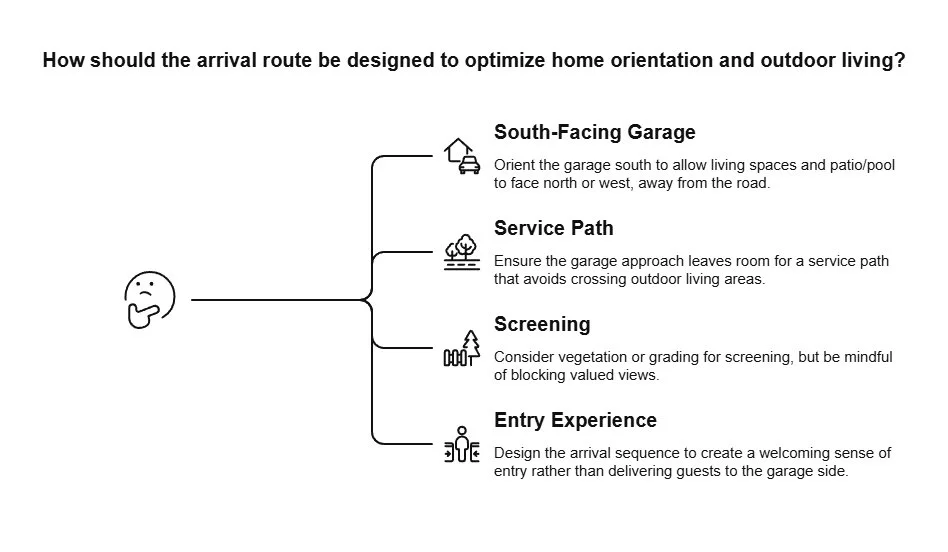
The driveway does not stop at the garage door. The route from the road to the building site shapes decisions about home orientation, the front-door experience, service zones, and outdoor-living screening.
If the approach enters from the south side of the lot, the garage may need to face south — pushing the front entry, primary living spaces, and patio or pool toward the north or west. That chain reaction is worth sketching before the floor plan takes shape.
Consider these relationships early:
Can the home be oriented so the most-used outdoor spaces face away from both the road and the driveway?
Does the garage approach leave room for a service path that does not cross the patio or pool area?
Would screening the house from the road with vegetation or grading also block a view the household values?
Does the arrival sequence create a sense of entry, or does it deliver guests to the side of the garage?
The common objection — "I can solve access later" — overlooks how unresolved route questions may shape early planning decisions that are difficult and expensive to reverse. That does not predict cost or feasibility, but it explains why the approach belongs in the conversation before the home concept becomes fixed.
Waiting to resolve access questions until after design begins can force revisions that ripple through the floor plan, site layout, and budget. These are planning questions, not design conclusions — but they are far easier to explore before commitments are made. Riverbend Homes describes its property-based Discovery Meeting as a starting point for assessing how site conditions, infrastructure, and budget interact with design priorities.
Score the Shortlist, Then Verify the Unknowns
Apply the matrix below to every shortlisted property. Score what you can observe, note the trade-offs, and flag what remains unverified.
Privacy-and-Access Lot Comparison Matrix
| Criteria | Priority Weight (H/M/L) | Parcel Observation | Trade-Off Notes | Verification Needed? |
|---|---|---|---|---|
| Visual separation from road and neighbors | ||||
| Arrival experience and wayfinding | ||||
| Everyday vehicle access | ||||
| Guest and delivery clarity | ||||
| Maintenance and service access | ||||
| Construction-vehicle access | ||||
| Driveway-to-garage-to-entry relationship | ||||
| Outdoor-living screening | ||||
| Long-term household usability | ||||
| Legal access, easements, and approvals | Yes — title, survey, authority | |||
| Utility, septic, and infrastructure | Yes — provider and authority | |||
| HOA or subdivision restrictions | Yes — governing documents |
Use the trade-off column to state each exchange plainly — "More screened arrival, less direct guest approach" is more useful than "good privacy." For example, under 'Everyday vehicle access,' your observation might be 'Long, steep gravel approach,' your trade-off note might be 'Beautiful entry, but will require 4WD for winter commutes,' and your verification needed would be 'Yes — civil engineer to check max grade for paving. In the verification column, name the unresolved item and who may be able to confirm it.
Mark items in the "Verification Needed" column instead of guessing. Preference decisions — how much separation feels right, where the patio should face — are yours to make. Access rights, easements, utility availability, permitting, and site feasibility require confirmation from the applicable authorities and qualified professionals, which may include a licensed surveyor, a civil engineer, title or easement professionals, utility providers, and the governing HOA or permitting body.
Use the comparison matrix on every shortlisted property before deciding which one deserves deeper verification.
For a broader set of builder-focused questions to bring into the conversation, see questions to ask a custom home builder before making an offer.
Frequently Asked Questions
Does more acreage always mean more privacy?
Not necessarily. Privacy may depend on home placement, road exposure, neighboring uses, sightlines, topography, and outdoor-living orientation rather than total acreage. A large lot with the buildable area near the road can feel less separated than a smaller lot positioned behind a natural buffer.
What access questions should I ask before making an offer on a Spicewood lot?
Start with how the property handles everyday arrival, guests, deliveries, maintenance, and construction traffic. Then identify which items — legal access, easements, driveway approvals, utilities, and site conditions — require written confirmation from the applicable authority or a qualified professional. For a more detailed checklist, see questions to ask a custom home builder before making an offer.
Can driveway access affect the custom-home design?
It can influence early thinking about home placement, garage orientation, the front-entry experience, service zones, and outdoor-living privacy. A constrained approach may limit where the home sits on the lot, which affects which direction the primary living spaces and patio face. These relationships are worth discussing during a site evaluation before the floor plan is developed.
Which lot type is usually cheapest to build on?
There is no reliable answer by lot label alone. Development costs depend on parcel-specific factors including driveway length and grade, site preparation, infrastructure availability, utility connections, permitting, and the home's design requirements. The only way to compare costs meaningfully is through an evaluation tied to a specific parcel and plan.
The Right Lot Fits the Household, Not Just the View
The property that deserves your commitment is not the one with the most seclusion. It is the one whose privacy and access trade-offs align with the way your household actually lives — and whose unresolved questions can be answered through professional verification rather than optimism.
Bring your privacy, access, and home-planning priorities to a property-based Discovery Meeting. If you want to discuss those relationships with custom home builders in Spicewood, bring your matrix and early home ideas. When you are ready to start that conversation, contact Riverbend Homes.
Disclaimer: This article is for general educational purposes only. Conditions vary by property. Confirm access, easements, utilities, permitting, and site feasibility with the applicable authorities and qualified local professionals before purchasing land or finalizing a custom-home plan.
Our Editorial Process
Our expert team uses AI tools to help organize and structure our initial drafts. Every piece is then extensively rewritten, fact-checked, and enriched with first-hand insights and experiences by expert humans on our Insights Team to ensure accuracy and clarity.
By Riverbend Homes Editorial Team
Riverbend Homes is a second-generation family-owned custom home builder serving Spicewood, Lake Travis, Horseshoe Bay, Lake LBJ, and the Texas Hill Country. Since 1996, Riverbend Homes has focused on listening closely, building selectively, staying involved on site, and helping families turn custom-home visions into well-planned homes.
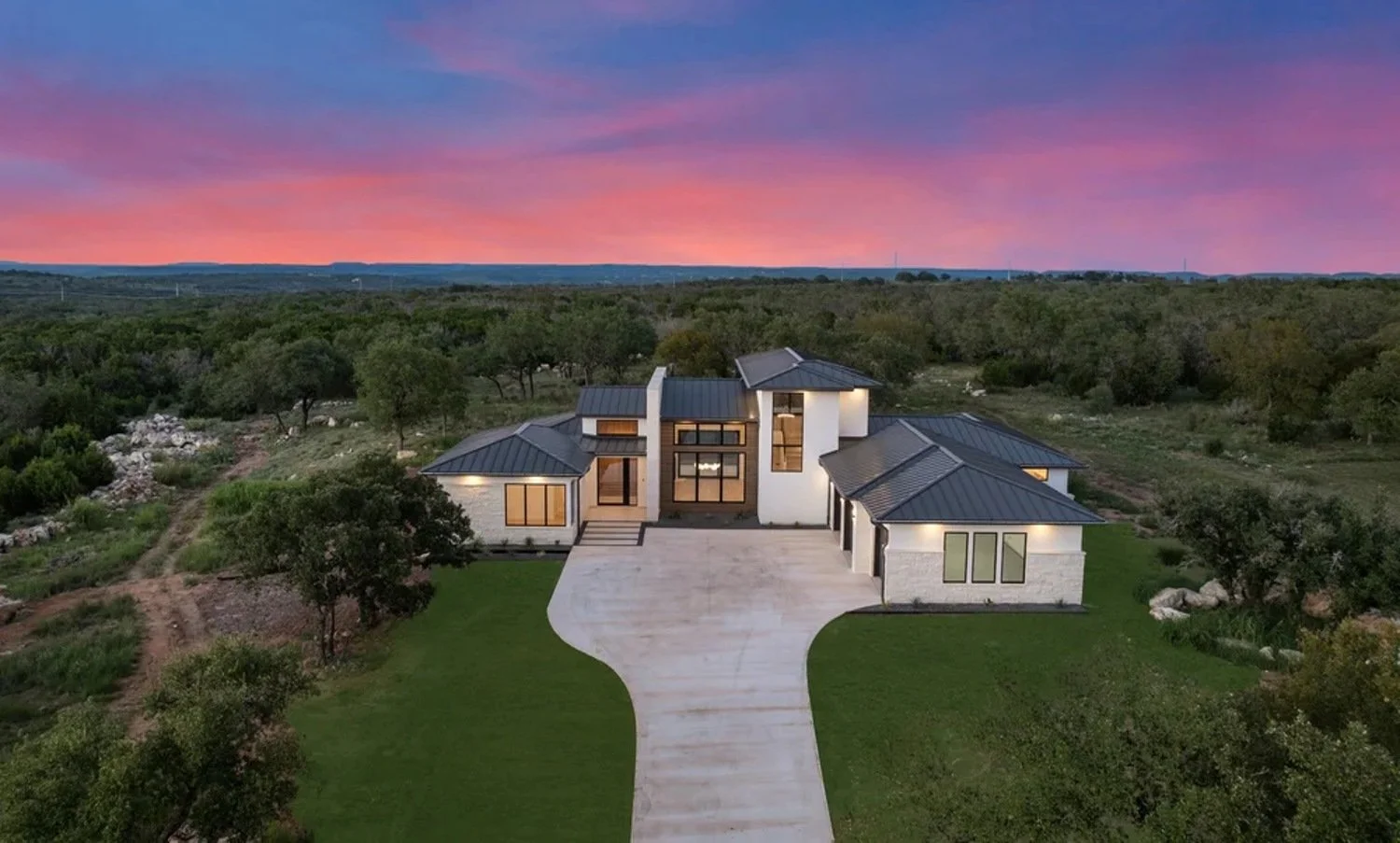
Acreage or Cul-de-Sac Lot in Spicewood? Custom Home Trade-Offs to Compare
📌 Key Takeaways
The best Spicewood lot supports your full home plan, lifestyle priorities, and verified site conditions.
Judge the Parcel: Compare usable building space, access, utilities, restrictions, and maintenance instead of relying on broad property labels.
Test the Full Plan: Place the home, garage, driveway, pool, and outdoor spaces together before deciding whether a lot truly works.
Confirm Every Constraint: Surveys, easements, slopes, drainage, rules, and written utility details reveal how much design freedom you actually have.
Match Daily Life: Acreage can add privacy and upkeep, while cul-de-sacs may offer community with tighter design limits.
Price the Whole Site: Separate house costs from driveways, grading, retaining walls, utilities, wells, septic systems, and drainage work.
The right lot proves it can fit your life.
Spicewood custom-home buyers will compare parcels with fewer blind spots using the questions and checks below.
~ ~ ~ ~ ~ ~ ~ ~ ~ ~ ~ ~ ~ ~ ~ ~ ~ ~
Two Spicewood listings catch your eye. One sits on several acres with separation from neighbors and room to spread out. The other anchors a quiet cul-de-sac with a neighborhood feel and a defined streetscape. Both look promising—but neither listing label tells you whether the property can actually hold the home, driveway, pool, outdoor kitchen, and garage arrangement you have in mind.
The stronger fit depends less on the property type and more on what the individual parcel can verify: usable building area, access, utilities, restrictions, maintenance scope, and how your daily life would work on that specific piece of ground. Here is a framework for comparing the two profiles across the criteria that matter most before you narrow your search.
Compare the Parcel, Not Just the Property Type
Before diving into trade-offs, it helps to clarify what each label actually describes—and why treating them as opposites can mislead you. "Acreage" refers to lot size and the degree of separation from surrounding properties. "Cul-de-sac" describes street position—a dead-end turnaround that limits through-traffic. The two are not mutually exclusive: a property can sit on multiple acres at the end of a cul-de-sac within a larger development. That overlap matters because buyers sometimes frame these as opposite choices when the real comparison should happen at the parcel level.
The table below organizes the planning criteria that tend to differ between the two profiles.
| Planning Criterion | Acreage Profile | Cul-de-Sac Profile |
|---|---|---|
| Privacy potential | May offer greater separation, depending on terrain, tree cover, and neighbor proximity | May have closer neighboring structures; sightlines depend on lot shape and orientation |
| Usable building area | Gross acreage can be misleading—slope, easements, setbacks, and drainage may reduce it | Defined footprint may appear simpler, but irregular shapes and setbacks can still limit placement |
| Driveway and access | Longer routes possible; access standards depend on the road authority | Shorter approach from the street; turning radius and garage orientation may be constrained by the cul-de-sac geometry |
| Utilities | May require well, septic, or extended service runs—confirm with providers | Neighborhood infrastructure may be present, but connection capacity and conditions still need verification |
| Restrictions and rules | Deed restrictions and county requirements vary; fewer HOA constraints in some cases | HOA design review, architectural standards, setbacks, and material requirements may apply |
| Outdoor living | More space for pools, patios, gardens, workshops, and future additions—if the terrain allows | Outdoor program competes with the home footprint, setbacks, and neighbor proximity |
| Maintenance | Land stewardship, longer driveways, private infrastructure, and vegetation management may add responsibility | Typically lower land-care scope, though HOA obligations and shared-area fees can apply |
| Planning complexity | Site work, infrastructure, and permitting scope may be broader | Fewer unknowns in some cases, but lot geometry and design rules can still create constraints |
Every cell in this table shifts once you examine a real parcel's survey, restrictions, and infrastructure.
What Acreage May Offer—and What It May Ask of You
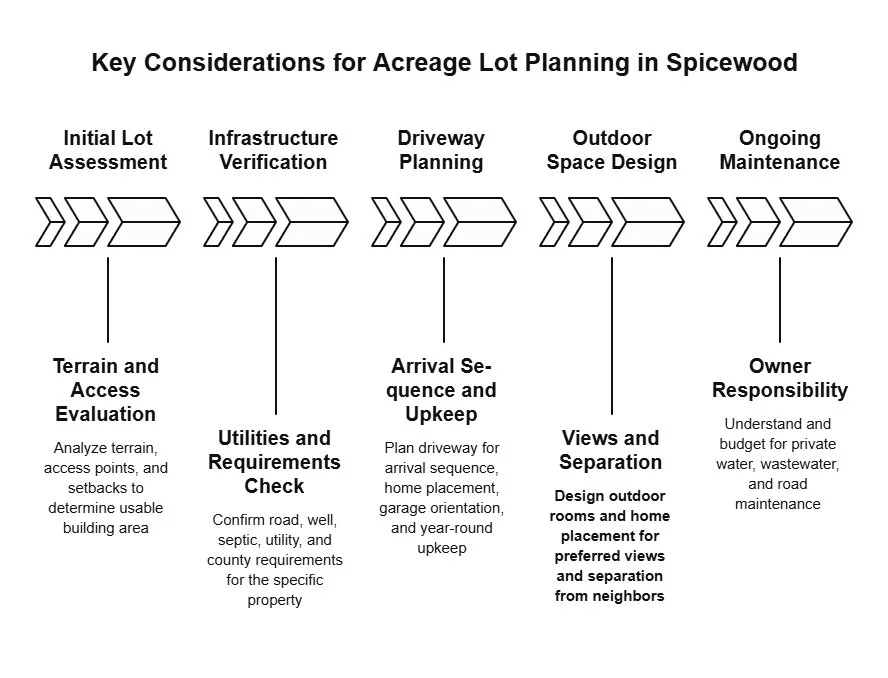
Acreage in Spicewood can mean breathing room: the ability to position a home for a preferred view, orient the primary living spaces away from neighbors, set a workshop or detached garage well apart from the house, and plan outdoor rooms without bumping into a property line.
Consider a buyer who prioritizes separation, a private arrival sequence, generous storage for equipment, and uninterrupted views from the back porch. Acreage may accommodate all of those goals—but the gross lot size alone does not confirm it. A ten-acre property with steep terrain, a floodplain corridor, deep setbacks, and a single access point may leave less usable building area than it appears on the listing. Longer driveways can affect construction-vehicle access, daily convenience, guest wayfinding, and long-term upkeep. Private water, wastewater, and road maintenance may become the owner's ongoing responsibility.
The planning value of acreage rises when the intended home program needs space and you confirm the terrain, access, and infrastructure support it. A long drive can create an intentional arrival sequence while also influencing home placement, garage orientation, and year-round upkeep. For a deeper look at how access routes affect home placement on larger Spicewood properties, see how driveway access shapes acreage planning.
Do not assume every Spicewood acreage parcel has the same road, well, septic, utility, or county requirements. Verify them for the individual property.
What a Cul-de-Sac Setting May Offer—and What Can Still Constrain It
A cul-de-sac lot in a Spicewood neighborhood may appeal to buyers who value community proximity, a defined streetscape, reduced through-traffic, and potentially lower land-care demands. When shared amenities exist—a pool, trails, or common green space—they can supplement the home's own outdoor program.
Picture a buyer drawn to a neighborhood setting: walkable streets, nearby families, and the convenience of established infrastructure. The cul-de-sac position reduces passing traffic, and the community offers a shared park. That sounds straightforward—until the lot turns out to be a pie-shaped wedge with a narrow frontage, an HOA that restricts roof materials and exterior colors, setbacks that push the buildable envelope toward the back of the property, and a garage approach that limits driveway length.
The turnaround itself often creates irregular frontage or a lot that widens or narrows behind the street. A wide rear yard can open up options for outdoor living, while curved boundaries or a compressed front can complicate circulation and garage placement. Shape and topography—not just the street label—determine where the home, pool, and outdoor rooms can go.
Neighborhood infrastructure does not automatically simplify the build. Lot shape, setback geometry, drainage grading, and design-review requirements still determine how much of the home program fits and where everything can go. Assumptions about "easy" utility access also need written confirmation from the serving providers.
Six Questions That Reveal Which Lot Better Fits Your Plans
How much of the property is actually usable?
Total acreage or listed square footage is a starting point, not a building envelope. Setbacks, easements, slope, drainage paths, and recorded restrictions subtract from that number. An easement grants another party specified use or access rights over part of the property—review the recorded document to understand its effect on your plan. A current survey and plat show the boundaries; the buildable area emerges only after those subtractions. Compare usable space—not the number on the listing—when evaluating either profile. For related considerations, review how lot shape questions can affect custom home design options.
Can the home, garage, driveway, pool, and outdoor spaces work together?
On either lot type, these elements compete for space and affect each other's placement. A front-entry garage on a cul-de-sac lot may dictate the home's orientation. A long acreage driveway may limit where the garage can sit relative to the living areas. A pool pushed to the only flat area may crowd the outdoor kitchen or block the preferred view. Test the full program on the site before committing to design.
What views, privacy, and orientation matter most?
A beautiful hilltop view may come with western sun exposure that heats the patio every summer afternoon. A cul-de-sac lot that backs up to open land may offer rear privacy but face a neighbor's second story from the primary bedroom. Sightlines, sun paths, prevailing breezes, and neighboring development all factor into the placement decision. Prioritize these before choosing the lot—not after the floor plan is drawn.
What infrastructure reaches the intended home location?
Water, wastewater or septic, electricity, internet, and drainage infrastructure may or may not serve the specific building site. Proximity to utility lines does not confirm availability, capacity, or connection cost. Confirm each service in writing with the provider and applicable authority for the parcel. On acreage, private well and septic evaluations may be necessary. In a neighborhood, verify that the lot's connection conditions match the home's requirements.
Which rules shape design options?
Plat notes, deed restrictions, HOA architectural standards, permitting requirements, and road-access authority rules can all affect exterior materials, roof pitch, setbacks, fencing, accessory structures, parking, and landscaping. A deed restriction is a recorded limitation on property use—do not rely on a verbal summary to interpret its meaning or applicability. Review the governing documents for either property type before design work starts, and obtain appropriate legal or professional guidance when interpretation is required.
What will everyday ownership require?
Acreage may mean vegetation management, driveway maintenance, private infrastructure upkeep, and longer distances to services. A cul-de-sac property may involve HOA dues, shared-space obligations, architectural compliance, and closer neighbor relationships. Compare the daily ownership picture—not just the building experience—against your tolerance for ongoing responsibility and your preferred lifestyle rhythm.
A Pre-Purchase Lot-Fit Checklist for Spicewood Buyers
Before making an offer or finalizing plans on either property type, work through these verification steps. They apply equally to acreage and cul-de-sac homesites.
Define your full home program. List the home, garage, driveway, pool, outdoor kitchen, storage, workshop, guest quarters, and any other non-negotiable elements with approximate footprints.
Obtain the current survey and plat. Confirm boundaries, easements, setbacks, and recorded restrictions from the most recent filed documents.
Confirm the governing jurisdiction. Identify the applicable county, permitting authority, and any municipal or special-district requirements for the parcel. In Spicewood, this often means checking whether the property falls within corporate city limits, a municipal ETJ, or unincorporated Travis or Burnet County, as this dictates who handles your development review and driveway permits.
Test the program against the buildable area. Overlay the full home program on the usable site—not the gross lot—to see whether everything fits with adequate separation and circulation.
Verify road access and driveway requirements. Identify who owns the road and what standards apply before assuming where the driveway can go.
Confirm utility availability in writing. Contact each provider—water, wastewater or septic, electricity, and internet—and obtain written confirmation of service, capacity, and connection conditions for the specific parcel.
Review drainage, floodplain, slope, and soil conditions. These may require evaluation by a licensed surveyor, civil engineer, or geotechnical professional, particularly on sloped or waterfront properties.
Identify HOA and architectural requirements. Request current governing documents and confirm design-review timelines before beginning detailed plans.
Separate house-construction cost from site and infrastructure scope. Driveway construction, grading, retaining walls, utility extensions, septic systems, well drilling, and drainage work can significantly affect the total investment—and these costs differ by parcel, not by lot type.
Seek property-specific builder input before design becomes fixed. Early professional perspective on site fit, access, and infrastructure can surface questions that listing descriptions do not answer. See questions to ask a custom home builder before making an offer for guidance on that conversation.
This checklist supports—but does not replace—professional due diligence, property-specific evaluations, and official approvals.
Which Profile Should Move to the Top of Your List?
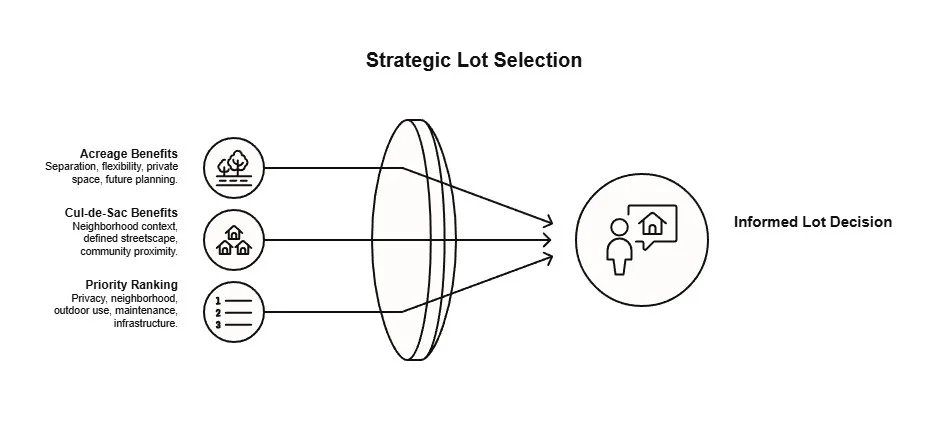
Rather than picking a winner, rank your own priorities and let the ranking guide which properties deserve deeper investigation.
Lean toward further acreage investigation when separation, flexible home positioning, private outdoor space, and room for future plans matter enough to justify broader site verification and potentially greater land-stewardship responsibility.
Lean toward further cul-de-sac investigation when neighborhood context, a defined streetscape, community proximity, and potentially lower land-care demands are priorities—subject to confirming that the lot's shape, restrictions, and infrastructure support your intended home program.
Five-priority decision check: Before your next property tour, rank these in order of importance to you: (1) privacy and separation, (2) neighborhood and community context, (3) outdoor use and future flexibility, (4) maintenance and stewardship tolerance, and (5) infrastructure complexity. Test both properties against that same ranking and your complete home program. The ranking will not choose the lot for you, but it will sharpen the questions you ask at every showing.
Frequently Asked Questions
Is acreage always better for a custom home in Spicewood?
Not necessarily. Acreage may offer separation and more positioning options, but usable building area depends on terrain, access, easements, setbacks, restrictions, and the intended home program. A smaller, well-situated lot can outperform a larger parcel with significant constraints.
Is a cul-de-sac lot usually easier or less expensive to build on?
That depends on the individual property. Neighborhood infrastructure may reduce some unknowns, but lot geometry, setbacks, grading, HOA design rules, and utility conditions can still create constraints. Avoid cost conclusions without parcel-specific estimates from qualified professionals.
Will a Spicewood acreage property require a well and septic system?
It cannot be assumed either way. Water and wastewater arrangements depend on the parcel and the services available to it. Confirm current availability, capacity, and connection conditions with the relevant providers, and verify applicable requirements with the proper authorities for the specific property.
Should a custom-home builder review a lot before I make an offer?
Early builder input can help identify site-fit and infrastructure questions that listing descriptions may not address. That said, a builder walk supplements—but does not replace—current surveys, property documents, professional evaluations, and official approvals.
The Better Lot Is the One That Checks Out
No comparison article can tell you which Spicewood parcel fits your plans. The answer lives in the survey, the restrictions, the infrastructure confirmations, and the site conditions that only a property-specific review can reveal. Use the framework and checklist above to screen properties against your actual priorities—and investigate the details before the floor plan locks in.
If you want parcel-specific input before narrowing your search, contact Riverbend Homes to discuss a Discovery Meeting at the property. Riverbend describes this meeting as an opportunity to understand your vision, help assess site feasibility—an early evaluation of whether site conditions and the intended project appear compatible—and discuss infrastructure requirements that may affect design and budget. You can also explore more about working with custom home builders in Spicewood.
Disclaimer: This article provides general educational information about custom-home lot planning. Property conditions, restrictions, approvals, utilities, and costs vary by parcel; confirm them with the applicable authorities and qualified local professionals before purchasing land or finalizing a design.
Our Editorial Process
Riverbend Homes content is created to help Texas Hill Country homeowners make clearer, calmer custom-home decisions. The editorial process begins with Riverbend's documented building process, local experience, client-facing materials, and verified internal resources. Drafts are reviewed for practical accuracy, plain-language usefulness, local relevance, and alignment with Riverbend Homes' site-first approach before publication.
About the Riverbend Homes Insights Team
The Riverbend Homes Insights Team is our dedicated engine for synthesizing complex topics into clear, helpful guides. While our content is thoroughly reviewed for clarity and accuracy, it is for informational purposes and should not replace professional advice.
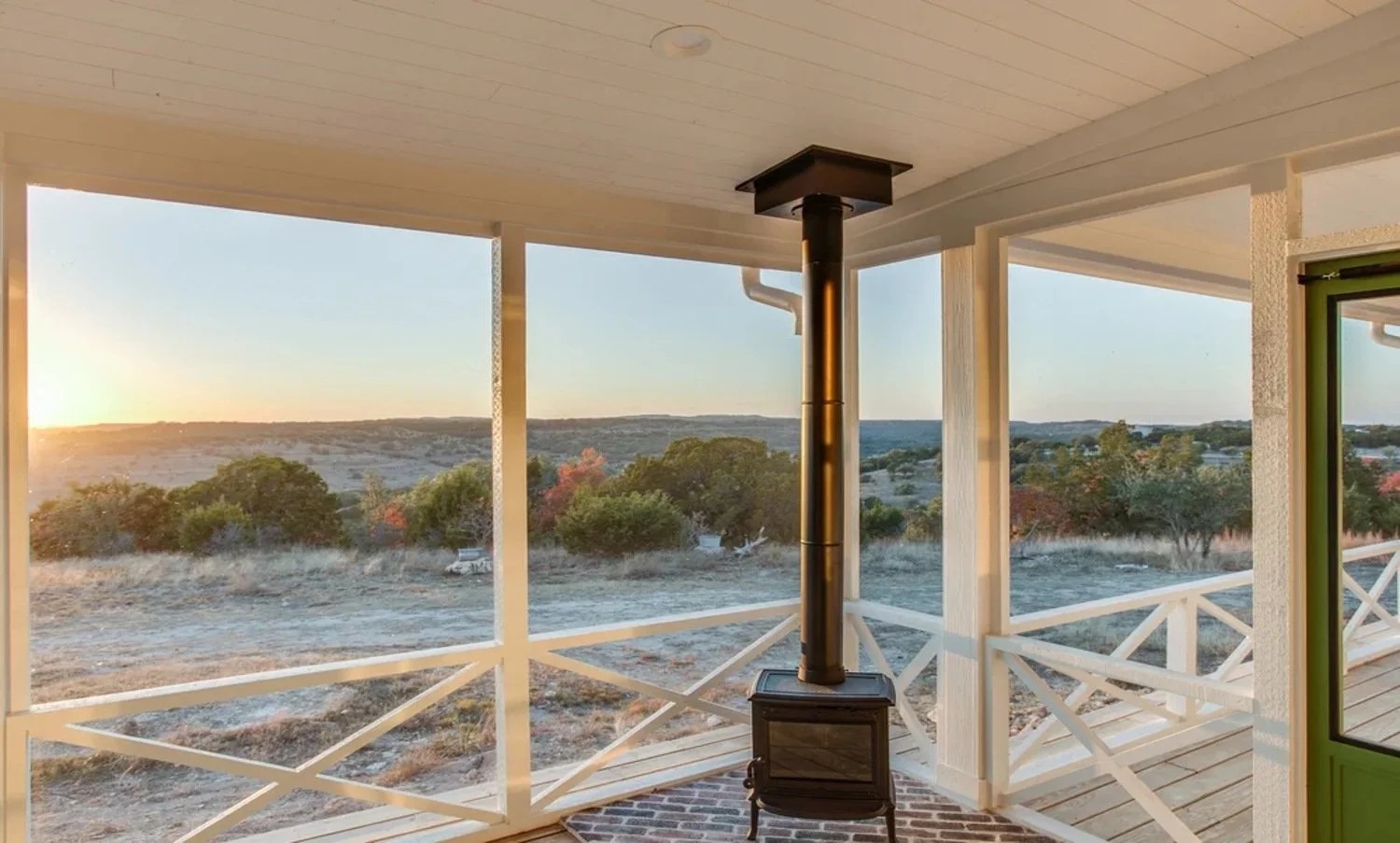
When a Scenic Spicewood Lot Needs a Builder’s Feasibility Review
📌 Key Takeaways
Review a scenic Spicewood lot early, because beauty alone does not prove the home will fit the land.
Find Buildable Space: The usable area matters more than acreage when slope, setbacks, easements, trees, or access limit placement.
Test The Slope: Elevation can create views, but it can also shape foundations, drainage, driveways, and site-prep costs.
Plan Access Early: Driveway approach affects garage placement, privacy, grading, daily use, and how crews reach the homesite.
Check Infrastructure First: Septic, water, power, internet, and drainage routes can change where the home and outdoor areas belong.
Use Experts Wisely: A builder can flag site-fit questions, while engineers, surveyors, authorities, and providers confirm property-specific limits.
The land must fit the dream, not just inspire it.
Spicewood lot buyers will spot site risks sooner, preparing them for the feasibility review steps that follow.
~ ~ ~ ~ ~ ~ ~ ~ ~ ~ ~ ~ ~ ~ ~ ~ ~ ~
A Spicewood lot with views, privacy, trees, elevation, or acreage can feel like the right place for a custom home at first walk-through. The setting may already suggest the lifestyle: a quiet approach, outdoor living facing the Hill Country, rooms arranged around the view, and enough separation from neighboring homes to feel private.
That first impression matters. It is part of why buyers are drawn to scenic land.
Still, a beautiful lot may deserve builder review when the same features that create its appeal can affect where the home sits, how access works, how utilities reach the site, and whether the design vision fits the land.
A feasibility review is not a lot approval. It is an early site-read that flags placement, access, infrastructure, and design-sequencing questions while changes are still manageable.
A Scenic Lot Can Be Beautiful Before It Is Clearly Buildable
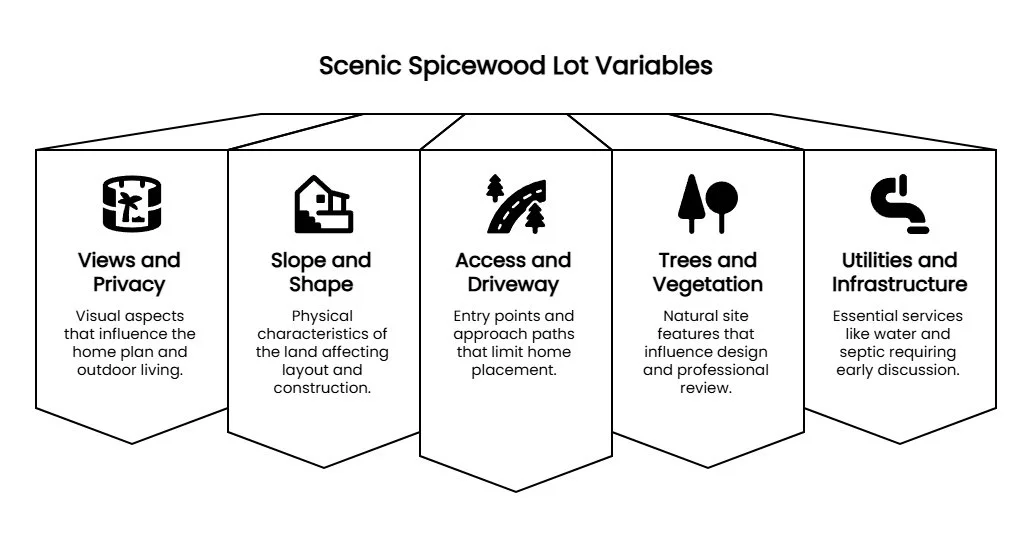
A scenic Spicewood lot deserves closer review when views, privacy, slope, access, lot shape, trees, or utility questions could influence the home plan. The goal is not to diagnose the property from afar; it is to identify the site variables most likely to drive layout, cost, and professional-review needs.
Assuming emotional fit and design fit are the same thing is a common mistake. A lot can feel perfect because of the view, but that view may need to be balanced against driveway approach, garage placement, outdoor living, drainage, utilities, and construction access.
Complexity is a planning signal, not a rejection. It means the home concept should be tested against the land’s constraints and opportunities.
The First Signal Is Whether the Lot Has a Clear Build Envelope
The build envelope is the practical area where a home may be placed after accounting for property boundaries, setbacks, easements, deed restrictions, terrain, access, and other site-specific limits. It is not the same as total acreage.
That distinction matters. A large homesite may still have a smaller usable area than expected if the preferred home location competes with slope, driveway access, easements, septic planning, utility routes, trees, drainage, or outdoor living space.
The build envelope can shape the entire design conversation. It may affect how the home faces the view, where the garage belongs, whether a pool or casita has room to work, and how privacy is preserved from the road or neighboring properties.
Specific setbacks, easements, HOA rules, deed restrictions, and county requirements should be verified through the survey, plat, title documents, HOA documents, deed restrictions, and the appropriate local authority. For official starting points, buyers may need to check resources such as Travis County Development Services, Burnet County Development Services, or Blanco County development rules, depending on the property.
Slope, Rock, and Elevation Can Change the Design Conversation
Scenic views often come from elevation changes. In the Hill Country, that can be part of the appeal: the home feels connected to the land, outdoor spaces open toward the horizon, and the natural terrain creates privacy.
Slope can also affect design options. Depending on the lot, it may influence the foundation approach, driveway alignment, drainage planning, retaining needs, outdoor living transitions, and construction staging.
The question is not whether a slope is good or bad, but how the home should meet the land.
In Spicewood specifically, hillside lots often mean building on solid limestone. While this provides an incredibly stable foundation, it also means excavation for a flat pad, pool, or extended driveway will require specialized equipment and impact the site-prep budget
A hypothetical ridge-view lot illustrates the issue. The best view may be uphill from the easiest driveway approach. The garage may want one orientation, the living spaces another, and the pool may need usable ground that is not obvious from the first walk-through. That does not make the lot unworkable. It means the first floor plan should respond to access, grade, and outdoor-living realities instead of treating them as afterthoughts.
Any slope thresholds, driveway-grade limits, retaining-wall needs, foundation requirements, or drainage conclusions should come from qualified professionals, such as a surveyor, civil engineer, geotechnical professional, or other appropriate expert.
Driveway Approach and Site Access Can Limit Where the Home Belongs
Driveway approach is often treated as a later detail, but on a scenic homesite it can guide the whole plan. Access can affect the arrival sequence, home orientation, garage location, grading, drainage, privacy, and construction logistics.
A tucked-away homesite may need a longer access route. A private setting may feel ideal until the team considers how equipment, deliveries, staging, and daily construction movement could reach the preferred building area. Everyday driveway use and construction access are related, but they are not identical.
This is where builder input becomes practical, not theoretical. A builder can connect the desired arrival experience to practical site questions: where vehicles enter, how the garage is approached, whether the driveway supports the home’s orientation, and which access assumptions need verification.
Technical access rules, road requirements, fire access, and permitting issues should be confirmed with the appropriate professionals or authorities for the specific property.
Utilities, Septic, Water, and Infrastructure Should Be Discussed Early
Infrastructure can influence both design and budget planning. Utilities, septic, water, power, internet, drainage, and service routes may affect where the home, driveway, pool, and outdoor living areas can sit.
Because the Spicewood area spans Travis, Burnet, and Blanco counties—and is largely unincorporated—the rules for well drilling, septic permits, and impervious cover limits depend entirely on where the property lines fall. A seller may say utilities are nearby, but “nearby” does not answer every design question. The route from a road, utility point, or service area to the preferred homesite may still need review. Septic and water questions can also be highly site-specific, depending on the property and applicable authority.
Treat infrastructure as a site-planning constraint, not a late utility hookup task. A builder feasibility conversation can separate design-sensitive infrastructure questions from items that require direct confirmation from a provider, septic professional, water district, or local authority.
For septic-related verification, the Texas Commission on Environmental Quality’s OSSF guidance is a useful official starting point. For drainage or flood-related questions, buyers may also need to check the FEMA Flood Map Service Center and relevant local sources. These resources do not replace property-specific professional review.
Views, Privacy, and Outdoor Living Need to Work Together
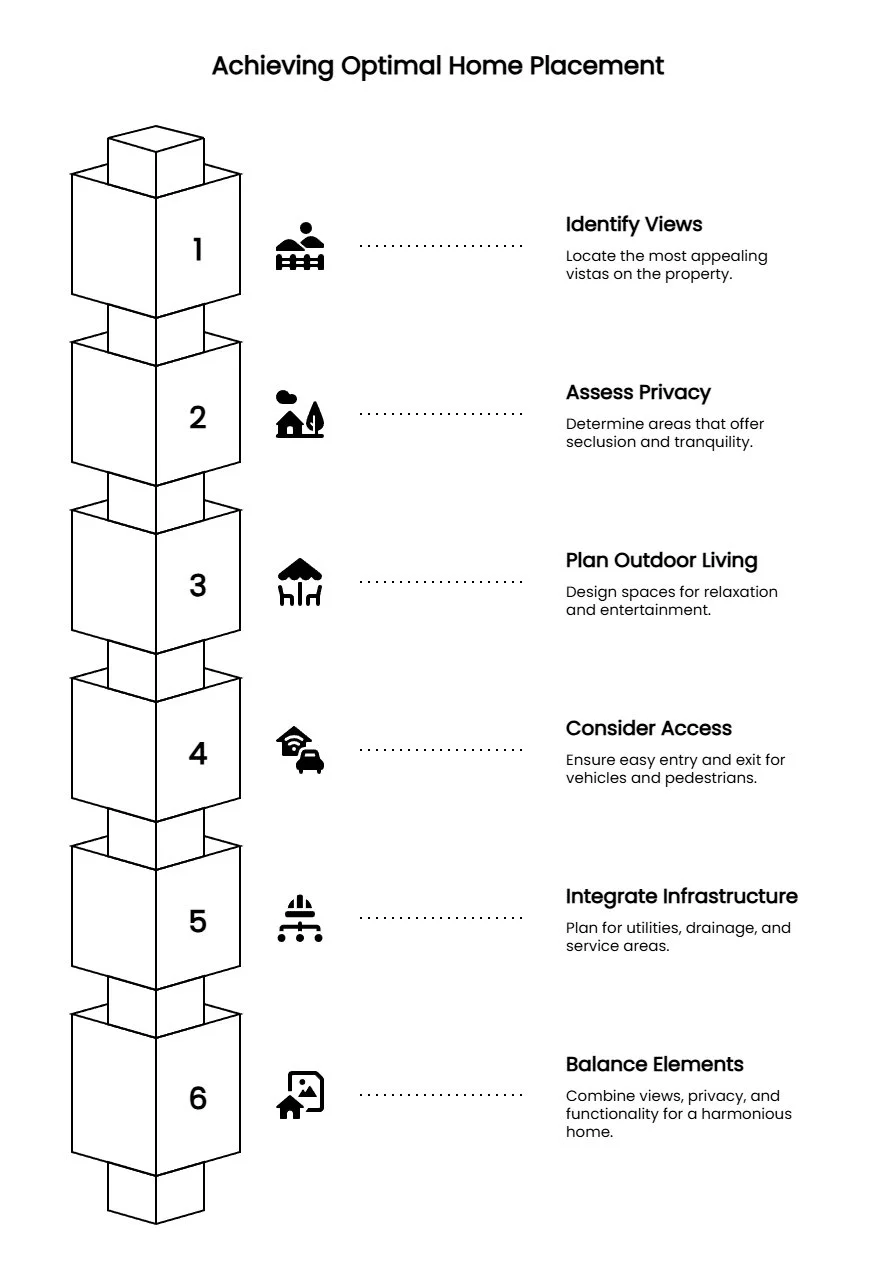
The strongest view is not always the best overall home placement. A custom home also has to work with access, privacy, garage location, pool placement, covered patios, guest areas, service areas, drainage, and the way the owners expect to live on the property.
A view-facing home may compete with the pool, outdoor kitchen, detached casita, or garage for the same usable area. A private wooded setting may create questions about clearing, access, utility routes, and where outdoor living will feel open without losing privacy.
Walking the site allows buyers to test their full lifestyle vision against the land. The question becomes less “Where is the prettiest view?” and more “Where can the home, driveway, outdoor living, infrastructure, and privacy work together?”
For related planning context, Riverbend’s article on a site-first custom home plan offers supporting reading on view, access, and outdoor-living questions.
Scenic Lot Feasibility Signals Checklist
| Signal you notice | Why it matters to site fit |
|---|---|
| Steep or uneven terrain | It can affect placement, access, drainage, outdoor living, and construction logistics. |
| Irregular lot shape or narrow frontage | Total acreage may not translate into flexible usable area. |
| Unclear build envelope | Boundaries, easements, restrictions, terrain, or access may influence home placement. |
| Long or steep driveway approach | Access can affect garage location, grading, privacy, and arrival experience. |
| Limited construction access | Equipment, deliveries, staging, and site movement may need early planning. |
| Unknown septic, water, or utility path | Infrastructure routes can affect design sequencing and site layout. |
| Desired views competing with privacy or sun exposure | The best view may not create the best full-site plan. |
| Pool, casita, or outdoor living goals | These features may compete with the home, driveway, and infrastructure for usable space. |
| HOA, easement, deed restriction, or county uncertainty | Property-specific documents and official review may be needed before relying on setback, placement, or approval assumptions. |
This checklist is not a pass/fail test. It is a practical way to decide whether the lot should be discussed with a builder and the right professionals while the home concept is still flexible.
A Builder’s Feasibility Review Should Clarify Questions, Not Promise Certainty
A builder feasibility review should help connect the desired home to the actual property. It may surface questions about site fit, design implications, infrastructure, access, budget-sensitive unknowns, and which professionals need to weigh in.
Riverbend’s Discovery Meeting is described as a property-based meeting focused on understanding the client’s vision, assessing site feasibility, and identifying infrastructure requirements that may affect budget and design. That makes it relevant when a Spicewood lot raises questions about slope, access, utilities, or home placement.
A builder should not be treated as the only reviewer. Engineers, surveyors, architects, septic professionals, utility providers, title professionals, HOA representatives, and local authorities may still be needed depending on the lot.
| A builder can help identify | A qualified professional or authority may need to verify |
|---|---|
| Whether the desired home concept appears aligned with the site | Engineering, drainage, foundation, or slope requirements |
| How driveway, garage, and home orientation may relate | Road, fire access, grade, or permitting requirements |
| Infrastructure questions that could affect design sequencing | Utility, water, septic, or provider availability |
| Site-planning conflicts between views, privacy, and outdoor living | Survey, title, easement, deed restriction, HOA, or county requirements |
| Questions that could change scope, sequencing, or budget | Official approvals, permits, and property-specific compliance items |
For local service context, buyers can review Riverbend’s Spicewood custom home builder page. Bring the survey, inspiration images, and site questions so the conversation starts with the actual lot, not just the dream plan.
What to Bring to a Scenic-Lot Feasibility Conversation
Start by gathering the documents and details that help the site conversation stay grounded. Useful materials may include the survey, plat, seller disclosures, deed restrictions, HOA documents, utility information, septic or water notes, site photos, inspiration images, desired home size, outdoor living priorities, and questions about views or access.
Then walk the property with a builder while the home concept is still flexible. The purpose is not to decide everything in one visit. It is to identify what appears worth exploring, what may affect design direction, and what needs professional verification.
For a deeper related guide, review Riverbend’s article on what a Spicewood lot can really support before starting the floor plan.
FAQs
Should a builder review a Spicewood lot before buying it?
A builder review can be useful before purchase when the lot’s slope, access, shape, utilities, restrictions, or desired home placement raises questions. This is not legal or contract advice. Purchase decisions should also account for appropriate survey, title, HOA, engineering, septic, utility, and local authority review.
Does a scenic lot always cost more to build on?
Not necessarily. Scenic features may introduce planning variables, but cost impact depends on site-specific conditions, design choices, infrastructure, access, and professional review. Without current project-specific support, it is safer to discuss possible planning implications rather than assume a cost outcome.
Is a builder feasibility review the same as engineering or permitting approval?
No. A builder feasibility review can help identify design and construction questions. It is not engineering approval, permitting approval, septic approval, title review, HOA approval, or a legal determination. Depending on the lot, those reviews may still be needed from the appropriate professional or official source.
Conclusion
A scenic Spicewood lot can be a strong custom home opportunity. The right review turns that vision into site-specific questions about placement, access, infrastructure, and lifestyle fit.
Building on a scenic lot requires careful evaluation of whether the slope, driveway access, utilities, and build envelope support the intended home, outdoor living plan, and construction approach. A builder’s site-read can help reveal whether the design is likely to work with the land’s slope, driveway access, utility paths, and buildable area.
If a Spicewood lot raises questions about slope, access, utilities, or home placement, prepare the site documents and contact Riverbend Homes to discuss a Discovery Meeting focused on how the land can support the home.
Disclaimer
This article is for general informational purposes only. It is not a substitute for advice from a qualified builder, architect, engineer, surveyor, septic professional, utility provider, HOA, permitting authority, legal professional, or other expert familiar with the specific property. Always verify important lot, design, infrastructure, and approval questions with the appropriate professional or official source before making decisions.
Our Editorial Process
Our expert team uses AI tools to help organize and structure our initial drafts. Every piece is then extensively rewritten, fact-checked, and enriched with first-hand insights and experiences by expert humans on our Insights Team to ensure accuracy and clarity.
By Riverbend Homes Editorial Team
Riverbend Homes is a second-generation family-owned custom home builder serving Spicewood, Lake Travis, Horseshoe Bay, Lake LBJ, and the Texas Hill Country. Since 1996, Riverbend Homes has focused on listening closely, building selectively, staying involved on site, and helping families turn custom-home visions into well-planned homes.
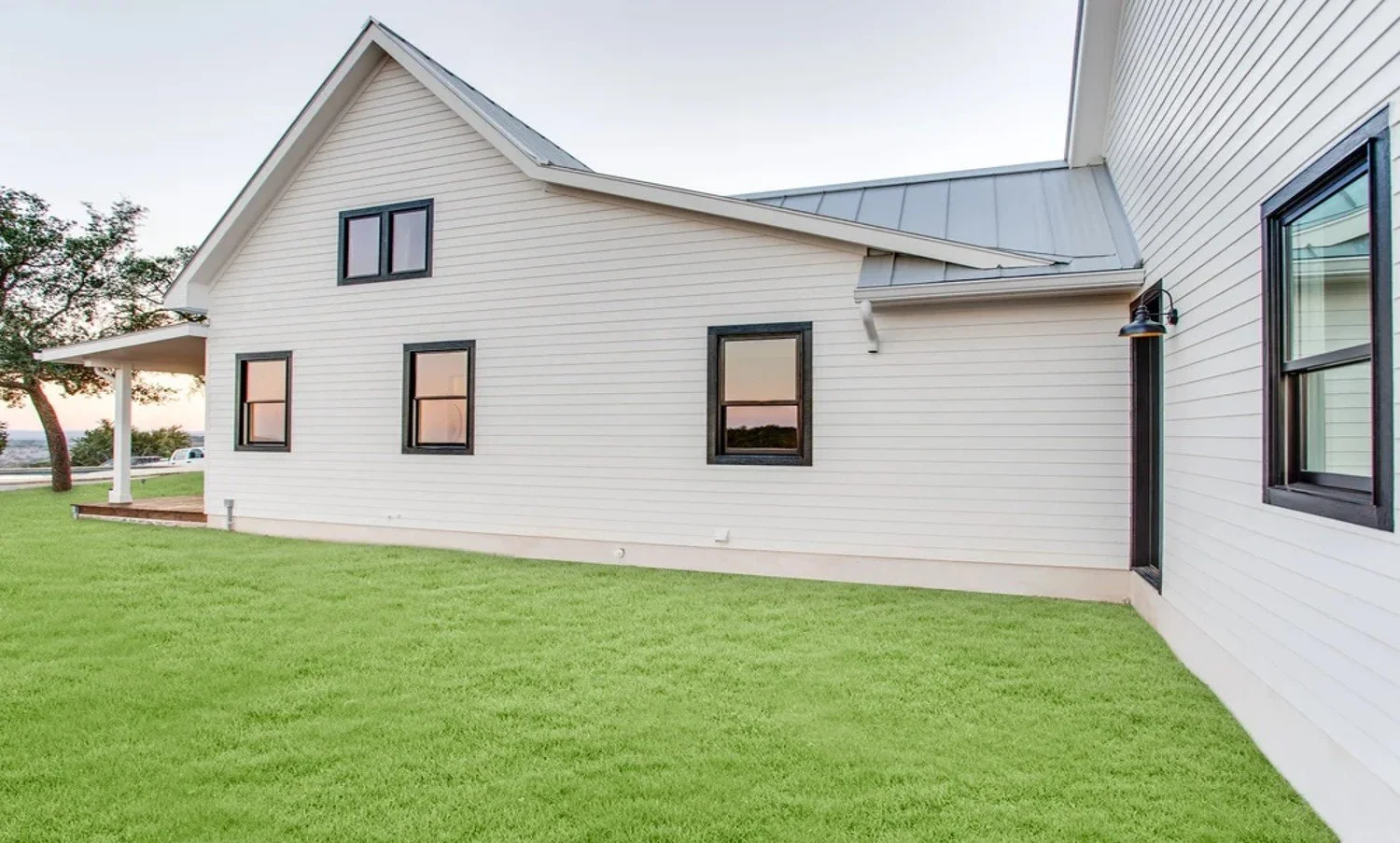
How Driveway Access Can Shape Early Custom Home Planning on Spicewood Acreage
📌 Key Takeaways
Driveway access should shape the home plan early, before buyers fall in love with the wrong layout.
Plan Access First: Treat the driveway as part of the site plan, not a line added after design.
Protect The Arrival: The road approach can shape privacy, garage views, guest entry, and daily use.
Walk The Route: Slope, rock, curves, and turning space can change what looks easy on paper.
Check The Build Envelope: The driveway should support the home, pool, garage, utilities, and outdoor living together.
Verify Before Designing: Builders can spot early issues, but engineers, officials, or legal counsel may need to confirm details.
The driveway is part of the home, not an afterthought.
Spicewood acreage buyers will ask better site questions, preparing them for the driveway planning checklist that follows.
~ ~ ~ ~ ~ ~ ~ ~ ~ ~ ~ ~ ~ ~ ~ ~ ~ ~
A scenic acreage lot can make the future home feel almost tangible. The view suggests where the living room might face. A grove of trees hints at privacy. A level-looking area seems ready for a pool, outdoor kitchen, or detached guest space.
Then the driveway route starts asking harder questions.
On Spicewood acreage, driveway access can be an early planning signal. It does not prove whether a lot is buildable, and it should not be treated as engineering, legal, surveying, permitting, or drainage advice. But it can influence where the home sits, how the garage works, how guests arrive, where outdoor living feels natural, and how construction activity may reach the site before the finished home exists.
The most useful question is not simply, “Can a driveway fit?” It is, “Does the likely access support the custom home experience this property is supposed to create?”
Driveway Access Is More Than a Place to Park
Homeowners often view the driveway as a practical connection between the road and the garage. In early custom home planning, it can shape the whole arrival sequence.
The approach from the road may affect whether the home feels private or exposed. It can influence whether guests arrive at a welcoming entry or mostly see garage doors. It may also affect service access, daily circulation, and the way the home sits in relation to views, trees, slope, drainage patterns, and outdoor living areas.
For a Spicewood acreage buyer, this matters because a beautiful homesite may not automatically be the most practical place to reach. A view-oriented portion of the lot might be appealing, while the driveway path needed to reach it could interfere with privacy, outdoor space, or a future pool area. That is not a reason to dismiss the lot. It is a reason to ask better questions before design begins.
A useful general principle is to treat driveway access as part of the site plan, not a line added after the floor plan is finished.
How the Road Approach Can Influence the Home Site
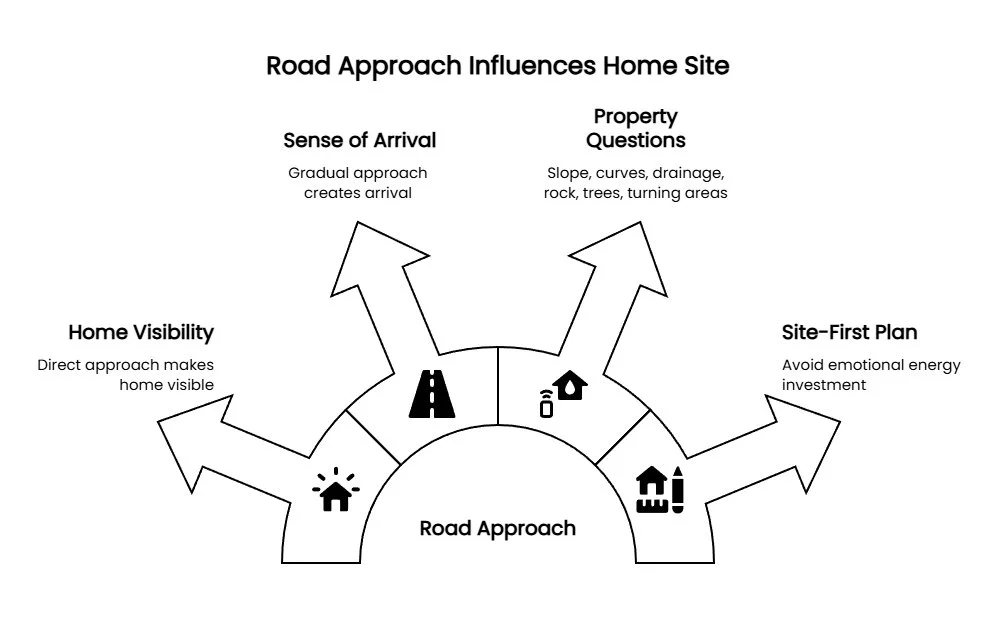
The driveway usually begins with the most logical point of entry from the road. That entry point can quietly influence the rest of the plan.
A direct approach may be efficient, but it could make the home feel too visible from the road. A more gradual approach may create a stronger sense of arrival, but it may also require closer review of slope, curves, drainage, rock, trees, or turning areas. These are property-specific questions, not universal rules.
For example, a buyer might find a lot where the best view is toward the rear of the property. The home may want to face that view, while the driveway needs to reach the garage without cutting through the outdoor living zone. In that situation, the driveway affects more than parking. It influences garage orientation, guest arrival, privacy, landscape planning, and the relationship between the home and the land.
A site-first custom home plan helps you avoid investing too much emotional energy in a floor plan that won't fit the land. The land and the access should shape the design conversation together.
Access Factor, Planning Impact, and Question to Ask
| Access factor | Possible planning impact | Question to ask early |
|---|---|---|
| Entry point from the road | May influence arrival sequence, privacy, and garage orientation | Where does the driveway most naturally enter the property? |
| Slope or grade change | Could affect comfort, grading, drainage, and garage placement conversations | What needs professional review before assuming this route works? |
| Curves and turning areas | May affect daily use, deliveries, guests, and construction movement | Is there enough practical room for vehicles to move without forcing awkward design choices? |
| Build envelope | Connects access with the home, garage, utilities, septic, and outdoor living | Does the driveway support the home site or compete with it? |
| Easements or shared access | May affect legal access and long-term use | What do the survey, plat, title documents, or legal review need to confirm? |
This table is a planning framework, not a technical standard. The answers can vary by property, jurisdiction, HOA, road type, utility provider, recorded documents, and professional review.
Slope, Curves, and Turning Space Can Change the Conversation
Slope is one of the first access-related features worth noticing during a property walk. A route that looks simple on a drawing may feel different when walking the land. For example, many Spicewood lots feature solid limestone just inches below the topsoil, or steep ravines that require switchbacks. A driveway route that looks short on a map might require expensive rock milling or extensive retaining walls once you stand on the property.
Slope can affect the perceived comfort of the approach, the way the garage meets the home, and whether grading, retaining, drainage, or route alternatives should be reviewed. Curves and turning space can matter for everyday driving, guest parking, deliveries, service access, and construction movement. While exact requirements vary, a standard side-entry garage typically requires at least 25 to 30 feet of backing space to allow vehicles to turn around comfortably.
The important point is not to assign a universal driveway grade or turning standard. Those requirements may depend on the property and the applicable authority. A general article should not replace review by a qualified professional or official source.
A blog article, listing description, or AI summary cannot replace official guidance on grades, drainage, culverts, or fire access. Confirm those details with the appropriate professional, county office, HOA or subdivision documents, road authority, utility provider, fire code authority, surveyor, civil engineer, or real estate attorney when needed.
Review Driveway Access With the Build Envelope
A build envelope is the area where the home and related improvements may reasonably fit after considering setbacks, easements, terrain, utilities, septic, drainage, trees, rock, and other site constraints. Driveway access should be reviewed with that area, not separately from it.
A long driveway may affect more than cost. It can influence privacy, utility routing, arrival sequence, service access, and construction logistics. A shorter driveway may seem easier, but it could force the garage into a visually dominant position or create conflict with outdoor living space.
A driveway that technically reaches the home may still fight the way the home wants to live.
The better planning question is: “Does this access route support the home, pool, garage, outdoor living, and daily use pattern we want?” A related Riverbend article on whether a lot can hold the home, pool, and driveway you want can help frame the lot as one connected planning problem.
Construction Access Is Different From the Finished Driveway
The finished driveway is part of the long-term home experience. Construction access is about how workers, deliveries, materials, equipment, and staging may reach the home site while the house is being built.
Those needs can overlap, but they are not identical. A finished driveway may be designed for beauty, privacy, and daily use. Construction access may require a practical temporary approach that supports site activity without creating avoidable conflicts.
This does not mean a buyer needs to solve construction logistics before buying the lot. It means construction access should be part of the early feasibility conversation.
Riverbend’s process describes a Discovery Meeting at the property to understand the client’s vision, assess site feasibility, and discuss infrastructure requirements that may affect budget and design. For an acreage buyer, that type of property-based conversation can help connect access, home placement, utilities, and design expectations before plans become too developed.
Driveway Access Pre-Design Question Checklist
Use this checklist during a property walk, survey review, or early builder conversation. These questions are meant to guide discussion, not provide technical answers.
Road and entry questions
Where is the most logical entry point from the road?
Does access appear to depend on road frontage, a shared drive, or an easement?
Would the approach feel private, exposed, formal, or service-oriented?
Could the driveway route make the garage the dominant first impression?
Slope and route questions
Does the likely route feel comfortable when walking the land?
Could slope, rock, drainage, trees, or natural features complicate the route?
What parts of the route need review by a qualified site professional?
Is there an alternate route that better supports the home site?
Home placement and garage questions
Does the driveway support the preferred home location?
Could the route interfere with the best view, privacy area, pool, or outdoor living space?
How might the approach affect garage orientation, guest parking, turnaround space, and service access?
Does the access route support your daily routine?
Construction access questions
How might construction traffic reach the home site before the finished driveway exists?
Is there a practical area for deliveries, staging, and site movement?
Could temporary access needs conflict with trees, slopes, drainage, or future outdoor living?
What should a builder review before assuming construction access is straightforward?
Approval, easement, and document questions
Does the survey show easements, shared access, setbacks, restrictions, or other access-related items?
Which HOA, county, or subdivision rules apply to this route?
Who should confirm legal access, easement rights, drainage questions, or permitting requirements?
Are any assumptions based only on a listing description or seller statement?
Builder feasibility questions
What driveway-access questions should be answered before floor plans move forward?
How could the route interact with utilities, septic, drainage, pool placement, or outdoor living?
Which questions require a surveyor, civil engineer, or local authority to answer?
What would need to be verified before relying on the driveway route as part of the design?
For buyers still organizing early site information, Riverbend’s article on lot checks before your dream home is drawn offers another practical way to prepare for a property conversation.
When to Bring in a Builder for a Site-First Conversation
A builder can be helpful when the lot looks promising but access, slope, utilities, build envelope, or outdoor living questions remain unresolved. At this early stage, the builder’s role is not to guarantee that every issue is settled before purchase. It is to help identify what needs review before the design moves too far.
That distinction matters. Early builder input can help a buyer recognize planning conflicts, but final answers may still require a formal review by site engineers, local authorities, or legal counsel.
Riverbend Homes is a custom home builder in Spicewood, and its building process begins with a property-based Discovery Meeting. That makes the soft next step straightforward: before design begins, walk the property with a builder who can help identify site-feasibility questions.
Useful Official Resources to Verify Access Questions
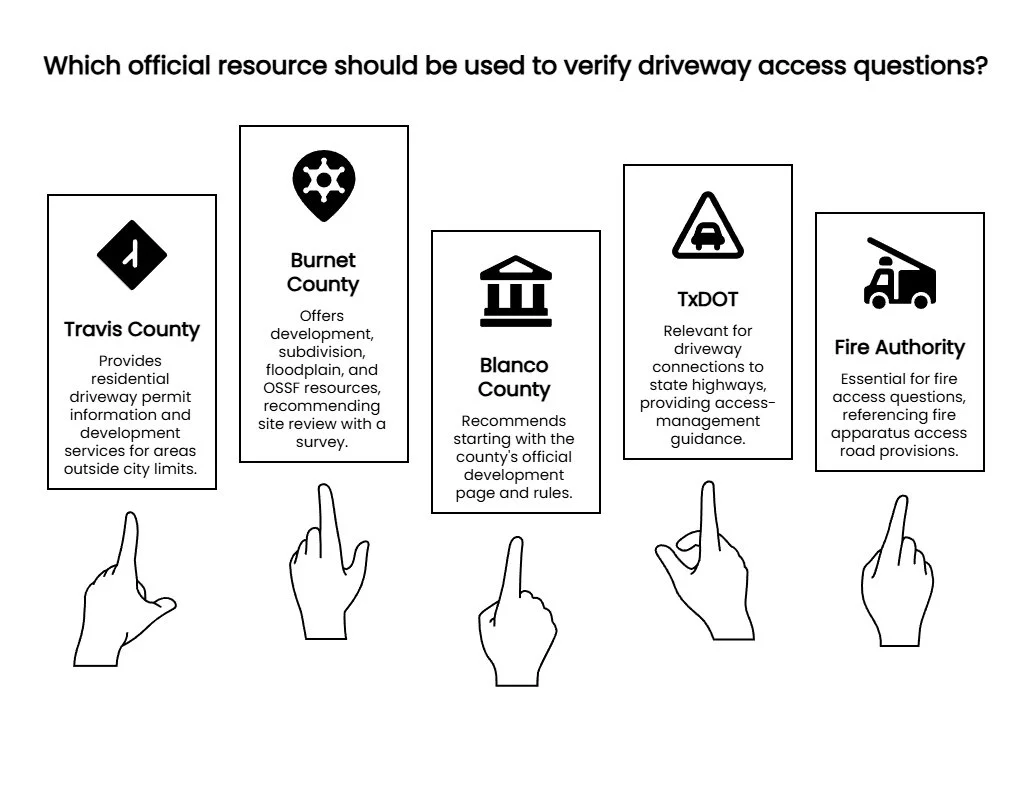
Because driveway requirements can vary by property and authority, use official sources for local or technical answers. For example, Travis County provides a residential driveway permit page for driveway access to a maintained county right-of-way, and Travis County Development Services describes its role in permitting and development outside corporate city limits and in certain ETJ contexts.
Burnet County’s official development pages include development, subdivision, floodplain, and OSSF-related resources, and its subdivision development guidance recommends contacting Development Services and bringing the latest survey for site review.
For Blanco County context, start with the county’s official Development page and current development rules rather than third-party permit summaries.
If the driveway may connect to a state highway, TxDOT’s access-management guidance is the relevant official starting point for driveway permits and highway right-of-way access.
Fire access questions should be confirmed with the authority having jurisdiction. The International Code Council publishes fire apparatus access road provisions, but applicability depends on the adopted code and local authority.
FAQs About Driveway Access Before Designing on Spicewood Acreage
Should driveway access be reviewed before buying acreage in Spicewood?
Yes, as an early planning consideration. Driveway access may affect home placement, garage orientation, privacy, guest arrival, outdoor living, and construction logistics. The review should identify questions, not replace property-specific professional input.
Can driveway access affect where the house sits?
It can. The route from the road to the home site may influence the practical layout of the home, garage, outdoor living areas, and utility planning. A scenic homesite still needs a workable relationship to the rest of the property.
Does a survey show whether a driveway will work?
A survey may show important information such as boundaries, easements, and visible site features. It does not replace a site-specific feasibility review, engineering review, legal review, utility review, or authority review when those are needed.
Who should review driveway access before design begins?
A builder can help identify planning questions. Depending on the property, a specialized site consultant, permitting office, or real estate attorney may need to evaluate specific constraints.
Are driveway requirements the same for every Spicewood property?
Do not assume they are the same. Requirements may vary by property, jurisdiction, subdivision, HOA, road type, easements, utilities, and authority review. Confirm the requirements for the actual property before relying on them.
Conclusion: Treat the Driveway as Part of the Home Plan
A thoughtfully planned driveway sets the tone for the entire property. By treating the route from the road to the home as a core design element rather than an afterthought, you ensure the land and the architecture work in harmony before the first foundation is poured.
Before committing emotionally or financially to a specific layout, walk the property with access in mind. Ask before the floor plan feels final.
To discuss how driveway access, site feasibility, and early planning questions may affect a Spicewood acreage build, talk with Riverbend Homes before design begins.
Disclaimer: This article is for general informational purposes only and does not constitute compliance, safety, technical, legal, engineering, surveying, or professional advice. Requirements, risks, and best practices may vary by property, jurisdiction, HOA, utility provider, authority, and project context. Confirm important decisions with the appropriate qualified professional, authority, or service provider.
Our Editorial Process
Riverbend Homes content is created to help Texas Hill Country homeowners make clearer, calmer custom-home decisions. The editorial process begins with Riverbend's documented building process, local experience, client-facing materials, and verified internal resources. Drafts are reviewed for practical accuracy, plain-language usefulness, local relevance, and alignment with Riverbend Homes' site-first approach before publication.
About the Riverbend Homes Insights Team
The Riverbend Homes Insights Team is our dedicated engine for synthesizing complex topics into clear, helpful guides. While our content is thoroughly reviewed for clarity and accuracy, it is for informational purposes and should not replace professional advice.
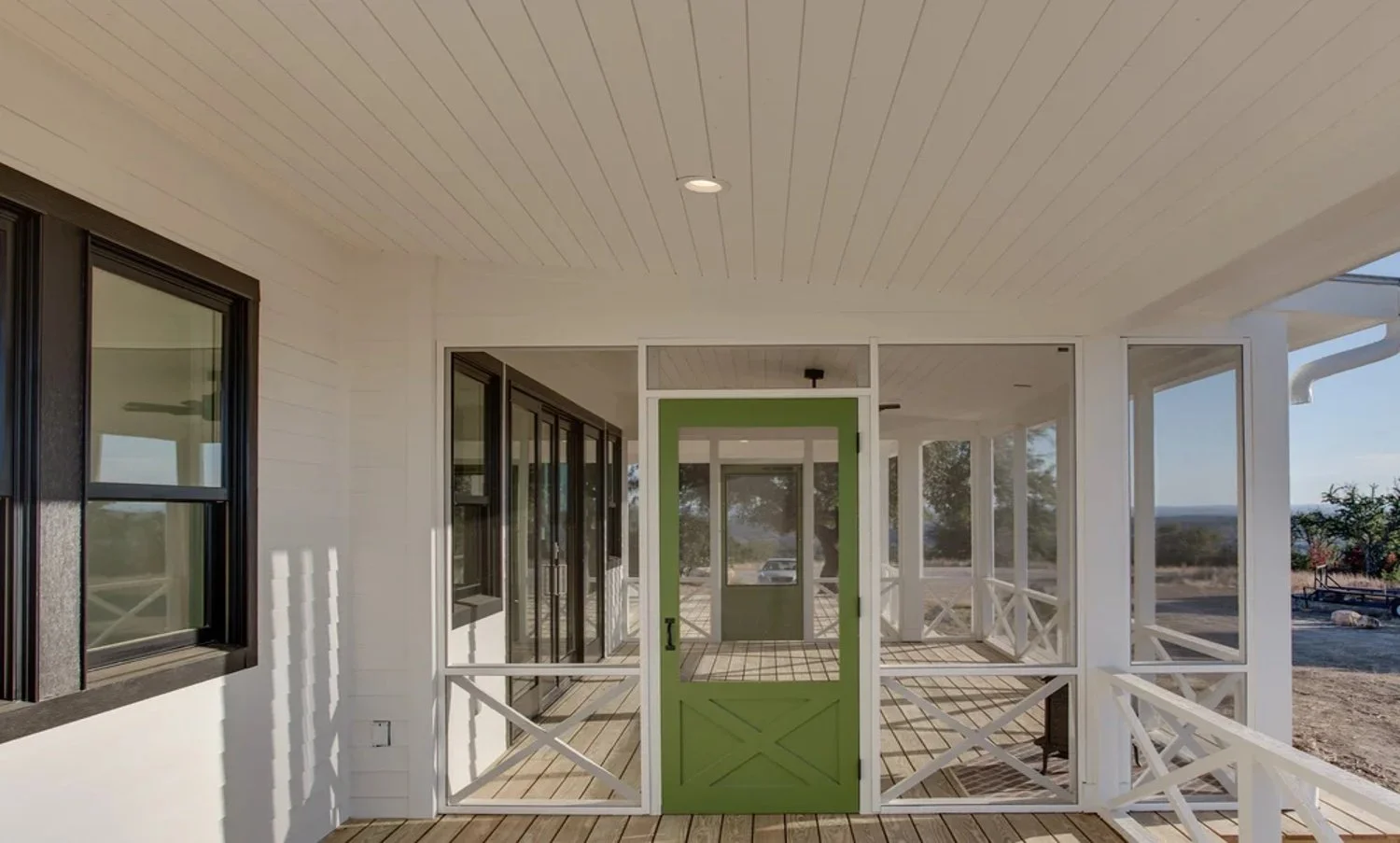
Lot Shape Questions That Can Affect Custom Home Design Options in Spicewood
📌 Key Takeaways
Lot shape matters because a custom home must fit the usable land, not just the property lines.
Study Usable Space: Acreage alone misleads because access, slope, utilities, setbacks, and outdoor plans can shrink design options.
Plan Arrival Early: Frontage shapes the driveway, garage, guest parking, and first impression before the floor plan feels final.
Check Outdoor Fit: Pools, patios, views, and privacy need to work together, not squeeze into leftover space.
Respect Site Limits: Slope, drainage, utilities, easements, and county rules can change where the home belongs.
Bring Help Soon: Early builder input helps buyers spot design and budget questions before they commit.
The best lot is the one your full plan can use.
Spicewood lot buyers will ask sharper site questions, preparing them for the lot-shape guide that follows.
~ ~ ~ ~ ~ ~ ~ ~ ~ ~ ~ ~ ~ ~ ~ ~ ~ ~
A Spicewood lot might feel perfect before anyone studies how a home will actually sit on it. The view may be strong. The acreage may feel generous. The cul-de-sac position may offer the privacy the buyer wants. Then the practical questions begin: where would the driveway enter, how would the garage align, where would the pool go, and how much usable design area remains once access, outdoor living, utilities, slope, and restrictions are considered?
Lot shape can affect custom home design options because a home must fit within the workable part of the property, not just inside the boundary lines. This article cannot confirm whether a specific homesite can support a specific home. It can help buyers ask better questions before design assumptions become fixed.
Lot Shape Is About Usable Design Space, Not Just Acreage
Acreage matters, but it does not tell the whole story. Two lots can have similar acreage and very different design flexibility.
One lot may have a broad, balanced shape with several possible home orientations. Another may be long, narrow, angled, steep, or difficult to access from the road. Both may be attractive. The difference is that one may offer more practical options for placing the home, driveway, garage, pool, patios, and service areas together.
Usable design area is the portion of the lot that can realistically support the home and the way the owner wants to live around it. It is shaped by the home’s footprint, outdoor living goals, driveway circulation, garage placement, views, privacy, utility routing, easements, setbacks, slope, drainage, and construction access.
A simple early comparison can help.
| Lot condition | Design question worth asking |
|---|---|
| Narrow frontage | How would the driveway, garage, and entry sequence work? |
| Deep lot | Would the preferred home location create access or utility challenges? |
| Wide lot | Which orientation best balances views, privacy, and outdoor living? |
| Cul-de-sac or wedge-shaped lot | Does the front approach work with the wider or angled rear area? |
| Irregular acreage | Which areas are truly usable for the home, pool, patios, and access? |
| Sloped or varied terrain | How does the shape interact with grading, drainage, and construction logistics? |
A lot-shape review should identify questions, not replace professional due diligence.
How Frontage, Width, and Depth Can Influence Home Placement
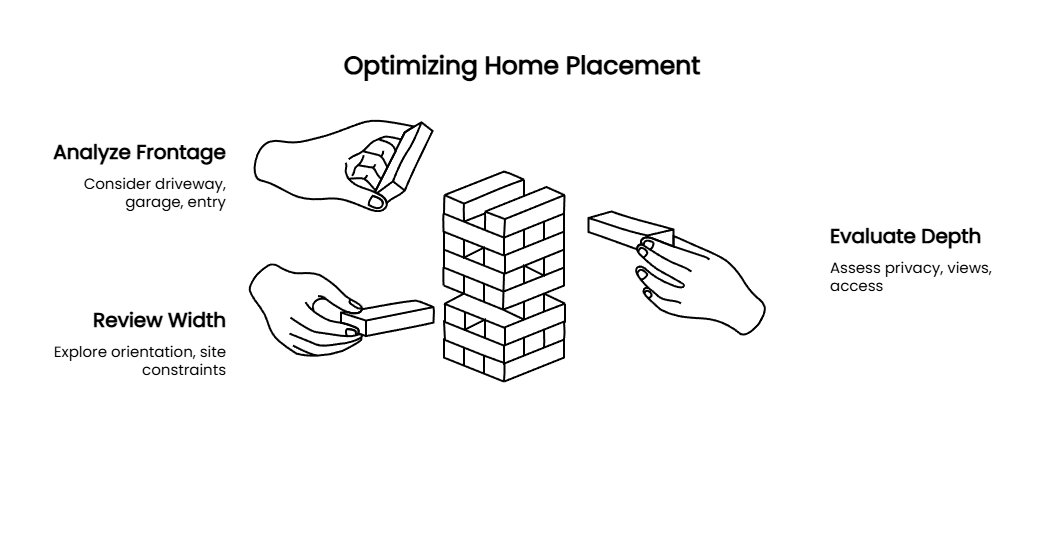
Frontage is the part of the lot that meets the access side, often the road or entry point. It may affect how the driveway enters, where the garage can sit, and how the home presents itself on approach.
A lot with narrow frontage is not automatically a poor fit for a custom home. It simply raises different questions. The design team may need to study turning movements, guest parking, garage placement, and whether the entry sequence feels intentional rather than forced.
Depth creates another set of tradeoffs. A deep lot may create privacy or allow the home to sit farther from the road. That can be attractive, especially when the best views or outdoor living opportunities are deeper into the property. Still, a deeper home location may affect driveway length, utility routing, grading, and construction access.
Wide lots may appear more flexible because they can offer more frontage and orientation options. Even then, width does not remove the need for a site-specific review. Easements, restrictions, terrain, drainage, or infrastructure needs can still influence where the home belongs.
A useful question is not only “Can the house fit?” It is “Can the house, arrival experience, garage, outdoor living, utilities, and construction access work together without compromising the main reasons this lot is appealing?”
Why Cul-de-Sac and Wedge-Shaped Lots Need Careful Questions
Cul-de-sac lots often appeal to buyers because they can feel tucked away, private, or quieter than through-street lots. Their geometry can also be less straightforward.
Many wedge-shaped lots have narrower frontage and more width toward the rear, though every property is different. That shape can create useful opportunities for rear-yard living, privacy, or view orientation. It can also make the driveway, garage, and guest parking harder to resolve if the front approach is tight.
For a Spicewood buyer, the right question is not whether a cul-de-sac lot is better or harder. The right question is how that particular lot’s shape affects the design program.
For example, a wedge-shaped lot may appear to offer a generous rear area for a pool and covered patio. But if the driveway, garage, and home entry must all work through a narrow front, the design team needs to study circulation before assuming the rear yard solves everything.
Ask how the home, garage, guest parking, driveway, and outdoor living areas would align as one plan. If each piece only works separately, the site plan may become harder to resolve later.
Irregular Boundaries Can Affect Outdoor Living, Pools, and Views
Irregular lots can be exciting because they often invite a more site-specific custom home. Angled boundaries, varied depths, and unusual edges may create a home that feels tailored to the land rather than placed on a rectangle.
They can also make outdoor living more complicated.
A buyer may want a pool, cabana, outdoor kitchen, covered patios, guest parking, a strong view orientation, and privacy from neighboring properties. Each feature needs space. More importantly, those features need to relate to one another.
A pool that technically fits may still feel disconnected if it lands too far from the main living area. A patio may capture the view but conflict with the best garage approach. A home may face the right direction but leave an awkward side yard where the outdoor kitchen was expected to go.
For example, a lot might have room for the house, but the most attractive view angle pulls the main living area toward one side. The pool then wants to sit along the same line of sight, while the driveway works better from another angle. None of those needs is wrong. The issue is whether the lot shape lets them work together without crowding the home or weakening the daily experience.
This is why outdoor living should be studied as part of the early site concept, not as a leftover area after the floor plan is chosen. Riverbend’s related article on a site-first custom home plan offers additional context for thinking about views, access, and outdoor living together.
Shape Works Together With Slope, Drainage, Utilities, and Site Access
Lot shape does not operate by itself. The same shape can behave differently depending on slope, drainage, utility access, septic or well needs, easements, restrictions, and construction logistics.
This matters in Spicewood because buyers may be comparing lots with Hill Country terrain, privacy, acreage, or lake-adjacent appeal. Those qualities can be part of the attraction, but they should be studied carefully before the home location feels settled.
Slope may affect the driveway approach, foundation concept, outdoor transitions, drainage planning, and construction staging. If the property has meaningful grade changes, the buyer should expect appropriate professional review.
Utilities can also influence usable design area. A preferred home location may look ideal until the route for power, water, septic, well, or other infrastructure is considered. Easements and restrictions can further affect where structures, drives, service lines, or outdoor improvements may be placed.
Spicewood properties can also involve different county contexts, including Travis, Burnet, and Blanco. That makes it important to verify the correct jurisdiction for the exact property rather than relying on broad local assumptions. Useful starting points may include Travis County Development Services, Burnet County Environmental Services, and Blanco County Development Services, depending on the homesite.
For septic-related questions, the Texas Commission on Environmental Quality’s on-site sewage facility resources can help identify the type of official information buyers may need to verify with the appropriate authority or professional. For broader professional education around site planning and development process concepts, the National Association of Home Builders site-planning education resource is a relevant high-authority reference.
Riverbend’s article on what your Spicewood lot can really support may also help buyers frame broader site-fit questions before design begins.
Lot Shape Questions to Ask Before You Make an Offer
Use this checklist as a conversation guide. It does not confirm buildability. Any item involving rules, restrictions, utilities, engineering, or site conditions should be verified with the appropriate professional, HOA, utility provider, or local authority.
Home placement
Where could the house reasonably sit on the lot? Does that location support the desired views, privacy, entry experience, and outdoor living plan?
Usable area
Which parts of the property are practical for the home, driveway, garage, pool, patios, and service access? Are any areas affected by slope, easements, setbacks, drainage, or restrictions?
Frontage and access
Where would the driveway enter and turn? Does the access point create a natural arrival sequence, or does it force the home and garage into a less desirable position?
Driveway and garage
Can the garage location work with the lot shape and the preferred home orientation? Is there room for guest parking without letting pavement dominate the front of the home?
Outdoor living and pool
Can the pool, covered patio, outdoor kitchen, cabana, or lawn area fit together as one outdoor living plan? Does the layout preserve the views and privacy that made the lot appealing?
Slope and drainage
How does the lot shape interact with grade changes and water movement? What should be reviewed by a surveyor, civil engineer, geotechnical professional, or other qualified expert?
Utilities, septic, and easements
How would utilities reach the home? Could septic, well, service lines, easements, or restrictions reduce the usable design area?
Construction access
Can crews, equipment, and materials reach the likely building area? Could narrow frontage, steep drives, angled boundaries, or limited staging area affect construction planning?
Builder feasibility review
What can a builder identify during an early site walk, and what still requires property documents, official review, engineering input, utility confirmation, or HOA review?
For buyers who already have survey documents, Riverbend’s article on lot checks before your dream home is drawn may be a helpful companion resource.
When to Bring a Builder Into the Conversation
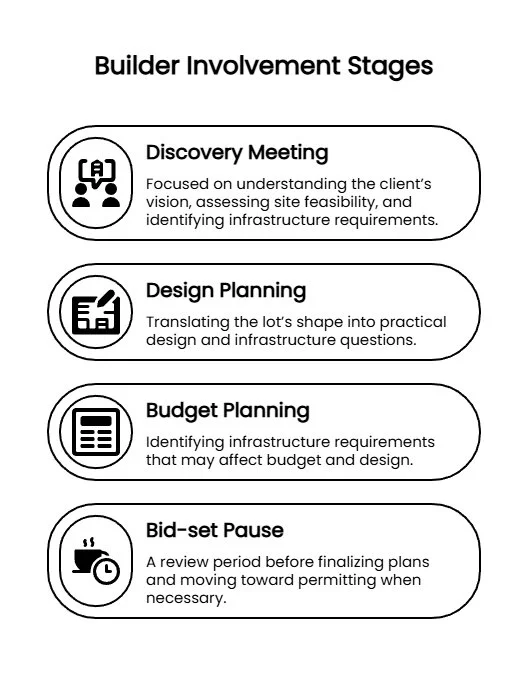
A builder should be involved before a buyer assumes a floor plan will fit the property. Early input cannot replace a surveyor, engineer, architect, utility provider, HOA, county office, or attorney where those reviews are needed. It can, however, help translate the lot’s shape into practical design and infrastructure questions.
Riverbend’s process begins with a property-based Discovery Meeting focused on understanding the client’s vision, assessing site feasibility, and identifying infrastructure requirements that may affect budget and design. Riverbend also stays involved during design and budget planning, including a bid-set pause before finalizing plans and moving toward permitting when necessary.
That sequence matters because lot shape can influence design before the floor plan feels final. A buyer may discover that the most appealing part of the land also creates access questions. Or the best view orientation may compete with garage placement. Or the outdoor living plan may need to be studied before the home footprint is fixed.
Early builder input doesn't provide a premature answer; it provides a clearer path for deciding what to verify next.
Compare the Shape Before You Commit to the Dream
A distinctive lot can support a distinctive custom home, but its shape deserves careful attention before the design path is set. Frontage, depth, usable area, boundaries, slope, access, utilities, and outdoor living goals can influence whether the homesite supports the experience the buyer has in mind.
The practical next step is not to overanalyze every possibility alone. It is to ask better questions early, then verify the property-specific details with the right professionals and official sources.
Have a Spicewood lot in mind? Bring your questions to a property Discovery Meeting with Riverbend Homes, or contact Riverbend Homes to discuss early questions about a Spicewood homesite with custom home builders in Spicewood.
FAQs
Can lot shape affect where a custom home can be placed?
Yes. Lot shape can affect home placement because the house, driveway, garage, outdoor living areas, utilities, and construction access all need workable space. A specific lot still needs a site-specific review before design assumptions are treated as reliable.
Is an irregular lot a bad choice for a custom home?
Not necessarily. Irregular lots can sometimes support creative, site-responsive design. Buyers should ask how the shape affects usable area, access, outdoor living, easements, restrictions, utilities, and construction logistics.
Are cul-de-sac lots harder to build on?
They can raise different questions, especially around frontage, driveway approach, garage placement, and wedge-shaped boundaries. They are not categorically harder or easier. The answer depends on the specific homesite.
What should buyers ask before buying a Spicewood lot for a custom home?
Ask about home placement, driveway access, build envelope, usable area, slope, utilities, septic, easements, restrictions, outdoor living fit, and whether a builder should review the property before design begins.
When should a builder be involved in lot evaluation?
A builder should be involved before a buyer assumes a floor plan will fit or before design work goes too far. Early builder input can help identify site feasibility and infrastructure questions that may affect budget and design.
Disclaimer:This article is for general informational purposes only. It is not a substitute for advice from a qualified professional, provider, or official source relevant to your situation. Always verify important decisions with the appropriate expert, authority, or service provider.
Our Editorial Process
Our expert team uses AI tools to help organize and structure our initial drafts. Every piece is then extensively rewritten, fact-checked, and enriched with first-hand insights and experiences by expert humans on our Insights Team to ensure accuracy and clarity.
About the Riverbend Homes Insights Team
The Riverbend Homes Insights Team shares practical guidance for families planning custom homes in Spicewood, Lake Travis, Lake LBJ, Horseshoe Bay, and the Texas Hill Country. Our content draws on Riverbend Homes' property-first design-build process, local building experience, and commitment to helping homeowners make confident decisions before plans move too far ahead of the land.
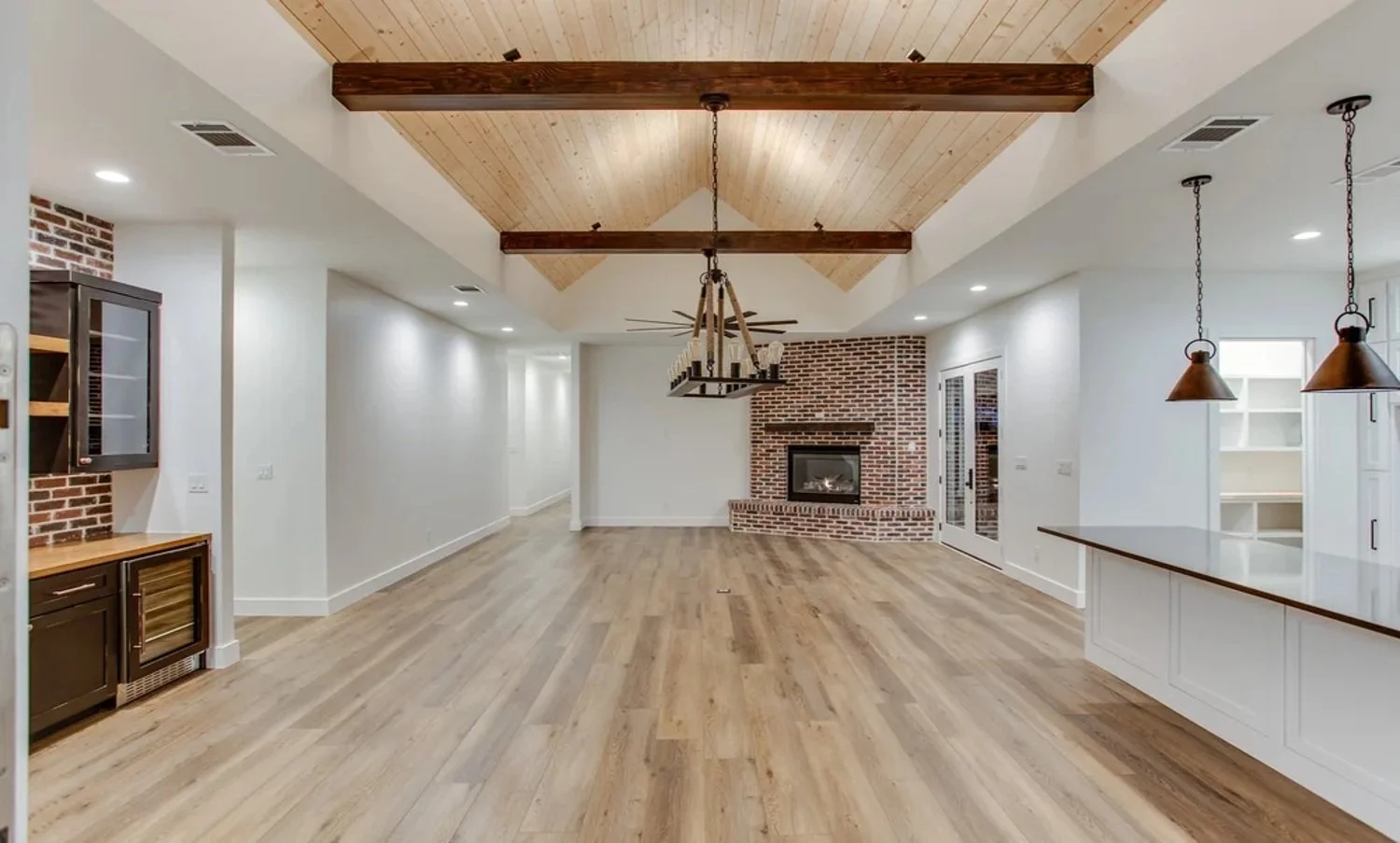
What Spicewood Land Buyers Should Ask a Custom Home Builder Before Making an Offer
📌 Key Takeaways
A better Spicewood offer starts by checking whether the lot truly fits the home, access, utilities, and outdoor living.
Start With Vision: Bring your home goals first, because the lot only matters if it supports the life you want.
Test Likely Placement: Ask where the home could sit before you trust views, acreage, or online listing details.
Check Site Limits: Slope, shape, rock, and access can change foundations, driveways, drainage, pools, and construction plans.
Confirm Utilities Early: Water, septic, electric, internet, and propane can affect both budget and usable space.
Know Who Verifies: Builders can flag concerns, but professionals and authorities must confirm legal, utility, and permit questions.
Beautiful land still needs hard questions.
Spicewood land buyers will make clearer offers, using the builder questions and verification checklist that follows.
~ ~ ~ ~ ~ ~ ~ ~ ~ ~ ~ ~ ~ ~ ~ ~ ~ ~
A Spicewood lot can look ideal online or during a showing. The view works. The acreage feels right. The setting seems to match the custom home you have been picturing.
Before making an offer, the more useful question is not simply, “Can this lot be built on?” It is, “What should be checked before relying on this lot for the home, driveway, utilities, outdoor living, and access I want?”
A custom home builder cannot responsibly guarantee full buildability from one early conversation. Surveys, engineering, utility confirmation, septic review, HOA documents, title work, and permitting may still be needed. A builder can, however, help identify early concerns, better questions, and assumptions that should be verified before the offer process moves too far.
Before making an offer, ask about likely home placement, slope, access, utilities, outdoor living fit, and what must be confirmed by the right professional or authority.
Start With the Home You Want, Not Just the Lot You Like
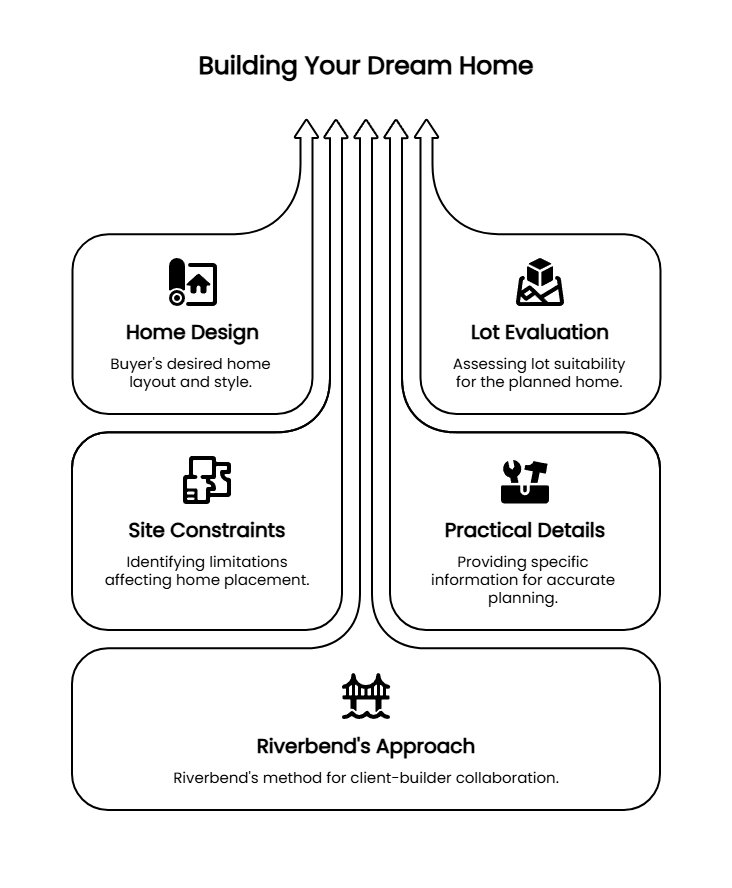
A pre-offer builder conversation should begin with the custom home vision, not only the land. Ask the builder: “Based on the home, driveway, outdoor living, and access I want, what should we look at on this lot?”
This matters because a homesite is not evaluated in the abstract. A lot that appears generous may become more complicated once the build envelope, driveway approach, septic area, drainage, easements, setbacks, and outdoor living priorities are considered together.
A build envelope is the area where a home may be able to sit after site constraints are accounted for. Site feasibility means the early review of whether the land appears to fit the intended home, access, infrastructure, and design goals. Neither term should be treated as a final approval before professional review.
Bring practical details to the conversation: inspiration photos, rough sketches, must-have rooms, preferred views, garage needs, outdoor living priorities, and any known documents from the listing. For example, a buyer who wants a single-level home, pool, guest suite, and sunset-facing patio should ask how the lot’s shape, slope, driveway access, and likely utility path may affect that vision.
Riverbend describes its Discovery Meeting as a property-based conversation focused on understanding the client’s vision, assessing site feasibility, and discussing infrastructure requirements that may affect budget and design.
Ask Where the Home Could Realistically Sit
The most beautiful part of a lot is not always the most practical place to build. Ask the builder: “Where could the home likely sit, and what would need to be verified before we rely on that assumption?”
A useful answer should discuss likely orientation, usable area, driveway approach, outdoor living space, and the documents needed for a clearer review. Those documents may include a survey, plat, restrictions, HOA documents, known easements, utility information, and listing materials. In many Spicewood communities, an Architectural Review Committee (ARC) dictates strict exterior requirements—such as mandatory masonry percentages, specific roof pitches, or approved color palettes—that can significantly impact your design and budget.
A survey can be a strong starting point, but it is not the same as a complete buildability answer. A survey may show boundaries and certain recorded conditions, while other questions may still require review by a surveyor, engineer, HOA, utility provider, septic professional, title professional, or relevant county authority.
Lot shape also matters. An irregular homesite may affect where the driveway can enter, how the home can face a view, and whether there is practical room for a pool, guest area, detached garage, or outdoor kitchen. That does not mean the lot is unsuitable. It means the placement conversation should happen before the floor plan feels locked.
Riverbend’s guide on what your Spicewood lot can really support expands on site-first planning before design.
Ask How Slope, Shape, and Access Could Affect Design Options
Slope is one of the easiest site traits to underestimate. A sloped lot may affect foundation approach, drainage planning, driveway design, outdoor living areas, and construction logistics. The impact depends on the specific property and should not be reduced to a generic rule. In the Hill Country, this often includes evaluating the depth and hardness of limestone rock, which heavily influences excavation costs for foundations, pools, and utility trenching.
Ask the builder: “What should we know about the slope before assuming this home plan will work here?” A careful answer may identify areas that appear more workable, areas that may need engineering input, or parts of the plan that could require adjustment.
Lot shape should be part of the same discussion. A narrow, angled, or unusually shaped homesite may still be usable, but it can change how the home, pool, driveway, septic area, and outdoor spaces relate to each other. Acreage alone does not tell the full story.
Access is also more than the finished driveway experience. It can affect construction staging, material delivery, equipment movement, and where the home can reasonably sit. Ask whether the likely driveway approach appears to support the design vision, and ask what driveway or access items must be confirmed separately.
For property-specific requirements, buyers should verify with the applicable authority rather than relying on general assumptions. Official sources such as Travis County’s single-family development permit resources, Burnet County Development Services, Blanco County’s Development department, and TCEQ’s on-site sewage facility information may be useful starting points, depending on the property’s jurisdiction and infrastructure needs.
A site-first custom home plan can help connect view, access, outdoor living, septic, and utilities before the design becomes too fixed.
Ask Utility and Infrastructure Questions Before You Assume the Budget
Utility availability should not be assumed from nearby homes, visible lines, or listing language alone. Ask the builder: “What utility and infrastructure information should be confirmed before we assume this lot fits the budget and design?”
The answer may involve electric service, water source, septic suitability, internet, propane, or other infrastructure. In rural Spicewood, this often means confirming whether the lot ties into a municipal water system or requires drilling a private well—and whether that well will yield enough water for your household. The builder can help identify which questions matter, but availability and requirements should be confirmed through the correct provider, authority, seller documentation, or qualified professional.
Septic and water questions are especially important because they can affect usable space. A septic area, water source, easement, utility route, or drainage concern may compete with the same part of the lot where the buyer hopes to place a pool, patio, guest suite, or driveway. Given the shallow, rocky soil common in the Hill Country, many lots require aerobic septic systems with dedicated spray fields, which demand a larger footprint than traditional gravity systems.
This is where early builder input has practical value. The builder can help the buyer understand which infrastructure unknowns may affect design direction or budget assumptions. That is different from saying the builder can confirm every utility, septic, or permitting answer before formal review.
Riverbend’s article on site feasibility before design discusses why land conditions should be considered before plans feel final.
Ask What Must Be Verified by Someone Other Than the Builder
A responsible builder conversation should include clear limits. Ask: “What can you flag from a site walk, and what would you want verified before offer deadlines or contingencies?”
Builder input is valuable because it connects site traits to design and construction questions. It is not a substitute for legal, financial, engineering, surveying, septic, utility, HOA, title, or permitting review.
Spicewood may involve different county contexts, so the safest approach is to confirm the specific property’s jurisdiction before relying on any procedural assumption. The question is not, “What applies to every Spicewood lot?” The better question is, “Who needs to confirm this for this property?”
| A builder may help flag | What may still need verification |
|---|---|
| Likely home placement concerns | Survey, plat, setbacks, easements, restrictions |
| Slope, drainage, and access questions | Topographic survey, engineering, driveway/access requirements |
| Utility and infrastructure questions | Utility providers, water authority, septic authority, seller documentation |
| Outdoor living and pool fit concerns | Setbacks, septic area, drainage, easements, HOA rules |
| Construction access concerns | Site-specific access rules, fire/access requirements, professional review |
A useful builder answer may sound cautious: “This looks worth exploring, but verify the easement,” or “The driveway approach should be reviewed early,” or “Do not assume utilities are available until the provider confirms them.” That kind of answer is helpful because it separates possibility from confirmation.
Use This Pre-Offer Builder Question Checklist
Use this checklist before your next builder, agent, or due-diligence conversation. It is a preparation tool, not a DIY approval tool.
| Ask the Builder | Why It Matters | What May Need Verification |
|---|---|---|
| Where could the home likely sit? | Tests whether the lot appears to fit the desired placement, orientation, and usable area. | Survey, setbacks, easements, HOA documents, restrictions. |
| What site features could affect driveway access? | Access may affect design, construction planning, and daily use. | Driveway rules, fire/access requirements, culverts, relevant authority review. |
| What should be reviewed about slope? | Slope may affect foundation approach, drainage, driveway design, and outdoor living. | Survey, topography, engineering, geotechnical or professional review. |
| What utilities should be confirmed? | Utilities and infrastructure may affect budget assumptions and design decisions. | Utility providers, water/septic authorities, seller documentation, property-specific confirmation. |
| Can the lot support outdoor living priorities? | Pools, patios, view orientation, guest space, and outdoor kitchens need usable space. | Setbacks, septic area, drainage, easements, HOA rules, engineering. |
| What should be verified before offer deadlines? | Helps prioritize the checks that matter before contingencies or deadlines arrive. | Relevant professionals, authorities, providers, HOA, surveyor, engineer, or septic professional. |
Riverbend’s article on lot checks before your dream home is drawn can also help organize these early site questions.
When to Bring a Builder Into the Conversation
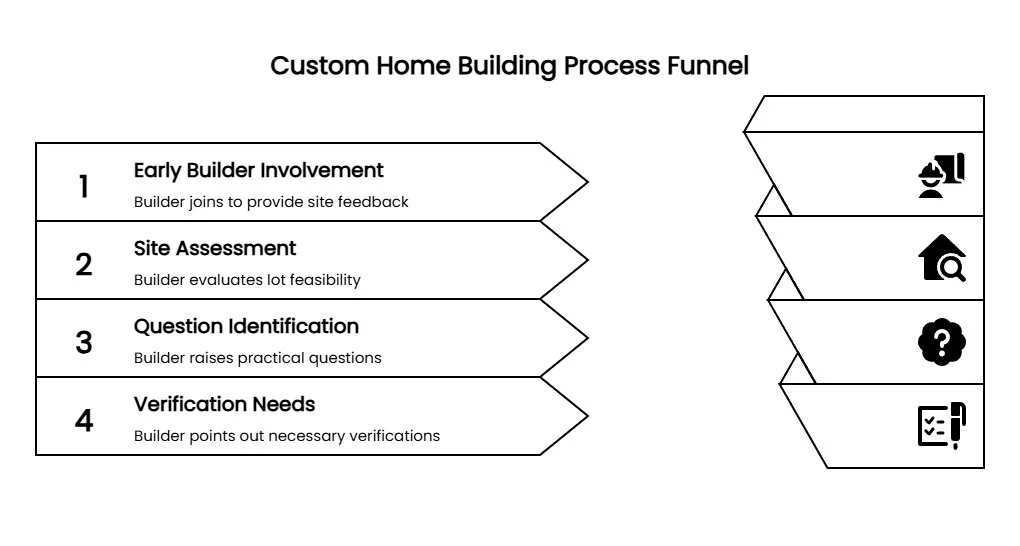
Bring a builder into the conversation early enough to shape the questions, not after the design is emotionally fixed. Once a buyer has already committed mentally to a specific floor plan, pool location, driveway route, or view angle, site feedback can feel like a problem instead of useful information.
A pre-offer conversation is most helpful when the buyer has a vision but still has room to adapt. The builder can walk the site with that vision in mind, identify practical questions, and point out what should be verified before the buyer relies on the lot.
Riverbend describes its work as building luxury custom homes in the Spicewood and Lake Travis areas. Buyers looking for custom home builders in Spicewood can use a property-focused conversation to connect early design goals with site-fit questions. Learn how Riverbend’s Discovery Meeting helps connect vision to site feasibility and infrastructure questions.
FAQs About Asking a Builder Before Buying Land in Spicewood
Should land buyers talk to a builder before making an offer?
It can be useful when there is already a custom home vision. A builder may help identify site-fit questions before the buyer commits, while formal verification may still be needed.
Can a builder tell whether a lot is buildable before purchase?
A builder can often flag concerns and questions, but should not guarantee buildability without proper due diligence, surveys, engineering, utility confirmation, septic review, and approvals.
What documents should be brought to a pre-offer builder conversation?
Helpful documents may include the listing, survey or plat if available, restrictions, HOA documents, utility information, photos, and a rough list of what the buyer wants to build.
What utility questions should be asked before buying land?
Ask what utilities appear to be available, what needs confirmation, and whether septic, water, electric, internet, propane, or other infrastructure may affect budget and design. Property-specific availability should be confirmed with the appropriate provider or authority.
How does slope affect a custom home lot?
Slope may influence home placement, foundation approach, driveway design, drainage, outdoor living, and construction access. Avoid relying on exact slope thresholds unless the property has been professionally reviewed.
A Better Offer Starts With Better Questions
The goal is not to get every answer before making an offer. The goal is to know what to ask, what may affect the home you want, and what should be verified before relying on an assumption.
A good builder conversation can help turn a beautiful lot into a clearer decision framework. It can also show where the buyer needs a surveyor, engineer, utility provider, HOA representative, county authority, septic professional, or other qualified professional before moving forward.
Have questions about a Spicewood lot before making an offer? Contact Riverbend Homes to start a property-focused conversation.
Disclaimer: This article is for general informational purposes only. It is not a substitute for advice from a qualified professional, provider, or official source relevant to your situation. Always verify important decisions with the appropriate expert, authority, or service provider.
Our Editorial Process
Riverbend Homes content is created to help Texas Hill Country homeowners make clearer, calmer custom-home decisions. The editorial process begins with Riverbend's documented building process, local experience, client-facing materials, and verified internal resources. Drafts are reviewed for practical accuracy, plain-language usefulness, local relevance, and alignment with Riverbend Homes' site-first approach before publication.
By Riverbend Homes Editorial Team
Riverbend Homes is a second-generation family-owned custom home builder serving Spicewood, Lake Travis, Horseshoe Bay, Lake LBJ, and the Texas Hill Country. Since 1996, Riverbend Homes has focused on listening closely, building selectively, staying involved on site, and helping families turn custom-home visions into well-planned homes.
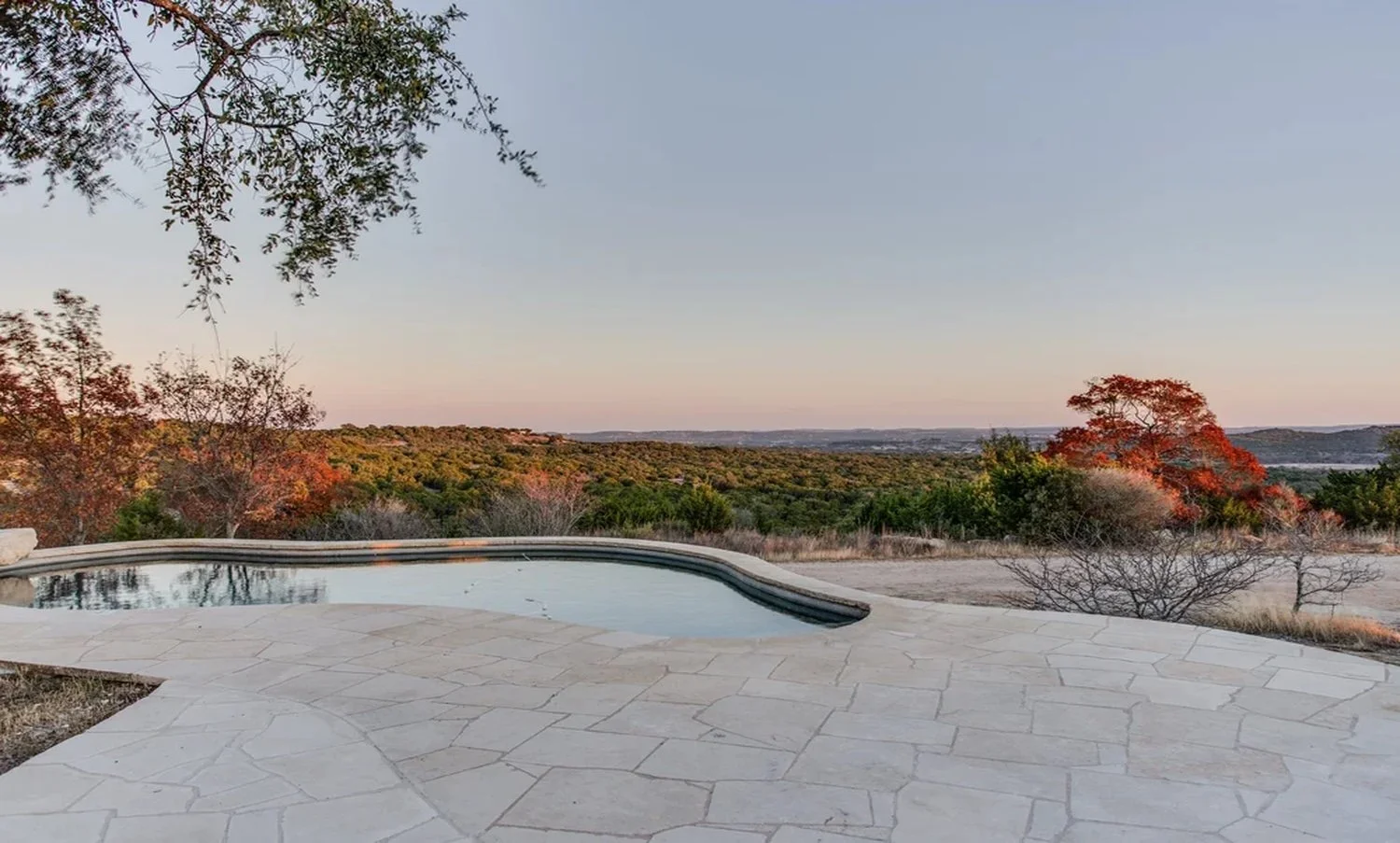
Keep the Dream on Budget: Why Design Needs Cost Feedback Before Plans Are Final
📌 Key Takeaways
Cost feedback protects a custom home dream before design choices become expensive surprises.
Price Before Final Plans: Early cost checks help families adjust the design before they feel locked in.
Use The Bid-Set Pause: A bid-set pause gives enough detail to estimate costs while changes still feel manageable.
Watch Quiet Cost Drift: Windows, rooflines, driveways, pools, and site work can raise costs faster than expected.
Start With The Land: A site walk helps uncover slope, utilities, drainage, access, and other budget-sensitive details.
Track Allowances Closely: Clear allowance tracking keeps finish choices tied to the full project budget.
Budget feedback does not shrink the dream; it makes the dream safer to build.
Custom home buyers in the Texas Hill Country will gain clearer budget confidence, preparing them for the detailed overview that follows.
~ ~ ~ ~ ~ ~ ~ ~ ~ ~ ~ ~ ~ ~ ~ ~ ~ ~
Custom home design needs cost feedback before final plans because design choices can quietly shift the total construction cost before anyone notices. When a builder stays involved during design and pauses at bid-set completeness, the homeowner can review estimated construction costs, adjust the plan if needed, approve the budget, and move into final design with genuine confidence — not guesswork.
The Dream Feels Real Before the Budget Does
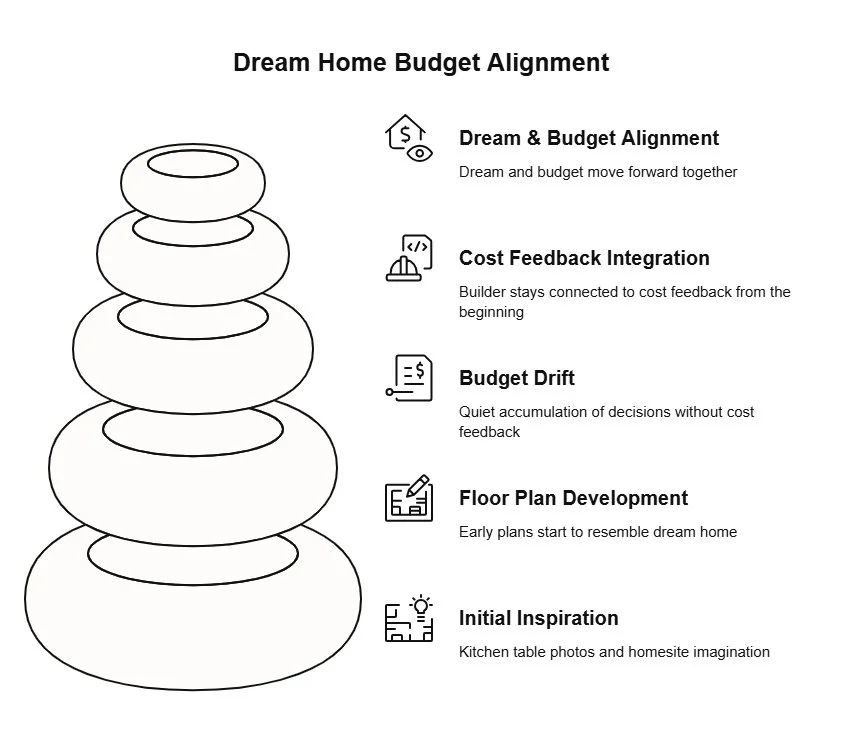
It may start around the kitchen table, with inspiration photos spread out between family members. It may happen while standing on a Spicewood homesite, imagining where the kitchen view should face, where the pool might sit, or how the driveway should approach the home. It may happen when an early floor plan finally starts to look like the place where holidays, quiet mornings, and family visits could unfold.
That stage should feel exciting. The home is still flexible.
It is also the stage where the budget can begin to drift.
The problem is not one bad decision. It is the quiet accumulation of beautiful decisions without whole-project cost feedback. A larger window package, a more complex roofline, a longer driveway, a pool cabana, upgraded finishes, and added outdoor living space may each feel reasonable on their own. Together, they can move the project further than the household expected.
That is why cost feedback belongs inside the design process, not after final plans are complete.
The families who build their dream homes in Spicewood, Lake Travis, and the Texas Hill Country without late-stage budget surprises are rarely the ones who spent less. They are the ones whose builder stayed connected to cost feedback from the beginning, so the dream and the budget moved forward together. The Riverbend process integrates this vision into a disciplined financial framework.
What Design and Budget Alignment Means in a Custom Home Build
Design and budget alignment means keeping design decisions connected to cost feedback so the home vision stays feasible before permitting and construction. The builder stays involved during design, the budget is not treated as an afterthought, and the household receives cost estimates before final plans harden. The goal is not to shrink the dream — it is to protect it.
When shaping a dream home, a homeowner wants cost feedback before the design is finalized so they can protect the vision without losing control of the budget. A budget-aware design process helps answer questions such as:
Is the home being designed around the family's highest priorities?
Has the property been walked and reviewed before architectural overcommitment?
Are site feasibility and infrastructure requirements part of the budget conversation?
Is the design detailed enough to support a useful construction-cost estimate?
Are allowances being treated as active budget tools rather than placeholders?
Does the family have a chance to approve the budget before final design and permitting?
That is the core purpose of design and budget alignment: to protect the home vision from late-stage surprises.
Why Final Plans Are Too Late for the First Serious Cost Conversation
The standard advice is straightforward: finish the design, then price the build. On the surface, this sequence seems efficient. In practice, it transfers a significant amount of financial risk to the family — quietly, and at exactly the wrong moment.
By the time plans are final, the family may already feel attached to the home. The kitchen view has meaning. The guest suite has a purpose. The pool, porch, and outdoor spaces are part of the imagined lifestyle.
Design decisions accumulate throughout the process. Every choice that gets approved — ceiling heights, structural spans, the outdoor living configuration, the window-to-wall ratio, the driveway grade, the pool placement — adds weight to the total project cost. Each choice, in isolation, seems manageable. Collectively, the cost impact stays invisible until it is not.
Emotional commitment also deepens with every design iteration. By the time a family has reviewed three rounds of floor plans and started imagining their furniture in each room, they have invested far more than time. Asking them to scale back at that stage is not a budget conversation. It is a loss.
A roofline simplification may feel like the home is being watered down. Reducing glass may feel like giving up the view. Reworking outdoor living may feel like losing the heart of the plan. When early cost feedback is part of design, the family makes clear, calm tradeoffs before the design becomes rigid.
This is especially important for a custom home in the Texas Hill Country because the land itself often affects the design. A view lot, acreage parcel, sloped site, long driveway, outdoor living plan, or Lake Travis-area property may create practical questions that are not visible from a floor plan alone. Budget confidence is created during design, not after plans are finalized.
The Design-Budget Checkpoint Map
The most useful custom home budgeting conversation is not a single meeting at the end. It is a sequence of checkpoints that keep the dream and the budget moving together.
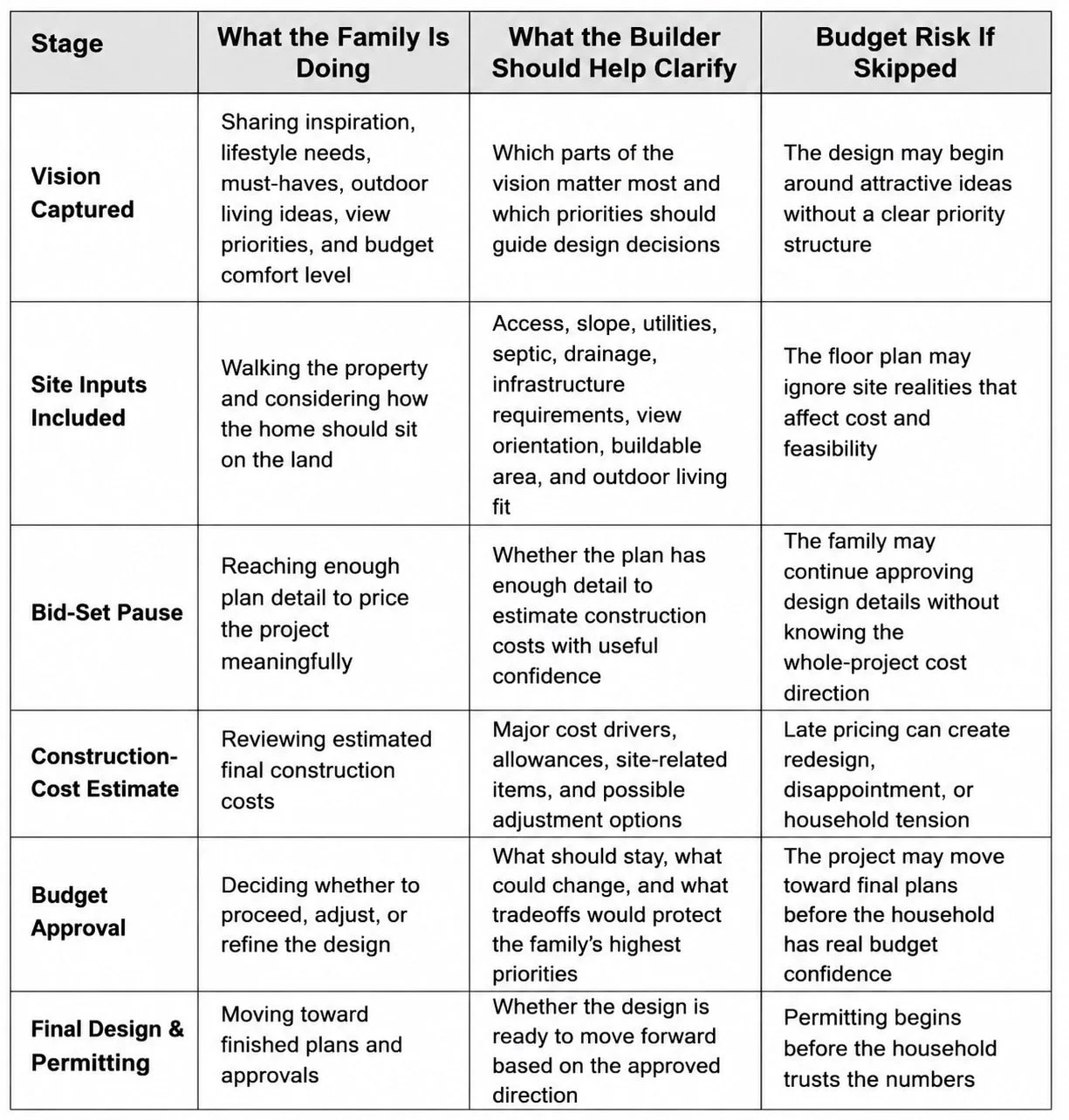
A bid-set is the level of plan completeness at which the builder can pause and estimate final construction costs meaningfully — not a rough ballpark based on square footage, but a grounded estimate based on the actual design, the actual site, and the actual selections being considered. It is not simply a rough sketch, and it is not necessarily the final construction document set. It is the pause point where the design is clear enough to price, while still flexible enough to adjust.
That pause is not a delay. It is a decision-protection point. NAHB's 2024 Construction Cost Survey found that, in its national sample, construction costs represented 64.4% of the average sales price and finished lot costs 13.7%. That is a national survey, not a Spicewood project estimate — but it illustrates why cost feedback deserves attention early, not after plans are finalized.
Once budget approval is given, design continues into its final form and permitting begins. The family moves forward not on hope, but on confirmation.
Where Budget Drift Quietly Enters the Design
Budget drift is not a single line item. It is a pattern of small additions, each individually justified, that together produce an estimate the original budget did not anticipate. These are the categories where it most commonly appears in Texas Hill Country custom home projects.
Layout complexity. Open floor plans with long structural spans, vaulted ceilings, or multi-level configurations require more material and engineering than simpler layouts. A custom layout may also need separate wings, extra corners, or special transitions to support a family's lifestyle. The visual drama of a great room with soaring ceilings is real. So is its effect on the structural budget.
Foundation and site-related work. On Hill Country terrain, slope changes the math significantly. A lot with meaningful grade may require retaining walls, stepped foundations, or substantial grading and drainage work before a single wall goes up. None of that is visible from a floor plan — it is only visible from a site walk.
Driveway length, access, and grading. A long private driveway on a Spicewood or Lake Travis acreage lot is not a landscaping line item. It is a real construction cost with implications for grading, base material, drainage culverts, and construction-site access.
Windows, doors, and view-driven glass. On a Hill Country or Lake Travis view lot, glass placement matters. Expansive glass walls, specialty window systems, or large sliding door assemblies carry costs that are easy to underestimate when they appear as simple rectangles on a floor plan. Glass is also a thermal factor, which affects HVAC design and cost.
Rooflines and architectural complexity. A straightforward roofline is one of the most cost-efficient structural decisions in custom home design. Complex intersecting rooflines, dramatic pitch changes, or architectural features that create difficult framing geometry move the budget quickly — often without the family realizing it during design review.
Outdoor living, pools, patios, and cabanas. Texas Hill Country homes often include substantial outdoor living areas, and for good reason. But a covered outdoor kitchen, pool and spa, cabana, fire feature, and connecting patio can add real cost to a project whose interior budget was already fully allocated. Because these spaces affect site planning and construction scope, they should be part of the early budget conversation.
HOA, permitting, and timing dependencies. On many Spicewood and Lake Travis lots, HOA architectural review, permitting timelines, and construction loan draw schedules are cost and schedule drivers, not administrative formalities. HOA approval processes can add weeks to a project timeline. Permitting requirements vary by jurisdiction and can affect what is buildable.
Utility, septic, and infrastructure requirements. Every lot carries infrastructure requirements: water well or municipal connection, septic system placement and type, electrical service, propane or natural gas, drainage strategy. On rural acreage or constrained properties, these costs can be substantial and must be understood before design begins in earnest.
Finish allowances and selection decisions. Allowances are often misunderstood. An allowance is a budgeted amount for a category that may not be fully selected yet — tile, lighting, plumbing fixtures, appliances, flooring, or cabinetry. Allowances can be helpful because they let design and planning move forward before every selection is final. But they need discipline. If the allowance is too vague, or if updates are not communicated clearly, the family may discover overages late. The goal is not to pressure the family toward less. It is to make sure finish choices carry visible cumulative impact. For a deeper look, Navigating Allowances: 3 Ways to Maximize Your Integrated Home Design and Shopping Allowance Autonomy: How to Choose Luxury Finishes Without Losing Budget Control are both worth reading before selections begin.
None of these categories is a reason to scale back the vision. Each is a reason to make sure cost feedback is present while the vision is still being shaped — not after it has become emotionally fixed.
A Practical Example: When Every Idea Is a Good Idea
Consider a family planning a custom home on acreage near Spicewood. They want the main living area aimed toward a view, a pool near the covered patio, a separate primary wing, a guest space for visiting family, and a driveway that feels private from the road.
None of those ideas is careless. Each one supports the life the family wants.
But together, they touch many budget-sensitive parts of the project: home orientation, grading, foundation, driveway access, roofline, exterior openings, outdoor living, pool location, drainage, utilities, and finish allowances.
Without cost feedback during design, the family may keep saying yes to good ideas without seeing the combined effect.
With cost feedback during design, the conversation becomes more useful. The builder can help the household understand which choices protect the dream, which choices carry the most cost sensitivity, and where adjustments may preserve the most important parts of the vision.
That is the difference between restriction and relief.
How Riverbend Homes Keeps the Design Creative Without Letting the Budget Disappear
"Ben was able to stay on budget with only the exception of things we planned to upgrade from the initial contract. This was minimal for a home in this price range, which is not at all what other people we know have experienced. He frequently found ways to save us money on our selections." — Christine G., Riverbend Homes client
The Riverbend process is built around a straightforward conviction: budget confidence is created during design, not after. That belief shapes every stage of how a project moves forward.
The Discovery Meeting begins at the property. The Riverbend Homes building process starts with a meeting at the actual lot — not at a desk, not over floor plans. Riverbend listens first. The conversation covers the family's vision, lifestyle needs, and inspiration ideas alongside the specific realities of the site: slope, access, views, drainage, utilities, setbacks, and infrastructure requirements. That listening posture is the Riverbend Difference — understanding what the family wants before offering a single recommendation, because a custom home is the foundation for family memories, not merely a structure.
The goal of that first conversation is not to produce a design. It is to make sure the design that follows is grounded in what the property can actually support — and what that support will cost.
Builder involvement continues through design. Riverbend stays involved as design develops, not to restrict the creative process but to keep the vision feasible. When a design choice carries cost implications — a roofline detail, a window package, an outdoor living configuration — that information remains visible to the household while it can still shape the decision. For more on why this unified accountability matters, Beyond the Kitchen Table Sketches: How Custom Home Design-Build Stops Budget Overruns explores how the design-build approach prevents the cost surprises that separated contracts create.
The bid-set pause creates the cost checkpoint. Once plans reach bid-set completeness, Riverbend pauses design development and prepares an estimated final construction cost. The household reviews that estimate, understands where the project stands, and approves the budget before final plans are drawn and permitting begins. This is the concrete process moment where budget confidence is created — not assumed.
Riverbend takes on a select number of projects at a time. That selectivity is not a constraint — it is what makes daily on-site involvement possible. It means every project gets the attention it deserves, and builds move faster than they typically do with builders juggling too many sites simultaneously. Riverbend Homes is a second-generation family-owned builder that has designed and built homes in the Texas Hill Country since 1996, serving Spicewood alongside Lake Travis, Horseshoe Bay, Lake LBJ, and the wider Hill Country region.
Understanding the AIA's framework for design phases — schematic design, design development, and construction documents — can help homeowners understand where cost estimating typically occurs in traditional architect-led processes. The AIA's resource on defining basic services provides useful context. The key distinction in a design-build model is that cost feedback is integrated throughout, rather than appearing only after construction documents are complete.
Questions to Ask Your Builder Before Plans Are Final
A homeowner does not need to become a builder to ask better questions. The goal is to understand whether the builder has a real process for connecting design decisions to cost feedback — or whether that feedback arrives too late to protect the household's vision.
At what point in the design process do you provide cost feedback? The answer should describe a specific stage during design — not a number delivered after plans are complete.
Do you stay involved during design, or do you wait until plans are finished to price the build? A builder who waits until final plans is a builder who may deliver a surprise.
What level of plan detail do you need before estimating final construction costs? Understanding what "bid-set completeness" means to this specific builder clarifies when the cost checkpoint will actually occur.
Which site conditions or infrastructure requirements must be understood before your cost feedback is meaningful? A builder with real site-first experience will have a specific answer — slope, access, utilities, septic, drainage, and HOA or permitting requirements are the starting points.
How do you account for HOA architectural review, permitting timelines, and financing draw schedules before final plans? These factors affect both cost and schedule. A thorough answer signals a builder who plans ahead.
How are allowances set, and how do we track whether our selections are staying within them? A builder with allowance discipline can explain specifically how allowances are established, communicated, and updated throughout the project.
How do allowances change when selections evolve, and how will we know if choices are moving the total budget? The goal is transparency before selections are finalized, not a reconciliation conversation afterward.
How do you prevent attractive design choices from accumulating into a budget surprise? A process-oriented builder will describe a specific mechanism — not a vague commitment to staying in touch.
How do you keep both the vision and the budget visible during design? This verifies whether your builder utilizes an integrated design-build fiscal model.
What happens to the design and the budget before permitting begins? The answer should include a budget approval step — not just a design sign-off.
The FTC's guidance on home improvement contracts is a useful reference for any homeowner evaluating written estimates, scope clarity, and contract terms — a helpful baseline before signing anything. For further context on how contract type shapes budget risk, Fixed-Price vs. Cost-Plus: Which Contract Protects Your Custom Home Budget explains the tradeoffs clearly.
For a broader introduction to how design-build differs from the traditional architect-then-builder model, What is Design-Build? The Simple Explanation for Custom Homeowners is a useful starting point.
Financing and Timing Should Not Be Ignored
Not every homeowner uses the same financing path, and financing details vary by lender, household, and project. Still, construction financing, permitting, HOA review, and start-date timing can affect the planning sequence.
Riverbend's process notes that several factors influence the construction start date — financing, permitting, and HOA requirements among them. That is another reason design-budget alignment matters. If the household moves toward final plans without cost feedback, later budget adjustments can create timing friction. If cost feedback is built into design earlier, the family has a clearer basis for the next set of conversations and fewer surprises when those conversations happen.
For homeowners using construction financing, the Consumer Financial Protection Bureau's resources on mortgage disclosure rules can be a useful general reference. Project-specific financing questions should be discussed with qualified lending and financial professionals.
Budget Feedback Should Feel Like Relief, Not Restriction
Budget confidence is not only mathematical. It is relational. A family building a custom home is trusting the builder with one of the most personal and expensive decisions they may ever make. The home is not just a structure — it is the foundation for family memories, a reflection of personal style, and a long-term investment in how the household wants to live.
That level of trust requires listening, clear communication, process discipline, and the willingness to pause before the design outruns the budget. Clients who have built with Riverbend consistently describe the process as more fun and more rewarding than they expected — not because the project was simple, but because the process kept them informed, involved, and confident that the builder understood both the vision and the responsibility it carried.
A dream home does not become less special because it receives cost feedback during design. It becomes more trustworthy. The household that knows its construction estimate — before final plans are drawn, before permitting is filed, before emotional momentum makes adjustments feel like losses — is the household that moves through the build with real confidence. They have made genuine decisions, not provisional ones.
Budget feedback is not where the dream gets smaller. It is where the dream becomes safer to build.
When the design, the land, and the budget are part of the same ongoing conversation, the choices made along the way carry real weight. They stick. And the home that results reflects what the family actually decided — not what got locked in before the numbers were visible.
See how Riverbend's process protects the vision before final plans.Explore the Riverbend building process
Ready to think through what your lot can support?Explore what it means to build a custom home in Spicewood
When the household is ready for a property-first conversation, contact Riverbend Homes.
FAQs
What is design and budget alignment in custom home building?
Design and budget alignment means keeping design decisions connected to cost feedback as the home is developed. The purpose is to help the homeowner protect the vision before plans are final, permitting begins, or major decisions become harder to change.
When should cost feedback happen during custom home design?
Cost feedback should happen before final plans. A useful checkpoint is the bid-set stage, when the design is detailed enough to estimate construction costs meaningfully but still flexible enough for thoughtful adjustments.
What is a bid-set pause?
A bid-set pause is the point where plan development stops long enough for the builder to estimate likely final construction costs. It gives the homeowner a clearer budget picture before moving into final design and permitting.
Why is late pricing risky for a custom home?
Late pricing can create emotional and practical stress because the family may already be attached to the design. If the estimate arrives after plans feel final, necessary adjustments may feel like losses rather than normal design decisions.
How can homeowners keep allowances from causing budget surprises?
Homeowners can ask what each allowance covers, how selections are tracked, how credits and overages are handled, and when the budget is updated. Allowance discipline helps finish choices stay connected to the full project budget.
Related Reading
Beyond the Kitchen Table Sketches: How Custom Home Design-Build Stops Budget Overruns
What is Design-Build? The Simple Explanation for Custom Homeowners
Fixed-Price vs. Cost-Plus: Which Contract Protects Your Custom Home Budget
Navigating Allowances: 3 Ways to Maximize Your Integrated Home Design
Shopping Allowance Autonomy: How to Choose Luxury Finishes Without Losing Budget Control
Stop the Finger-Pointing: How Design-Build Delivers Your Custom Home On Budget
How to Translate Your Dream Home Vision into a Functional Design Plan
Every custom home and homesite is different. Cost, feasibility, permitting, financing, and construction details depend on the property, design, selections, jurisdiction, and project scope. Use this article as a planning guide, not as a final estimate or professional engineering, legal, or financial advice.
Our Editorial Process
Riverbend Homes content is created to help Texas Hill Country homeowners make clearer, calmer custom-home decisions. The editorial process begins with Riverbend's documented building process, local experience, client-facing materials, and verified internal resources. Drafts are reviewed for practical accuracy, plain-language usefulness, local relevance, and alignment with Riverbend Homes' site-first approach before publication.
By Riverbend Homes Editorial Team
Riverbend Homes is a second-generation family-owned custom home builder serving Spicewood, Lake Travis, Horseshoe Bay, Lake LBJ, and the Texas Hill Country. Since 1996, Riverbend Homes has focused on listening closely, building selectively, staying involved on site, and helping families turn custom-home visions into well-planned homes.
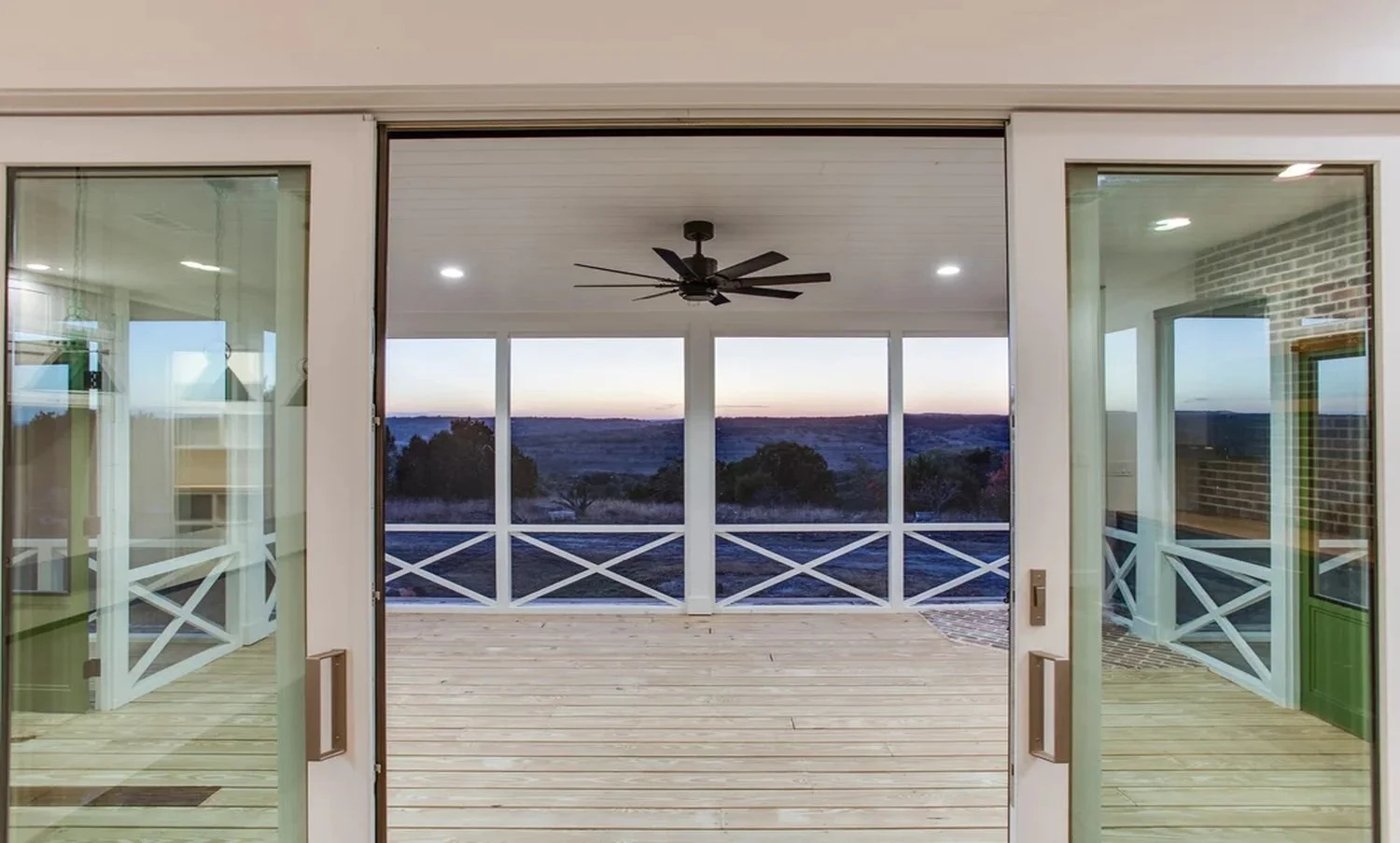
A Home That Fits the Land: View, Access, and Outdoor Living Questions
📌 Key Takeaways
The right custom home starts by reading the land before drawing the floor plan.
Read Land First: The lot should guide the home’s view, entry, outdoor spaces, and budget.
Design Around Daily Life: Family routines should shape where rooms, patios, pools, and guest areas belong.
Protect The View: Great views need smart planning for sun, glare, slope, privacy, and cost.
Plan Access Early: Driveways affect arrival, drainage, parking, trailers, service access, and daily use.
Check Site Limits: Septic, utilities, drainage, county rules, and HOA guidelines can reshape the plan.
Land first = fewer surprises and a home that feels meant to be there.
Families planning custom homes in Spicewood and the Texas Hill Country will gain clearer planning priorities, preparing them for the detailed overview that follows.
~ ~ ~ ~ ~ ~ ~ ~ ~ ~ ~ ~ ~ ~ ~ ~ ~ ~
Picture the morning you wake up in that house for the first time. Maybe it is the light spilling across a Hill Country view before the rest of the family stirs. Maybe it is the sound of guests arriving — tires on gravel, the familiar crunch of a driveway that feels like it was always meant to be there. Or the smell of something on the outdoor grill while children run between the pool and the covered porch.
That picture is clear. The challenge is that the lot still holds a few unknowns, and it is not always obvious which of them could quietly reshape the dream — or the budget — before a single plan is drawn.
A home fits the land when the view, the entry, and the way the family lives all work together. Before drawing plans, homeowners should ask how the property handles arrival, drainage, shade, septic, utilities, view corridors, and daily outdoor use. Most surprises are not unavoidable. They are the product of starting design before the property has been properly read.
As an experienced Spicewood custom home builder, Riverbend Homes — a second-generation family-owned business building in the Texas Hill Country since 1996 — starts every project with a single principle: listen first, then design. The best design questions begin outside, on the land.
Start With the Life You Want to Live on the Land
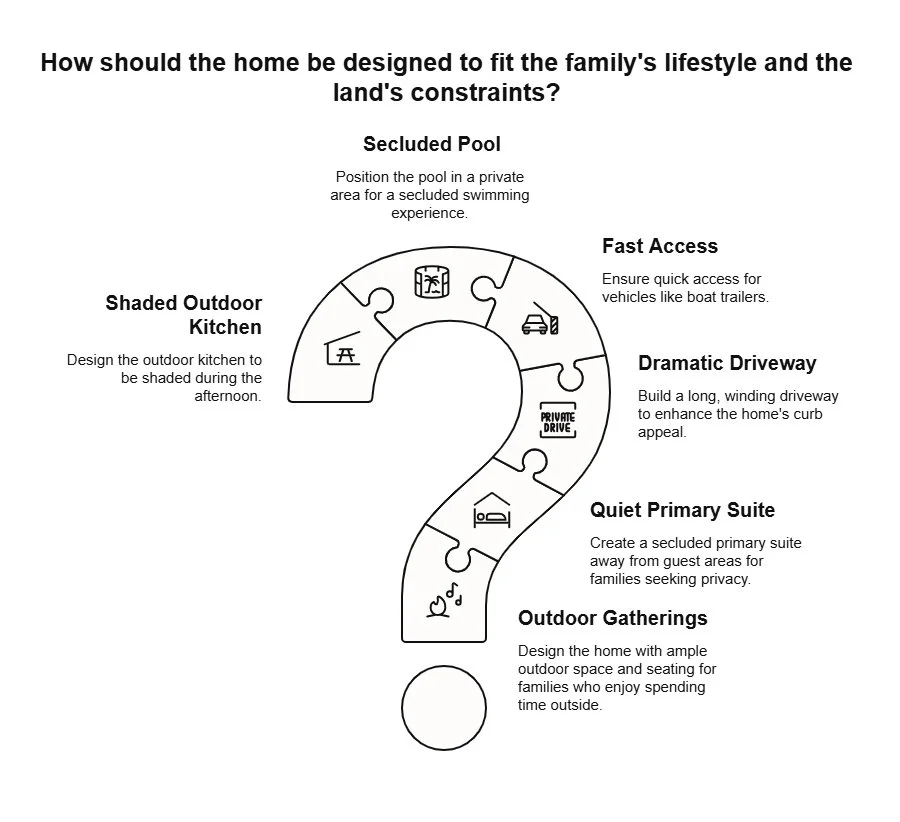
Before opening a floor plan, it helps to ask a more personal question: how does the family actually live?
Some families gather outside every evening. Others need a quiet primary suite far from where guests stay. Some want a driveway that builds anticipation before the house comes into view; others need a fast turnaround that works for a boat trailer after a day on Lake Travis. None of those goals is better than another — but they land differently on different lots.
A lot with a dramatic bluff view may put the most beautiful house position at the back of the property, which could mean a longer or more expensive driveway. A lot with natural privacy from cedar and live oak might make the pool feel secluded, or it might shade the outdoor kitchen all afternoon. Constraints are not dream-killers; they are planning inputs. The earlier they are understood, the more of the family's vision they can protect.
Your land is the most critical constraint on your design.
The Lifestyle-to-Site Question List
These questions translate broad lifestyle goals into the specific site realities a builder needs to hear. Bring them to any early property conversation.
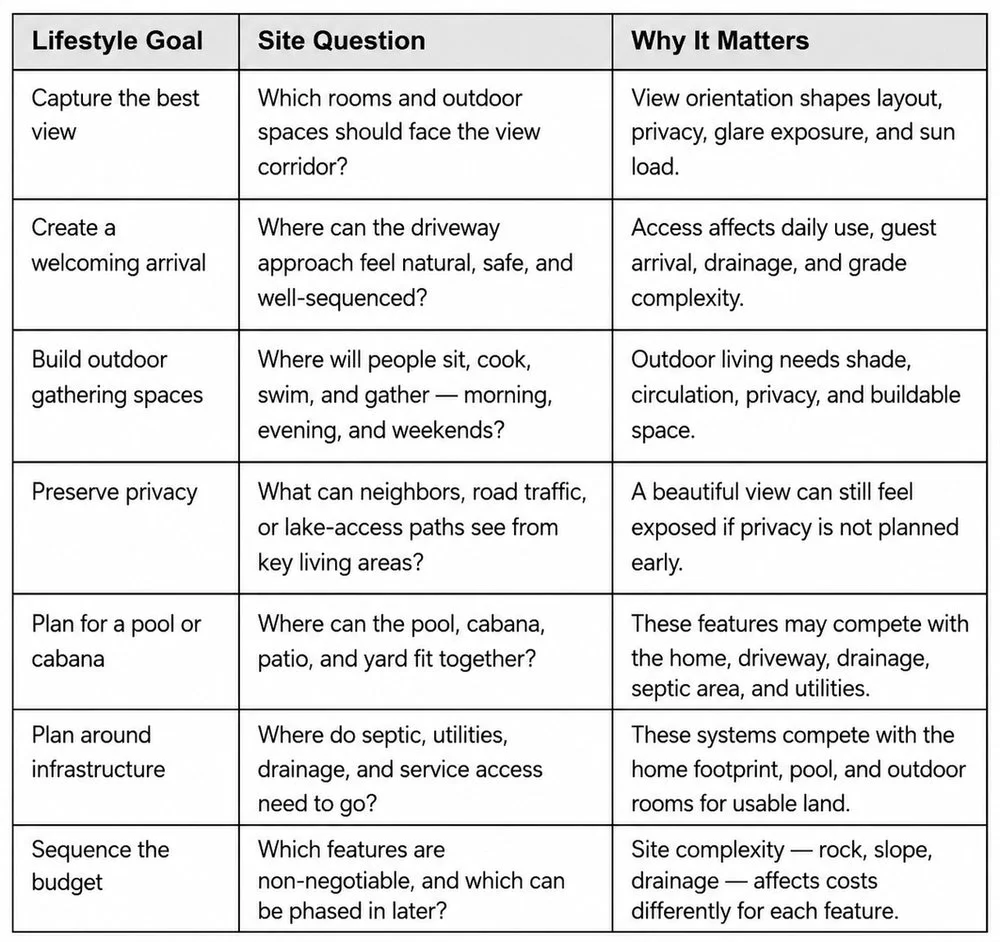
View Questions: What Will You See, and When Will You See It?
The view is a design input, not just a backdrop. In the Texas Hill Country, views can be the single biggest reason a family chooses a specific lot — distant ridgelines, miles of Lake Travis shoreline, open sky over rolling terrain. That makes view orientation worth more planning weight than it typically receives.
The question is not just where the view is. It is which rooms should receive it, at what time of day, and at what cost to everything else on the lot. If the best view corridor faces east, the primary bedroom captures it at sunrise — which may be exactly right. But a large glass wall in the kitchen facing the same direction can mean significant glare during peak morning use. That is not a reason to abandon the view; it is a reason to design for it intentionally, with overhangs, window placement, and interior orientation working together from the start.
View corridors can also compete with slope. The most dramatic vantage point is often on the highest, steepest ground. Placing the home there for the view may mean more grading and a driveway managing a more complex grade change — costs that are far easier to weigh before the design is emotionally locked. For a closer look at how sightlines and window orientation shape daily livability, Designing for the View: How to Maximize Your Hill Country Landscape in Your Custom Home covers the practical decisions in detail.
Access Questions: How Will the Home Welcome You In?
Arrival is part of how a home feels — and how it functions every single day. The sequence from the road to the front entry, the moment the view opens up, the place where the house finally reveals itself — these are experiences worth designing as deliberately as any interior space.
They are also worth checking against site realities early. Depending on the lot's road frontage, slope, drainage patterns, and road jurisdiction—which in Spicewood can fall under Travis, Burnet, or Blanco County—driveway placement involves specific grade limits, sight distance standards, and drainage requirements. Because permitting processes and governing bodies differ significantly by county, homeowners must identify the specific jurisdiction (e.g., Travis County Development Services for unincorporated Travis County) to understand the requirements for approach angle, positive drainage, and the distinction between county and state road maintenance.
Beyond approach, practical questions matter: room for a guest turnaround, service vehicle access, emergency access, and — for families with boats or trailers — a storage location that does not create a visual problem from the main living area. Can Your Lot Hold the Home, Pool, and Driveway You Want? is useful reading for families working through how much space all of these elements actually require.
Outdoor Living Questions: Where Will Family Life Actually Happen?
In central Texas, outdoor rooms are not seasonal luxuries — they are how homes are actually used for most of the year. That means they need to be planned with the same care as interior spaces, and the land needs to physically support them.
Start with where people will gather at different times of day and during different types of visits. A quiet morning spot near the primary bedroom calls for different placement than an outdoor kitchen anchoring a large weekend gathering. Those two spaces may not want to share the same porch. Then check placement against the competing demands on the land: a pool, covered patio, cabana, screened porch, fire feature, and detached casita together take up meaningful square footage. On lots with septic requirements, drainage swales, or significant slope, the buildable outdoor envelope may be more constrained than the survey suggests.
Afternoon sun in the Hill Country is aggressive from late spring through early fall. A west-facing patio with no shade becomes unusable during exactly the hours most families want to be outside. Roof extensions, pergolas, and mature trees all address this — but they need to be part of the original site plan to work effectively.
Privacy, Noise, and Neighbor Questions
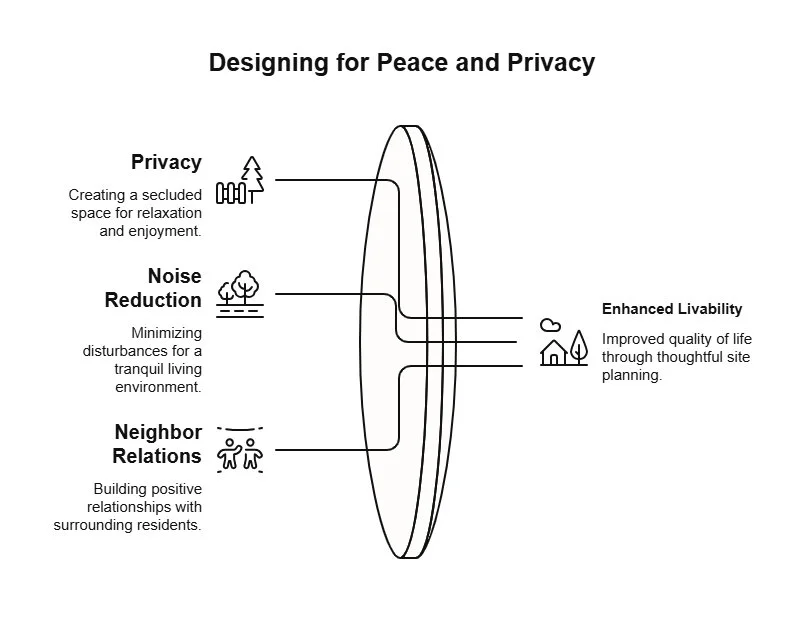
Privacy is a livability question, not a paranoid one. It is simply the difference between a pool area that feels like a genuine retreat and one that feels perpetually observed.
Walking the lot edges and asking what is visible from the road, from neighboring properties, and from any nearby lake-access paths is one of the most underrated early steps in lot planning. Natural vegetation, grade changes, and thoughtful building placement can create genuine privacy — but those design moves need to be identified early, not discovered mid-construction. Where headlights sweep across a bedroom terrace at night, or where road noise reaches a pool area, are real livability factors that thoughtful site planning can address. The question of whether views and privacy pull in opposite directions on a given lot is worth raising directly with the builder from the first conversation.
The Builder Question: Has the Property Been Read Before the Dream Is Drawn?
Site feasibility is a builder-led evaluation of whether the land can support the home a family imagines — encompassing site realities, infrastructure requirements, design implications, and budget risk. There is a version of the custom home process where design happens first — inspired images, floor plan preferences, a target square footage — and the land enters the picture after the plan already feels finished. That version is where expensive surprises live.
Riverbend's process begins with the Discover phase: a Discovery Meeting held at the property itself. Clients bring inspiration images and any saved designs; the builder listens, walks the land, assesses site feasibility, and identifies infrastructure requirements that will affect both design and cost. Understanding the potential and limitations of the space is not the end of the dream — it is how the dream gets built correctly.
The next phase, Design & Budget, keeps the builder involved alongside the architect to maintain both the vision and the budget. When plans reach bid-set completeness, the process pauses: a final construction cost estimate is produced before designs are finalized and permitting begins. Nothing moves past the point where the budget is understood. From there, the Build phase is shaped by financing, permitting, and HOA timelines — factors a builder active in the Hill Country navigates honestly rather than glossing over.
What to Bring to a Site Conversation
A first property conversation is most useful when priorities are clear. That does not mean arriving with plans — it means arriving with organized thinking.
Bring:
A current survey or plat of the property
HOA covenants or architectural guidelines, if available
Any known information about utilities, wells, or existing septic systems
Saved inspiration images — Pinterest boards, magazine clippings, photos from homes toured
A ranked list of must-have priorities: view, pool, privacy, outdoor kitchen, separate primary wing, casita, guest access, or multigenerational space
On the infrastructure side, lots near Lake Travis and the Highland Lakes may fall under the LCRA's On-Site Sewage Facility Program. The permit process can require proposed locations for the house, driveway, septic tank, drain field, and wells to be shown and marked on the property for inspection (LCRA OSSF Permit Steps). Additionally, lots within the Lake Travis watershed may be subject to the LCRA Highland Lakes Watershed Ordinance, which governs land disturbance, stormwater management, and erosion controls in ways that affect where things can be built. A builder who knows these systems can help determine what applies to a specific parcel before site or design investments are made.
For families also thinking through lot selection itself, Survey Papers in Hand: 5 Lot Checks Before Your Dream Home Is Drawn and The First 48 Hours After Buying Your Lot: 5 Smart Steps Before Custom Home Design cover complementary ground.
Stay informed with Hill Country building trends and tips as the planning process continues. When ready to walk the property with a site-first builder, contact Riverbend Homes to schedule a Discovery Meeting. The land has a great deal to say about the home — before the first line is drawn.
Our Editorial Process
Our expert team uses AI tools to help organize and structure our initial drafts. Every piece is then extensively rewritten, fact-checked, and enriched with first-hand insights and experiences by expert humans on our Insights Team to ensure accuracy and clarity.
About the Riverbend Homes Insights Team
The Riverbend Homes Insights Team shares practical guidance for families planning custom homes in Spicewood, Lake Travis, Lake LBJ, Horseshoe Bay, and the Texas Hill Country. Our content draws on Riverbend Homes' property-first design-build process, local building experience, and commitment to helping homeowners make confident decisions before plans move too far ahead of the land.
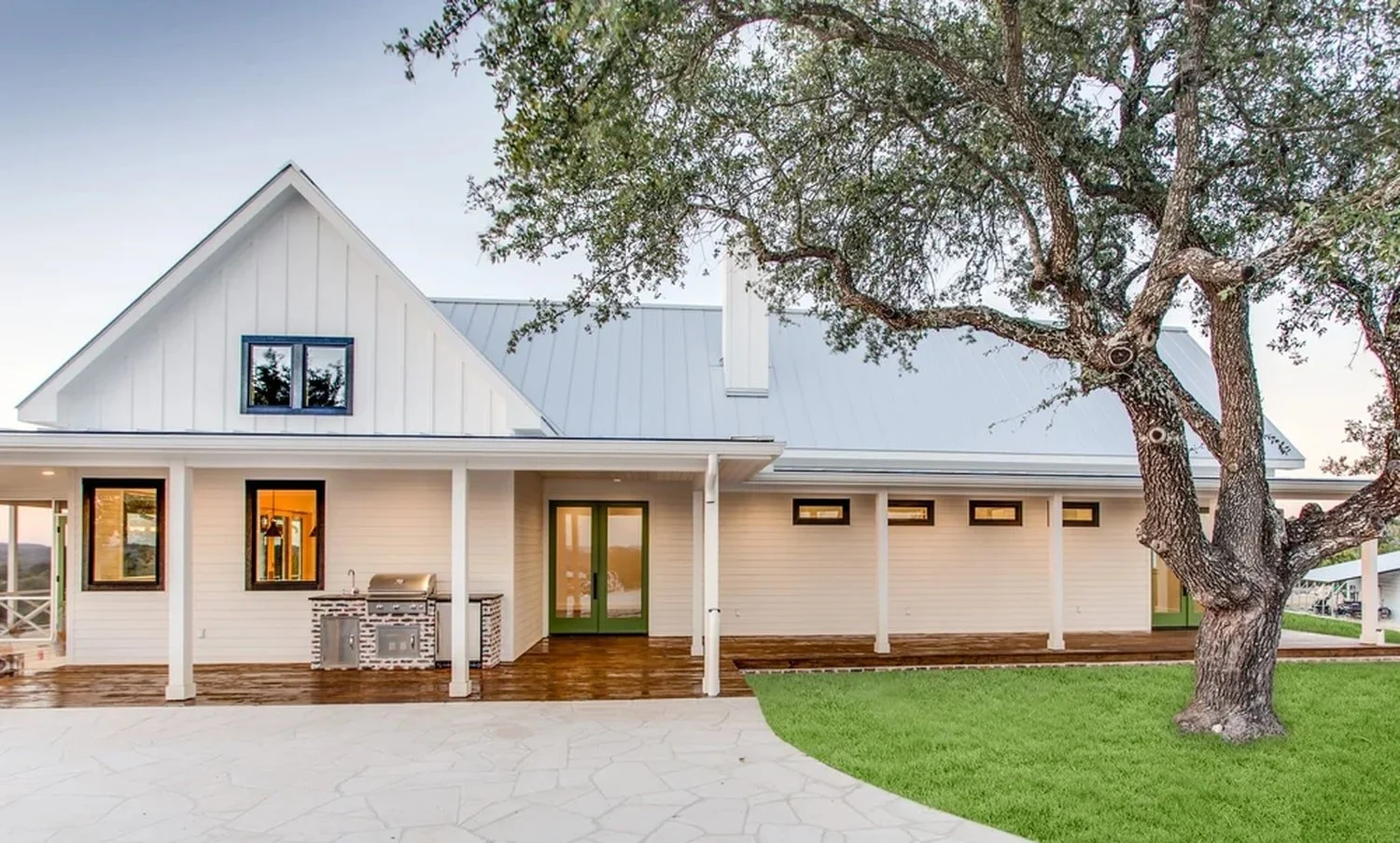
Before the Floor Plan: A Site-First Guide to What Your Spicewood Lot Can Really Support
📌 Key Takeaways
The best floor plan starts with the land, because Spicewood lots decide what can be built well.
Read Land First: Test the lot before design so slope, rock, drainage, and access guide smart choices.
Check Septic Early: Septic placement can shape the home, pool, driveway, and outdoor living plan.
Know Local Rules: County, HOA, utility, and permit rules can change from one Spicewood lot to another.
Protect The Budget: Early site review helps turn hidden land problems into planned design and cost choices.
Match Dream To Site: Views, privacy, pools, and patios work best when tested against the whole property.
Land-first planning keeps the dream strong by making it real.
Families planning a custom Spicewood home will gain clearer first steps here, preparing them for the detailed overview that follows.
~ ~ ~ ~ ~ ~ ~ ~ ~ ~ ~ ~ ~ ~ ~ ~ ~ ~
Survey papers in hand, you are standing on a piece of Spicewood land that feels exactly right. The distant Hill Country views, the space, the quiet — it all lines up with the vision. Maybe the lot was found after months of searching. Maybe it was inherited from family who understood what this land could become. Maybe it is still under evaluation, waiting for a final decision about whether to commit.
You may already picture the house from the road: the driveway curving toward the entry, the pool sitting just beyond the main living area, the outdoor kitchen facing the view, and the rooms arranged around how your family wants to live. That excitement is a good thing. It gives the project direction.
But in any of those situations, the same practical question sits underneath the excitement: what will this land actually let us build well?
That question deserves a serious answer before a floor plan gets drawn in ink.
Start With the Land: Why the Lot Comes Before the Floor Plan
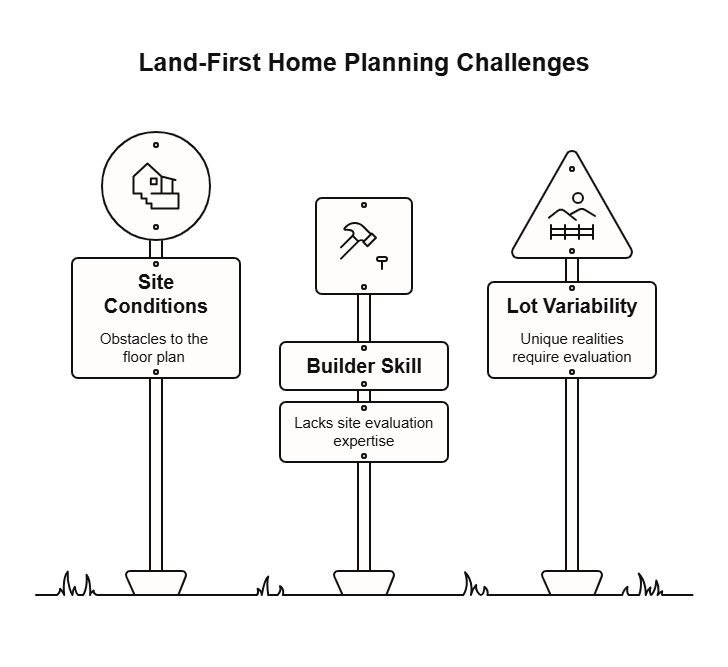
The conventional starting advice for custom home planning is familiar: gather inspiration images, sketch rough floor-plan preferences, and work out how many bedrooms the family needs. That is a reasonable beginning. It surfaces priorities, gives a designer something to respond to, and makes the first builder conversation feel less abstract.
But it runs into a problem once the land itself starts having opinions.
When a family falls in love with a specific floor plan before the property has been read, site conditions that challenge that plan begin to feel like obstacles rather than inputs. A slope that would have shaped the design quietly at month one becomes a budget variable at month six. A septic field requirement that could have guided outdoor living placement now conflicts with the pool location that feels emotionally settled. The conventional starting advice is not wrong; it simply runs ahead of the land.
There is a third challenge that matters just as much: not every builder who can construct a beautiful Hill Country home can also evaluate a difficult Hill Country lot well. Building skill and site-reading skill are not the same thing. A builder who walks a Spicewood property and focuses only on what the client wants to build — without translating what the terrain, infrastructure, drainage, and jurisdictional context will require — leaves the family to discover those realities later, at higher cost and under greater emotional pressure.
Often called the Gateway to the Hill Country, Spicewood offers some of the most striking terrain in Central Texas: distant views, limestone topography, proximity to Lake Travis, and the kind of space that closer Austin communities simply cannot offer. That same physical character means Spicewood lots are rarely flat, rarely simple, and rarely interchangeable. The land-to-design fit — the degree to which a property's physical and regulatory realities align with the home a family envisions — varies from lot to lot in ways only a property-based evaluation can reveal.
The land is the blueprint before the blueprint. A builder who understands how to read both the vision and the property is the professional most capable of protecting the dream from the surprises that shape too many custom home experiences.
What Site Feasibility Really Means for a Spicewood Luxury Lot
What site feasibility means: A builder-led evaluation of whether a specific lot can support the desired custom home — accounting for site realities such as slope, rock, drainage, and access; infrastructure requirements including utilities, septic, and driveway; design implications covering home placement, build envelope, and view orientation; and budget risk. It is the land's reality check before the dream gets drawn in ink.
Feasibility is not a single inspection. It is four interconnected layers of evaluation, each of which can affect the others.
Site realities: slope, rock, drainage, and access
The physical characteristics of a lot shape what can responsibly be built on it. Hill Country terrain is beautiful precisely because of its variation — limestone outcroppings, natural grade changes, seasonal drainage channels, mature tree cover. That variation also means no two lots sit the same way beneath a floor plan. Slope affects foundation complexity, driveway approach, outdoor living placement, and retaining requirements. Rock depth and hardness affect excavation, utility installation, and septic siting options. How water moves across the lot during heavy rainfall affects where the home can sit comfortably and safely over time.
For lots near the Lake Travis area, topography adds specific considerations around slope, rock, and foundation design that are worth understanding early. Navigating Lake Travis Topography goes deeper on how those conditions affect custom builds in this part of the Hill Country.
Infrastructure requirements: utilities, septic, driveway, and service access
Infrastructure requirements are the services a home needs to function: water, electricity, internet, gas where applicable, wastewater management, and road access that can serve both construction activity and daily life for decades. In Spicewood, many properties rely on on-site sewage facilities (OSSF) rather than municipal sewer. The Texas Commission on Environmental Quality provides homeowner guidance on OSSF systems, including how to identify the applicable permitting authority. For lots near Lake Travis and the Highland Lakes, the LCRA administers its own On-Site Sewage Facilities program within defined setback zones near the water. For properties within unincorporated Travis County, the Travis County Residential OSSF Permit process governs septic installation and approval.
Driveway access carries its own early-stage requirements. Where a new driveway connects to a county-maintained road, a Travis County Residential Driveway Permit may be required. The geometry of that driveway — how it enters the lot, how it grades, what construction traffic will navigate — affects home siting in ways that are far cheaper to resolve before architectural plans exist than after.
Design implications: home placement, build envelope, and view orientation
Once site realities and infrastructure demands are understood, they define the build envelope: the portion of the lot where the home can actually be placed after setbacks, easements, terrain, access paths, and utility locations are factored in. The build envelope is not always obvious from the survey plat, and it frequently surprises families who assumed they had more flexibility than the land actually allows.
View orientation is the process of identifying which sight lines and natural features are worth designing around — and what tradeoffs that orientation creates with sun exposure, thermal load, privacy, and the positions of outdoor features. A home oriented to capture the best Hill Country vista may face the western sun in ways that increase cooling demand or create afternoon glare in primary living areas. Resolving that tradeoff is simpler before window placement is locked.
Budget implications: why early unknowns become late stress
Site conditions discovered after design investment tend to be expensive to address. Extended utility runs, engineered retaining walls, steep-site foundation designs, and unexpected septic complexities are budget variables that can fundamentally reshape what is possible when they surface late. The goal of a site-first approach is not to eliminate these complexities — some are simply part of building on Hill Country terrain — but to understand them before they arrive as surprises.
Jurisdiction note for Spicewood-area lots: Sections of Spicewood can fall under Travis, Burnet, or Blanco County depending on the specific property. HOA requirements, utility service territories, permitting pathways, and development oversight can therefore differ from one lot to the next. Travis County Development Services handles development in unincorporated Travis County areas, including floodplain management and construction inspections. However, project oversight may also involve Municipal Utility Districts (MUDs), Emergency Service Districts (ESDs), or city Extraterritorial Jurisdictions (ETJs) depending on the specific lot’s location. Verifying what applies to the specific lot is the first practical step, not an assumption to carry forward.
The Hidden Lot Conditions That Can Change the Dream
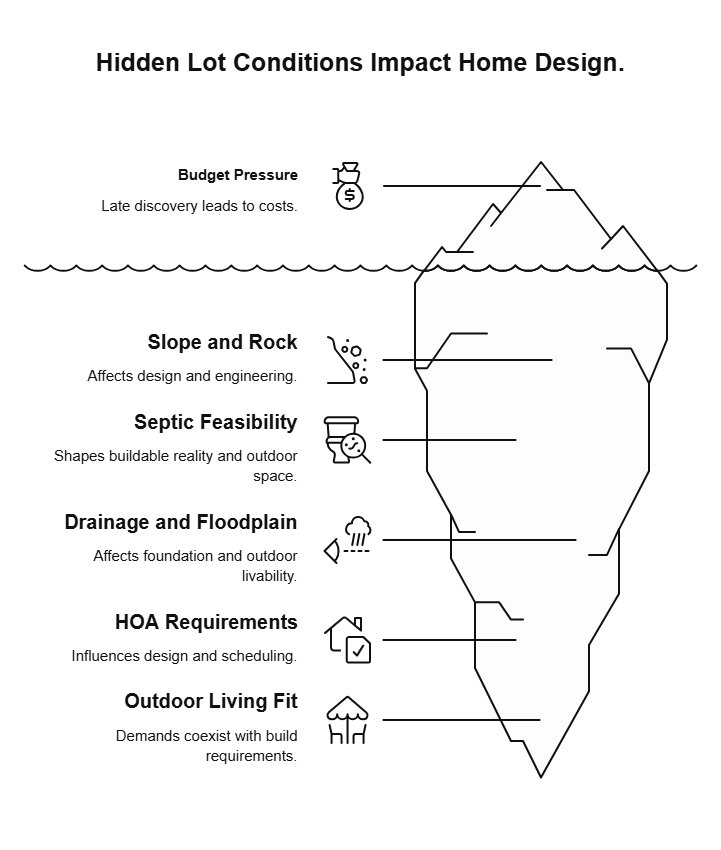
Discovered early, site conditions are design inputs. Discovered late, they are budget pressure. The difference between those two outcomes is almost entirely a function of when the conversation happens.
Slope and rock interact with nearly every major design decision on a Hill Country lot. A steeply graded site can produce beautiful elevated living areas and also require significant engineering to make the outdoor spaces usable. What the terrain gives in drama, it sometimes asks back in complexity. This is not a reason to avoid sloped lots — many of Spicewood's most compelling properties carry significant grade change. It is a reason to read the slope honestly before a floor plan assumes it away.
Septic and wastewater feasibility shapes more of a lot's buildable reality than most homeowners anticipate before the process begins. Where the OSSF system can be sited affects home placement, outdoor living options, and the area available for a pool or entertaining space. Identifying the permitting authority and understanding soil conditions belongs at the beginning of the design conversation, not near the end.
Drainage and floodplain conditions are equally site-specific on Hill Country terrain. Water behavior during heavy rain affects both foundation design and the long-term livability of outdoor areas. The FEMA National Flood Hazard Layer provides a starting reference for mapped flood zone exposure, though on-the-ground evaluation adds the context that flood maps alone cannot.
HOA requirements and permitting timelines add design and scheduling reality. In communities with active architectural review processes, design decisions may need to clear HOA approval before reaching the permit office. Understanding that timeline early keeps project sequencing from becoming a source of unexpected delay.
What clients who have been through a careful builder-led process often describe in retrospect is something like a concept-to-reality adjustment — the point at which the actual lot, the actual terrain, the finish-out choices, and the material realities of the build begin shaping the design in ways that drawings alone did not predict. Getting ahead of those adjustments, rather than navigating them reactively mid-project, is precisely what property-first evaluation makes possible.
Outdoor living and lifestyle fit — pools, cabanas, covered patios, outdoor kitchens, guest or casita spaces — are spatial demands that must coexist within the build envelope alongside the home, driveway, septic, and drainage requirements. Whether the lot can support those features in the arrangement the family imagines is a question worth settling before architectural drawings begin.
The Site-Readiness Checklist: What to Ask Before Design Begins
The most useful checklist is not the one that gives a homeowner false certainty. It is the one that helps the homeowner ask better questions. Use it as a conversation starter with a qualified builder, not as a substitute for professional site review. Each item connects a property condition to a design, budget, or household-confidence question worth answering before plans are finalized.
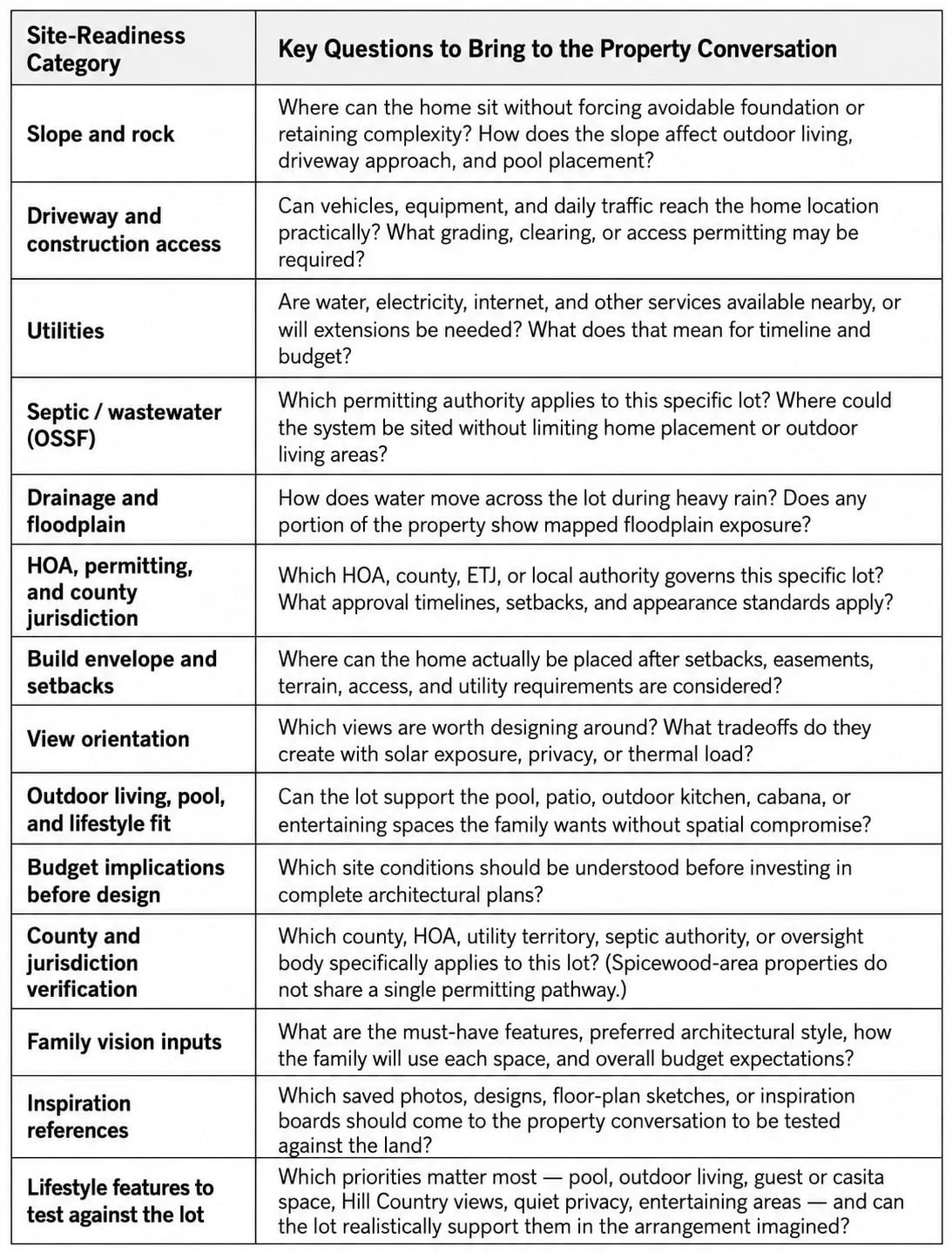
For septic authority questions, TCEQ's homeowner OSSF guidance and, for Lake Travis-area lots, the LCRA's On-Site Sewage Facilities program are the appropriate starting references. Travis County-specific OSSF permitting is handled through the Travis County Residential OSSF Permit process. Floodplain exposure can be checked against the FEMA National Flood Hazard Layer as an initial reference.
How a Property-Based Discovery Meeting Protects the Home You Imagine
One of the things homeowners who have built with Riverbend Homes consistently describe is the experience of being listened to before anything else. Not presented with what is easiest to build. Not redirected away from what they wanted. First, genuinely heard — including in cases where other builders had said the vision was not possible.
That sequencing is deliberate, and it is where the Riverbend Homes building process begins. The Discover phase is a meeting at the property itself. The purpose is to understand the homeowner's vision — what the family must have, the architectural style that fits their sense of home, how they will actually use each space, what the budget envelope looks like — and then to read the land alongside that vision. Where does the slope create opportunity and where does it require planning? What does the site's drainage behavior mean for outdoor living placement? Which infrastructure questions need answers before design begins?
A builder who has spent decades evaluating Hill Country terrain brings something specific to that conversation: the ability to hear what the family wants and translate it against what the land will support — before design momentum carries plans too far ahead of feasibility. Budget discipline and staying on schedule, without surprises that fall outside of planned choices and upgrades, are outcomes that come from this kind of front-loaded site intelligence, not from luck.
Because Riverbend limits the number of active projects it carries at any given time, the team can be on-site every day of the build. That daily presence is not a scheduling preference; it is a quality and continuity mechanism. Site conditions that emerge during construction — and they always do — are caught and addressed by the people who understand both the design intent and the property's physical behavior. It is part of what makes the process feel manageable rather than stressful.
From the Discover phase, the process moves into Design & Budget. The builder stays engaged alongside the designer at every step, keeping the vision buildable and the cost realistic as decisions are made. Plans are developed to bid-set level — the stage of design completeness at which drawings are detailed enough to estimate construction costs accurately, but not yet finalized for permit submission. At that point, the process pauses to produce an estimated final construction budget before design investment advances further. That pause is where the site knowledge from the first conversation earns its return: infrastructure decisions, slope realities, and build envelope constraints already understood mean the estimate reflects the actual lot rather than a hypothetical one.
The final phase, Build, follows with fewer avoidable interruptions precisely because the land was read before the floor plan was locked.
As a Spicewood custom home builder operating in this area since 1996, Riverbend Homes brings familiarity with Hill Country terrain, county permitting contexts, HOA processes, and the infrastructure realities specific to this region. Knowing the land before meeting it on paper is a different kind of preparation — and over time, it shows in results that clients describe as exceeding expectations rather than managing them.
The right first conversation should leave the family more capable, not more pressured.
From Site Feasibility to Budget Confidence
A site-feasibility conversation does not produce a final budget number. It produces better inputs for one. Slope, septic pathway, utility situation, driveway geometry, and build envelope become known quantities rather than unknowns — and known quantities, even challenging ones, can be planned around. Surprises discovered after a design is emotionally fixed cannot.
Those better inputs also enable better tradeoffs. Maybe the view is worth a more complex placement. Maybe the pool should be simplified so the outdoor living area works better. Maybe the driveway, garage, and entry sequence deserve more early attention than expected. Maybe the family's must-have list needs to be ranked before design begins. These are productive questions to carry into design — not reactive ones to answer under pressure mid-project.
The design-build model supports this sequence directly. When the same firm that walks the land stays involved through design, the relationship between site conditions and design decisions remains visible at every step. Cost feedback enters the conversation during design, not after it.
For families evaluating whether a Spicewood lot can support a particular home size, pool arrangement, or outdoor living plan, the most direct path to budget confidence runs through the land — not around it.
What Your Lot Can Support: A Calm Next-Step Framework
Whether the lot was recently purchased, inherited, or is still under evaluation, the following sequence helps bring structure to what can otherwise feel like an overwhelming collection of unknowns. This is guidance for a builder conversation — not a DIY feasibility assessment.
Gather the documents. Collect the survey, plat, available soils information, HOA covenants, and title or deed materials describing the property's easements and encumbrances.
Walk the property with the dream in mind — and write down the unknowns. Where does the slope run? Where does water collect? Where would the driveway naturally enter? What feels uncertain about whether the vision fits?
List the must-have lifestyle features. Home size, pool, driveway approach, outdoor living, guest or casita space, view priorities, privacy goals. Bring inspiration images and floor-plan sketches. They are valuable inputs to the conversation — as long as they are tested against the land before they become fixed intentions.
Identify the questions that could change the design most. Septic feasibility, slope complexity, utility access, drainage patterns, HOA approval scope, and build envelope constraints are the variables most likely to reshape a plan significantly when they surface late.
Verify what applies to this specific lot. Which county? Which HOA? Which utility territory? Which septic permitting authority? In Spicewood-area properties, those answers are not interchangeable from one address to the next.
Schedule a property-based builder conversation before paying for full plans. Use that meeting to separate site conditions that can be accommodated from ones that need to shape the design from the beginning. The First 48 Hours After Buying Your Lot outlines practical early steps worth taking as that process begins.
Spring is a natural moment to start this sequence before design calendars fill and construction activity builds. For those already in the middle of a busy building season, the goal is not urgency — it is clarity before the next commitment.
A Better First Question: Not "What Floor Plan Do We Want?" but "What Will This Land Let Us Build Well?"
Inspiration is a valid starting point. Floor plans, saved images, and style references communicate what the family values, how they want to live, and what the home should feel like. None of that work goes to waste.
What inspiration cannot do is account for the land. It does not know where the slope creates a retaining challenge. It does not know which direction the best view faces or what that means for afternoon sun load. It does not know whether the septic field and the pool can coexist in the arrangement the family imagined. The land knows those things. And a builder with the site-reading experience to translate both the vision and the property honestly — without defaulting to what is easiest to build or what an off-the-shelf floor plan assumes — is the professional best positioned to protect the dream from the avoidable surprises that shape too many custom home experiences.
Starting with site feasibility does not shrink the dream. It grounds the dream in what the land will genuinely support — so that by the time the floor plan is drawn, it has already been tested against the most consequential set of constraints it will ever face.
That shift changes the tone of the entire project. The view becomes part of the plan. The driveway becomes part of the experience. The pool and outdoor living areas are tested as part of the whole property rather than added to it after the fact. The budget conversation becomes more grounded. The design begins as a response to the land rather than a fight against it.
Before the floor plan gets drawn in ink, see how Riverbend's process starts with the land: the Riverbend Homes building process.
When ready to talk through a specific property, contact Riverbend Homes.
Let's bring your dream to life in the Texas Hill Country.
Disclaimer: This guide is for educational planning purposes only. Lot feasibility, septic, floodplain, permitting, utility, HOA, engineering, and budget questions should be confirmed with qualified local professionals and the relevant jurisdiction before design or construction decisions are made.
Our Editorial Process
Our expert team uses AI tools to help organize and structure our initial drafts. Every piece is then extensively rewritten, fact-checked, and enriched with first-hand insights and experiences by expert humans on our Insights Team to ensure accuracy and clarity.
About the Riverbend Homes Insights Team
The Riverbend Homes Insights Team is our dedicated engine for synthesizing complex topics into clear, helpful guides. While our content is thoroughly reviewed for clarity and accuracy, it is for informational purposes and should not replace professional advice.
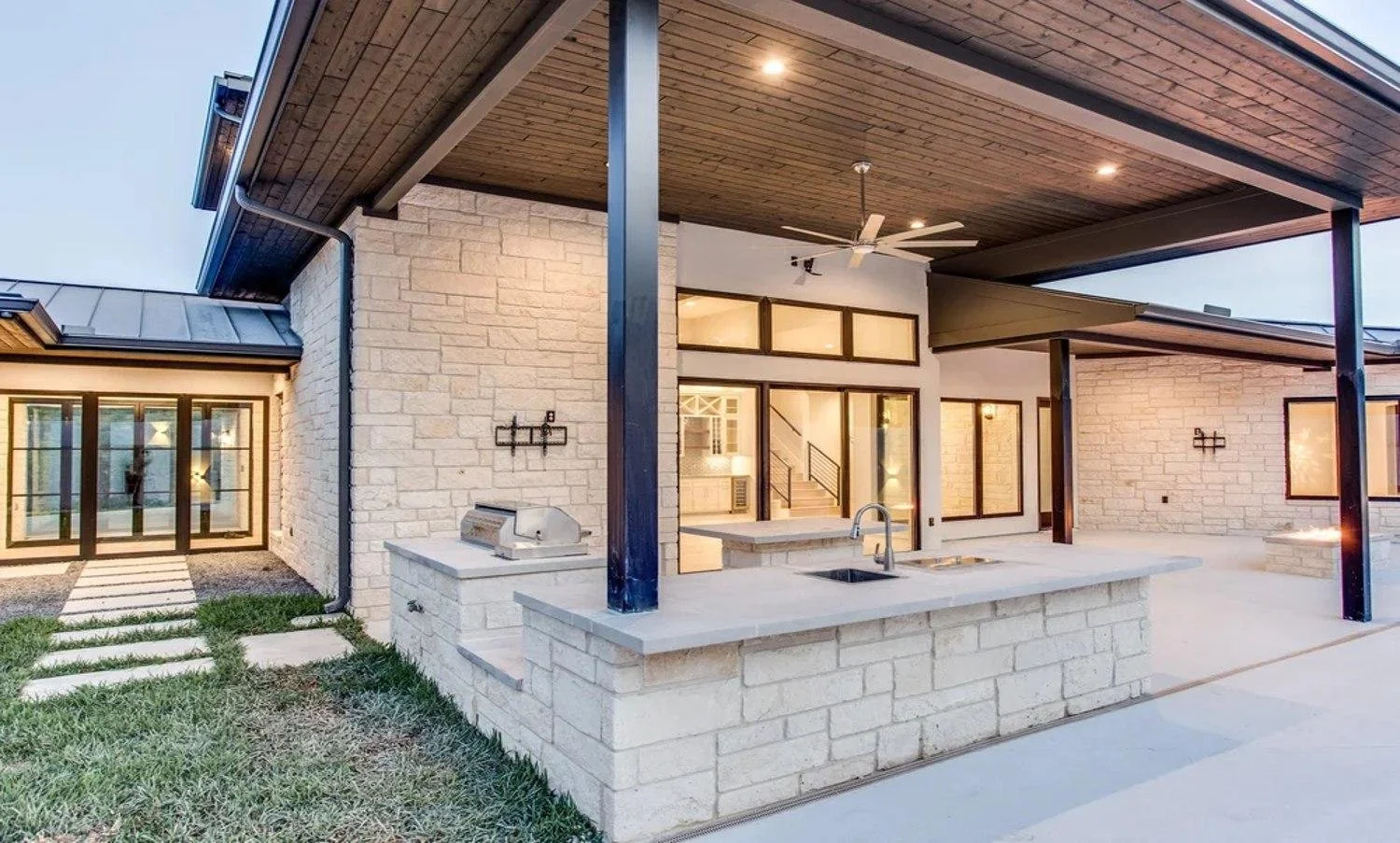
The Land Is the Budget: Why Waiting on Site Feasibility Costs Peace of Mind
📌 Key Takeaways
Site feasibility protects the dream by showing how the land may shape the home, budget, and design.
Start With Land: The lot should guide design before plans, costs, and family expectations feel fixed.
Unknowns Add Stress: Driveways, septic, slope, utilities, and drainage can change the budget late.
Ask Earlier Questions: Early site review helps families sort real concerns from vague worry.
Budget Lives Onsite: Foundation, access, and infrastructure decisions can matter as much as finishes.
Builder Clarity Helps: A property-based discovery meeting connects the dream to real site limits.
Let the land speak before the floor plan gets too emotional to change.
Families buying land for a custom Hill Country home will gain clearer planning confidence here, preparing them for the detailed overview that follows.
~ ~ ~ ~ ~ ~ ~ ~ ~ ~ ~ ~ ~ ~ ~ ~ ~ ~
The lot looks perfect.
Survey papers sit beside inspiration photos and handwritten budget notes on the kitchen island. A laptop glows with saved images of limestone fireplaces, long porches, glass walls, and a pool aimed toward the view.
You love the land. You can already picture the house. Still, one quiet thought keeps returning: What if the land changes everything?
That feeling is not indecision. It is your instincts asking for better information.
Before floor plans begin to feel final, site feasibility gives your family a calmer way to talk about the property, the budget, and the dream itself. It does not shrink the vision. It helps protect it.
The Real Problem: The Lot Feels Exciting, but the Unknowns Keep Growing
A Spicewood lot can feel like the beginning of everything. The view is there. The trees are there. The idea of outdoor living, a pool, a long driveway, or a private guest suite starts to feel real.
Then the questions arrive.
Can the driveway work where you imagined it? Will the septic location affect the pool? Does the slope change the foundation approach? Will utilities, drainage, HOA rules, or permitting affect the layout? These are not small details. They can shape how the home lives, how it is designed, and how confident your family feels about the budget.
The hard part is that waiting can feel responsible. You may think, Let’s not overcomplicate this yet. In reality, waiting sometimes gives the unknowns more power. The design gets more emotional. The assumptions get harder to unwind. The family conversation gets heavier.
That is where site feasibility matters.
The Hidden Costs of Assuming a Flat Lot
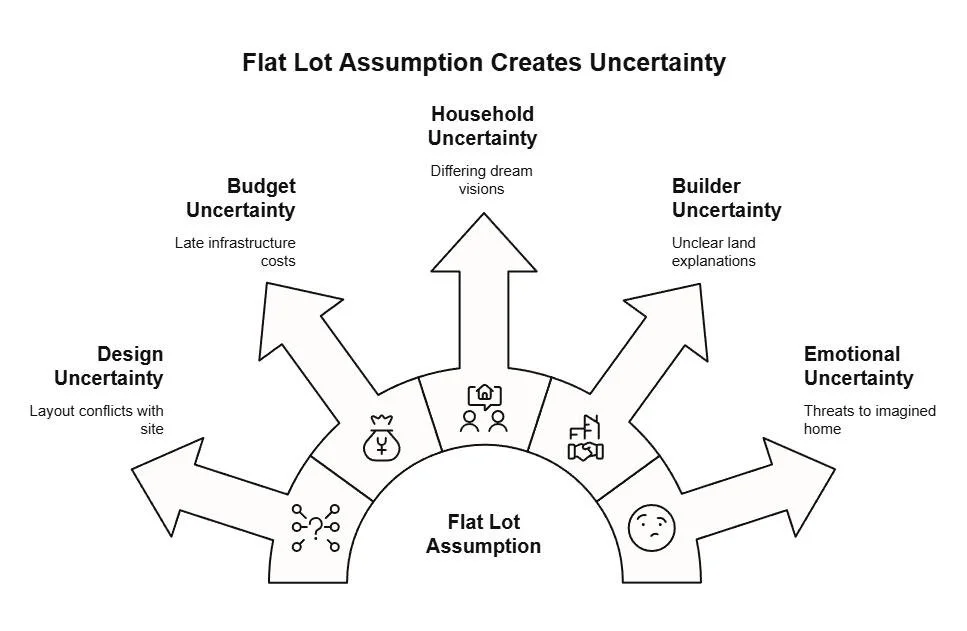
Site feasibility should happen before custom home design because the land can affect the home’s layout, driveway, foundation approach, utilities, septic, drainage, outdoor living areas, view orientation, and budget expectations. Early feasibility review helps your family discuss real site conditions before becoming emotionally attached to plans the property may not support.
That does not mean every question must be fully answered on day one. Some issues require surveyors, engineers, septic professionals, permitting offices, HOA review, or other qualified experts. The point is simpler: your first design conversations should be grounded in the land’s realities.
Waiting too long can create several kinds of uncertainty:
Design uncertainty: the plan may assume a layout the site makes difficult.
Budget uncertainty: infrastructure, access, drainage, or foundation needs may appear late.
Household uncertainty: family members may picture different versions of the same dream.
Builder uncertainty: you may not know whether a builder can explain the land clearly.
Emotional uncertainty: every new question can feel like a threat to the home you imagined.
The cost is not just financial. It is the mental strain of making a major decision without knowing which assumptions are safe.
The land is not a detail after design; it is one of the first budget conversations.
The Land Questions That Can Quietly Become Budget Questions
A good site-first conversation does not ask you to become a construction expert. It gives you better questions to bring to the right professionals.
For Hill Country and Lake Travis-area lots, these are common feasibility categories to discuss before design momentum builds:
Buildable area: Where can the home reasonably sit? A beautiful lot may still have setbacks, easements, trees, slope, drainage paths, or HOA limits that affect the usable building area.
Driveway and access: A driveway is not just a line on a plan. Grade, turning space, garage placement, guest parking, and construction access can influence the home’s position and cost.
Slope, rock, and foundation approach: Hill Country terrain can affect how the home meets the land. A sloped site may call for different foundation, grading, or retaining-wall conversations than a flatter lot.
Utilities and infrastructure: Water, power, internet, propane, and other service connections should be discussed early. Infrastructure requirements can affect both design and budget expectations.
Septic or wastewater planning: If a property requires an on-site sewage facility, permitting and approved plans may become part of the feasibility conversation. The Texas Commission on Environmental Quality provides general OSSF permitting guidance, and the LCRA On-Site Sewage Facilities Program may be relevant for certain Lake Travis and Highland Lakes properties.
Drainage and grading: Water needs a safe path away from the home. As a general building principle, proper grading and drainage help protect foundations and site performance; the Building America Solution Center provides general guidance on grading slopes away from foundations.
Floodplain and permitting questions: Some properties may need additional review if floodplain development rules apply. FEMA defines a floodplain development permit as a local authorization tied to development in a floodplain. Requirements vary by property and jurisdiction.
View orientation and outdoor living: The best view is not always the only design driver. Sun exposure, privacy, wind, pool placement, porch depth, and indoor-outdoor flow all need to work together.
That list can feel like a lot. It is also the reason early clarity feels so different from late-stage surprise.
A Household Conversation Guide: Known / Unknown / Ask the Builder
Before design decisions harden, your family can use a simple table to sort excitement from uncertainty. The goal is not to solve every site issue at the kitchen island. The goal is to stop vague worry from running the conversation.
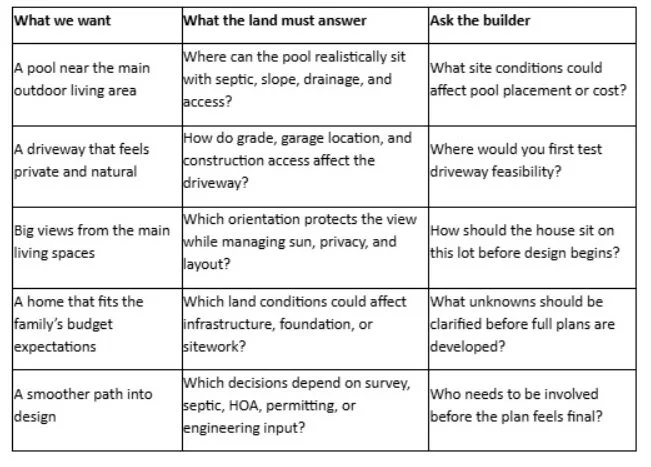
This conversation helps your family move from “something might go wrong” to “these are the questions we need answered.”
That is a better place to begin.
How a Builder-Led Discovery Meeting Protects the Dream
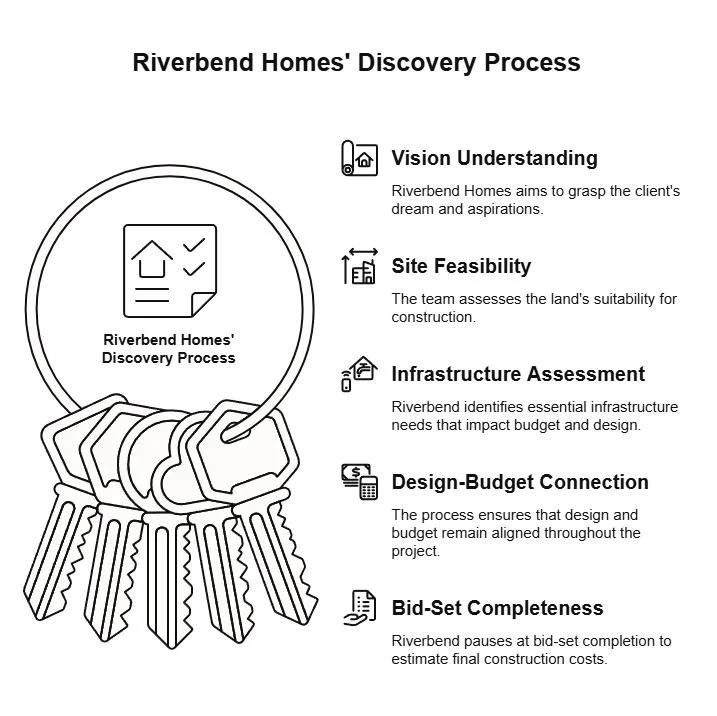
Riverbend Homes begins with a Discovery Meeting at the property. The purpose is to understand your vision, assess the site’s feasibility, and identify infrastructure requirements that may affect budget and design.
That sequence matters. A property-based conversation connects the dream to the land before the design gets too far ahead of the facts.
Riverbend’s process then keeps design and budget connected. After the initial discovery work, the team stays involved through design, then pauses at bid-set completeness to estimate final construction costs before plans move forward. For a family trying to protect both vision and budget, that pause is not a delay. It is a checkpoint.
Riverbend Homes is a second-generation, family-owned Texas Hill Country builder that has been designing and building custom homes since 1996. If you are evaluating land in Spicewood, the Spicewood custom home builder page offers more local context. If your property is closer to Lake Travis, the page for custom home builders in Lake Travis explains how Riverbend approaches property, design, infrastructure, and budget conversations in that area.
Immediate Next Steps for Land Buyers
Start with the land.
Walk the property with your family and write down what feels settled, what feels unclear, and what needs professional input. Bring the survey, inspiration photos, budget notes, HOA information, and any early sketches you already have.
Then slow the design conversation just long enough to ask better questions.
If you recently bought land, The First 48 Hours After Buying Your Lot is a useful next read. If slope, rock, or terrain already feel like part of the concern, Navigating Lake Travis Topography can help you think through those issues with more clarity.
The dream does not need to pause forever. It just needs to begin in the right order.
Before the Dream Gets Too Detailed
Bring the focus back to the physical property. The inspiration photos and budget notes hold no weight until the land dictates what is possible.
Nothing about site feasibility takes the dream away. It gives the dream a firmer place to stand.
When the land has been read more carefully, your family can move into design with fewer shadows in the room. You know which questions matter. You know where the uncertainty lives. You know what to ask before the plan becomes too emotional to change.
Stay informed with Hill Country building trends and tips, and when the time feels right, read more about the Riverbend Homes building process to see how a Discovery Meeting connects land, vision, infrastructure, design, and budget.
Build from clarity. Protect the dream. Let the land speak first.
Disclaimer: This article is for general educational purposes only and should not be treated as engineering, architectural, legal, permitting, septic, floodplain, or financial advice. Site conditions, jurisdictional requirements, HOA rules, utility access, and construction feasibility vary by property. Homeowners should consult qualified professionals before making design, purchasing, or construction decisions.
Our Editorial Process:
Our content is developed from Riverbend Homes’ published process, brand materials, local building experience, and homeowner-facing educational resources. Each article is structured to help Texas Hill Country homeowners understand custom-home decisions in plain language, connect early planning questions to real site and budget considerations, and identify the next responsible conversation before design or construction commitments move forward.
About the Riverbend Homes Insights Team
The Riverbend Homes Insights Team is our dedicated engine for synthesizing complex topics into clear, helpful guides. While our content is thoroughly reviewed for clarity and accuracy, it is for informational purposes and should not replace professional advice.
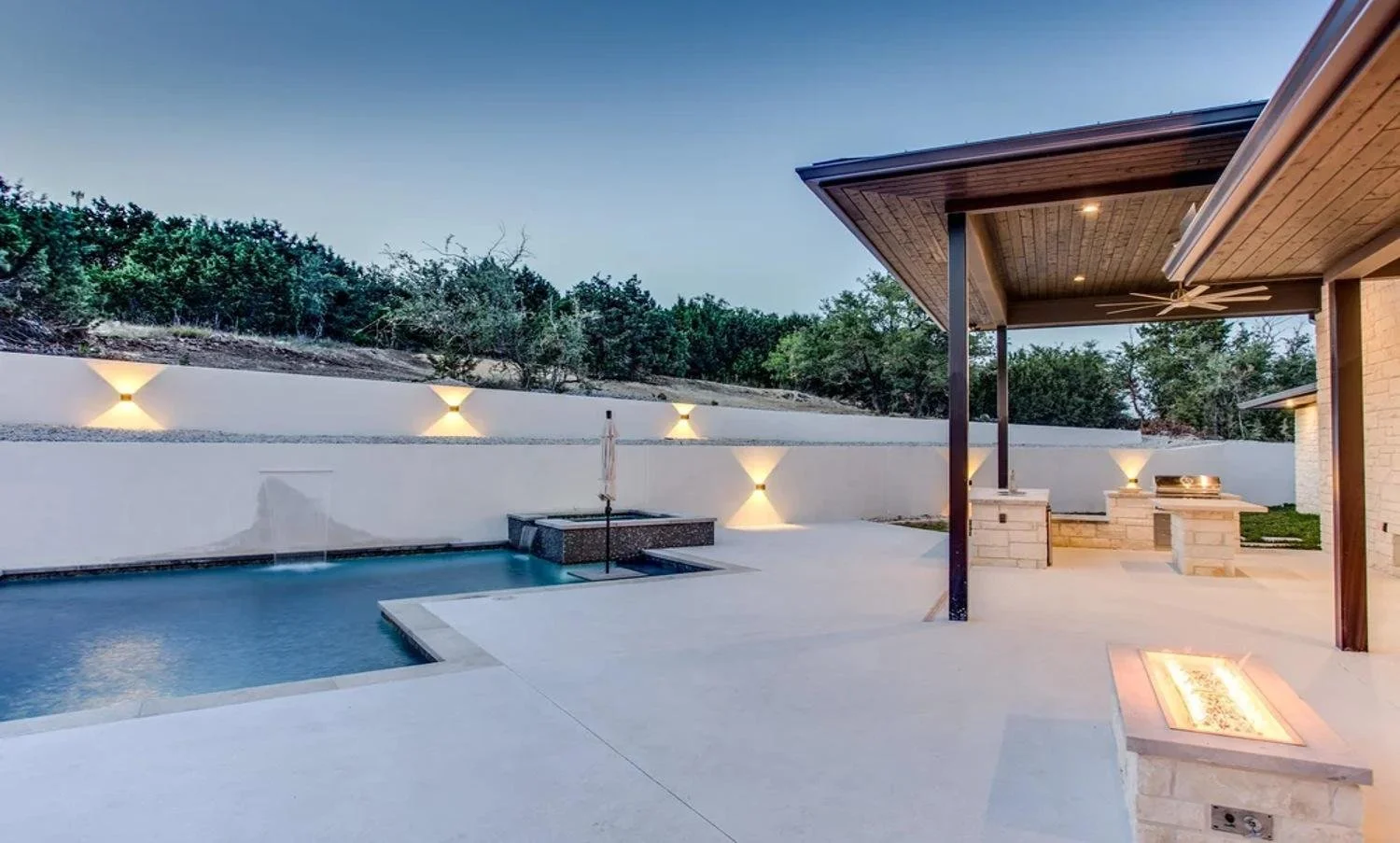
Can Your Lot Hold the Home, Pool, and Driveway You Want?
📌 Key Takeaways
A great custom home starts by testing whether the land can hold the whole lifestyle, not just the house.
Test Everything Together: The home, pool, driveway, views, and outdoor spaces must work as one connected plan.
Walk Before Drawing: A property walk helps reveal slope, access, utilities, drainage, and rule issues early.
Protect The Best Fit: The strongest layout may need tradeoffs between views, pool space, driveway comfort, and budget.
Keep Plans Flexible: Septic, permits, watershed rules, and HOA limits can affect where features truly belong.
Rank Priorities Early: Clear must-haves help the land shape the design before costly plans become fixed.
Read the land first, then draw the dream.
Spicewood and Hill Country homeowners planning a custom home will gain clearer site-planning confidence here, preparing them for the detailed overview that follows.
~ ~ ~ ~ ~ ~ ~ ~ ~ ~ ~ ~ ~ ~ ~ ~ ~ ~
Start with the land.
The gravel crunches under your shoes as your family stands where the pool might go, then turns to picture the driveway curving toward the front door.
You may already see the home in your mind. The real question is whether the lot can support the home, pool, driveway, views, outdoor living, utilities, drainage, and rules as one connected plan. What if the land changes the dream after we’ve already fallen in love with it?
Yes, a Spicewood lot can often hold the home, pool, driveway, and outdoor living plan you want. But those features have to be tested together against the real conditions of the property. A beautiful Hill Country lot is not automatically ready for every feature in the exact place your family imagines.
The lot has to hold the lifestyle, not just the house.
That is the calm way to think about site feasibility. It is not a reason to panic. It is the land’s reality check before the dream gets drawn in ink.
Can Your Lot Hold the Lifestyle, Not Just the House?
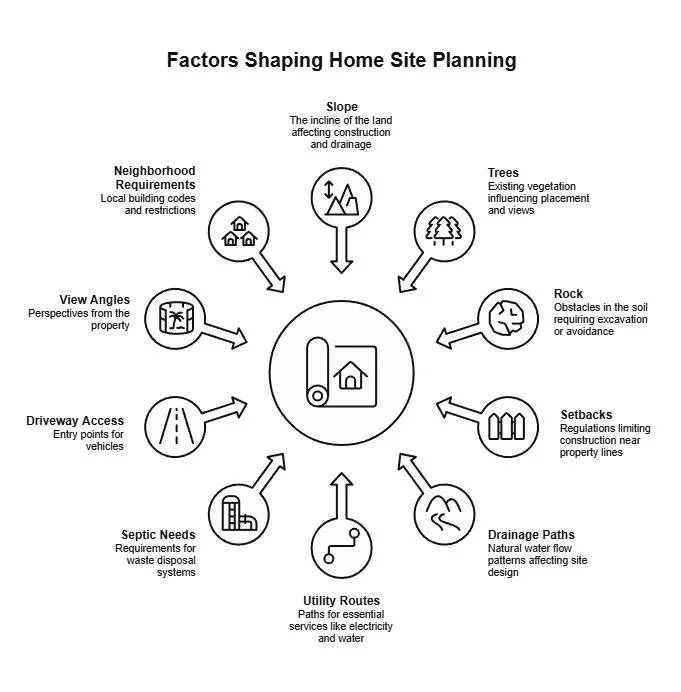
A custom home site is not a blank sheet of paper. It has slope, trees, rock, setbacks, drainage paths, utility routes, possible septic needs, driveway access, view angles, and neighborhood or permitting requirements. Each one can shape where the home sits and how the property feels day to day.
As a general planning principle, the house footprint should not be studied alone. The pool may need the same level area that makes sense for the driveway. The best view corridor may compete with the outdoor kitchen. A septic area may affect where patios, cabanas, or future additions can go.
This is where early online research reaches its limit. You can learn the vocabulary online, but the real planning moment happens on the property.
Riverbend Homes describes the first step of the Riverbend Homes building process as a Discovery Meeting at the property. During that meeting, the goal is to understand the homeowner’s vision, assess site feasibility, and identify infrastructure requirements that may affect budget and design.
The Feature-Fit Decision Grid: Home, Pool, Driveway, Views, and Outdoor Living
Use this grid as a planning conversation tool. It is not a technical site assessment, and it does not replace a builder, surveyor, engineer, septic designer, HOA review, or permitting authority. It helps your household ask better questions before detailed plans become emotionally and financially fixed.
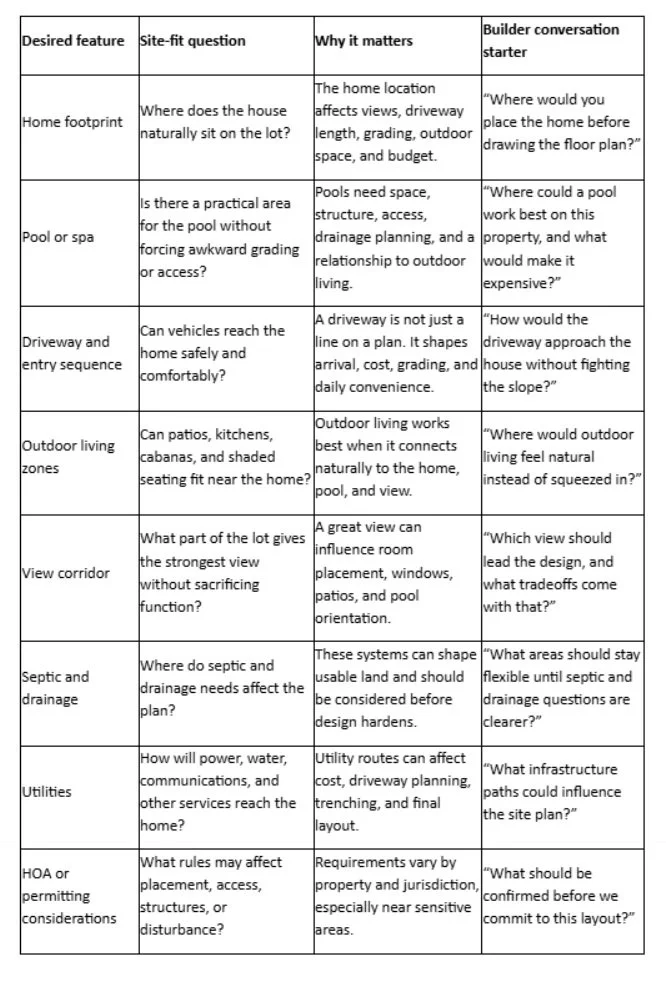
Walk your lot with a site-first builder before design gets locked in. That one step can turn vague worry into specific questions.
Why Pools, Driveways, and Views Compete for the Same Land
The most common planning mistake is treating each desired feature as separate. The home goes here. The pool goes there. The driveway comes later. The view will somehow work.
That approach can create conflict. A pool and cabana may want the same flat area as the most efficient driveway turn. A dramatic entry sequence may push the home farther from the best view. A large covered patio may work beautifully on paper but crowd the pool deck once drainage and utility paths are considered.
Hill Country properties reward careful planning. They also expose weak assumptions quickly.
In Spicewood and the Lake Travis area, it is sensible to ask about permitting, septic, and watershed considerations early. For official context, Travis County provides information on single-family development permits, TCEQ explains homeowner information related to on-site sewage facilities, and LCRA publishes guidance on the Highland Lakes Watershed Ordinance. These sources are public-authority references, not a substitute for property-specific review.
Ultimately, feature fit must be verified on-site before finalizing design documents.
What a Builder Looks for During a Property-Based Discovery Meeting
A strong property walk connects the dream to the dirt. It brings inspiration images, family priorities, and site realities into the same conversation.
Riverbend Homes is a second-generation family-owned business that has designed and built homes in the Texas Hill Country since 1996. This initial site visit establishes foundational infrastructure needs before the design phase accelerates. For homeowners searching for a Spicewood custom home builder, that site-first approach matters because Spicewood lots can involve views, acreage, terrain, lake-area considerations, and outdoor-lifestyle goals.
A builder may look at where the home naturally belongs, how cars will enter, where outdoor living will feel comfortable, what areas should remain flexible, and which unknowns need professional confirmation. That does not mean every answer appears in one visit. It means the right questions surface early.
That is how uncertainty becomes manageable.
Riverbend’s process also states that the team stays involved during design to help maintain the vision and budget, then pauses at bid-set completeness to estimate final construction costs before proceeding. That matters because design momentum can become expensive when site realities are discovered late.
How to Prioritize When the Lot Cannot Hold Everything Equally
Some lots can hold every desired feature comfortably. Others can support the full lifestyle only if the priorities are sequenced with care.
Start with daily life. If your family will use the pool four afternoons a week, it should not feel like an afterthought. If arrival experience matters, the driveway should not be treated as leftover space. If the view is the reason you love the property, the home and outdoor areas should protect that view instead of accidentally blocking it.
Then separate must-haves from nice-to-haves. One household member may care most about the pool. Another may focus on budget. Someone else may be thinking about guests, aging parents, teenagers, boats, pets, or a future detached structure. Put those priorities on the table early, before one floor plan starts making decisions for everyone.
A common pitfall is trying to preserve every idea equally. That rarely creates the best home. Better planning ranks the features, then lets the land help shape the final design.
Constraints are not dream-killers. They are design inputs.
Questions to Ask Before Paying for Detailed Plans
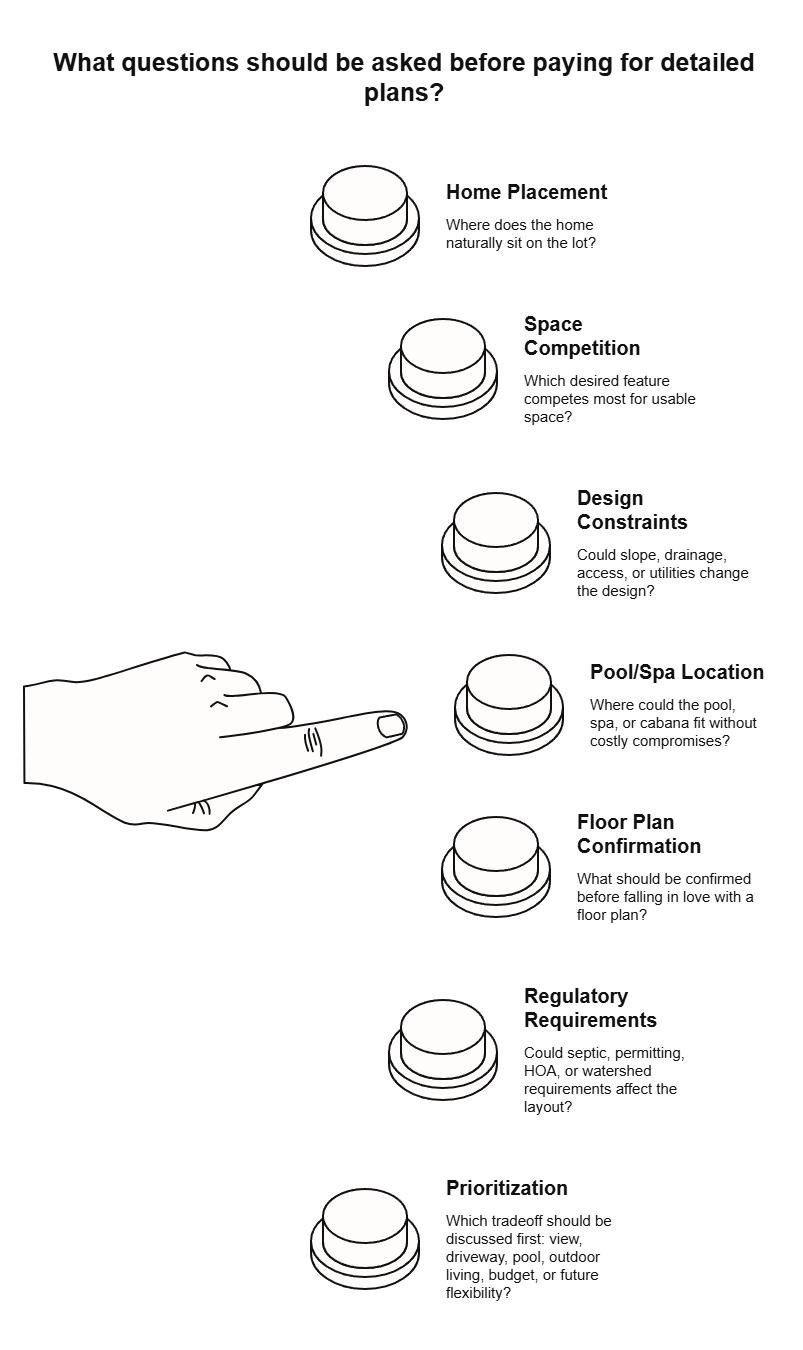
Before your household invests heavily in full architectural plans, bring these questions to a property-based builder conversation:
Where does the home naturally sit on this lot?
Which desired feature competes most for usable space?
Could slope, drainage, access, or utilities change the design?
Where could the pool, spa, or cabana fit without forcing costly compromises?
What should be confirmed before we fall in love with a floor plan?
Could septic, permitting, HOA, or watershed requirements affect the layout?
Which tradeoff should the household discuss first: view, driveway, pool, outdoor living, budget, or future flexibility?
These questions will not answer everything. They will reveal what needs professional review before the design becomes fixed.
That is the point.
The Calm Next Step: Read the Land Before the Design Is Locked
Return to the property in your mind. The pool is still there. The driveway still curves toward the entry. The outdoor living space still faces the view. Nothing about site-first planning takes that dream away.
It simply asks the land to join the conversation before the drawings get too far ahead.
That shift moves your household from uncertainty to grounded confidence. You are no longer asking whether a beautiful lot can somehow absorb every wish. You are asking how the home, pool, driveway, view, outdoor living, access, infrastructure, and rules can work together.
For a high-consideration custom home, that is a healthier starting point.
Explore the Riverbend Homes building process to see how a property-based Discovery Meeting fits before design and budgeting decisions harden. When your household is ready to talk through a specific lot, you can contact Riverbend Homes to start that conversation.
Read the land first. Then draw the dream.
Disclaimer: This content is for general educational planning only. Site feasibility, permitting, septic, drainage, engineering, HOA, and watershed requirements vary by property and should be reviewed with qualified professionals and the appropriate authorities before design or construction decisions are made.
Our expert team uses AI tools to help organize and structure our initial drafts. Every piece is then extensively rewritten, fact-checked, and enriched with first-hand insights and experiences by expert humans on our Insights Team to ensure accuracy and clarity.
Our Editorial Process:
Our content is developed from Riverbend Homes’ published process, brand materials, local building experience, and homeowner-facing educational resources. Each article is structured to help Texas Hill Country homeowners understand custom-home decisions in plain language, connect early planning questions to real site and budget considerations, and identify the next responsible conversation before design or construction commitments move forward.
About the Riverbend Homes Insights Team
The Riverbend Homes Insights Team is our dedicated engine for synthesizing complex topics into clear, helpful guides. While our content is thoroughly reviewed for clarity and accuracy, it is for informational purposes and should not replace professional advice.
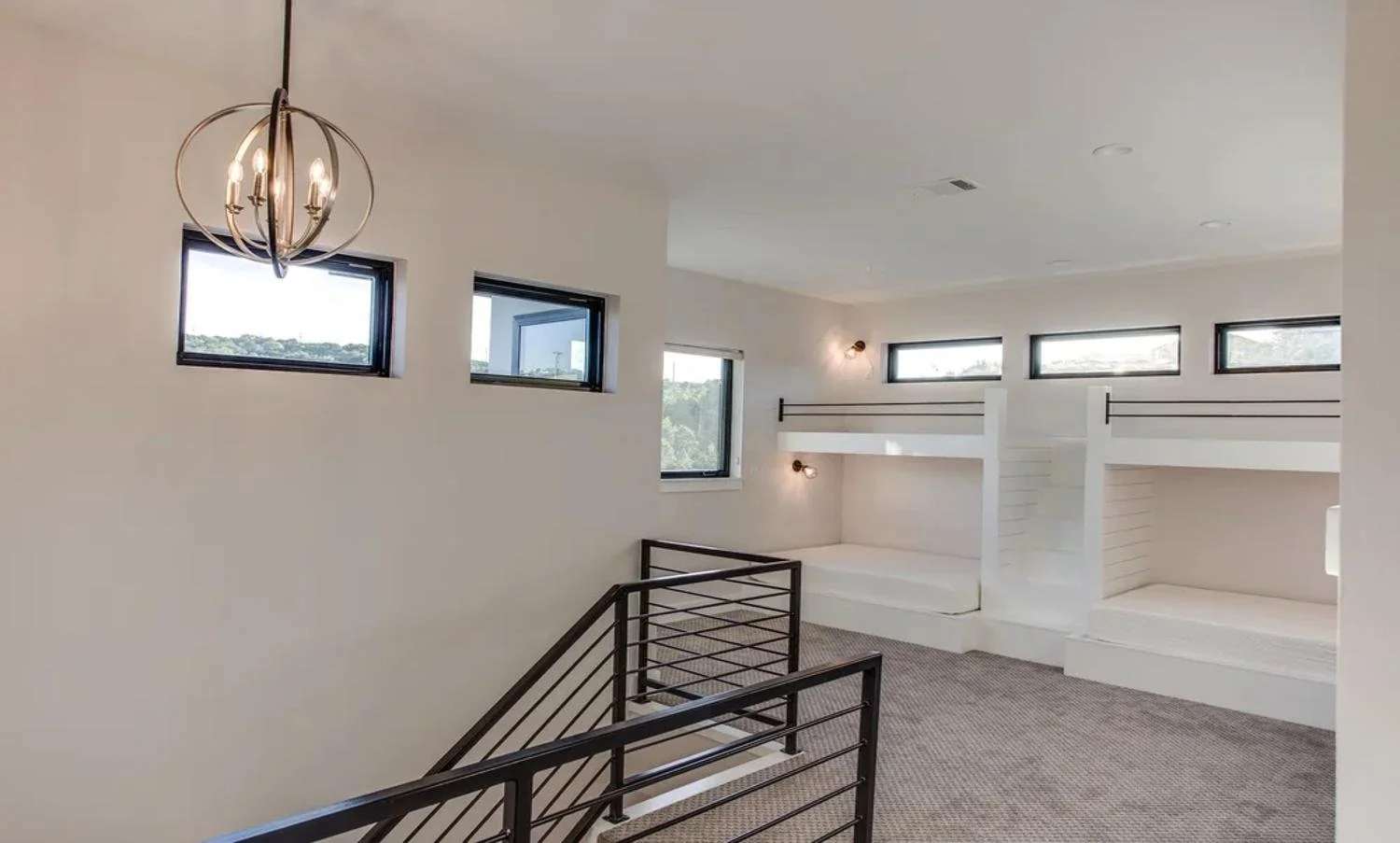
Survey Papers in Hand: 5 Lot Checks Before Your Dream Home Is Drawn
📌 Key Takeaways
A custom home plan works best when the land, not the dream sketch, leads the first decisions.
Walk Before Drawing: A property walk can reveal limits that a floor plan cannot solve later.
Check Usable Space: Lot size matters less than where the home, garage, pool, and patio can fit.
Read The Terrain: Slope, rock, and drainage can shape the foundation, driveway, budget, and timeline.
Verify Utilities Early: Water, septic, electric, and buried lines need answers before design choices become fixed.
Test The Dream: Views, privacy, sun, and outdoor living should match how the family will live daily.
Let the lot speak first, so the design can start with better facts and fewer costly surprises.
Luxury custom home buyers evaluating land in Spicewood will gain a clearer first-step checklist, preparing them for the detailed overview that follows.
~ ~ ~ ~ ~ ~ ~ ~ ~ ~ ~ ~ ~ ~ ~ ~ ~ ~
Start with the land.
The survey papers are spread across the hood of the car, the limestone is uneven under your boots, and the view across the Spicewood lot already has you picturing windows, a driveway, a pool, and a covered patio.
You have the dream in your head. You may even have inspiration photos on your phone. Still, before the floor plan is drawn, the land needs a careful first read. What if the lot changes the plan? That is a reasonable concern. The goal is not to shrink the dream. The goal is to understand what the land is asking the design to solve.
Start With the Land Before the Floor Plan
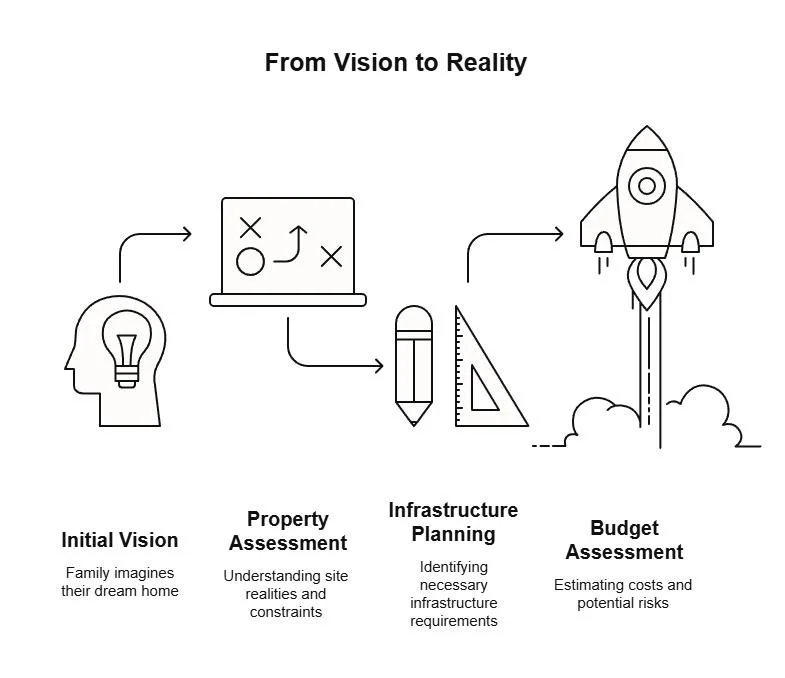
A luxury custom home should begin with the property, not a sketch. Inspiration images are useful, but they cannot answer the early site questions that shape design, infrastructure, timing, and budget.
That matters in Spicewood, where views, slope, rock, outdoor living, Lake Travis proximity, and county nuance can all affect the first conversation. Spicewood is Riverbend Homes’ home market and is often described as the Gateway to the Hill Country, but this article should not be read as a location rulebook. Depending on where your lot sits, different county, HOA, septic, floodplain, utility, or permitting questions may apply.
This is where a property-first conversation helps. Riverbend’s documented process begins with a Discovery Meeting at the property to understand your vision, assess site feasibility, and identify infrastructure requirements that may affect budget and design. You can learn more about the Riverbend Homes building process when you are ready to connect your notes to a builder-led conversation.
Site feasibility is the early process of understanding whether a property can support the home a family imagines. It includes site realities, infrastructure requirements, design implications, and budget risk.
Not everything is settled on the first walk. That is the point.
What Survey Papers Can Tell You—and What They Cannot
Your survey papers are a map. They are not yet a build plan.
A survey can help identify boundaries, easements, setbacks, existing features, and clues about the lot. It can show where the property begins and ends. It may also help you see where a driveway, home, pool, or outdoor living area could become more complicated.
What it cannot do by itself is translate the land into a full design decision. It does not automatically answer whether the best view works with the best driveway approach. It does not settle septic feasibility, drainage strategy, utility routing, HOA rules, or permitting requirements. Those items need professional review.
Your job is not to become a surveyor, engineer, septic designer, or permitting expert. Your job is to ask better first questions.
The 5 Lot Checks to Make Before Your Dream Home Is Drawn
Use this worksheet during your first property walk. It is not a professional feasibility determination. It is a first-pass conversation tool that helps you organize what to ask next.
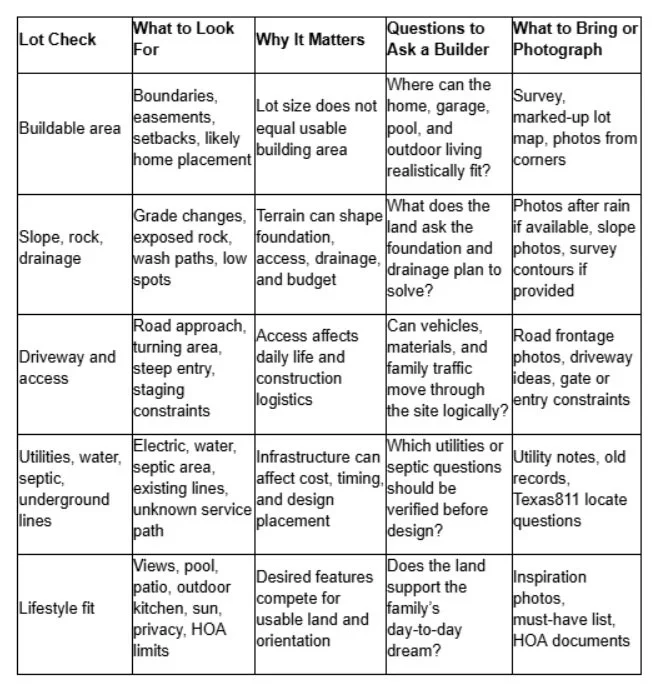
1. Check the Buildable Area, Not Just the Lot Size
A generous lot can still have a very specific best place to build.
Start by looking at the survey with one practical question in mind: where can the home realistically sit? Then widen the question. Where would the garage go? Where would the driveway arrive? Where could an in-ground pool, cabana, or outdoor kitchen fit without forcing the home into an awkward position?
The buildable area may be shaped by easements, setbacks, slope, protected areas, HOA requirements, driveway needs, or the relationship between indoor rooms and outdoor living. Some of those items are visible on paper. Others become clearer only when you stand on the land.
This is not a pass-fail check. It is a fit check.
2. Walk the Slope, Rock, and Drainage Patterns
Many beautiful Hill Country lots owe their character to terrain. The view may come from elevation. The privacy may come from a wooded slope. The outdoor living opportunity may come from how the home can sit into the land.
That same terrain can influence foundation strategy, drainage planning, retaining needs, driveway approach, and budget expectations. Look for exposed rock, low spots, wash paths, steep transitions, and places where water appears likely to move. Photos after rain can be useful if you have them.
A smart early question is simple: would the best view create a more complex foundation, access, or drainage question? For a deeper look at this topic, see Riverbend’s article on Navigating Lake Travis Topography.
3. Trace the Driveway and Construction Access
Access is not only about the finished driveway. It is also about construction deliveries, equipment, staging, guest parking, and daily life after move-in.
Stand near the road or entry point and picture 3 different moments: a concrete truck arriving, family pulling in after dinner, and guests finding the front door for the first time. The driveway has to work for all of them. A beautiful homesite can still become frustrating if the approach is steep, narrow, oddly curved, or in conflict with the best orientation for the house.
Photograph the road frontage, possible driveway entry, gate location, turning areas, and any trees or terrain that may affect the approach. Small access questions tend to grow once plans become emotionally fixed.
Better now than later.
4. Mark the Utility, Water, Septic, and Underground-Line Questions
Infrastructure questions are easier to address before the design assumes a specific home placement.
Start with what you know. Is there existing electric service? Is water available, or is another source being discussed? Is there prior septic documentation? Are there visible utility boxes, meters, easements, or old records? None of these details should be treated as final without verification, but each one can help shape the next professional conversation.
For digging or exploratory work, Texas811 homeowner guidance says Texas law requires you or your contractor to contact 811 two business days before digging, excluding weekends and holidays. The same page explains that Texas811 helps arrange utility locators to mark underground lines before digging. (Texas 811)
For septic, keep the language conditional. Depending on where the lot sits, on-site sewage requirements may involve local or regional authorities. The LCRA On-Site Sewage Facilities Program states that LCRA regulates on-site sewage facilities within a 2,000-foot zone around Lake Travis and a 2,200-foot zone around the upper Highland Lakes. (LCRA)
5. Test the Dream Features Against the Land
The question is not only, “Can the lot hold a house?” It is, “Can the lot support the life you are picturing?”
That means testing the dream features against the land. A pool may want sun, privacy, and enough usable area. A covered patio may need the right connection to the kitchen and living room. A sunset view may affect window placement, glare, and room orientation. A detached casita or separate primary wing may need more careful planning around circulation, utilities, and privacy.
This is where survey papers, photos, and inspiration images should come together. The dream is still welcome. It just needs to meet the property before the floor plan takes over.
If you are evaluating land in the area, Riverbend’s Spicewood custom home builder page offers more local context about building in Spicewood and the Lake Travis area.
What to Bring to a Builder-Led Discovery Meeting
Bring the materials that help a builder see both the dream and the constraints. You do not need a finished plan. You need enough information to start a grounded conversation.
Bring survey papers, parcel or plat documents, HOA materials if available, photos and videos from different parts of the lot, inspiration images, a must-have and nice-to-have list, rough budget expectations, and known questions about utilities, septic, access, drainage, views, and outdoor living.
Also bring your notes from the five-check worksheet. They show where you already see uncertainty.
This on-site evaluation naturally transitions into a formal Discovery Meeting. That setting matters because the conversation can connect your vision to site feasibility and infrastructure requirements before design and budget move too far forward. After that, the process can move into design and budget alignment with clearer assumptions.
Especially when project timelines begin to feel urgent, one careful property walk before design can prevent rushed assumptions.
When the Lot Needs a Professional Reality Check
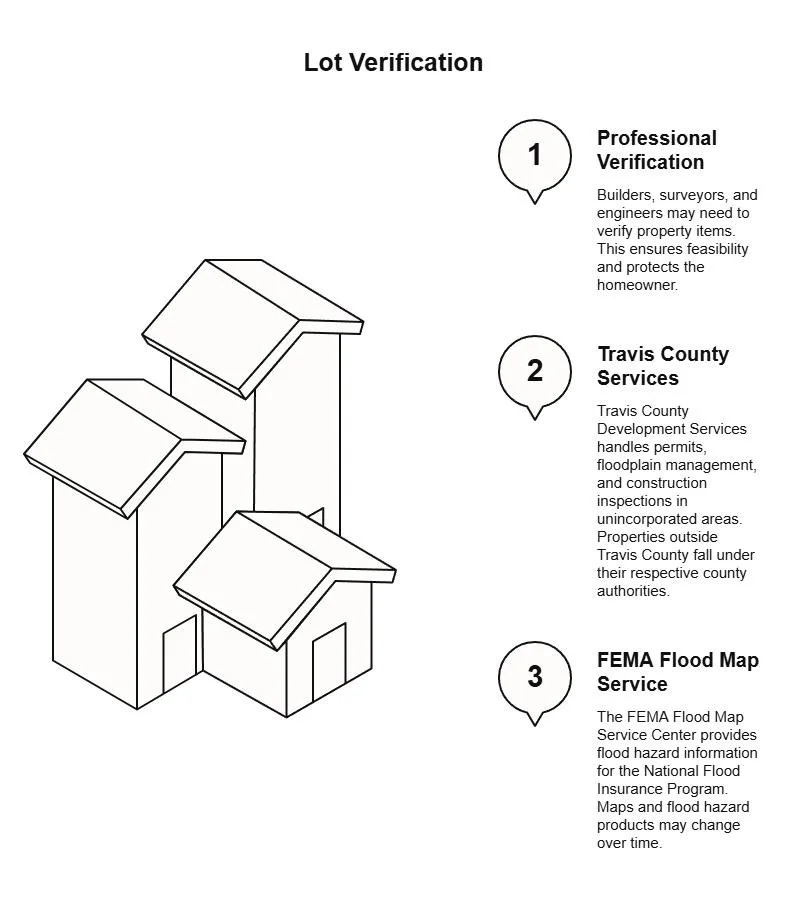
A homeowner worksheet can organize questions. It cannot determine feasibility.
That distinction protects you. A builder, surveyor, engineer, septic professional, utility locator, HOA, or permitting authority may need to verify the items that matter for your specific property. If a check raises uncertainty, the next step is not panic. It is a better conversation.
For relevant unincorporated-area situations, Travis County Development Services describes its role in development outside corporate city limits, including permits, floodplain management, construction activity inspections, and subdivision regulation. Because Spicewood spans multiple counties, properties located outside of Travis County will fall under the jurisdiction of their respective authorities—such as Burnet or Blanco counties—for similar requirements.
For flood questions, the FEMA Flood Map Service Center is the official public source for flood hazard information produced for the National Flood Insurance Program. FEMA notes that maps and flood hazard products may change over time, so current lookup and professional interpretation matter. (msc.fema.gov)
Let the Lot Shape the First Conversation
The survey papers are not the finish line. They are the start of a better property conversation.
Before the dream is drawn in ink, let the land speak first. Walk the boundaries. Notice the slope. Trace the driveway. Mark the utility and septic questions. Test the pool, patio, views, and outdoor living against the actual ground beneath your feet.
Aligning your vision with the lot's physical realities now prevents costly redesigns later. When the land is read early, the design conversation starts with better facts, calmer expectations, and a clearer path from vision to feasibility.
Save the five-check worksheet and bring it to your first builder conversation. Then use the Riverbend Homes building process to see how a property-based Discovery Meeting can turn those first notes into a more grounded path forward.
Our expert team uses AI tools to help organize and structure our initial drafts. Every piece is then extensively rewritten, fact-checked, and enriched with first-hand insights and experiences by expert humans on our Insights Team to ensure accuracy and clarity.
Our Editorial Process:
Our content is developed from Riverbend Homes’ published process, brand materials, local building experience, and homeowner-facing educational resources. Each article is structured to help Texas Hill Country homeowners understand custom-home decisions in plain language, connect early planning questions to real site and budget considerations, and identify the next responsible conversation before design or construction commitments move forward.
About the Riverbend Homes Insights Team
The Riverbend Homes Insights Team is our dedicated engine for synthesizing complex topics into clear, helpful guides. While our content is thoroughly reviewed for clarity and accuracy, it is for informational purposes and should not replace professional advice.
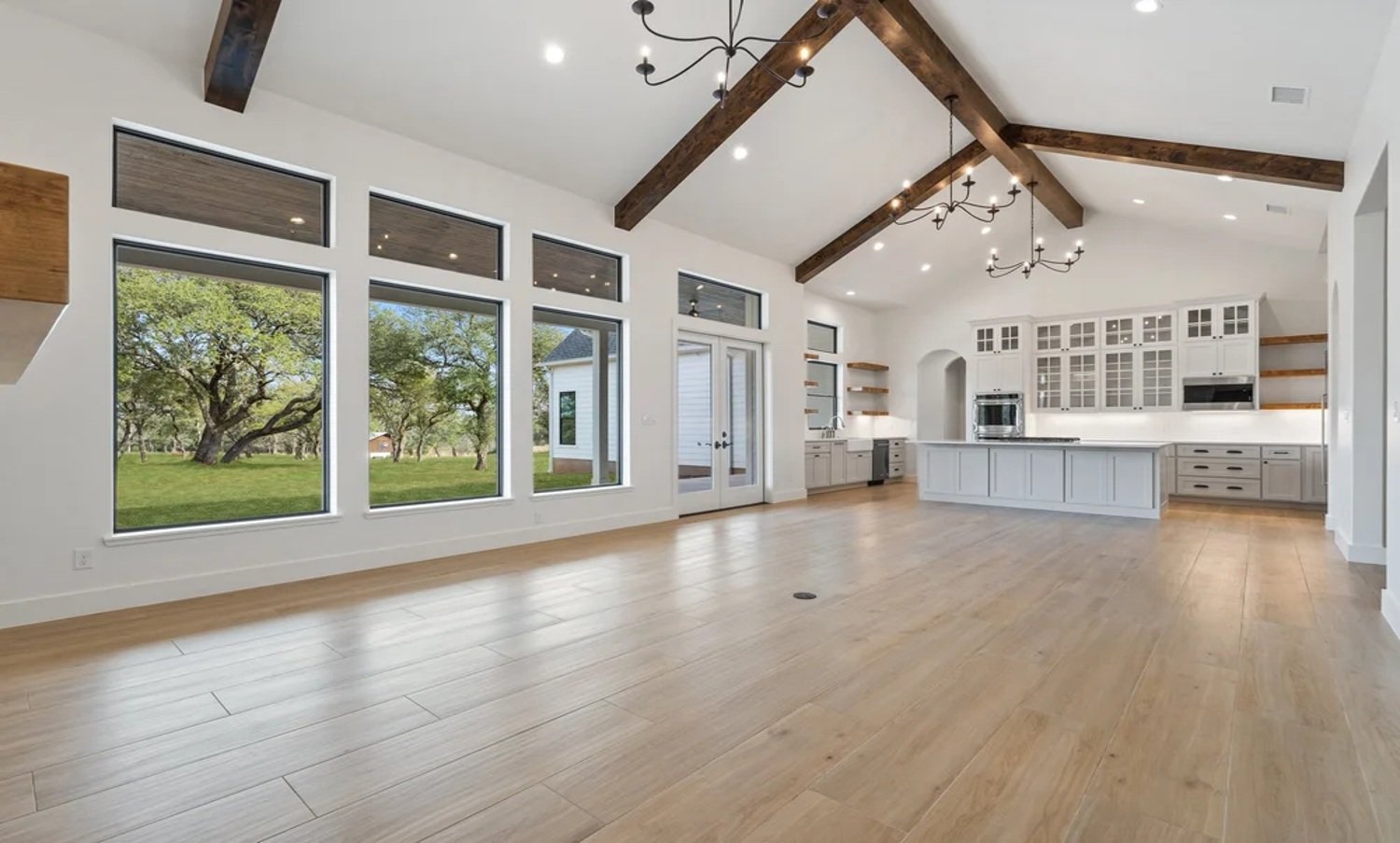
Beyond the Kitchen Table Sketches: How Custom Home Design-Build Stops Budget Overruns
Custom home budgets blow up when architects and builders work separately. Design-build prevents overruns by calculating costs during design, not after plans are finished.
📌 Key Takeaways
Custom home budgets blow up when design and construction teams work separately—unified design-build keeps costs visible from the start.
Separate Teams Create Surprise Bills: When your architect and builder don't talk until plans are done, you fall in love with a design before anyone checks what it actually costs to build.
Real-Time Cost Checks Prevent Heartbreak: Design-build teams calculate budget impact as you make decisions, not months later when changes are expensive.
Your Lot Hides Costs You Can't See: Rock, slopes, septic systems, and utility access in Hill Country terrain can add tens of thousands—a site walk before design catches these early.
Allowances Should Give You Control: Good contracts let you shop for finishes yourself and keep the savings, rather than locking you into builder-selected materials.
Daily Oversight Speeds Up Your Build: Builders who limit their projects and show up every day finish faster and catch problems before they become budget emergencies.
One team from start to finish means no finger-pointing and no surprise invoices.
Texas Hill Country homeowners planning custom builds will gain budget protection strategies here, preparing them for the detailed process overview that follows.
~ ~ ~ ~ ~ ~ ~ ~ ~ ~ ~ ~ ~ ~ ~ ~ ~ ~
The sketches are spread across the table. Inspiration photos glow on the laptop screen. Maybe there's a Pinterest board with 47 saved images of Hill Country great rooms and outdoor kitchens. The excitement is real. So is the knot in your stomach.
You and your partner have purchased the lot. You've imagined the sunrise view from a future primary suite. You've talked about where the kids will play, where guests will gather, how the house will finally feel like yours. Yet, beneath the anticipation lies a persistent financial anxiety.
That fear is not irrational. It's not a sign of cold feet or poor planning. It's the reasonable response of a thoughtful person facing one of the largest financial commitments of their life—and knowing that custom home projects have a reputation for spinning out of control.
The good news? Budget overruns are not inevitable. They follow a predictable pattern, and that pattern can be interrupted. Understanding where budget problems actually begin—and how a unified custom home design-build approach stops them—is the first step toward building your Texas Hill Country home with both your vision and your financial boundaries intact.
The Kitchen-Table Moment: Why Custom Home Budget Anxiety Starts So Early
Budget anxiety doesn't wait for construction to begin. It starts the moment you realize that the gap between "dream" and "done" is filled with decisions you don't yet know how to make.
If you're researching and budgeting this spring, the timing matters. Late winter through early spring is generally when many homeowners across the Hill Country begin preparing for major construction decisions, making it an ideal time to understand what causes overruns and what helps prevent them.
You may have already encountered a version of this tension. One partner gravitates toward the soaring ceilings and the chef's kitchen. The other keeps circling back to the spreadsheet, wondering how much contingency is really enough. Both concerns are valid. Both people are trying to protect the same thing: a home that works for your family without becoming a source of regret.
The fear isn't really about money. It's about control. Will you be the one making the hard calls, or will those calls be made for you—by contractors who didn't communicate, by site conditions no one anticipated, by a design that looked beautiful on paper but costs significantly more than anyone quoted?
Custom home projects carry an uncomfortable reputation. Stories circulate about budgets that doubled, timelines that stretched into years, and relationships between homeowners and builders that ended in lawyers' offices. Even if you've never personally experienced a build gone wrong, you've probably heard enough cautionary tales to wonder whether the dream is worth the risk.
Here's what those stories often have in common: the budget problem started long before anyone poured concrete. It started when design decisions were made without real-time cost feedback. It started when no one asked hard questions about the lot until permits were already in motion. It started when the architect and the builder operated in separate worlds, each assuming the other would catch the problem.
Why Custom Home Budgets Blow Up Before the House Is Even Built
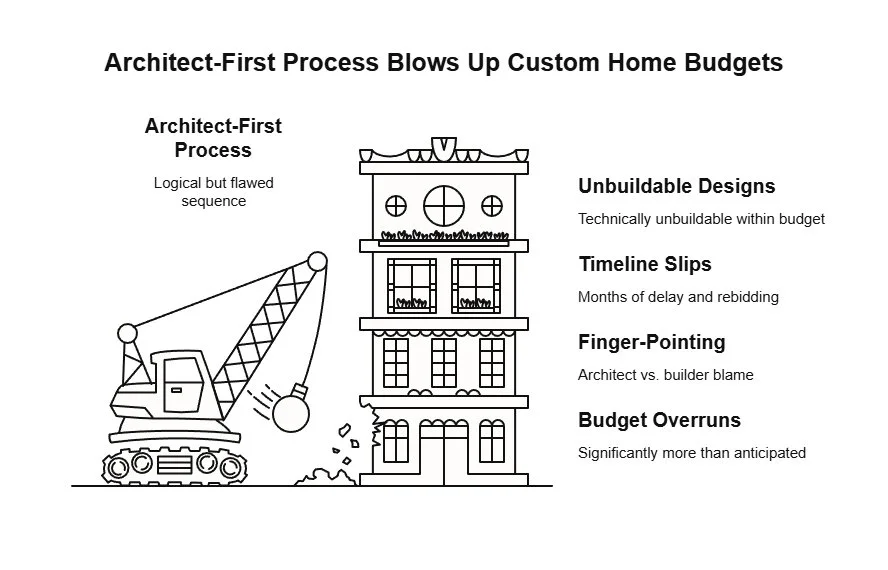
The traditional custom home process follows a sequence that feels logical but contains a structural flaw.
First, you hire an architect. The architect asks about your vision, your lifestyle, your aesthetic preferences. Together, you develop a set of plans. The architect may suggest features you hadn't considered, materials that would elevate the design, spatial arrangements that solve problems you didn't know you had. The plans grow more beautiful and more detailed.
Then, once the design is complete, you take those plans out to bid. Multiple builders review the drawings and submit their estimates. You compare the numbers, select a contractor, and prepare to break ground.
The problem? By the time you receive those bids, you've already fallen in love with the design. You've shown the renderings to friends and family. You've mentally moved into that house. And now a builder is telling you it will cost significantly more than you anticipated—or that certain features can't be built on your lot without expensive modifications.
This is the architect-first, bid-later trap. It's the moment when finger-pointing begins. The architect says the builder is overcharging. The builder says the architect designed something that ignores site realities. You're caught in the middle, trying to figure out who to trust while your budget stretches and your timeline slips.
The root cause is not bad intentions. It's disconnected workflows. When the person designing your home has no accountability for construction costs, and the person building your home had no input during design, misalignment is almost guaranteed. Beautiful ideas get approved without anyone calculating what they'll actually cost to execute. Site conditions—rock, slope, utility access, septic requirements—get discovered after the plans are locked.
Fragmented teams lead to designs that are technically unbuildable within the set budget. The redesign fees, the rebidding process, the months of delay—these are the hidden costs of a workflow that separates imagination from reality.
This is not a criticism of architects or builders as individuals. It's a recognition that the traditional sequence creates structural incentives for problems. And if you're planning to build in the Texas Hill Country, where site conditions are rarely simple, those problems multiply.
What Custom Home Design-Build Actually Means for a Homeowner
Custom home design-build is a unified project delivery system where a single entity assumes responsibility for both architectural design and construction.
That definition sounds straightforward, but the implications are significant. Instead of hiring an architect first and a builder later, you work with one integrated team from the beginning. Design decisions and construction realities stay in the same conversation. The people imagining your home are the same people who will build it—and who are accountable for delivering it within your budget.
Think of it this way: design-build puts the architect and the accountant at the same desk from day one.
When a design idea emerges, someone on the team immediately asks: What will this cost? What does it require from the site? What tradeoffs does it create elsewhere in the budget? Those questions don't wait until the design is finished. They happen in real time, while changes are still easy and inexpensive to make.
For you as a homeowner, this means something practical: you don't fall in love with a plan you can't afford. You don't discover six months into the process that your lot requires $80,000 in retaining walls that nobody mentioned. You don't find yourself choosing between gutting your design or blowing past your budget.
Design-build is not a magic wand. Challenges still arise. Costs still require tradeoffs. But the unified structure means those challenges surface early, when you have options—not late, when you're trapped.
The Design-Build Institute of America has documented that this approach works best when multiple disciplines are convened early and managed within a unified framework. The principle applies whether you're building a commercial facility or a custom home: when design and construction operate as partners rather than separate contractors, accountability stays clear and surprises stay manageable.
For a deeper look at what design-build means in the context of custom homes, Riverbend Homes has published a plain-language explanation that avoids contractor jargon.
Continuous Estimating: The Budget-Protection Engine Most Homeowners Never See
Continuous estimating means that budget impact is calculated throughout the design process, not just at the end. This practice is the real power of design-build—not just organizational, but operational.
Every significant design decision triggers a cost check. Want to add a second primary suite for visiting parents? The team calculates what that does to your total before you commit. Considering a switch from stucco to stone on the exterior? You see the number before the plans are finalized.
This sounds obvious, but it's surprisingly rare in traditional custom home projects. When the architect and builder are separate entities with separate contracts, there's often no mechanism for real-time cost feedback. The architect may not have access to current construction pricing. The builder may not be involved until the design is complete. The homeowner is left hoping that the final bid will somehow match the original vision.
Hope-based budgeting is the opposite of what you need when building a luxury home. You need continuous visibility. You need someone who will tell you the truth while you still have room to adjust.
A well-structured design-build process includes a specific checkpoint: when plans reach what's called "bid-set completeness," the team pauses. Before pushing forward into permitting and final documentation, they calculate a realistic final construction estimate. This is the moment to confirm alignment—or to make changes before costs are locked.
Riverbend Homes builds this pause into every project. The team stays involved throughout design specifically to prevent budget drift. When plans reach the bid-set level, they stop and present a clear estimate. If adjustments are needed, they happen before anyone breaks ground—not after.
National construction-cost research from the National Association of Home Builders confirms that site work represents a meaningful cost category in home construction. That's national context, not a local Texas luxury-home estimate, but it reinforces the same principle: visible finishes are only one part of the financial picture. Early feasibility testing and ongoing estimating matter precisely because costs hide in places most homeowners don't initially see.
This approach won't eliminate every hard decision. Budgets are finite, and tradeoffs are part of any custom build. But continuous estimating ensures that you're making those tradeoffs with full information, not discovering them as unpleasant surprises months into construction.
To understand how this workflow stops the finger-pointing that plagues traditional builds, the linked article explains the accountability structure in more detail.
The Hill Country Reality Check: Rock, Slope, Utilities and Permits Change Everything
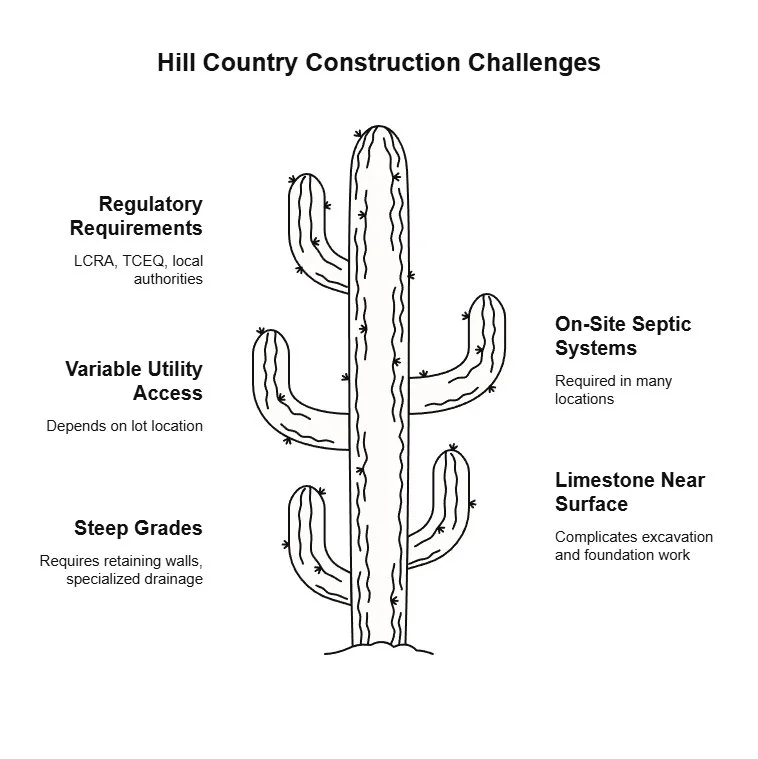
If you've purchased a lot in the Texas Hill Country, you already know the land is not simple. The views are spectacular precisely because the terrain is dramatic. Limestone ridges, steep grades, and irregular topography create the character that draws people to this part of Central Texas.
That same character creates construction realities that must be addressed early—or paid for later.
Slopes above a certain threshold often require retaining walls, stepped foundations, or specialized drainage systems. Limestone near the surface can complicate excavation and foundation work. Utility access varies widely depending on where your lot sits relative to existing infrastructure. And in many Hill Country locations, wastewater handling requires on-site septic systems rather than municipal sewer connections.
These are not reasons to avoid building. They're reasons to understand your site before custom home design locks in assumptions that don't match reality.
Septic planning is a particular concern near Lake Travis and throughout the Highland Lakes region. The Lower Colorado River Authority administers on-site sewage facilities programs for properties within its jurisdiction, regulating facilities within a 2,000-foot zone around the lake. The Texas Commission on Environmental Quality establishes statewide requirements for permits and approved plans, and advises arranging a preconstruction site evaluation by a licensed site evaluator or professional engineer. That evaluation typically includes a lot survey, soil analysis, and other suitability factors. Local authorities may impose additional restrictions beyond state minimums, particularly for lots close to waterways.
None of this is meant as legal or engineering advice. Every site is different, and specific requirements depend on your lot's location, soil conditions, and regulatory context. The point is that these factors affect both design and budget—and that a unified design-build team should be surfacing them early, during the Discovery Meeting, not discovering them after plans are finalized.
When site conditions are understood from the start, they become planning constraints rather than budget emergencies. A retaining wall that's designed into the project from day one is a feature. A retaining wall that gets added after foundation plans are complete is a crisis.
For more detail on how rock and slope impact custom builds in this region, the linked resource covers what to expect and how to plan accordingly.
From Discovery Meeting to Buildable Plan: How the Process Protects the Budget
A well-structured design-build process follows a clear sequence, and each phase serves a budget-protection function.
Discovery: Surface Reality Before Attachment
The process begins with a Discovery Meeting—not in an office, but on your property. Walking the lot together allows the team to assess site conditions firsthand: where the views are strongest, how the land slopes, where utilities connect, what infrastructure requirements will affect both design and budget.
This meeting is also the time to understand your vision. What are your must-haves? Do you have a preferred architectural style? How will you actually use the space? What's your budget for the project? The goal is alignment: making sure the team understands both what you want and what the site will support.
Riverbend Homes treats this Discovery Meeting as the essential first step. The team evaluates feasibility, identifies infrastructure needs, and begins connecting your vision to the realities of your specific lot. Problems that would otherwise surface months later get addressed before design work begins.
Design and Budget: Keep Decisions Tied to Costs
Once discovery is complete, the design phase begins—with the builder involved throughout. As plans develop, cost implications are calculated in real time. The team translates saved inspiration images, magazine clippings, or Pinterest boards into a design that fits both the site and the budget.
This is where continuous estimating does its work. Design choices don't outrun financial reality because someone is always asking what each decision costs. When plans reach bid-set completeness, the team pauses to present a realistic final construction estimate. If the number is right, permitting moves forward. If adjustments are needed, they happen now—not after contracts are signed.
Build: Faster Execution Through Daily Management
When construction begins, the unified accountability continues. Because the team that designed your home is the same team building it, there's no translation gap between plans and execution. Questions get answered quickly. Changes get evaluated against the original budget. Progress stays visible.
Riverbend Homes takes on a select number of projects at a time specifically to ensure close involvement. The commitment is to be on-site and managing the build every single day—not juggling dozens of projects with occasional check-ins. For homeowners, this translates to a faster timeline and fewer opportunities for miscommunication.
"Ben made it easy and fun to watch our designs come to life," one Austin-area client noted, describing the experience of staying informed and involved throughout construction.
For a complete walkthrough of this sequence, visit the process page on the Riverbend Homes website.
Budget Control Without Killing the Dream: Allowances, Selections and Autonomy
One of the fears that accompanies budget discipline is the loss of personal taste. If staying on budget means accepting whatever the builder chooses—generic finishes, builder-grade fixtures, no input on materials—then what's the point of building custom?
The right design-build partner understands that budget protection and design autonomy are not opposites. They work together.
Allowances are the mechanism. A well-structured contract includes allowances for categories like flooring, countertops, lighting, and fixtures. These allowances define how much is budgeted for each category, giving you clarity about what's included and what would constitute an upgrade.
But allowances are only useful if they're realistic and if you have genuine flexibility in how you use them. Some builders set allowances so low that overages are inevitable. Others restrict your ability to shop for better deals, requiring you to purchase through their vendors regardless of price.
A transparent design-build firm operates differently. Allowances are set at levels that genuinely support the finish quality appropriate for your project. And if you find a better price on a material you love—because you found a tile supplier running a promotion, or a lighting showroom with discontinued fixtures—you can capture those savings.
"He frequently found ways to save us money on our selections," one Riverbend Homes client reported, describing how the team actively helped identify value without sacrificing quality.
This approach respects your judgment. You're not a passive recipient of whatever the builder decides. You're a participant in the process, making informed choices about where to invest and where to economize—with full visibility into how those choices affect your overall budget.
For more on how shopping allowances work and what questions to ask, the linked article provides practical guidance.
The Budget Protection Checklist: 5 Questions to Ask Before You Approve Design Work
Before you commit to a design or sign a construction contract, these five questions will help you evaluate whether the process is set up to protect your budget—or whether you're walking into a structure that makes overruns likely.
This checklist is designed to be shared. If you and your partner have different priorities—one focused on the vision, one focused on the numbers—these questions give you common ground for evaluating any builder you're considering.
1. Who is responsible for both design decisions and construction budget alignment from day one?
If the answer is split across separate parties with no clear owner, expect gaps.
2. At what point do you stop design work and calculate a realistic final construction estimate?
The right answer should include a clear checkpoint, not just "later."
3. How do you surface site feasibility, rock, slope, utilities, and permit-related costs before final plans are approved?
A beautiful plan is not the same thing as a buildable one.
4. How do allowances work, and can I shop selections independently if I find better value?
This helps you protect both quality and flexibility.
5. How many projects are you actively managing at one time, and who is on site daily during construction?
Capacity discipline matters. Oversight is not a detail. It's part of the value.
These questions are not adversarial. They're clarifying. A builder confident in their process will answer them directly. Evasive responses or frustration at being asked are signals worth heeding.
For additional guidance on evaluating builders and avoiding common pitfalls, the article on how the right builder helps you avoid surprise bills covers what to look for and what to avoid. If you want to understand contract structures more deeply, Fixed-Price vs. Cost-Plus explains the tradeoffs in each approach.
When Design-Build Is the Right Fit for a Budget-Conscious Luxury Project
Design-build is the right fit when you want creativity, but not creative accounting.
Not every homeowner needs this approach. If your lot is flat and simple, your design preferences are standard, and you have deep experience managing construction projects, the traditional approach may work fine.
But if you're building in the Texas Hill Country—where site conditions are rarely straightforward—and if budget clarity matters as much as design creativity, design-build offers something the traditional approach cannot: unified accountability from vision to completion.
This is not about finding the cheapest build. It's about finding the clearest path to a buildable dream. It's about working with a team that will tell you the truth about costs while there's still time to adjust. It's about protecting both your investment and your peace of mind.
The right fit is someone who wants both creativity and boundaries. Someone who values transparency over pleasant surprises. Someone who recognizes that responsible planning is not small thinking—it's the smartest way to protect a significant vision.
Riverbend Homes has operated as a second-generation family-owned Texas Hill Country builder since 1996. The approach is straightforward: listen first, test ideas against site realities early, keep design and budget in the same conversation, and build with daily attention rather than occasional check-ins. For a clearer sense of how the company works and what it values, explore about Riverbend Homes and read what past clients say in the testimonials.
"He will keep you on budget and on time with no surprises," one client summarized after completing their custom home.
If you're in the spring planning phase—researching options, evaluating lots, trying to understand how to move from kitchen-table sketches to buildable plans—the next step is not a commitment. It's a conversation.
See the process to understand how Discovery, Design, and Build connect. When you're ready to talk about your specific lot and vision, schedule a Discovery Meeting to start the conversation on your property.
The dream doesn't have to outrun the budget. With the right structure, the right team, and the right questions, you can build exactly what you imagined—and know what it costs before you commit.
Our Editorial Process:
Our expert team uses AI tools to help organize and structure our initial drafts. Every piece is then extensively rewritten, fact-checked, and enriched with first-hand insights and experiences by expert humans on our Insights Team to ensure accuracy and clarity.
By: The Riverbend Homes Insights Team
The Riverbend Homes Insights Team is our dedicated engine for synthesizing complex topics into clear, helpful guides. While our content is thoroughly reviewed for clarity and accuracy, it is for informational purposes and should not replace professional advice.
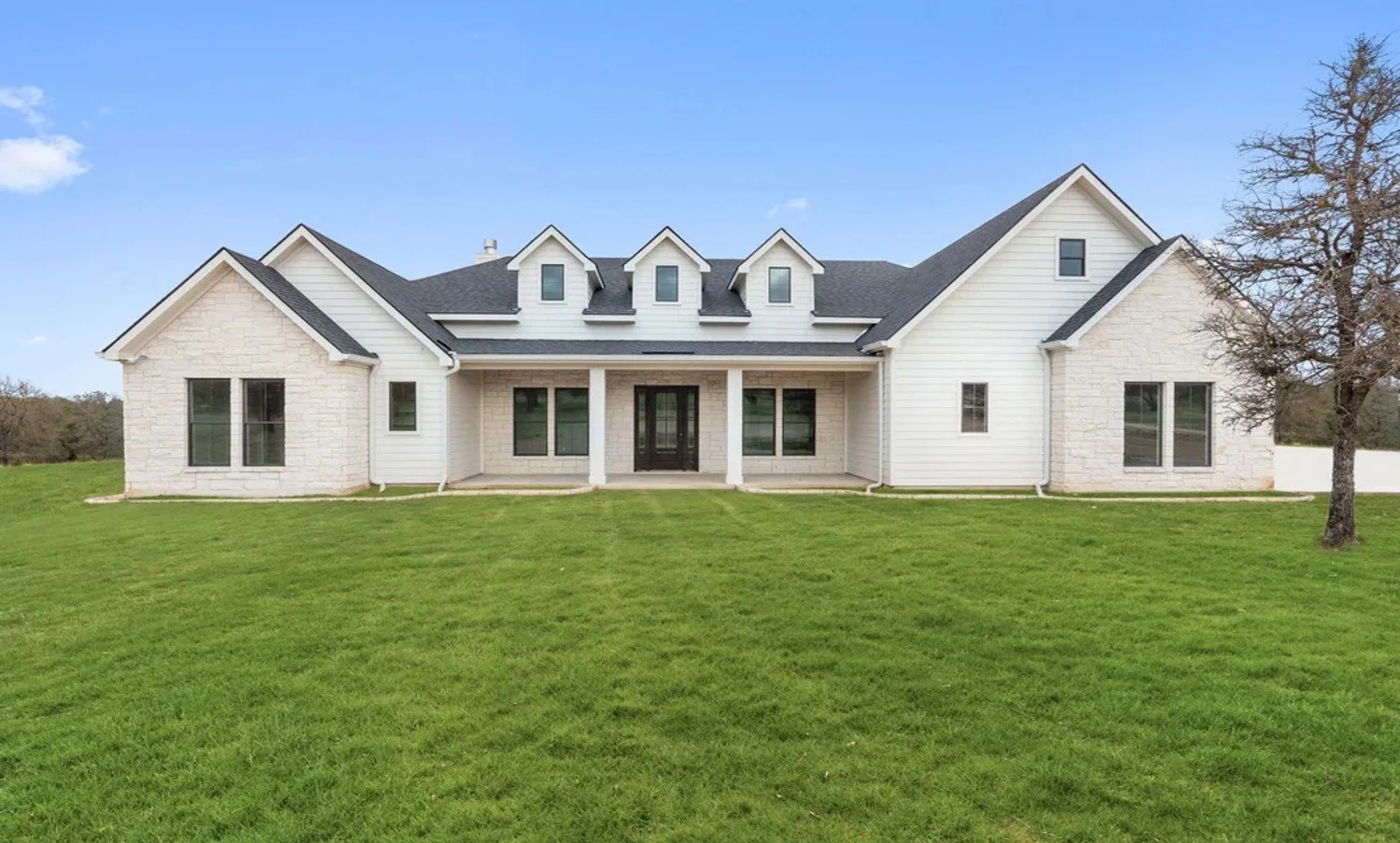
The Secret to Stress-Free Construction: How Single-Source Custom Building Protects Your Vision
Custom builds go off-track when architects and builders interpret plans differently. Design-build keeps one team accountable from first sketch to final walkthrough.
📌 Key Takeaways
One team handling both design and construction eliminates the finger-pointing and miscommunication that derail most custom home projects.
Fragmented Teams Create Chaos: When your architect and builder work separately, you become the full-time translator caught between conflicting interpretations and blame-shifting.
Unified Accountability Protects Your Vision: Design-build keeps your approved plans intact because the same people who drew them are responsible for building them correctly.
Field Decisions Stay on Track: When surprises happen during construction, one team balances aesthetics, structure, and cost together instead of defaulting to whatever's fastest.
Ask Who Owns Design Intent: Before signing, confirm one party is accountable if the build team says the plan needs to change—vague answers signal trouble ahead.
Limited Projects Mean Daily Presence: Builders who cap their workload can manage your site every day, catching problems before they become expensive fixes.
One accountable team turns construction from a stressful mediation job into an experience you actually enjoy.
Homeowners planning a custom build in the Texas Hill Country will find a clear framework for evaluating builders here, preparing them for the detailed process overview that follows.
~ ~ ~ ~ ~ ~ ~ ~ ~ ~ ~ ~ ~ ~ ~ ~ ~ ~
The call comes on a Saturday morning. Your friend just finished their custom home—eighteen months late and $200,000 over budget. The worst part? The house looks nothing like the renderings they fell in love with.
"The builder said the architect's design wasn't practical," they explain. "So they 'adjusted' things. By the time we noticed, the framing was done."
This story plays out across the Texas Hill Country more often than it should. Beautiful architectural plans slowly erode during construction. Details get "value engineered" away. The homeowner spends months mediating between professionals who point fingers at each other.
But here's what most people don't realize: this chaos isn't inevitable. It's the predictable result of a fragmented process—and it's entirely preventable.
Why Custom Builds Feel So Stressful Once Construction Starts
Fragmented accountability causes most construction stress, not the complexity of building itself.
In the traditional model, you hire an architect to design your home. Then you take those plans to a separate builder who prices and constructs the project. Sounds reasonable on paper. In practice, it creates a communication nightmare.
The architect draws what they believe is possible. The builder interprets those drawings through their own lens of cost and convenience. When conflicts arise—and they always arise—you're standing in the middle. The architect says the builder isn't following the plans. The builder says the plans aren't buildable. Meanwhile, the framing crew is waiting for an answer, and every delay costs money.
Who signed off on that change? Who's responsible for fixing it? Why does nobody seem to own this problem?
You didn't sign up to manage professionals. You signed up to build a home. Yet the traditional model quietly transforms every homeowner into a full-time project mediator.
This isn't about finding better architects or builders. It's about recognizing that the structure itself creates friction. Separate contracts mean separate agendas. Separate timelines. Separate definitions of success.
What a Stress-Free Build Actually Feels Like
Imagine a different scenario.
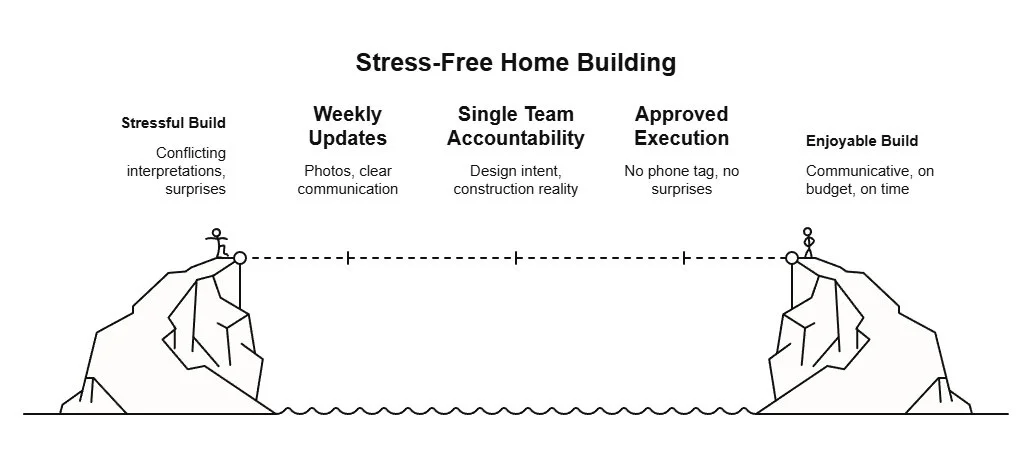
You receive a weekly update with photos showing exactly what happened on site. When a question comes up about a window placement, one team handles it—consulting both the design intent and the construction reality before bringing you a recommendation. You approve. They execute. Done.
No phone tag between separate offices. No conflicting interpretations of the same drawing. No surprises when you visit the site and find something that doesn't match what you approved.
This isn't fantasy. It's what happens when one team carries accountability from the first sketch through the final walkthrough. Riverbend Homes clients describe this kind of experience as communicative, on budget, on time, and even enjoyable—a sharp contrast to the horror stories they'd heard before building. You can read their accounts on the testimonials page.
The emotional shift is significant. Instead of bracing for the next conflict, you actually enjoy watching your home take shape. You trust that the vision you approved will survive contact with reality because the people protecting it are the same people building it.
Stress drops when accountability stops bouncing between separate parties.
What Single-Source Custom Building Means in Real Life
Single-source custom building means the team that designs your home is contractually responsible for constructing it. No handoff. No translation errors. No "that's not our department."
Design-build is the formal industry term. According to the Design-Build Institute of America, this delivery method works because it creates a single point of accountability for quality, cost, and schedule. When problems arise, there's no finger-pointing—just problem-solving. The institute describes design-build as a collaborative, integrated process with benefits such as faster delivery, earlier knowledge of firm costs, and fewer changes, claims, and disputes when executed well. Outcomes can still vary by team and project, but the structural advantages are clear.
For homeowners, single-source building changes the daily experience of construction. Questions get answered faster because decisions don't require coordination between separate companies. Design intent stays intact because the people building understand why specific details matter.
How One Team Protects Your Vision From Sketches to Site Decisions
Design protection isn't about rigid adherence to every line on a drawing. It's about preserving the intent behind those lines when construction realities require adjustments.
Every custom home encounters surprises. Rock appears where soil tests predicted dirt. A window placement conflicts with structural requirements. Material lead times shift. The question isn't whether changes will happen—it's who manages them and with what priorities.
In a fragmented model, field decisions often default to whatever's fastest or cheapest. The builder's crew needs to keep moving. The architect isn't on site. Small compromises accumulate until the finished home feels different from what you approved.
Under unified accountability, the design team and build team share the same goal: executing your approved vision within your approved budget. When field conditions require adaptation, the conversation happens internally before reaching you. The recommendation you receive balances aesthetic intent, structural reality, and cost impact—because one team holds all three responsibilities.
This is how design-build delivers custom homes on budget without sacrificing the details that made you fall in love with the design.
This unified approach is why the initial discovery meeting at your property is so critical. Understanding site feasibility and infrastructure requirements early—before design gets too far ahead—prevents the painful "value engineering" conversations that plague traditional builds. Riverbend Homes stays involved throughout design specifically to maintain vision while keeping projects within budget, pausing at bid-set completeness to estimate final construction costs before permitting begins.
The secret? We listen. From the initial meeting, the conversation covers must-haves, style preferences, space use, and budget—so later reinterpretation becomes far less likely.
5 Signs Your Builder Will Protect the Plan Instead of Reinterpreting It
Not every builder operates the same way. These indicators help distinguish partners who protect your vision from those who might quietly reinterpret it.
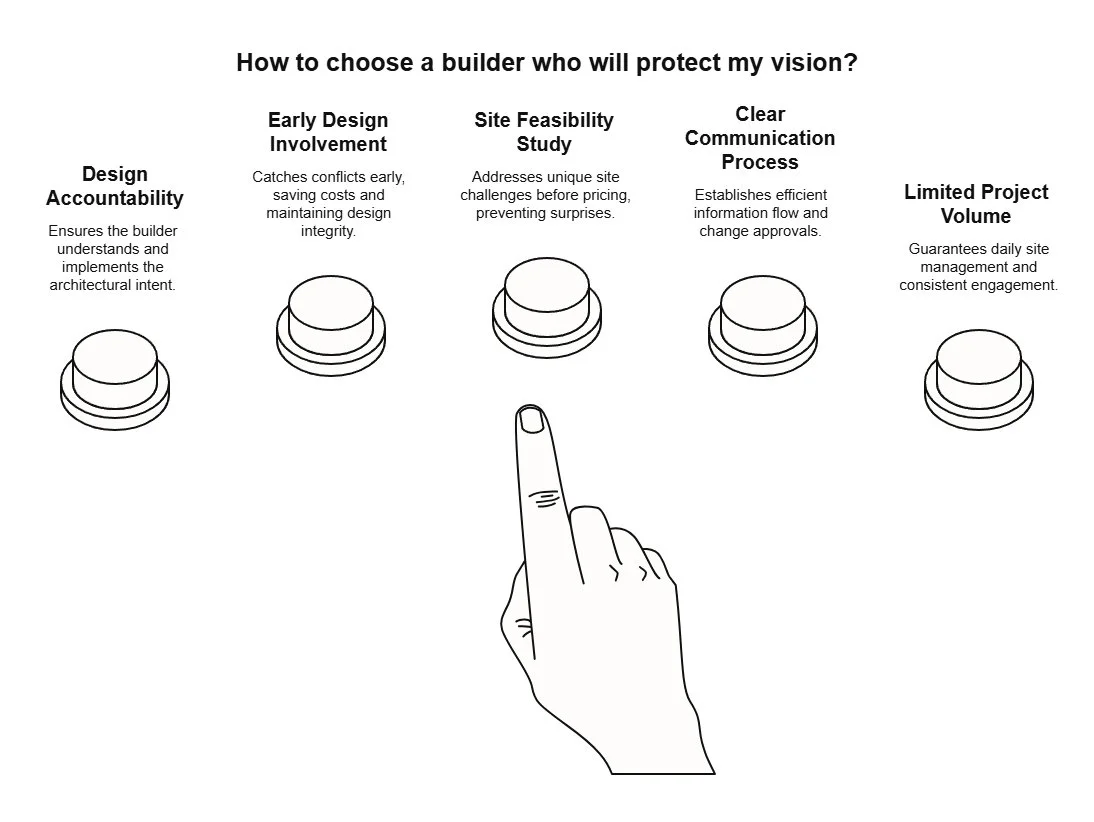
They explain design accountability clearly.
Ask who owns the architectural intent during construction. If the answer involves phrases like "we'll coordinate with your architect" or "that's really between you and the designer," accountability is already fractured. A single-source builder should be able to explain exactly how design decisions carry through to field execution.
They participate actively in design and budgeting before breaking ground.
Builders who only engage after plans are complete have no ownership of the design's buildability. Look for partners who stay involved during design to catch conflicts early, when changes are cheap, not during framing when they're expensive. If budget continuity concerns you, The "Bidding" Myth explains why unified delivery prevents surprises.
They walk your site and discuss feasibility before talking numbers.
Generic square-foot pricing ignores everything that makes your lot unique. Rock, slope, access, utilities—these factors determine what's actually possible and at what cost. A builder who hasn't studied your specific property isn't ready to protect your project.
They can describe their communication process when field questions arise.
Construction generates dozens of small decisions weekly. How does information flow? Who approves changes? How quickly do you hear about issues? Vague answers suggest ad-hoc processes that create gaps.
They limit their project volume.
Builders who overcommit can't provide daily site management. Ask how many projects they run simultaneously and how often someone from their team is physically present on your job site. The Design-Build Institute's best practices emphasize that effective project delivery requires consistent engagement, not periodic check-ins.
A Simple Communication Map: Traditional Build vs. Single-Source Build
The difference between stressful and stress-free often comes down to how information flows.
Traditional Build Communication: In a separated model, you sit at the center of a web. Questions from the builder go to you. You relay them to the architect. The architect responds to you. You translate back to the builder. Multiply this by hundreds of decisions across a twelve-month build. Add subcontractors who report to the builder but may need design clarification. The lines tangle quickly.
When something goes wrong, tracing responsibility requires archaeology. Which conversation contained the miscommunication? Whose interpretation prevailed? Who approved what, and when?
Single-Source Communication: Under unified delivery, the communication map simplifies dramatically. Design questions stay internal. The team resolves conflicts before presenting options. You receive recommendations rather than problems. Your role shifts from translator and mediator to approver and decision-maker.
More handoffs mean more reinterpretation and more homeowner mediation. One accountable team means clearer decisions and less stress.
This streamlined structure is why Riverbend Homes limits project volume—to maintain daily on-site presence and keep communication tight. When the team isn't stretched across too many builds, nothing falls through the cracks.
What to Ask Before You Sign Anything
The right questions reveal whether a builder will protect your vision or leave you mediating between professionals. Consider these before committing:
"Who is accountable if the build team says the plan needs to change?"
The answer should be immediate and specific. If it involves multiple parties negotiating, accountability is already diluted.
"How do you protect the original design intent during construction?"
Listen for process, not promises. What systems ensure that field decisions honor approved aesthetics?
"How involved are you in the design phase before pricing is finalized?"
Builders who only price completed plans have no stake in their buildability. Continuous involvement during design prevents later conflicts.
"How do you handle site-driven realities without breaking the vision?"
Every project encounters surprises. The question is whether adjustments preserve intent or simply expedite construction.
"Who do I call when I have a question during the build?"
One clear answer indicates unified accountability. Multiple contacts suggest fragmented responsibility.
"How many projects are you managing right now, and how often will someone be on my site?"
Volume reveals capacity. Daily presence indicates commitment.
These aren't confrontational questions—they're clarifying ones. Builders who operate under single-source accountability welcome them because the answers showcase their model's strength.
Your Vision Deserves Protection
Building a custom home in the Texas Hill Country should be an experience worth remembering—for the right reasons. The land is beautiful. The possibilities are exciting. The process doesn't have to be painful.
Stress-free construction isn't about finding a builder with a better personality or hoping for good luck. It's about choosing a structure that eliminates preventable friction. One accountable team. Clear communication. Design intent that survives first contact with the job site.
If you're still early in the process—perhaps you've just purchased land or you're comparing approaches—the first 48 hours after buying your lot offer a critical window for smart decisions. Spring is traditionally a popular season when many prospective homeowners accelerate their researching and budgeting for major builds, and making process decisions early means entering the peak construction season with momentum rather than scrambling.
Explore how Riverbend Homes approaches the design-build process, stay informed with Hill Country building insights, or schedule a Discovery Meeting to see how your lot, goals, and constraints would be evaluated in real life.
Disclaimer: This content is educational and reflects general principles of design-build project delivery. Individual project outcomes depend on site conditions, local regulations, and specific contractual arrangements.
Our Editorial Process:
Our expert team uses AI tools to help organize and structure our initial drafts. Every piece is then extensively rewritten, fact-checked, and enriched with first-hand insights and experiences by expert humans on our Insights Team to ensure accuracy and clarity.
By the Riverbend Homes Insights Team
Riverbend Homes has designed and built custom homes in the Texas Hill Country since 1996. As a second-generation family-owned design-build firm, the team focuses on listening closely, staying involved through design and budget decisions, and helping homeowners create distinctive homes without losing control of the process.
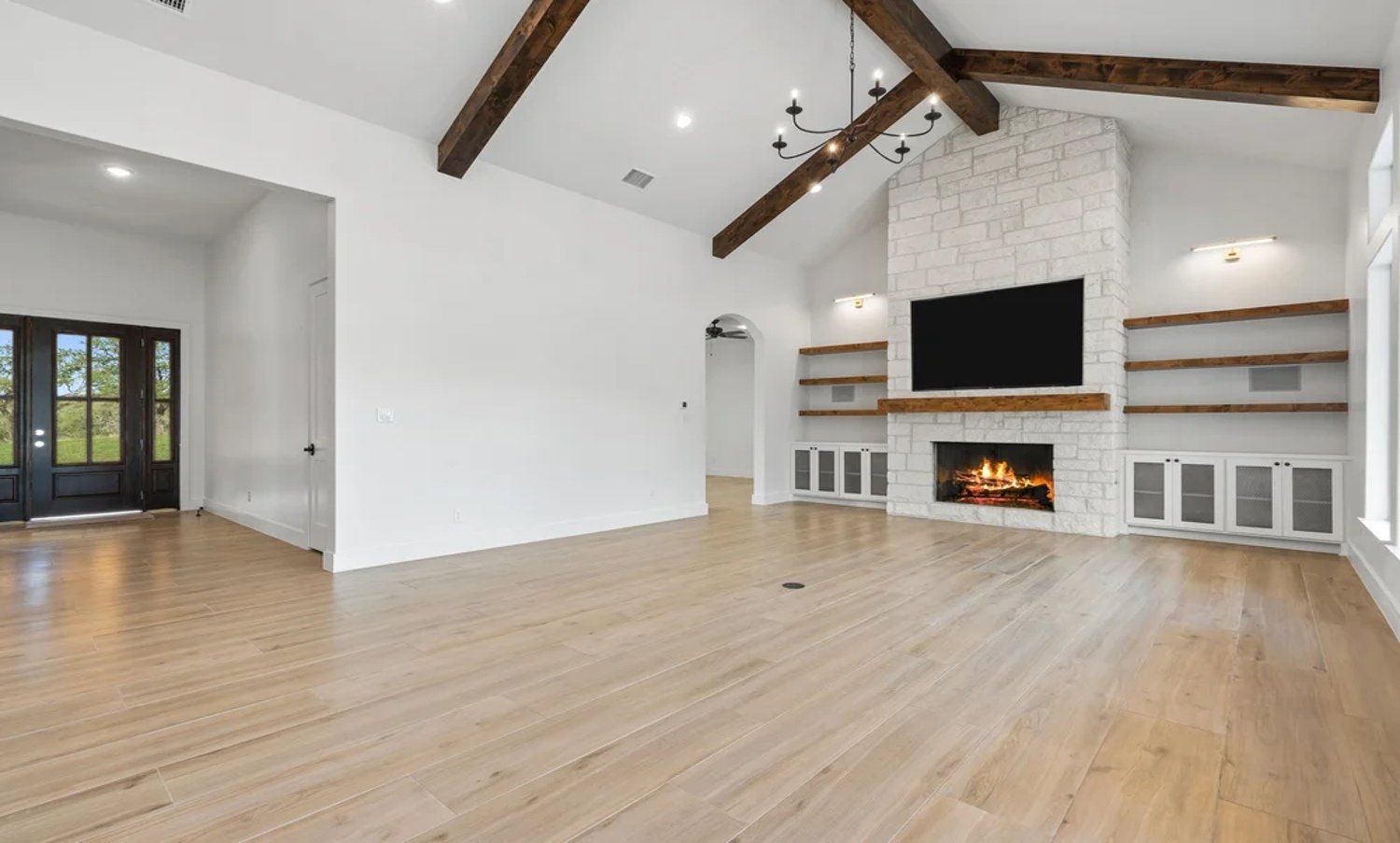
Navigating Allowances: 3 Ways to Maximize Your Integrated Home Design
Finish allowances protect your budget when you rank priorities first and redirect savings between categories. Three strategies for choosing luxury finishes intentionally.
📌 Key Takeaways
Allowances work best when you treat them as connected budget tools, not separate shopping sprees.
Rank Your Priorities First: Before visiting showrooms, decide which finish categories matter most to your household so you can splurge intentionally and save elsewhere.
Use Credits Strategically: Money saved in one category can shift to another—redirect guest bath savings toward that kitchen upgrade you really want.
Get Budget Feedback Early: Ask your builder how each selection affects your total costs before you commit, not after the order is placed.
Avoid the "Free Money" Trap: Treating allowances as isolated budgets leads to overages that force painful cuts later in the project.
Choose a Process That Tracks Everything: Builders who stay involved during design catch budget drift in real time and prevent surprise bills at the end.
Smart allowance decisions protect your whole home, not just one room.
Homeowners planning a custom build in the Texas Hill Country will gain clarity on finish selections and budget tradeoffs, preparing them for the detailed overview that follows.
~ ~ ~ ~ ~ ~ ~ ~ ~ ~ ~ ~ ~ ~ ~ ~ ~ ~
You finally have the chance to choose the finishes you really want. The countertops. The flooring. That statement light fixture you've been eyeing for months.
But now every decision feels like it could wreck the budget.
You're staring at tile samples in a showroom, and a pit forms in your stomach. Which one of these is going to push us over? The beautiful quartzite countertop seems worth any price in the moment—until you remember the windows, the appliances, the outdoor kitchen you promised your partner.
This tension is real. And it's completely normal.
Fortunately, allowances do not have to function as a guessing game. When they're handled inside an integrated design-build process, they become decision tools that help you protect the overall home while still making meaningful upgrades. The key is treating them as part of your whole-house strategy—not as isolated shopping budgets.
What Allowances Actually Mean in an Integrated Home Design Process
An allowance is a dollar amount set aside in your construction contract for a specific category of finishes or materials—flooring, lighting fixtures, appliances, countertops, tile, or plumbing fixtures. The builder includes this amount in the overall contract price, and you use it to make your selections.
Simple enough on paper.
The problem starts when homeowners treat each allowance as a separate pot of money, disconnected from everything else. They fall in love with selections before understanding what happens if they go over—or what they could gain if they come in under.
An allowance is only functional when you understand its ripple effect on the total project cost.
In an integrated home design approach, your builder stays involved during the design phase specifically to track how finish decisions ripple through the total project cost. This isn't micromanagement. It's protection. When design and construction work as one system, you get real-time feedback instead of surprise bills at the end.
3 Ways to Maximize Your Allowances Without Losing Budget Control
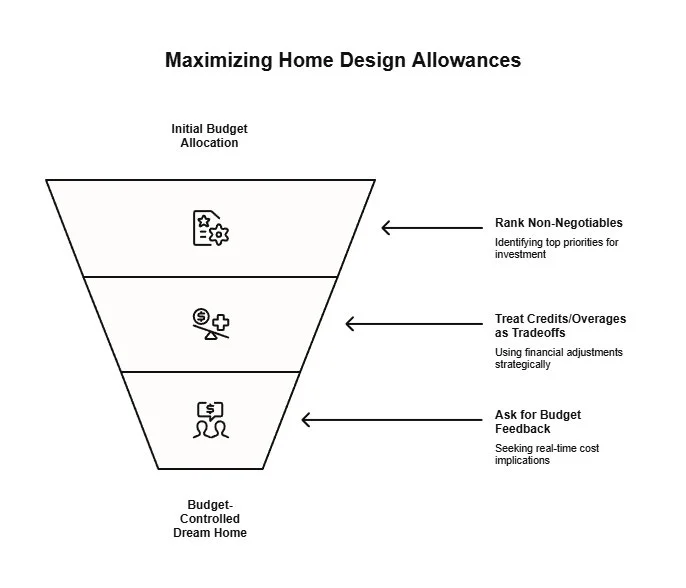
Way 1: Rank Your Non-Negotiables Before You Shop
Before you set foot in a showroom, sit down with your partner or family and identify your top-priority categories. Where do you want to invest? Where can you be more flexible?
Consider ranking these common allowance areas:
Kitchen surfaces and backsplash
Primary bathroom finishes
Windows and exterior doors
Lighting fixtures
Outdoor living features
Flooring throughout the home
Appliances
This isn't about restricting yourself. It's about directing your budget toward what matters most to your household. A couple building a forever home in the Texas Hill Country might prioritize view-facing windows and outdoor living. A family with young children might put durability and kitchen functionality at the top.
The ranking exercise prevents a common trap: spreading your budget so thin across every category that nothing feels special. When you know your non-negotiables upfront, you can be disciplined in lower-priority areas and generous where it counts.
Way 2: Treat Credits and Overages as Whole-House Tradeoffs
Here's where a unified design-build approach becomes essential.
When you come in under an allowance, you typically receive a credit. When you exceed it, you pay the overage. Most homeowners understand this in theory. What they miss is the strategic opportunity.
Credits and overages aren't just accounting adjustments. They're tradeoff levers.
Say you've allocated allowances for both the primary bathroom and the guest bath. You find tile for the guest bath that you genuinely like—and it costs less than the allowance. In a disconnected process, that credit might just disappear into the contract or get applied somewhere arbitrary. In an integrated process, you can redirect those savings intentionally. Maybe that credit helps you upgrade the range hood in the kitchen. Maybe it strengthens your outdoor fireplace budget.
The reverse is also true. If you're about to exceed an allowance on countertops, a builder who's tracking the whole budget can show you the downstream impact before you commit. That transparency lets you make an informed decision rather than discovering the problem months later.
The most expensive item is not always the wrong item. The least expensive item is not always the right one. The goal is not to strip luxury out of the home. The goal is to put budget behind what matters most.
One important note: contract details vary by builder. Credits, overages, and selection handling are not always managed the same way. Ask how savings are applied, how overages are documented, and when updated estimates are shared.
As one Horseshoe Bay homeowner put it, working with the right builder means having "good ideas for making your home match your dreams, while staying within your budget."
Way 3: Ask for Budget Feedback Before Finalizing Selections
The most valuable thing a builder can give you during finish selections isn't a bigger allowance. It's immediate feedback.
Before you finalize any major selection, ask: How does this affect the rest of the budget? A builder operating in an integrated design-build model can answer that question in real time because they're tracking the full project—not just handing off selections to a separate designer or subcontractor.
This is where the design-build approach delivers real value. When one team handles both design and construction, there's no finger-pointing, no delayed cost feedback, and no surprises showing up in change orders.
You want a builder who functions as a financial guide, not just a contractor who builds what's drawn.
"All through the building process Ben was able to stay on budget with only the exception of things we planned to upgrade from the initial contract. He frequently found ways to save us money on our selections. He will also allow you to shop around on your own for money saving deals, which others builders will not allow." — Chris S., Spicewood, TX
The Common Mistake That Makes Allowances Backfire
The most dangerous assumption in custom home building? Treating allowances like free money.
It happens easily. You see an allowance line item for lighting fixtures and think, That's my budget to spend however I want. So you visit showrooms without a whole-house plan. You fall in love with a chandelier before understanding how overages are handled. You make finish choices in isolation, category by category, without asking how one decision affects another.
Then the financial reality becomes unavoidable. The beautiful selections you made individually don't add up to a coherent budget collectively. Suddenly you're facing difficult tradeoffs late in the process—cutting things you care about to cover things you already ordered.
This is why builder process matters as much as the allowance itself. A disciplined process prevents drift. It keeps every selection connected to the larger vision and the real numbers.
How Riverbend's Process Helps Homeowners Stay Flexible Without Losing Control
At Riverbend Homes, the process is built around continuous budget visibility—not end-of-project surprises. The sequence is deliberate: Discover → Design & Budget → Build.
It starts with a Discovery Meeting at your property. This isn't a sales pitch. It's a working session to understand your vision, identify must-haves, discuss architectural style and space usage, and assess site feasibility. Infrastructure realities that affect budget and design get surfaced early, before you're deep into floor plans.
From there, the Design & Budget phase keeps builder involvement active throughout. The goal is to maintain your vision while keeping you in budget. At bid-set completeness, design pauses and a detailed estimate is produced before moving forward. You see where you stand before construction begins—not after.
During the build, Riverbend limits project volume and manages each site daily. That selectivity translates to faster timelines, tighter oversight, and a builder who knows your project inside and out.
The result? Generous allowances, the freedom to shop around for deals, and a partner who helps you redirect savings where they matter most. This is what shopping allowance autonomy looks like when it's paired with clear budget guardrails.
Allowance Planning Checklist for Integrated Home Design
Use this checklist before making selection decisions:
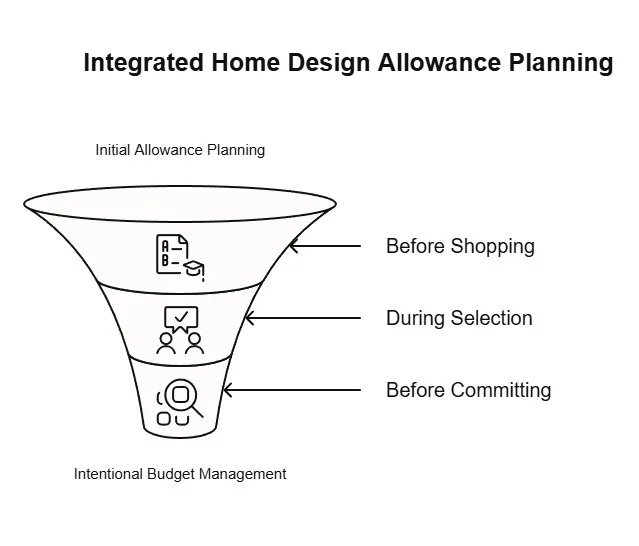
Before You Shop
Have you ranked your finish categories by priority with your household?
Do you know your non-negotiables versus your flexible areas?
Have you asked your builder how credits and overages are handled?
During Selection
Are you getting budget feedback before finalizing each major choice?
Do you understand how this selection affects other categories?
Is the builder tracking the whole-house impact in real time?
Before You Commit
Have you compared your selections against the full allowance picture?
Are planned overages intentional choices, not surprises?
Can you redirect savings from one area to strengthen another?
Bring Your Priorities to the Discovery Meeting
Building a custom home in the Texas Hill Country—whether in Spicewood, Lake Travis, Horseshoe Bay, or the surrounding area—means navigating real site challenges, real budgets, and real decisions. The homeowners who feel most in control are the ones who treat allowances as strategic tools, not isolated shopping trips.
Disciplined decisions create more freedom, not less.
A luxury result and a disciplined budget can coexist. The difference is process.
If you're planning your build, start by organizing your priorities and questions. Understand what matters most to your household. Then find a builder whose process gives you visibility, flexibility, and guidance—not just a number on a spreadsheet.
Explore how Riverbend's design-build process works before you finalize your selections. Review our work to see how other homeowners have brought their visions to life. Or bring your finish priorities and budget questions to a Discovery Meeting and see what integrated home design actually looks like.
If financing is part of your conversation, the CFPB's Loan Estimate explainer offers a solid general reference for comparing loan details. And if long-term design performance matters to you, the DOE's guidance on efficient home design reinforces why a whole-house approach creates better outcomes over time.
Our Editorial Process:
Our expert team uses AI tools to help organize and structure our initial drafts. Every piece is then extensively rewritten, fact-checked, and enriched with first-hand insights and experiences by expert humans on our Insights Team to ensure accuracy and clarity.
By the Riverbend Homes Insights Team
Riverbend Homes has designed and built custom homes in the Texas Hill Country since 1996. As a second-generation family-owned design-build firm, the team focuses on listening closely, staying involved through design and budget decisions, and helping homeowners create distinctive homes without losing control of the process.
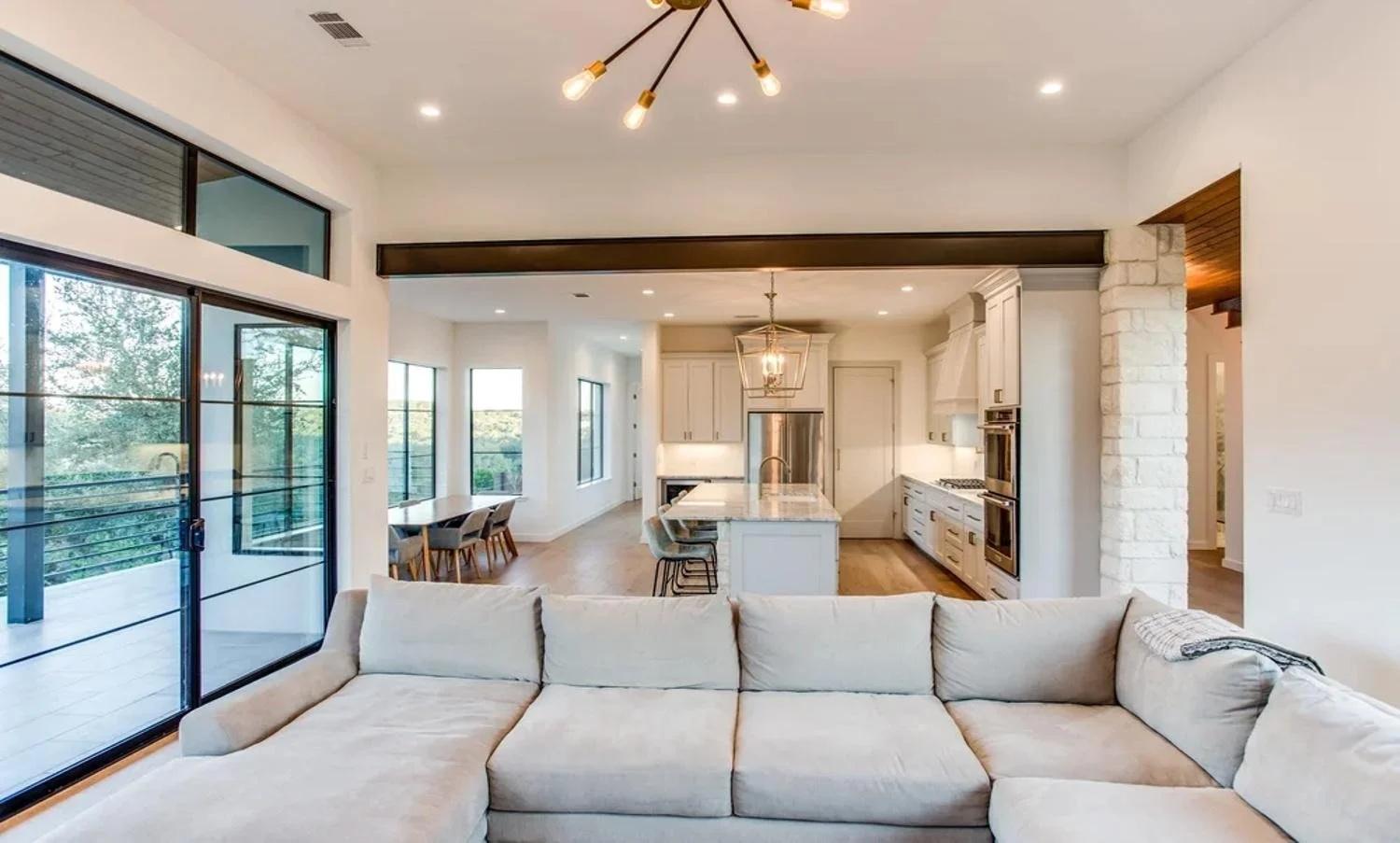
Shopping Allowance Autonomy: How to Choose Luxury Finishes Without Losing Budget Control
Finish allowances give budget flexibility, but ask how credits and overages work before falling in love with countertops or tiles you can't afford.
📌 Key Takeaways
Shopping allowance autonomy lets you pick the finishes you actually want while staying on budget—if your builder explains the rules upfront.
Transparency Beats Big Numbers: A generous allowance means nothing if you can't shop outside your builder's preferred vendors or don't know how credits and overages work.
Freedom Needs Structure: You can source finishes anywhere, but only if your builder knows what's coming, when it arrives, and how it fits the construction schedule.
Splurge Where You Live: Kitchen counters, primary bath tile, and main-area flooring deserve your best dollars because you'll see and touch them every day.
Track Spending in Real Time: Small upgrades add up fast—log each selection against its allowance before you fall in love with the next one.
Ask the Right Questions Early: Find out if you can shop independently, how savings flow back to you, and when selections must be final to avoid delays.
Real finish autonomy means curating your home, not just approving a catalog.
Homeowners planning custom builds in the Texas Hill Country will learn how to protect both style and budget here, preparing them for the detailed finish-selection process that follows.
~ ~ ~ ~ ~ ~ ~ ~ ~ ~ ~ ~ ~ ~ ~ ~ ~ ~
The tile samples are spread across the kitchen island. Twelve squares of marble, porcelain, and natural stone catch the afternoon light. This is the moment you've been waiting for—the moment your custom home stops being a floor plan and starts becoming yours.
Then the question surfaces. How much does this actually cost? And what happens if I fall in love with the wrong one?
Finish selection is where custom homes become personal. It's also where budgets can spiral if the allowance process isn't clear. The good news: you don't have to choose between the finishes you love and the financial control you need. The key is understanding how shopping allowances work—and finding a builder who gives you real autonomy within a transparent framework.
Why Finish Selection Feels So Exciting and So Risky
The moment the dream home starts feeling personal
For most of the custom home journey, you're working with abstractions. Site plans, elevations, structural drawings. Important, yes. But not exactly the stuff that makes your heart race.
Finishes are different. When you start choosing countertops for the kitchen, tile for the primary bath, flooring that will stretch through every room you walk through daily—suddenly the home feels real. You're not building a house anymore. You're building your house.
This is the phase where clients in Spicewood, Lake Travis, and across the Texas Hill Country start imagining actual mornings in their new space. The light on the backsplash. The feel of the floor under bare feet. The hardware they'll touch a hundred times a day.
Why many homeowners worry about markups and limited choices
The excitement comes with an edge of anxiety. You've heard the stories. Friends who wanted a specific faucet but were told they had to choose from a narrow catalog. Neighbors who discovered their "luxury" tile allowance wouldn't cover anything they actually liked. Clients who found out—too late—that the builder's preferred vendor charged thirty percent more than what they could have found on their own.
These aren't irrational fears. Many high-end builders do restrict clients to specific showrooms, sometimes with significant markups baked into the pricing. The result is a frustrating disconnect: you're building a custom home, but the finishes feel anything but custom.
What a Shopping Allowance Actually Means in a Custom Home Build
A shopping allowance is a budget placeholder for a category of finishes that hasn't been finalized yet. It's the dollar amount your builder has estimated for that category based on your overall project scope. Understanding this mechanism is the first step toward using it strategically.
Allowance vs. all-inclusive finish pricing
Some builders offer all-inclusive pricing, where finishes are pre-selected and bundled into the contract. You get less decision-making, but also less variability. Other builders use allowance-based pricing, which gives you a set dollar amount and the freedom to choose how to spend it.
Neither approach is inherently better. The question is whether the approach matches how involved you want to be—and whether the builder is transparent about how each model works.
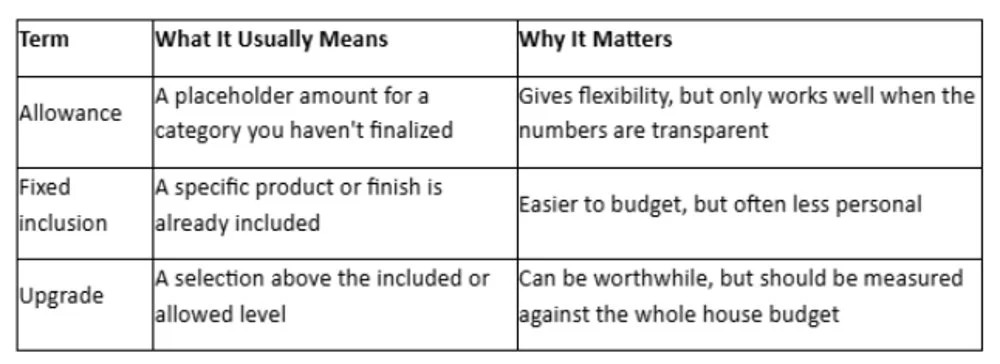
What is usually covered and what is not
Allowances typically cover items that involve personal taste and visible design impact: kitchen and bath fixtures, lighting, flooring, tile, countertops, cabinet hardware, and sometimes appliances. They usually don't cover structural elements, framing, roofing, insulation, or mechanical systems. Those items are priced separately and aren't subject to the same selection process.
Understanding this distinction matters because it sets realistic expectations. Your allowance dollars are meant for the finishes that shape daily experience—not for the bones of the house.
Why transparency matters more than the allowance number alone
A generous allowance means little if you don't understand how it works. Can you shop beyond the builder's preferred vendors? What happens if you come in under budget—do you get a credit, or does the savings disappear? What happens if you exceed the allowance—how are overages handled, and when do you find out?
Builders who explain allowances clearly from the start are signaling something important: they want you to make informed decisions, not discover surprises at closing.
The Problem With Restrictive Showrooms and Builder-Grade Boxes

How limited choices can flatten the design vision
You didn't commission a custom home to end up with the same finishes as every other house in the neighborhood. But restrictive showroom policies can push you exactly there.
When builders limit selections to a single vendor or a narrow catalog, the options start blending together. The countertop choices look similar. The tile formats repeat. The lighting feels safe rather than inspired. The home that was supposed to feel uniquely yours starts feeling like a well-executed template.
Where markups and missed value often happen
Restrictive vendor relationships aren't always about quality control. Sometimes they're about margin. Preferred vendors may offer builders rebates or commissions, which can inflate the price you pay without adding value you receive.
This isn't universal—some vendor relationships genuinely benefit clients through volume pricing or streamlined coordination. But when you're not allowed to compare prices or source independently, it's worth asking why.
Why affluent buyers resent being boxed in
Budget-conscious doesn't mean unwilling to spend. It means unwilling to spend blindly. Affluent buyers building custom homes in places like Horseshoe Bay, Lake LBJ, or the broader Hill Country want to invest in quality. They simply want to know where their money is going—and they want the freedom to direct it toward finishes that actually matter to them.
Being told "you have to choose from this showroom" feels like a constraint that contradicts the entire premise of building custom. This is not just about price. It's about authorship. A custom home should not leave you feeling like a guest in your own selections.
How Shopping Allowance Autonomy Protects Both Style and Budget
Freedom to source the finish you actually want
Shopping allowance autonomy means you're not locked into a single source. If you find the perfect pendant lights at a design market in Austin, you can buy them. If a stone yard in Marble Falls has the exact slab you've been dreaming about, you can source it directly. If an online retailer offers the same faucet for significantly less, you're free to make that call.
This freedom transforms finish selection from a constrained checklist into an actual design process. You're curating your home, not just approving predetermined options.
One Spicewood client described the difference this way:
"He frequently found ways to save us money on our selections. Ben will give you a high end product and generous allowances for choices at a fair price. He will also allow you to shop around on your own for money saving deals, which others builders will not allow." — Chris S., Spicewood, TX
How savings can be reallocated across the house
When you find a better price on flooring, where does that savings go? With some builders, it vanishes into the project margin. With transparent builders, it flows back to you—either as a credit or as additional budget you can redirect elsewhere.
This reallocation creates a virtuous cycle. Savings on one category can fund an upgrade in another. The money you didn't spend on tile might cover the upgraded range hood you actually wanted. The lighting credit might stretch your countertop budget just enough to get the waterfall edge.
Why autonomy still needs builder coordination
Autonomy doesn't mean chaos. Sourcing your own finishes only works if your builder knows what's coming, when it's arriving, and how it integrates with the construction schedule.
The best approach is structured freedom: you have the latitude to shop, but you're doing it within a clear timeline and with ongoing communication. Your builder should know your selections early enough to coordinate installation, avoid delays, and flag any compatibility issues before they become problems.
This is why the design-build process matters. When the same team handles design and construction, they can provide real-time feedback on how your selections affect the schedule and budget—not surprises three months later. Riverbend's process, for example, pauses at bid-set completeness to estimate final construction costs before moving forward. That checkpoint keeps finish decisions tethered to reality.
For a closer look at how that budgeting structure works in practice, the article on continuous estimating explains the mechanics.
Where to Splurge and Where to Stay Practical
Not every finish deserves the same investment. Strategic prioritization lets you allocate allowance dollars where they'll have the greatest impact on your daily experience.
High-visibility finishes that shape daily experience
Some finishes you'll touch, see, or walk on every single day. These are the places where quality and personal taste matter most:
Kitchen countertops and backsplash. You'll prepare meals here, gather here, and notice these surfaces constantly. This is often the single most visible finish decision in the home. Organizations like the Natural Stone Institute offer guidance on selecting and caring for stone surfaces—useful context when evaluating material options.
Primary bathroom tile and fixtures. You start and end every day in this room. The shower tile, the faucet you adjust half-asleep, the vanity you lean against while brushing your teeth—these details register even when you're not consciously noticing them. The NKBA Kitchen & Bath Planning Guidelines provide authoritative standards for layout and fixture placement.
Flooring in main living areas. The floor connects every room. It's the backdrop for furniture, light, and daily movement. Quality flooring in high-traffic areas pays dividends for years.
Lighting in gathering spaces. Light shapes mood. The right fixtures in the kitchen, dining area, and living room elevate the entire atmosphere. For more on this, the article on luxury lighting choices explores how thoughtful lighting design transforms spaces.
Categories where performance matters more than prestige
Some finishes need to work well, but they don't need to carry the design. Utility rooms, closet interiors, and garage spaces rarely benefit from premium finishes. Durable and functional beats expensive and underappreciated.
Similarly, guest bathrooms see less daily use than primary suites. A clean, quality tile works beautifully here without requiring the same investment you'd make in the spaces you use constantly.
A framework for prioritizing
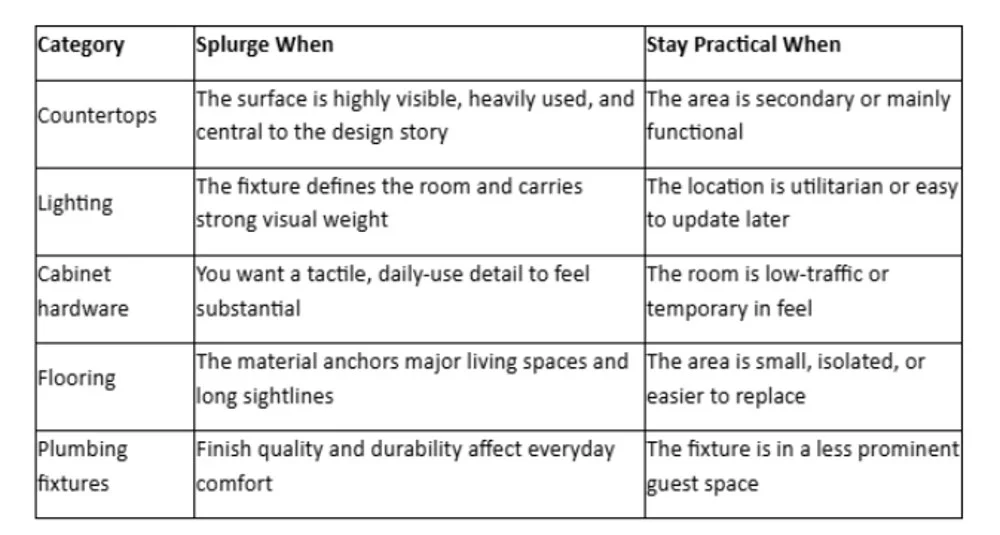
How to avoid overspending in low-impact areas
The risk isn't choosing bad finishes—it's allocating premium dollars to spaces that don't reward them. Before upgrading, ask: How often will I actually see or touch this? Will I notice the difference in six months?
If the answer is "rarely" or "probably not," that's a sign to stay practical and save the splurge for where it counts.
A Smarter Way to Shop Finishes Without Creating Budget Drift

Start with your non-negotiables
Before browsing showrooms or scrolling design sites, identify the three to five finish decisions that matter most to you. Maybe it's the kitchen countertop material, the primary bath tile, and the front door hardware. Maybe it's the wide-plank flooring you've wanted for years.
Starting with non-negotiables focuses your energy and your allowance dollars. Everything else becomes flexible—places where you can make practical choices without feeling like you compromised.
Track selections against allowances in real time
Budget drift happens when decisions accumulate without visibility. You upgrade the faucet, then the cabinet pulls, then the tile—and suddenly you're significantly over allowance without having made any single dramatic choice.
The antidote is real-time tracking. Know your allowance for each category. Log your selections as you make them. Compare running totals against limits before falling in love with the next upgrade.
This is where continuous estimating becomes essential. Builders who stay involved during the design phase can provide ongoing feedback, catching budget drift before it compounds.
Resolve upgrades before they ripple through the whole plan
An upgrade in one area often affects others. Heavier countertops may require reinforced cabinetry. Larger-format tile may need different substrate preparation. High-end fixtures may require specialized installation.
Resolving these ripple effects early prevents late-stage surprises. When your builder knows about upgrades before construction reaches that phase, they can adjust plans, pricing, and schedules accordingly.
This is also where a functional design plan matters. A finish doesn't live alone. It belongs to a room, a sightline, a material palette, and a budget sequence.
What to Ask Your Builder Before You Fall in Love With a Finish
The right questions reveal how much autonomy you'll actually have—and how transparent the process will be.
Can I shop beyond your preferred vendors?
This question cuts to the heart of allowance autonomy. If the answer is "no" or "only with restrictions," you'll want to understand why. Some builders have legitimate coordination reasons; others simply prefer the margin from exclusive vendor relationships. A builder who supports independent shopping is signaling confidence in their own value proposition.
How are credits, overages, and substitutions handled?
Understand the financial mechanics before you start selecting. If you come in under allowance, do you receive a credit? If you go over, when do you find out and how is the overage billed? If you want to substitute a different product after selections are finalized, what's the process and cost?
When do selections need to be finalized to avoid delays?
Timing matters more than most clients realize. Certain finishes have long lead times. Others need to be specified before framing is complete. Missing a selection deadline can delay the entire project. Ask for a selection timeline early so you can shop with purpose rather than scrambling at the last minute.
If one finish changes, what other parts of the plan might move with it?
Upgrades can create ripple effects. Understanding these connections upfront helps you make decisions with full awareness of their downstream impact.
Which categories are easiest to personalize without creating downstream complications?
Some finish categories offer more flexibility than others. Knowing where you have room to explore—and where constraints are tighter—helps you focus your creative energy productively.
Where do you recommend prioritizing budget for the strongest long-term impact?
A good builder has seen hundreds of finish decisions play out over time. Their perspective on where investment pays off most can be invaluable.
These questions do two jobs. They clarify the system, and they reveal whether the builder treats finish autonomy as a real planning tool or as a slogan. For more on evaluating builder transparency, the article on what design-build means provides useful context.
The Best Outcome: A Home That Feels Custom in Every Room
The emotional payoff of intentional finish choices
When you've chosen every finish with intention—weighing options, comparing sources, making real decisions—the completed home carries that investment. You don't just live in the house; you recognize your own judgment in every room.
The countertop isn't just a surface. It's the slab you chose after visiting three stone yards. The lighting isn't just illumination. It's the fixture you found at a design market and knew immediately was right.
This is what personalized luxury actually means: not the most expensive option, but the most intentional one. You're not trying to prove that every room is expensive. You're trying to make every room feel intentional.
Why the right builder makes autonomy feel safe
Freedom without structure creates anxiety. Shopping allowance autonomy works when it's paired with clear allowances, transparent tracking, and a builder who communicates throughout the process.
Another Hill Country client put it simply: "Thank you for your input when she struggled with uncertainty, yet allowing her to make choices on her own." That balance—guidance without control, support without restriction—is what makes finish selection feel empowering rather than overwhelming.
The journey from foundation to finishes involves hundreds of decisions. The finish phase should feel like the payoff for all that planning, not a new source of stress.
As you begin gathering inspiration for your custom home finishes, consider how your builder handles allowances, sourcing, and communication. The answers will shape not just your budget, but your entire experience of creating a home that feels unmistakably yours.
Explore how a design-build firm approaches finish selection—or learn more about what design-build means for homeowners who want both creative control and budget protection.
When your ideas are ready to be tested against real allowances and site realities, a Discovery Meeting is the natural next step.
Our Editorial Process
Our expert team uses AI tools to help organize and structure our initial drafts. Every piece is then extensively rewritten, fact-checked, and enriched with first-hand insights and experiences by expert humans on our Insights Team to ensure accuracy and clarity.
About the Riverbend Homes Insights Team
The Riverbend Homes Insights Team shares practical guidance for homeowners planning custom homes in Spicewood, Lake Travis, Lake LBJ, and the wider Texas Hill Country. Their work combines Riverbend Homes' design-build perspective, local site knowledge, and homeowner-first budgeting philosophy to help clients make confident decisions.
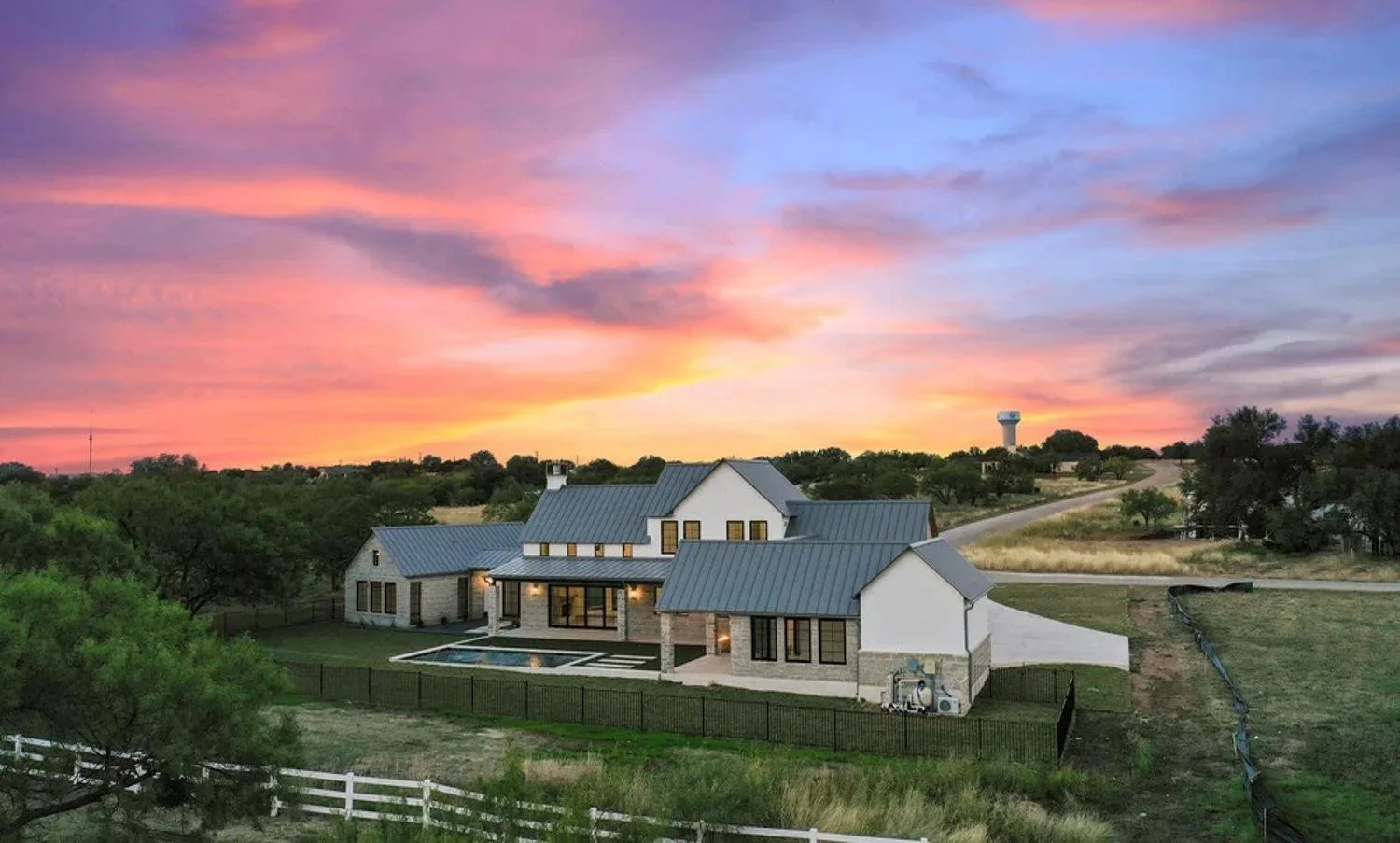
The First 48 Hours After Buying Your Lot: 5 Smart Steps Before Custom Home Design
New lot owners waste thousands designing homes their land can't support. Avoid this by walking your site and following 5 steps before any floor plans.
📌 Key Takeaways
The smartest move after buying your lot isn't designing your dream home—it's understanding what your land can actually support first.
Pause on Floor Plans: Buying designs before you know your lot's slope, utilities, and setbacks often leads to expensive dead ends when the land can't support your vision.
Walk the Site With Purpose: Identify buildable areas, drainage patterns, access points, and utility connections before any design work begins—these shape every decision that follows.
Meet Your Builder on the Land: A discovery meeting at the property connects your ideas to physical reality and surfaces budget-affecting surprises no office meeting can reveal.
Gather Your Priorities First: Bring inspiration photos, must-haves versus nice-to-haves, and honest budget numbers so designers can create plans grounded in what you actually need.
Expect Budget Checkpoints: Good design-build teams pause at key milestones to confirm costs before finalizing plans, protecting you from sticker shock later.
Let the land speak first—floor plans can wait.
New lot owners in the Texas Hill Country will avoid costly false starts by following these steps, preparing them for the detailed planning process that follows.
~ ~ ~ ~ ~ ~ ~ ~ ~ ~ ~ ~ ~ ~ ~ ~ ~ ~
The closing folder is sitting on your kitchen counter. The keys—or at least the survey stakes—are finally yours. After months of searching for the right piece of Texas Hill Country land, you did it.
Now comes the question that catches most new lot owners off guard: What do I actually do next?
The urge to keep momentum is real. You want to see progress. Maybe you've already saved dozens of inspiration photos or bookmarked floor plans that seem perfect. But here's the thing—the smartest move in the first 48 hours isn't about design at all. It's about understanding what your land can actually support before you fall in love with a home that doesn't fit.
In the Hill Country, dreams meet slope, drainage, access, utilities, and budget very quickly. The next five steps will protect your budget, save you from expensive false starts, and set your custom home design on solid ground from day one.
Step 1: Pause Before You Buy Floor Plans
This is the most common early mistake, and it's an expensive one.
Buying floor plans online feels like progress. The designs are beautiful. The prices seem reasonable. And scrolling through options scratches that itch to move forward. But a floor plan purchased in isolation—without knowing your lot's topography, access points, utility availability, or setback requirements—can become a very pretty dead end.
That dream layout might require a foundation your slope can't support. The garage placement might block the best view. The square footage might push past what your budget allows once you factor in the site work this particular piece of land requires.
The risk isn't the plan itself. It's designing backward. When design comes before site understanding, you end up forcing the land to fit the paper instead of letting the land shape a home that actually works.
Floor plans can come later. Right now, the land needs to speak first.
Step 2: Schedule a Site Feasibility Walk

Site feasibility answers a plain question: what will this land actually let you build, and what will it take to get there?
Walking the property with clear purpose means identifying the physical realities that will shape every decision that follows. In the Texas Hill Country, this matters more than in flat suburban subdivisions. Limestone shelves, drainage patterns, steep grades, and mature trees all influence where a home can sit, how foundations get built, and what infrastructure work the budget needs to absorb.
A proper site walk should consider:
Topography and slope — Where are the buildable areas? What requires retaining walls or stepped foundations?
Access and driveway routing — How do vehicles, construction equipment, and eventually you get in and out?
Utility availability — Is water, electric, and sewer or septic accessible, and from where?
Drainage patterns — Where does water flow during heavy Hill Country rains?
Views and orientation — Which direction captures the best light and scenery?
Setbacks and easements — What does the plat or HOA restrict?
For lots near Lake Travis or other Highland Lakes areas, septic permitting can affect both timeline and cost. The LCRA On-Site Sewage Facilities Program inspects and permits on-site sewage systems in parts of the Highland Lakes area, and the Texas Commission on Environmental Quality homeowner guidance helps you identify your permitting authority. Knowing this early prevents surprises later.
This walk doesn't need to answer every question. It needs to surface the questions worth answering before you spend money on design.
For broader lot due diligence, Five Key Factors for Selecting the Perfect Lot in Spicewood, TX is a useful next read.
Step 3: Meet a Design-Build Team on the Property
There's a reason experienced custom home builders want to meet you on the land, not in an office.
A Discovery Meeting held on your actual lot does something a conference room never can: it connects your vision to physical reality in real time. You can point to where you imagine the kitchen windows facing. The builder can show you where the grade drops or where utility access makes more sense. Together, you start seeing what's possible—not in theory, but on this specific piece of ground.
This is where a design-build approach earns its value. When design and construction expertise walk the site together from the beginning, you get immediate feedback on feasibility and budget implications. No waiting months for an architect's vision to collide with a builder's reality check.
The Discovery Meeting also protects your budget. Understanding infrastructure requirements—what the site actually needs before walls go up—prevents thousands of dollars in redesign fees down the road. One property walk can reveal that your lot needs specific foundation work, extended utility runs, or careful tree preservation that would have blindsided a floor-plan-first approach.
Riverbend Homes starts every project this way: on the property, understanding the owner's vision, assessing what the land allows, and surfacing the realities that affect both design and budget. As a second-generation family-owned business that has been designing and building homes in the Texas Hill Country since 1996, the company takes on a selective number of projects and stays involved daily—an approach that keeps site realities and budget alignment connected from the start.
Step 4: Gather the Right Inputs Before Design Starts

A productive first design conversation depends on what you bring to it.
You don't need a finished vision. You need the raw materials that help a design-build team understand how you want to live in this home. The more clearly you can articulate your priorities, the faster the design phase moves—and the fewer expensive changes happen mid-process.
Before your Discovery Meeting, gather:
Inspiration images — Photos from magazines, Pinterest boards, or homes you've visited that capture the feel you want. Even images of what you don't want help.
Must-haves versus nice-to-haves — A primary suite on the main floor might be non-negotiable. A wine cellar might be flexible. Know the difference.
How you'll use the space — Do you work from home? Host extended family? Need a separate casita for guests or aging parents?
Architectural style preferences — Hill Country modern, traditional Texas ranch, something else entirely?
Budget boundaries — Not a vague range, but the real number you're working with. Establishing strict financial parameters upfront keeps the design grounded in reality.
This preparation isn't busywork. Builders who listen well—and the good ones do—use these inputs to translate your priorities into designs that fit both your life and your land.
Step 5: Understand What Happens Next in Design & Budget
Knowing the road ahead reduces anxiety.
After the Discovery Meeting, a design-build process typically moves into what's often called the Design & Budget phase. This is where your inspiration images and must-haves become actual plans—and where cost reality meets creative ambition.
A well-run design-build process keeps the builder involved throughout design, not just at the end. That continuous involvement means you get real-time budget feedback as decisions are made, rather than sticker shock when final bids arrive. Riverbend stays involved through Design & Budget specifically to help keep the design aligned with budget before the project moves into the build phase.
Most design-build teams pause at what's called "bid-set level of completeness"—the point where plans are detailed enough to produce accurate cost estimates. You'll review that estimate before anyone finalizes drawings or pulls permits. This checkpoint exists specifically to protect you from the budget surprises that plague separated architect-then-builder approaches.
Once designs and budget align, permitting begins, financing finalizes, and construction has a clear start date. The process moves faster than you might expect when the foundation is solid.
For a broader regional planning view, Building Without Regret: The Complete Guide to Luxury Custom Homes in the Texas Hill Country expands on how site realities and budget alignment work together. And for general guidance when comparing professionals, the FTC's contractor hiring tips offer a helpful consumer resource.
New Lot Next Steps Checklist
Use this checklist to stay on track in the first 48 hours and beyond:
Do not buy floor plans yet — Design should follow site understanding, not the other way around
Schedule a site feasibility walk — Identify topography, access, utilities, drainage, and buildable areas
Review what the land may require before design gets serious
Book a Discovery Meeting on the property — Meet your design-build team where the home will actually stand
Gather inspiration photos and must-haves — Clarify how you want to live in this home
Write down budget boundaries before design starts — Honest numbers prevent painful surprises
Ask what site conditions may affect design and cost — Infrastructure requirements vary by lot
This list is simple to share with a spouse or partner. The best decisions happen when everyone sees the same path forward.
Start With the Land So the Design Can Be Real
You bought this lot because something about it felt right. Maybe it was the view, the privacy, the proximity to the water, or simply the sense that this is where your next chapter belongs.
That feeling is worth protecting.
True progress doesn't come from forcing a pre-packaged layout onto your new property. It comes from letting the site's unique physical realities dictate the blueprint from day one.
Start with the site. Meet your team on the property. Let the land shape the vision.
The floor plans can wait. The foundation for a great custom home starts with understanding what you're building on. In the first 48 hours, the best momentum is grounded momentum.
To keep learning, explore Hill Country building trends and tips.
Stay Informed: Hill Country Building Trends & Tips — For more guidance on navigating custom home design in the Texas Hill Country, explore additional resources on selecting the right lot and choosing a builder you can trust.
By Riverbend Homes Editorial Team.
Riverbend Homes Group, LLC. is a second-generation family-owned design-build contractor serving Spicewood and the surrounding Texas Hill Country. The company has been designing and building homes in the region since 1996.
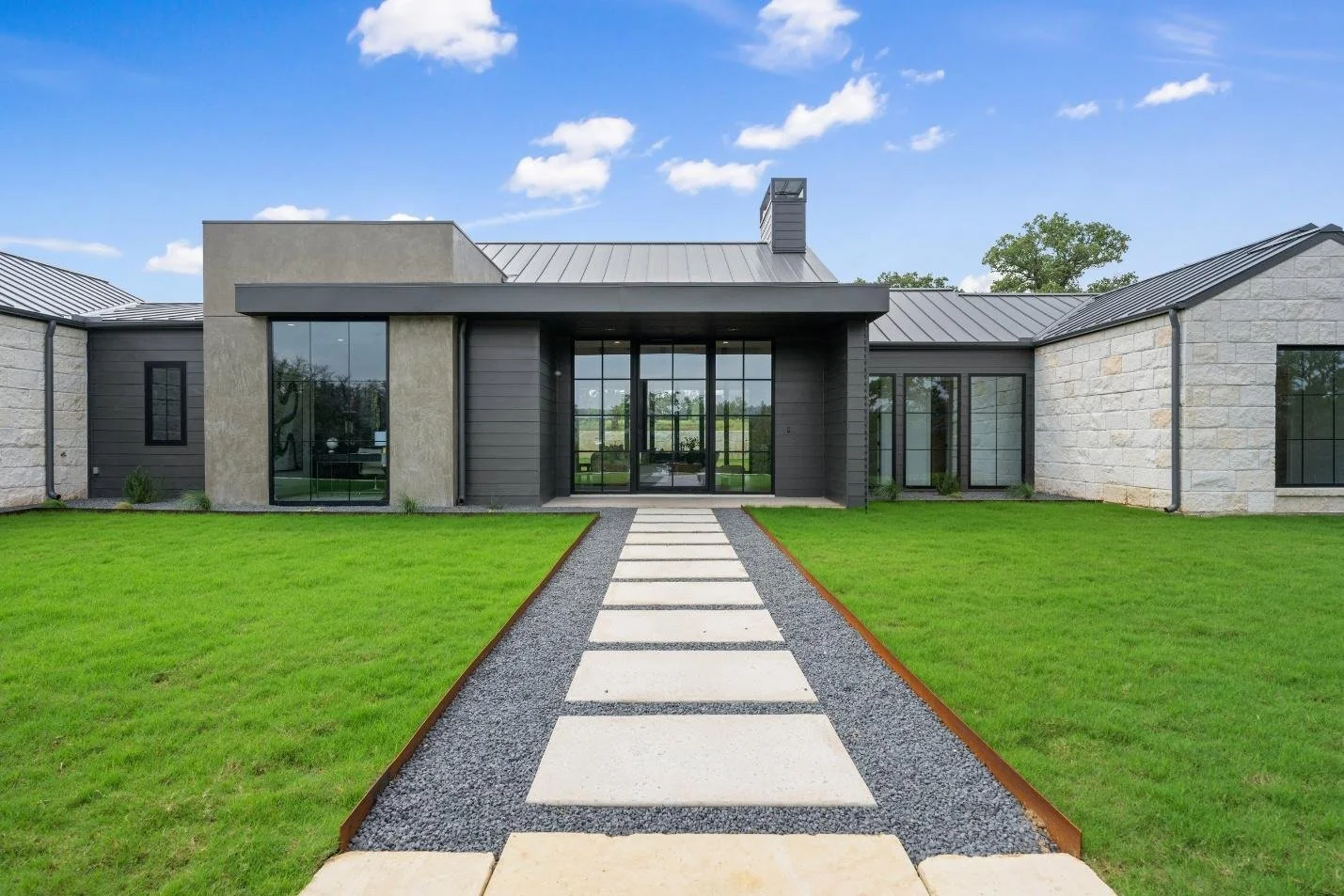
The 'Bidding' Myth: Why Unified Construction Delivery Prevents Budget Blowouts
The lowest custom home bid often hides site costs that surface as change orders. Unified design-build keeps pricing honest by testing budgets during design, not after.
📌 Key Takeaways
The lowest bid on your custom home plans often leads to the biggest budget surprises—because it's based on guesses, not your actual land.
Bids Hide What They Don't Know: A builder who hasn't walked your lot is guessing about rock, slope, and utility costs—and those guesses grow into change orders after construction starts.
Site Reality Before Floor Plans: Start with a Discovery Meeting on your property so the team knows what the land will actually require before anyone draws a single line.
One Team Keeps Costs Honest: When the same people design and build your home, budget feedback happens during planning—not as a surprise invoice mid-construction.
Ask What's Excluded: The items left off a bid often matter more than the line items included—request that exclusion list in writing before you compare prices.
Allowances Can Mislead: Low allowances make bids look smaller, but your real costs show up the moment you start picking actual cabinets, counters, and fixtures.
A truthful process doesn't kill the dream—it's what makes the dream buildable.
Homeowners planning a custom build in the Texas Hill Country will spot hidden bid risks here, preparing them for the builder selection steps that follow.
~ ~ ~ ~ ~ ~ ~ ~ ~ ~ ~ ~ ~ ~ ~ ~ ~ ~
The plans are finally done. Weeks of meetings, hundreds of decisions, a vision that now lives on paper. The next sentence feels obvious: send those drawings to three or four builders, compare what comes back, and pick the best number.
That instinct feels exactly right. It's how you negotiate a car purchase. It's how you get a fair price on a kitchen remodel. But a custom home built on Texas Hill Country terrain isn't a commodity transaction—and the moment you treat it like one, the budget risk begins.
Here's the core problem: a bid is only as honest as the assumptions behind it. When those assumptions don't account for your specific lot, your specific slope, and what lies beneath the surface, the lowest number on the page isn't a savings. It's a starting point for surprises.
Unified Construction Delivery—a process where one accountable team manages both design and construction from day one—prevents budget blowouts by keeping cost feedback active during design, before site realities become expensive mid-build problems. Think of it as having the architect and the accountant working at the same desk from the start.
The lowest bid on an unbuildable design is the most expensive mistake you can make.
The Myth: Why "Get Several Bids" Feels Like the Smartest Move
The logic is completely understandable. Competition drives prices down. More bids mean more leverage. You're protecting yourself.
In commodity purchasing, that logic holds. Custom home building breaks it.
When two builders review the same set of drawings, they don't price the same project. They price their own assumptions about what the land will require, what allowances will cover, and what risks they're choosing to defer. The finished plans sitting on your kitchen table look complete. Underneath them—literally and financially—are dozens of variables that experienced builders estimate differently and less experienced builders quietly ignore.
Luxury custom home clients often approach this process as savvy shoppers who refuse to be taken advantage of. That instinct is healthy. The problem is that shopping for the lowest bid on a set of plans doesn't protect against contractor overcharging. It exposes you to something more dangerous: a design that was never fully priced against the reality of your land.
This is the part many homeowners don't see at first. The danger isn't incompetence in the abstract. The danger is fragmentation. When the architect works separately, the builder prices later, and the lot hasn't been fully stress-tested against the budget, the plan can become emotionally real long before the price becomes financially real. That's how a dream home starts feeling like an endless money pit instead of a collaborative project.
Where Hidden Fees Usually Hide in a Traditional Construction Bid

Site prep and excavation top the list. Rock removal, grading, tree clearing, and soil stabilization costs vary enormously depending on the actual lot. A builder who hasn't walked your land is guessing—and guessing conservatively enough to win the job, not accurately enough to protect your budget.
Slope and retaining requirements are the second most common omission. A hillside lot that photographs beautifully may require engineered retaining walls, terracing, and drainage infrastructure that never appears as a line item in a plan-based bid.
Utility and infrastructure routing—where water lines run, how electrical service reaches the structure, whether propane or natural gas is available, where septic will sit—depends entirely on your specific parcel. Generic bids use placeholder assumptions that can unravel once a site engineer gets involved.
Allowance gaps deserve special attention. Allowances are the placeholders builders assign when final selections haven't been made—flooring, fixtures, cabinetry, countertops. A low allowance makes the bid look smaller without making your home cost less. The gap surfaces the moment you start choosing actual materials.
Permit and regulatory fees vary by county, watershed zone, and HOA jurisdiction in ways that out-of-area or desk-based bidders routinely underestimate.
Coordination costs from design-construction separation are the least visible category. When the team that drew the plans is different from the team building them, every question, discrepancy, and mid-build adjustment generates back-and-forth—and frequently a change order. For a deeper look at that coordination problem, see Stop the Finger-Pointing: How Design-Build Delivers Your Custom Home On Budget.
The Federal Trade Commission's guidance on home improvement contracts is clear on why written scope and careful contractor evaluation matter: verbal estimates and optimistic projections leave homeowners exposed. That principle applies with particular force in custom home building, where the scope is complex and the stakes are high.
The Texas Hill Country Multiplier: Why False-Low Bids Break Faster Here
In a flat suburban development, square-footage pricing works reasonably well because the land behaves predictably. The Texas Hill Country does not behave predictably, and that's precisely what makes it beautiful—and what makes generic pricing assumptions dangerous.
Limestone bedrock is common across Spicewood, Lake Travis, and surrounding areas. It can sit inches below the topsoil or several feet down. There is no way to know without a site-specific investigation, and there is no way to price it accurately without that knowledge.
Slope requirements on lakefront or ridgeline lots—the kinds of properties that attract Hill Country custom home buyers—can trigger engineered retaining systems that add substantial costs to a build, costs that a plan-only bid simply doesn't include.
Properties within the Highland Lakes and Lake Travis watershed zone also carry specific septic permitting requirements under the Lower Colorado River Authority's On-Site Sewage Facilities Program. System design, placement, and cost are all affected. A builder quoting from plans without local regulatory knowledge is quoting from incomplete information.
Across the broader service area—from Horseshoe Bay and Marble Falls to Kingsland and the Burnet County corridor—the same principle applies. The variables that define the landscape are the same variables that define the true cost of building on it. A builder who hasn't engaged with those variables before submitting a number is offering you a price that's designed to win the bid, not protect the budget.
For readers still early in the land stage, Five Key Factors for Selecting the Perfect Lot in Spicewood, TX offers a useful local companion to this discussion.
What Unified Construction Delivery Does Differently

Riverbend Homes is a second-generation family-owned business that has been designing and building custom homes in the Texas Hill Country since 1996. That history matters because it represents decades of site-specific knowledge—the kind of experience that tells a builder what a particular ridge above Lake Travis is likely to cost before a single trench is dug.
The process begins at the property, not at a desk. The Discovery Meeting happens on the land itself: walking the site, understanding what the terrain will require, assessing infrastructure needs, and mapping what's genuinely buildable within the approved budget. More importantly, this meeting initiates site feasibility testing—such as geotechnical soil and rock boring—which happens concurrently with initial design. If subsurface limestone is discovered, the architect and builder collaborate immediately to shift the footprint or adapt the foundation, ensuring the budget is grounded in reality before plans are locked.
From there, Riverbend stays actively involved through the design phase—not as a passive recipient of completed drawings, but as a continuous cost-feedback partner. The design process pauses at bid-set completeness, the point at which plans are detailed enough to estimate final construction costs with real precision. That pause is where the budget is stress-tested against site reality. If a design decision pushes the project beyond what was approved, you find out during design—when adjustments are still a conversation, not a change order.
This is what the Design-Build Institute of America identifies as the core advantage of unified project delivery: single-team accountability eliminates the handoff point where an architect's vision becomes a builder's problem.
Clients who already have plans developed are welcomed into this process. The goal isn't to start over—it's to bring cost and site reality into the conversation before expensive assumptions become locked decisions.
Riverbend also takes on a deliberately selective number of projects at any one time, maintaining daily on-site management throughout each build. That commitment isn't a marketing claim. It's a schedule and quality-control mechanism—one that keeps the build moving efficiently and keeps surprises from compounding into delays.
This is where the brand's emphasis on listening matters most. Budget protection isn't just about saying no. It's about hearing what matters most, then shaping design decisions around both vision and reality. The process is designed to be collaborative, personalized, and as stress-free as a major construction project can be.
Christine G., who described her experience in a Google review, put the outcome plainly: all through the building process, Ben was able to stay on budget with only the exception of things they planned to upgrade from the initial contract. He frequently found ways to save money on selections and allowed them to shop around on their own for deals—something other builders don't permit.
Chad F. described the same dynamic from a different angle: Ben is professional and consistently offers options to stay within budget while still delivering a fantastic product.
The Bid Comparison De-Coder: 7 Questions to Ask Before You Compare Prices
Before evaluating any number, evaluate the assumptions behind it. These seven questions should be asked of every builder under consideration—and the quality of the answers will tell you more than the bid itself.
1. Has this builder visited the actual lot?
A bid generated from plans alone, without a site visit, excludes the most variable costs in a Hill Country build.
2. What site-prep work is explicitly included?
Ask for a written breakdown of excavation, grading, rock removal, and drainage. Vagueness here means optimism—your optimism, not the builder's.
3. What is specifically excluded from this bid?
The exclusion list is often more revealing than the line items. Ask for it in writing.
4. How are allowances being set, and what are they based on?
If allowances are below what your actual selections will cost, the bid will grow the moment you begin choosing materials.
5. When are final site realities—rock, slope, drainage, utilities—priced in?
If the answer is "after we break ground," you are carrying all the budget risk.
6. What triggers a change order, and how are they approved?
The change order process is where budget control either holds or collapses.
7. Who is accountable if the design exceeds the approved budget?
On a fragmented team, the architect and builder each have someone else to point to. On a unified team, there is one answer.
A builder operating with honest, site-informed assumptions should be able to answer all seven of these questions clearly and specifically. Hesitation, deflection, or vague process language is useful information.
When the Lowest Bid Costs More: The Chain Reaction of a Change Order
The danger of a false-low bid isn't the number itself. It's what the number sets in motion.
Consider the sequence that plays out on Hill Country builds with some regularity:
False-low bid accepted → Site reality discovered after groundbreaking → Added excavation, retaining, or utility work required → Change order issued → Schedule disruption → Extended construction financing → Budget blowout
Each link in that chain is a cost. The change order itself. The redesign conversation if structural adjustments are needed. The carrying costs of financing a project that runs longer than planned. The emotional cost of a process that was supposed to feel like a partnership and starts to feel like a negotiation.
Once that chain starts, the project often becomes more expensive in more than one way. There's the direct cost. There's the redesign delay. There's the emotional drag of watching control slip away after everyone thought the budget had already been set.
This is why the original myth is so dangerous. It doesn't just risk a bigger bill. It creates false confidence first.
What to Do Instead If You Want Real Budget Protection
Start by changing the question.
Don't ask, "Who will build this for the lowest number?" Ask, "Which team is showing the most truthful path from this lot and this design to a real budget?"
That shift leads to a better process.
Bring builder input into the design conversation early. The architect is essential for vision. The builder is essential for cost reality. Getting both in the same conversation—or choosing a unified firm where they're already the same conversation—keeps the budget honest before emotional attachment to a specific design sets in.
Start with the site. Before floor plans, before material selections, before elevations, understand what your specific parcel will actually require. The Discovery Meeting at Riverbend is built around exactly this: a real conversation at the property, not a quoting exercise from a conference room.
Treat transparency as a buying criterion. A builder who can tell you clearly what's included, what's excluded, and when site realities will be priced in isn't making the bid harder to evaluate—they're making it trustworthy. That transparency, extended through generous allowances and the freedom to shop your own selections, is part of what separates a collaborative partnership from a transaction.
Compare process, not just price. The Spring planning season—when most Hill Country homeowners begin seriously researching and budgeting for new builds—is precisely when the instinct to comparison-shop is strongest. That instinct is worth redirecting: compare how builders handle the unknowns, not just what they charge when the unknowns are assumed away.
A unified design-build approach doesn't remove the complexity of building in the Hill Country. It keeps that complexity visible, priced, and manageable from the beginning—which is the only way a budget stays a budget.
A truthful process isn't about killing the dream. It's what makes the dream buildable.
When the conversation is ready to move to the land itself, schedule a Discovery Meeting—the first step at Riverbend always begins on the property.
For related reading on budget protection and builder selection, How the Right Builder Helps You Avoid Surprise Bills and 7 Early Red Flags That Tell You to Walk Away cover the evaluation questions worth asking before committing to any builder. Fixed-Price vs. Cost-Plus: Which Contract Protects Your Custom Home Budget? is a useful companion piece on the contractual side of budget protection. And for a broader look at what makes luxury Hill Country building work, Building Without Regret: The Complete Guide to Luxury Custom Homes in the Texas Hill Country covers the full picture.
Frequently Asked Questions
Is bidding out custom home plans really the cheapest option?
Rarely. The lowest bid on a set of plans is only as reliable as the assumptions behind it. When those assumptions exclude site prep, slope work, accurate allowances, and utility realities, the number is temporarily small and then grows during construction—often significantly. For a custom build on Hill Country terrain, transparent and site-informed pricing is generally more protective than the lowest submitted number.
Why do custom home bids change after construction starts?
Most mid-build cost increases trace back to assumptions that were incomplete at bid time. Unknown subsurface site conditions (like bedrock), allowance gaps, and the coordination friction between separately hired architects and builders are the most common sources. When design and construction are managed by one team with continuous estimating, these gaps are identified during design rather than after ground is broken.
What costs are most often missing from a custom home bid?
Site prep and excavation, slope and retaining requirements, utility routing, septic system placement, and allowance undercalculation are the most frequent omissions. In the Texas Hill Country specifically, limestone depth, drainage complexity, and local permitting requirements add variability that plan-only pricing doesn't capture.
What is the difference between design-build and bidding out finished plans?
Bidding finished plans separates design accountability from construction accountability—one team draws the vision, another team builds and prices it. Unified construction delivery keeps both functions under one accountable team, so cost feedback during design prevents the surprises that appear after the design is complete. What is Design-Build? The Simple Explanation for Custom Homeowners covers this distinction in plain language.
When should a builder be involved in custom home design?
As early as possible—ideally before site selection and certainly before the design is finalized. A builder involved during design can flag site-specific cost implications, keep the plan aligned with the approved budget, and prevent the cycle of redesign that happens when a finished plan turns out to be unbuildable at the expected price. Riverbend's process is structured around this principle: the builder is present at the Discovery Meeting on the property and stays actively involved through design so the budget is tested against reality before construction begins.
For readers who want a broader look at builder selection and budget trust, Hiring a Custom Home Builder in the Texas Hill Country: Your Step-by-Step Guide to Choosing a Builder You Can Trust is a strong next read.
Our Editorial Process:
This article was built from Riverbend Homes source-of-truth materials and cross-checked against approved authority references for regulatory and consumer-protection context. Any factual claim about process, contracts, permitting, allowances, site prep, or pricing mechanics should be validated before publication.
By: Riverbend Homes Editorial Team
Riverbend Homes Editorial Team creates educational content for homeowners planning custom homes in Spicewood, Lake Travis, Horseshoe Bay, Lake LBJ, and the wider Texas Hill Country. Final publication should receive brand and factual review before going live. For trust context, see the Riverbend Homes Google Business Profile.
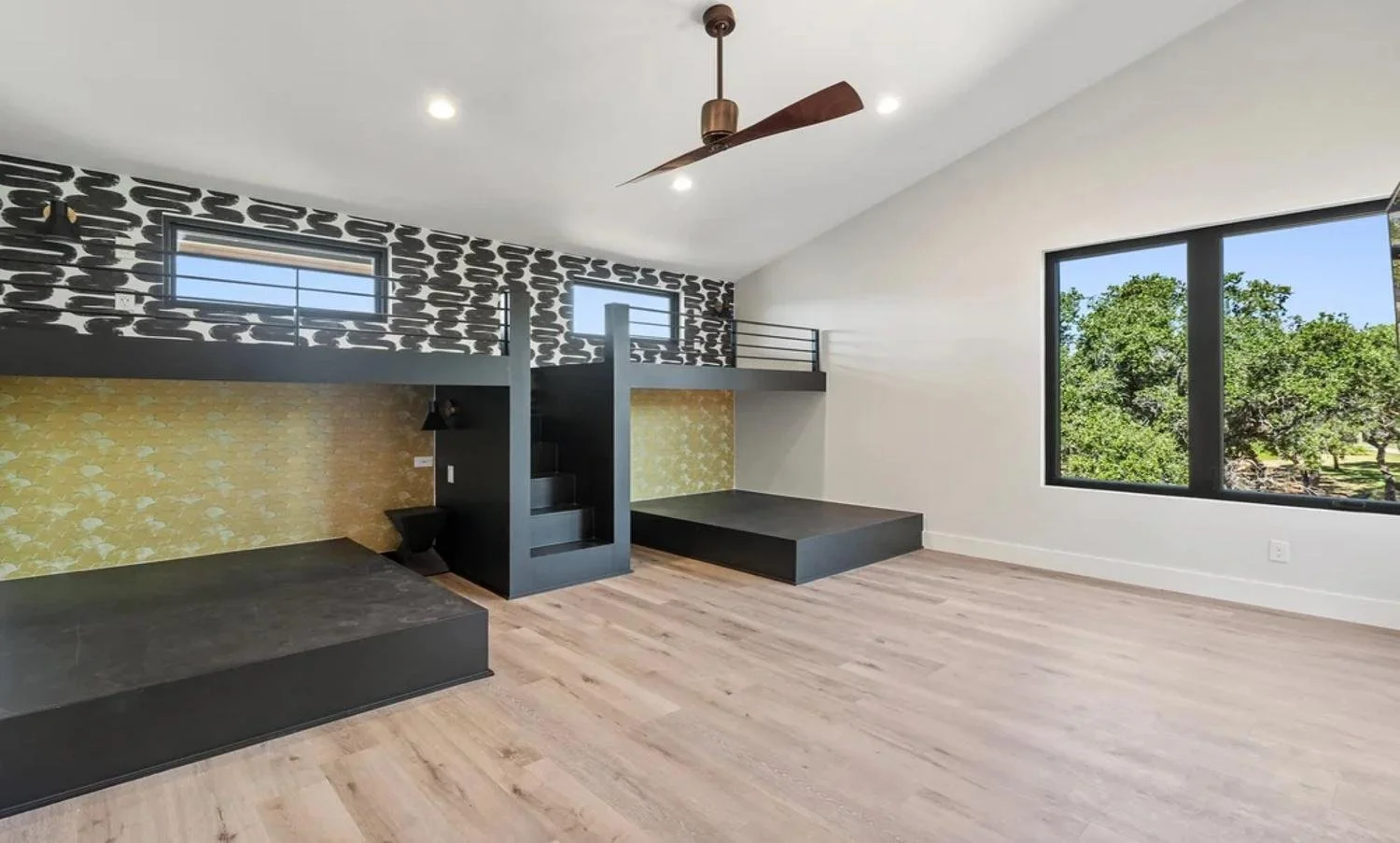
Fixed-Price vs. Cost-Plus: Which Contract Protects Your Custom Home Budget?
Fixed-Price contracts shift cost-increase risk to your builder, while Cost-Plus adds 15-20% markup on every overage you pay. Compare both before signing.
📌 Key Takeaways
Your construction contract determines who pays when costs rise—Fixed-Price shifts that risk to the builder, while Cost-Plus leaves you holding the bag.
Contract Type = Risk Owner: Cost-Plus means you pay for every price increase, delay, and inefficiency; Fixed-Price means the builder absorbs typical market swings after signing.
Low Bids Often Hide Incomplete Scope: That cheap estimate usually excludes items you'll need, turning "savings" into expensive change orders with markups attached.
Price-Per-Square-Foot Misleads: This number ignores site prep, septic, wells, and finish quality—only the total contract price with clear inclusions matters.
Vet Allowances Before Signing: Trustworthy builders explain exactly what's covered and what happens if you exceed allowances, so you're not surprised mid-project.
Demand Written Scope Clarity: If it's not written down, it's not real—ask to see what's included, what's excluded, and how change orders get priced and approved.
Budget certainty comes from contract structure, not promises.
Families planning custom homes in the Texas Hill Country will gain clarity on protecting their investment, preparing them for the detailed builder vetting process that follows.
~ ~ ~ ~ ~ ~ ~ ~ ~ ~ ~ ~ ~ ~ ~ ~ ~ ~ ~ ~ ~ ~ ~ ~ ~ ~ ~ ~ ~ ~ ~ ~ ~ ~ ~ ~ ~ ~ ~ ~ ~ ~ ~ ~ ~ ~ ~ ~ ~ ~ ~ ~ ~ ~
It's 6:00 PM on a Sunday evening. You're staring at a spreadsheet labeled "Allowances" and wondering if the granite countertops are actually included—or if that's another surprise waiting to hit your bank account. The numbers don't quite add up. The builder's proposal mentioned "estimated costs," but estimated by whom? And based on what?
This shouldn't be this confusing.
If you're planning a custom home in Spicewood, Horseshoe Bay, or anywhere along Lake Travis, you've likely encountered two contract types: Fixed-Price and Cost-Plus. The difference between them isn't just accounting—it's the difference between sleeping soundly and dreading every phone call from your builder.
Here's the honest truth before we go further: if you're looking for the lowest price-per-square-foot over long-term quality and budget certainty, we're not the right fit. This guide is for families who want to understand how contract structure protects—or exposes—their investment.
Your contract is not paperwork. It is your financial risk plan.
A Fixed-Price contract prevents budget spiraling out of control. It achieves this by shifting the financial risk of material price fluctuations from the homeowner to the builder once the agreement is signed.
Fixed-Price vs. Cost-Plus: The 5-Minute Breakdown
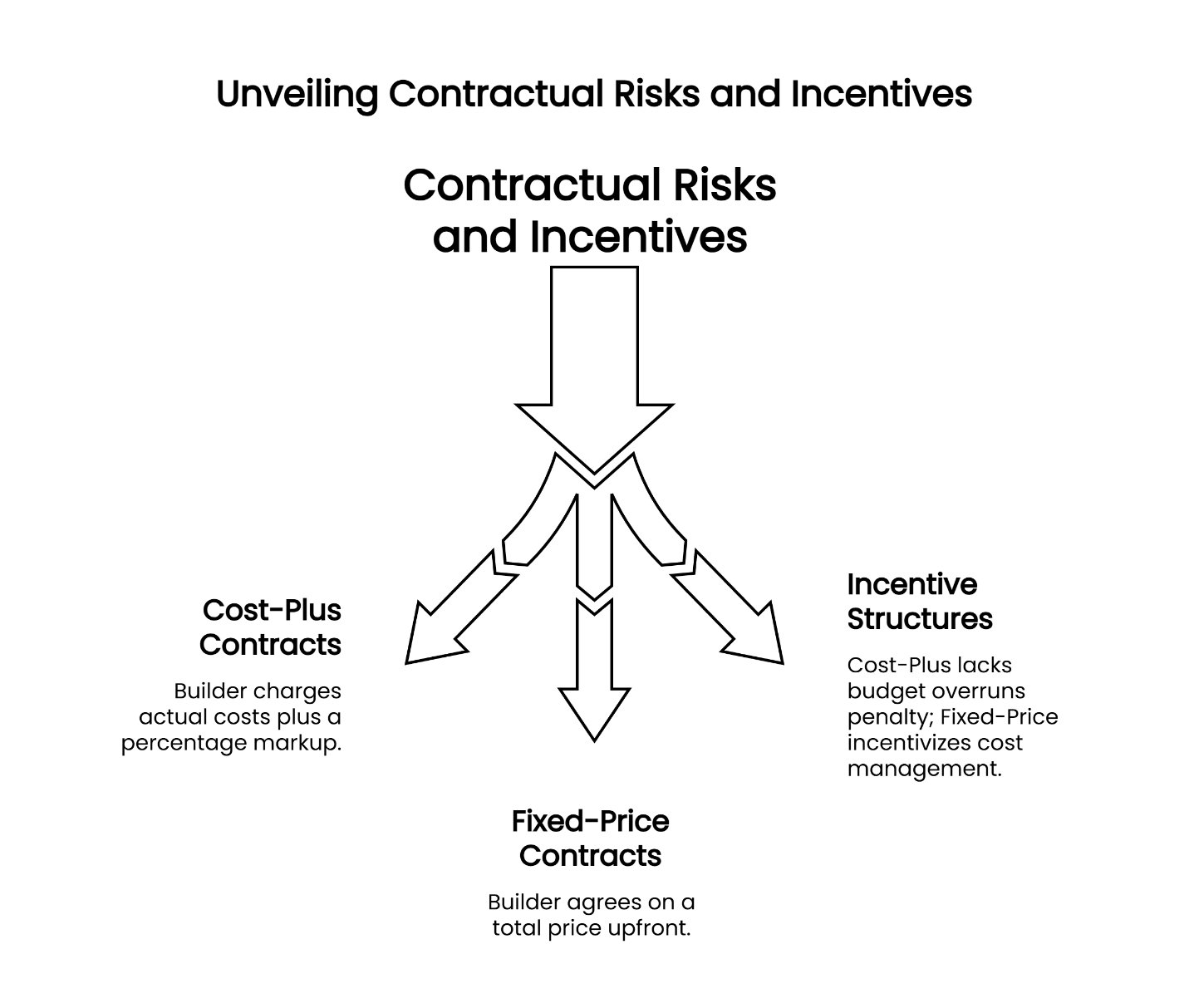
The contract you sign determines one critical thing: who pays when costs rise?
Cost-Plus contracts work like a blank check. The builder charges you for actual material and labor costs, then adds a percentage markup (typically 15-20%) as their fee. Sounds fair on paper. The problem? You bear 100% of the risk for price increases, delays, and inefficiencies. If lumber prices spike mid-project—that's your problem. If the crew takes longer than expected—that's your tab.
Fixed-Price contracts are designed to give you peace of mind, functioning much like an all-inclusive resort. You agree on a total target price upfront, and the builder generally absorbs the risk of standard market fluctuations once the contract is signed. If steel prices experience typical volatility after you've signed, a well-prepared builder usually covers it. If rock excavation takes three extra days on your Bee Cave lot, a thorough builder will have already factored those anticipated site conditions into your original number, severely limiting your exposure to surprises.
The incentive structures couldn't be more different. Under Cost-Plus, there's no penalty for the project running over budget—the builder still gets their percentage. Under Fixed-Price, the builder has every reason to manage costs tightly, because overruns eat into their margin.
Who Bears the Risk? A Side-by-Side Comparison
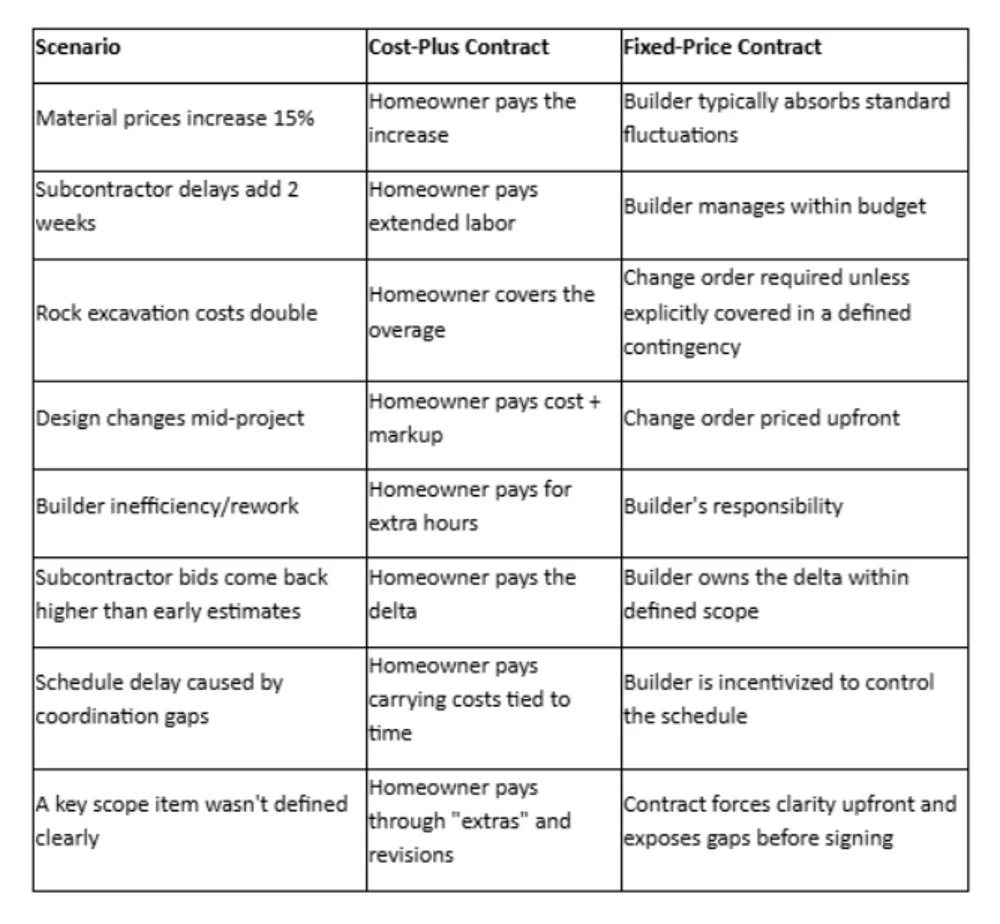
For families building on complex Hill Country terrain—where LCRA watershed regulations add permitting layers and limestone can lurk inches below the surface—the Cost-Plus model becomes especially risky. You're signing up for uncertainty on top of uncertainty.
The "Low-Ball" Bid Myth: Why Cheaper Upfront Costs More Later
Here's a misconception we encounter constantly: "I should get multiple bids and go with the lowest number."
For production homes on flat suburban lots, competitive bidding makes sense. For bespoke luxury homes on sloped Hill Country sites with specific drainage requirements and HOA design standards? Standard bidding fails because "lowest price" usually means "incomplete scope."
That low Cost-Plus bid often excludes allowances you'll actually need. The $200,000 "estimate" becomes $280,000 in reality—plus 18% markup on every overage. The builder who bid $240,000 with realistic allowances suddenly looks like the honest one.
The "Change Order" trap works like this: A Cost-Plus builder submits a lean initial bid to win your business. Once construction starts, every modification—every "oh, we didn't account for that"—triggers a change order. Each change order carries their markup percentage. By project end, you've paid a premium for what was marketed as a discount.
The "Cheap" Bid Reality: In custom building, the lowest bid often reflects incomplete scope. Missing scope doesn't disappear—it comes back as change orders, rework, and hard conversations when you're already committed. In a volatile market, a "low" Cost-Plus bid is actually a liability, not a saving.
As one Riverbend Homes client in Horseshoe Bay put it: "During these times of volatility, they won't leave you hanging." That's not a comment about price—it's about predictability.
Myth vs. Reality: The Price-Per-Square-Foot Trap
The Myth: "I can compare builders by their price per square foot."
The Reality: Price-per-square-foot tells you almost nothing about final cost. It doesn't account for site preparation on sloped lots, septic systems, well drilling, the quality of finishes, or the complexity of your floor plan. A $180/sq ft quote that excludes your kitchen appliances and driveway isn't comparable to a $220/sq ft quote that includes everything. The only number that matters is the total contract price—and whether that number is guaranteed or estimated.
If you're in a phase where you're comparing builders primarily by a number on a sheet, pause. That approach works for simpler projects, not complex luxury sites. If you're looking for a local team that understands what makes the Hill Country different, start with local custom home builders.
How to Vet a Fixed-Price Builder in the Texas Hill Country
Not every builder offering "fixed price" delivers the same protection. Fixed price only protects you if it's built on real scope clarity. Here's how to separate genuine budget security from marketing language.
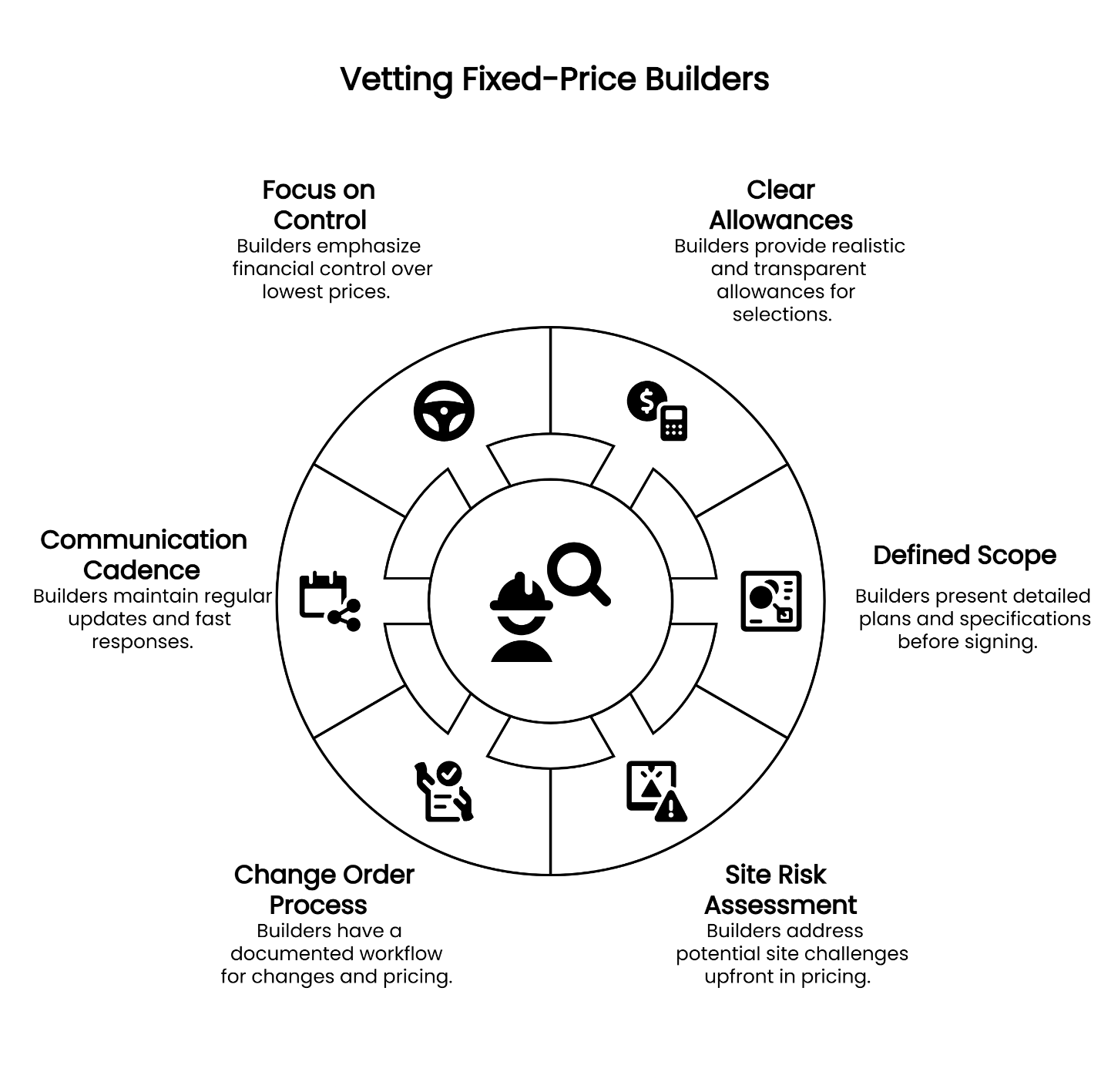
They explain allowances like an adult conversation. A trustworthy Fixed-Price builder provides generous, realistic allowances based on your stated preferences. They'll walk you through selections before signing so you understand what's covered. Vague or suspiciously low allowances signal a Cost-Plus mentality hiding behind Fixed-Price language.
They show you what "scope complete" means. The more complete the plans and specifications before signing, the less room for surprises. You should be able to see exactly what's included and what's excluded—in writing.
They address site risk upfront. Hill Country lots hide surprises. Rock. Springs. Drainage challenges. A genuine Fixed-Price builder has already accounted for likely scenarios in their pricing. They've built on enough Spicewood and Lake Travis properties to know what the land tends to reveal. Rock, drainage, access, utilities, and permitting processes should be part of early conversations—not discoveries after the contract.
They have a clear change-order process. Not "we'll figure it out later," but a documented workflow with pricing and approval before work proceeds. If you change the plan, upgrade finishes beyond allowances, or add scope, you should expect a documented change order with transparent pricing.
They emphasize communication cadence. Transparency isn't just about the contract—it's about communication throughout the build. Weekly updates, schedule visibility, and fast answers reduce the friction that causes delays and cost creep. One Riverbend Homes client described the experience this way: "Ben and Blake have good chemistry and are very approachable and accessible." That kind of communication isn't a feel-good extra—it's a budget control tool.
They don't sell you on the lowest number—they sell you on control. If a builder leans hard on "we're the lowest," it usually means scope is thin. The relief of watching your home take shape exactly as planned comes from knowing where you stand financially at every milestone.
When you find the right builder, the process transforms. As one client described their experience: "From our first discussion, Ben was aligned with our vision and told us that what others said was not possible would be possible."
That alignment—between your vision, your budget, and your builder's commitment—is what Fixed-Price protection actually delivers. This is where the design-build process earns its keep. When design and construction are coordinated, you get pricing feedback while decisions are still easy to adjust. For a deeper look at that accountability loop, read Stop the Finger-Pointing: How Design-Build Delivers Your Custom Home On Budget.
Three Questions for Your Contract Review
Before signing any construction agreement, ask these questions and demand clear answers:
1. "Show me what is explicitly included and explicitly excluded."
If it's not written down, it's not real. What's included in your allowances—and what happens if you exceed them?
2. "How are allowances structured—and what happens when selections exceed them?"
You want transparent overage handling, not mystery invoices.
3. "What's the process for change orders, and when do I see pricing?"
The safest answer is: pricing is presented and approved before work proceeds.
The Path Forward: From Budget Anxiety to Building Confidence
The contract decision isn't really about paperwork. It's about whether you'll spend the next 12 months worrying about phone calls from your builder—or enjoying the process of watching your Hill Country home rise from the foundation up.
As you enter the spring planning phase, locking in your budget matters more than ever. Interest rate shifts can change financing overnight. Material costs fluctuate with global supply chains. A Fixed-Price contract doesn't just protect your current budget—it shields you from market chaos you can't predict or control.
If you're considering managing the build yourself to save costs, we'd encourage you to read about the hidden stress of DIY home building before deciding. The math rarely works out the way people hope.
For families ready to build with transparency and without surprises, the next step is a conversation. Not a sales pitch—a discovery meeting where we walk your lot together, understand your vision, and determine if we're the right fit for each other.
Because your sanctuary deserves to be built on certainty, not estimates.
Stay Informed: Hill Country Building Trends & Tips
Ready for the Next Step? Schedule Your Discovery Meeting
Disclaimer: This article is for informational purposes and reflects general guidance on construction contract types. Specific contract terms, pricing structures, and project requirements vary. We recommend reviewing any construction agreement with appropriate legal and financial advisors before signing.
Our Editorial Process
Our expert team uses AI tools to help organize and structure our initial drafts. Every piece is then extensively rewritten, fact-checked, and enriched with first-hand insights and experiences by expert humans on our Riverbend Homes Insights Team to ensure accuracy and clarity.
By: The Riverbend Homes Insights Team
The Riverbend Homes Insights Team is our dedicated engine for synthesizing complex topics into clear, helpful guides. Riverbend Homes is a proud member of the National Association of Home Builders (NAHB), Texas Association of Builders (TAB), and Hill Country Builders Association (HCBA).