

Building Without Regret: The Complete Guide to Luxury Custom Homes in the Texas Hill Country
📌 Key Takeaways
Budget disasters in Hill Country custom builds trace to vague allowances and incomplete specifications before construction begins, not to unforeseen site conditions.
Limestone Demands Higher Contingency: Hill Country rock and slope require 10-15% contingency reserves, or higher for raw land with unverified geotechnical data.
Design-Build Prevents Budget Mismatch: Unified teams provide real-time cost feedback during design, catching overruns before bid-set drawings lock in unaffordable scope.
Site Diligence Precedes Design Investment: Rock depth, drainage patterns, and septic feasibility assessments prevent expensive plan revisions after architectural fees are spent.
Communication Rhythm Governs Experience: Predictable updates, clear decision deadlines, and transparent change order rules reduce stress more than construction quality alone.
Allowance Clarity Equals Cost Control: Narrow, realistic placeholders for fixtures and finishes protect budgets better than generous-sounding ranges that mask true costs.
Process discipline—not just finishes—defines luxury in custom Hill Country construction.
Homeowners planning luxury builds in Spicewood, Lake Travis, Horseshoe Bay, or surrounding Hill Country areas will gain immediate builder-evaluation clarity here, preparing them for the detailed discovery meeting questions that follow.
It's 6:00 PM on a Sunday. The builder's estimate sits open on the kitchen table. Are the granite countertops actually included? The numbers blur together, and that familiar knot tightens in your stomach.
This moment—staring at a document that should feel exciting but instead feels like a trap—is where most custom home dreams start to unravel. Not because the dream is wrong, but because the process lacks clarity.
In the Texas Hill Country, true luxury is defined by process, not just finishes. The families who build without regret aren't necessarily the biggest spenders. They are the ones who prioritized structural clarity over cosmetic upgrades, understood their budget before breaking ground, and partnered with a builder who treated transparency as non-negotiable.
This guide walks you through that roadmap—from standing on an empty lot wondering where the porch should go, all the way to handing you the keys to a home that matches both your vision and your budget.
The Hill Country Reality Check: Site, Rock, Slope, and Water Change Everything
Stand on almost any lot in the Texas Hill Country during summer, and you'll feel it immediately. The heat radiates off the limestone. The slope drops away toward a creek or canyon. Somewhere in the distance, Lake Travis or Lake LBJ catches the afternoon light.
This landscape is precisely why people want to build here. It's also why building here demands a different approach than constructing a home in a flat suburban subdivision.
Rock changes everything. Much of the Hill Country sits on limestone bedrock that can be inches below the surface. Excavating for foundations, utility trenches, and septic systems often requires specialized equipment. A lot that looks simple can hide significant rock removal costs that only a geotechnical report will reveal.
Slope creates opportunity and complexity. That dramatic view you're chasing? It usually comes with terrain that slopes, sometimes dramatically. Proper drainage planning prevents water from pooling against foundations or eroding the hillside over time. The USDA NRCS Web Soil Survey offers publicly available soil data that can inform early feasibility discussions.[^1]
Water proximity adds considerations. Waterfront and creek-adjacent properties in areas like Lake Travis, Lake LBJ, or Horseshoe Bay may fall within flood zones. Checking FEMA's Flood Map Service Center early helps you understand setback requirements and insurance implications before committing to a purchase.[^2]
Septic feasibility varies widely. Properties outside municipal sewer systems require on-site sewage facilities (OSSF). The Texas Commission on Environmental Quality regulates these systems, and soil conditions directly affect what type of system your lot can support—and what it will cost.[^3]
The Lot Feasibility Checklist
Before purchasing land or finalizing your site selection, work through these critical questions:
What does the slope percentage tell you about foundation requirements?
Has a geotechnical report identified rock depth and soil composition?
Where will utilities connect, and what's the distance to existing infrastructure?
Does the lot require a private septic system, and has soil testing confirmed feasibility?
Are there easements, setbacks, or view corridor restrictions?
What does the HOA architectural review process require?
How will drainage flow across the property during heavy rain?
Is fire department access adequate for emergency vehicles?
Addressing these questions before design begins prevents the most expensive surprises. A builder experienced in Texas Hill Country custom homes can often identify potential issues during an initial lot walk—before you've invested in architectural plans.
The Hill Country Custom Home Roadmap
The families who describe their building experience as "fun" rather than "stressful" share one thing in common: they understood the journey before they started. Here's the roadmap that transforms uncertainty into confidence.
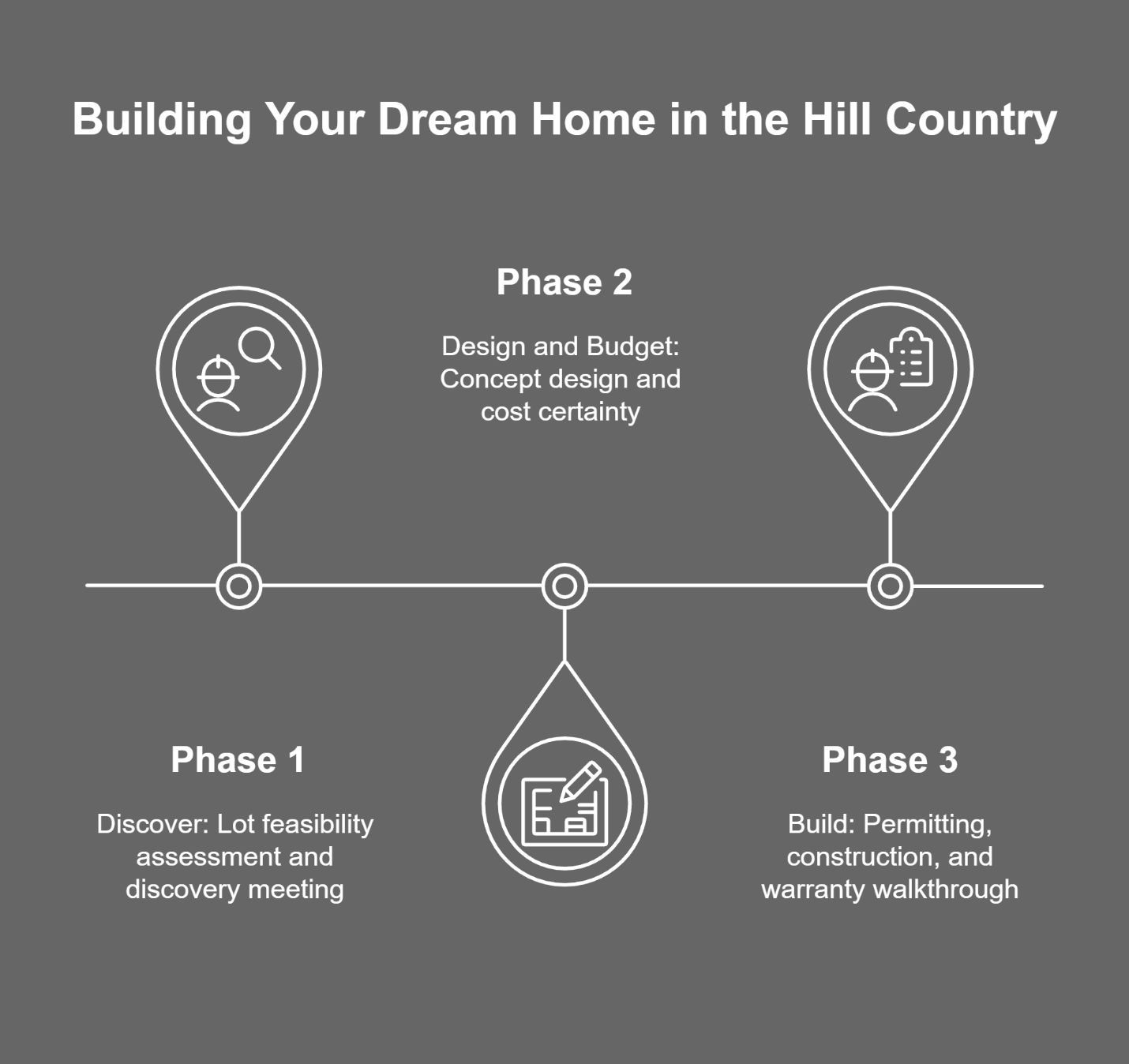
Phase 1: Discover
This phase answers a fundamental question: Can we build what we want, where we want, for what we can afford?
Lot feasibility assessment examines the physical realities of your property—slope, rock, drainage, utilities, and access. Discovery meeting brings you together with your builder on the actual site to discuss your vision, must-haves, and budget parameters. Concept exploration identifies whether your goals align with what the lot can realistically support.
The discovery phase should feel like a conversation, not a sales pitch. You're interviewing the builder as much as they're understanding your project.
Regret Prevention Focus: Validate site realities early; align expectations before design accelerates and expensive assumptions get locked in.
Phase 2: Design and Budget
This phase locks in the "what" and the "how much" before construction begins.
Concept design translates your vision into preliminary floor plans and elevations. Bid-set drawings develop those concepts into detailed construction documents complete enough to price accurately. Selections and allowances get defined early—not vaguely promised for "later." Cost certainty emerges from a line-item estimate based on actual specifications, not assumptions.
The goal here is eliminating the phrase "we'll figure it out later" from your vocabulary. Every decision deferred is a potential surprise waiting to surface.
Regret Prevention Focus: Turn inspiration into cost-validated scope; minimize vague allowances that shift risk to you.
Phase 3: Build
This phase brings your home to life through a predictable sequence of milestones.
Permitting and HOA approval secure the necessary authorizations. Foundation establishes the structural base. Framing and rough-ins create the skeleton and mechanical systems. Finishes transform raw construction into livable spaces. Punch list and inspections catch any remaining items before move-in. Warranty walkthrough documents the home's condition and your builder's ongoing commitments.
Throughout construction, communication rhythm matters as much as construction quality. Weekly updates, clear decision deadlines, and accessible project managers prevent the anxiety that comes from feeling out of the loop.
Regret Prevention Focus: Maintain predictable communication; control changes with clear documentation and approval rules.
Decision Points Along the Way
Several key decisions shape your project's trajectory:
Delivery model choice: Design-build, bid-build, or general contractor?
Contract model: Fixed-price, cost-plus, or hybrid?
Allowance strategy: Narrow and specific, or broad and risky?
Site constraint response: How will you address rock, slope, or drainage findings?
HOA and permit timing: When must architectural review happen relative to design completion?
Each decision point deserves focused attention. Rushing through them creates the conditions for regret.
Choose the Right Delivery Model: Design-Build vs. Bid-Build
Not every project demands the same approach. Understanding when each delivery model makes sense—and when it becomes a liability—helps you choose wisely.
When Bid-Build Can Work
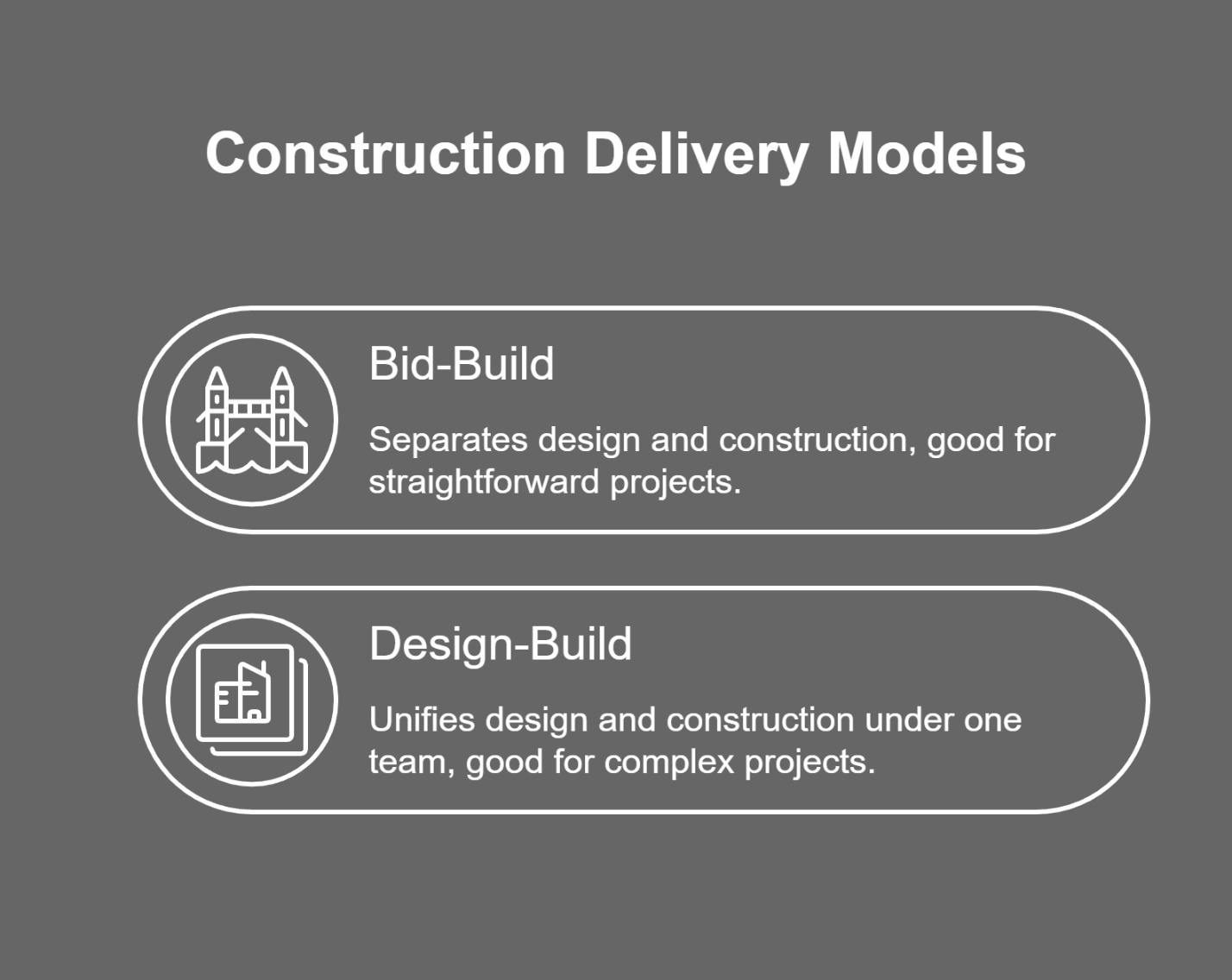
The traditional bid-build approach separates design from construction. You hire an architect to create plans, then solicit bids from multiple builders. This model can work well when the design is straightforward, the site is uncomplicated, and you have significant time to manage the process.
The appeal is competitive pricing. Multiple builders bid on identical plans, and you select based on price, reputation, or chemistry.
When Bid-Build Breaks Down
Problems emerge when the site is complex, finishes are high-end, or you're working within a strict budget alongside ambitious design goals.
In these scenarios, the architect designs without real-time cost feedback. By the time bids arrive, you may discover the design exceeds your budget by a significant margin. Redesign cycles follow. Frustration builds. The adversarial dynamic between designer and builder creates finger-pointing when problems arise.
Worse, the "low-bid" winner may have achieved that price through vague allowances, optimistic assumptions, or the intention to make profit through change orders. The estimate that looked attractive on paper becomes a vehicle for cost overruns.
When Design-Build Becomes the Safer Path
Design-build unifies design and construction under one team. The builder participates in design decisions from day one, providing real-time cost feedback as the plans develop. When you reach bid-set drawings, the estimate reflects actual specifications rather than hopeful assumptions.
This model excels when site complexity demands builder expertise during design, when budget discipline requires continuous cost monitoring, when high-end finishes create pricing variability that needs early resolution, and when you value a single point of accountability over managing multiple contracts.
The tradeoff? You're selecting your builder earlier in the process, before you have complete plans to compare. This requires trusting the builder's integrity and competence based on their track record, references, and the quality of their discovery process.
One client described the difference this way: "From our first discussion, Ben was aligned with our vision and told us that what others said was not possible would be possible." That alignment—builder and client working toward the same outcome from day one—defines the design-build approach.
Comparison: Delivery Model Tradeoffs
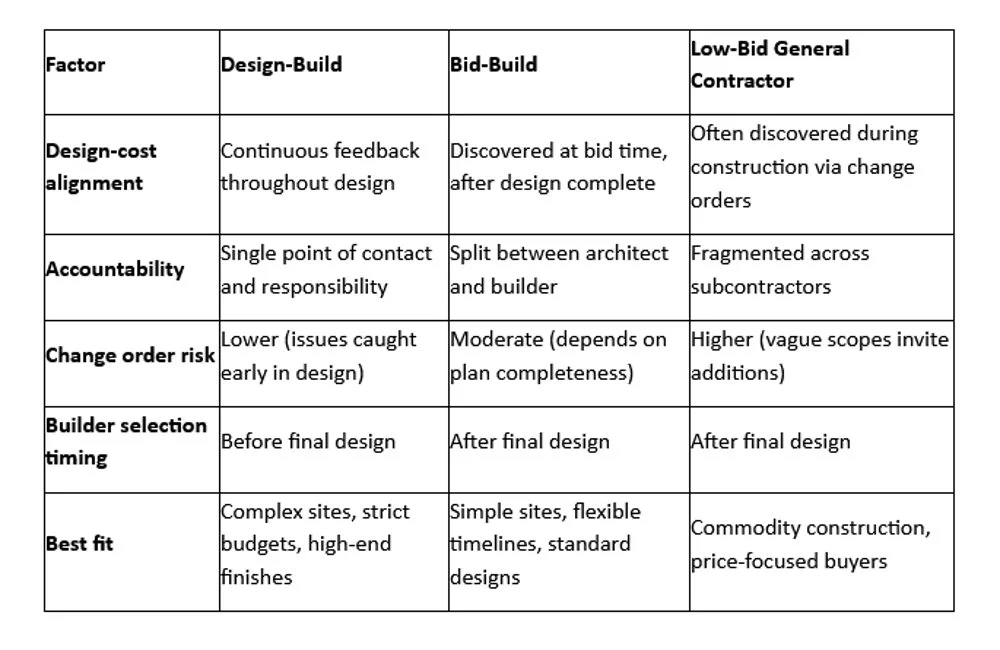
Note: This comparison reflects general principles; individual project outcomes depend on execution quality and contract structure.
Budget Discipline: How to Avoid Surprise Bills
Most custom home budget disasters don't stem from bad luck. They trace back to rushed estimating, vague scopes, and decisions deferred until construction is underway.
Understanding a few key terms transforms you from a passive recipient of estimates into an informed participant in budget management.
Bid-set drawings are construction documents detailed enough to price accurately. If your builder provides an estimate based on preliminary sketches, expect that number to change significantly as details emerge.
Allowances are placeholder amounts for items not yet selected—like light fixtures, plumbing hardware, or appliances. Narrow, realistic allowances protect you. Generous-sounding allowances often mask true costs, creating "surprises" when you discover your selections exceed the arbitrary placeholder.
Selections are the specific products you choose to fill those allowances. Making selections early—before construction begins—eliminates one of the largest sources of budget uncertainty.
Contingency is a reserve for genuinely unforeseen conditions. A reasonable contingency—often around 10-15% (or higher for raw land with unverified rock depth) depending on project complexity—isn't padding the estimate. It's acknowledging that even thorough planning can't predict every subsurface condition or material availability issue.
Change orders document modifications to the original scope. Some change orders are unavoidable (you discover unexpected rock, or you decide mid-construction that you want a different window configuration). But a pattern of change orders often signals that the original estimate wasn't thorough enough.
The "No-Surprise" Budget Stack (Illustrative Framework)
A well-structured budget separates these components clearly:
Base scope (fully defined): The core construction cost based on complete bid-set drawings
Site scope (validated): Excavation, foundation adjustments, and utility connections reflecting actual site conditions
Selections (made early): Specific fixtures, finishes, and materials chosen before construction begins
Allowances (narrow and limited): Small placeholders only for items that genuinely can't be specified yet
Contingency (transparent): A defined reserve for unforeseen conditions, tracked separately
Change order rules (tight): Clear documentation requirements and approval processes for any scope modifications
When a builder presents an estimate, ask how each component is handled. Vague answers about allowances or resistance to defining contingency separately are warning signs.
Fixed-Price vs. Cost-Plus Contracts
Fixed-price contracts establish a total cost for the defined scope. The builder assumes risk for cost overruns within that scope. Your risk is limited to change orders you initiate or genuinely unforeseen conditions.
Cost-plus contracts pass actual construction costs through to you, plus a fee (either fixed or percentage-based) for the builder's services. Your exposure is open-ended, though you gain visibility into actual costs as they occur.
Neither model is inherently better. Fixed-price offers budget certainty but requires complete specifications upfront. Cost-plus offers flexibility but demands trust and rigorous documentation.
The critical questions: How complete are the specifications before pricing? How are allowances defined? What triggers a change order versus a cost adjustment? What documentation will you receive throughout construction?
Designing a Luxury Hill Country Home That Lives as Good as It Looks
The most stunning Hill Country homes aren't just beautiful—they're comfortable despite the Texas heat, functional for how families actually live, and designed to minimize long-term maintenance headaches.
Orientation for Views, Shade, and Breezes
Standing on an empty lot in summer heat, trying to visualize where the porch should go to catch the afternoon breeze—this is where thoughtful design begins.
Window placement affects both views and solar gain. Large west-facing glass captures dramatic sunsets but also admits intense afternoon heat. Deep overhangs, covered porches, and strategic shading devices let you enjoy views without overwhelming your air conditioning system.
Cross-ventilation patterns matter for outdoor living spaces. Understanding prevailing wind direction on your specific lot helps position covered areas where breezes actually flow.
The relationship between indoor and outdoor spaces defines Hill Country living. Retractable doors, covered outdoor kitchens, and screened porches extend your livable square footage well beyond the air-conditioned envelope. For more on this approach, explore indoor-outdoor living features that work in this climate.
Material Choices for Heat, Sun, and Low Maintenance
Material selection balances aesthetics, durability, and maintenance requirements.
Exterior finishes face intense UV exposure. Some materials fade, crack, or require frequent repainting. Others weather gracefully with minimal intervention. Discussing maintenance expectations upfront prevents disappointment when your "forever home" demands constant upkeep.
Roofing choices affect both appearance and cooling loads. Light-colored or reflective roofing materials reduce heat absorption. The right choice depends on your home's style, local HOA requirements, and energy efficiency priorities.
Landscaping decisions made during construction affect long-term water usage, fire risk, and maintenance burden. Properties in wildfire-prone areas benefit from defensible space planning aligned with NFPA Firewise principles.[^4]
Lifestyle-First Planning
The best custom homes emerge from honest conversations about how you'll actually use the space.
Weekend lake house or full-time residence? Frequent entertaining or quiet retreat? Multigenerational living with grandparents or adult children? Home office requirements? These lifestyle factors shape floor plans more profoundly than square footage targets or room counts.
Clients who articulate these priorities clearly tend to end up with homes that feel right, not just homes that look impressive in photographs.
Permits, HOAs, Utilities: The "Hidden Work" That Protects Your Timeline
The visible construction—framing, roofing, finishes—captures most of the attention. But the invisible administrative work often determines whether your project stays on schedule or stalls for weeks.
Local Permitting Complexity
Permitting requirements vary significantly across the Hill Country. Some areas fall under city jurisdiction with established processes. Others lie in county-only territory with different requirements. Properties within municipal utility districts or special districts face additional layers.
The International Code Council provides model building codes that many Texas jurisdictions adopt with local amendments.[^5] A builder who works regularly in areas like Spicewood, Bee Cave, or Marble Falls understands the specific requirements, typical timelines, and relationships that keep projects moving. This local knowledge isn't glamorous, but it prevents costly delays.
HOA Architectural Review
Many Hill Country communities include architectural review requirements. Submitting plans that don't align with community standards wastes time and design fees on revisions.
Experienced builders know which HOAs have stringent review processes, what they typically approve or reject, and how to present submissions that move through efficiently. Ask prospective builders about their experience with your specific community's review board.
Utilities and Access
Utility connections seem straightforward until they aren't. Distance from existing infrastructure, transformer availability, well permitting, and driveway access requirements all affect cost and timing.
Septic system permitting deserves particular attention in rural areas. Soil testing, system design, and TCEQ approval can take weeks. Starting this process early prevents it from becoming a critical-path delay.
For a deeper exploration of how HOAs, permits, and utilities reveal true local expertise, see our dedicated guide on this topic.
During Construction: How Great Builders Keep It Fun and Predictable
"So many people dread the process of building a new home, but Ben made it easy and fun to watch our designs come to life." This sentiment, expressed by clients across the Hill Country, reveals what separates exceptional building experiences from stressful ones.
Communication Rhythm
Construction generates decisions. Which grout color for the master bath? Exactly where should the pendant lights hang over the island? How do you want to handle the minor elevation change the framers discovered?
Builders who establish predictable communication rhythms—weekly updates, scheduled site meetings, clear decision deadlines—prevent these questions from becoming sources of anxiety. You know when to expect information, when decisions are due, and who to contact with questions.
The opposite experience—sporadic updates, unanswered calls, decisions demanded with no notice—creates stress even when construction quality is acceptable.
Quality Assurance
Inspections happen at multiple stages: foundation, framing, mechanical rough-ins, insulation, final. These aren't just regulatory checkboxes. They're quality control opportunities.
Builders who invite client walkthroughs at key milestones demonstrate confidence in their work. Punch lists—documented items requiring attention before completion—should be addressed systematically, not argued about.
Schedule Risk Management
Weather delays happen in Texas. Material lead times fluctuate. Subcontractor availability varies. No schedule survives contact with reality completely intact.
What matters is how schedule risks are communicated and managed. Builders who pretend everything is on track until it obviously isn't create anxiety. Builders who proactively communicate delays, explain causes, and describe recovery plans maintain trust even when timelines shift.
If you're financing construction, schedule predictability also affects interest costs. Faster completion means less construction loan interest. A builder's track record of delivering projects within reasonable timeline variance directly impacts your total cost.
For a milestone-by-milestone view of the construction journey, see key milestones in your custom home journey.
Move-In and Beyond: Warranty, Maintenance, and Long-Term Value
The relationship with your builder shouldn't end at closing. Warranty coverage, maintenance guidance, and responsive service for issues that emerge over time all factor into long-term satisfaction.
The Warranty Walkthrough
Before taking possession, walk through the home systematically with your builder. Document any items requiring attention. Understand what's covered under warranty, for how long, and how to request service.
Most builders provide a one-year general warranty with longer coverage on structural elements. The specific terms vary. Understanding them upfront prevents confusion later.
Maintenance Mindset
Custom homes require maintenance. Exterior finishes need periodic attention. Mechanical systems require servicing. Drainage patterns should be monitored, especially after significant rain events.
Builders who provide maintenance guidance—schedules, recommended service providers, things to watch for—demonstrate investment in your long-term satisfaction. That guidance is worth following.
Protecting Your Investment
The views that attracted you to your Hill Country property can be affected by vegetation growth over time. The drainage solutions installed during construction need occasional clearing. The finishes that looked perfect at move-in eventually require refresh.
Planning for these realities as part of homeownership—not as unwelcome surprises—preserves both the home's value and your enjoyment of it.
Next Step: Book a Discovery Meeting and Bring These Questions
Reading about custom home building prepares you. But nothing replaces standing on your lot with a builder who asks the right questions and listens to the answers.
The discovery meeting isn't a sales pitch. It's an opportunity for mutual assessment. You're evaluating whether this builder understands your vision, communicates clearly, and demonstrates the expertise to navigate Hill Country complexity. The builder is assessing whether your project, budget, and timeline align with their capacity and approach.
10 Questions to Ask Your Builder
How many projects do you have under construction right now, and how often are you personally on each site?
Can you walk me through your process from discovery meeting to move-in?
How do you handle allowances, and what level of selection detail do you require before providing a final estimate?
What's your experience building in this specific community or area?
How do you handle change orders, and what's your typical change order rate on similar projects?
Can you provide references from clients whose projects were similar in scope and budget to mine?
What does your communication rhythm look like during construction—how and when will I get updates?
How do you approach budget management, and what visibility will I have into costs throughout the project?
What's your warranty coverage, and how do you handle service requests after move-in?
What concerns do you have about my lot or project that I should understand before proceeding?
The answers reveal more than the builder's capabilities. They reveal how the builder thinks about the client relationship.
Start the Conversation
Riverbend Homes has been building custom homes in the Texas Hill Country since 1996. Our approach centers on listening first, understanding your vision completely before discussing timelines or budgets. We limit the number of projects under construction at any time so every home receives daily attention.
If you're ready to explore what building without regret looks like for your family, schedule a discovery meeting. Bring your lot information, your inspiration images, your questions, and your concerns. The conversation starts there.
To see examples of completed projects and hear directly from clients about their experience, visit our work and client testimonials.
Frequently Asked Questions
How long does it take to build a luxury custom home in the Texas Hill Country?
Timelines vary based on design complexity, site conditions, permitting requirements, and selection timing. Your builder should provide a project-specific schedule after completing the discovery and design phases. Be wary of timeline promises made before the project is fully defined—they often prove optimistic.
Is design-build more expensive than hiring an architect and bidding it out?
Not necessarily. Design-build typically reduces change orders by catching design-budget misalignments early. The total project cost often compares favorably to bid-build, especially when strict budget discipline is a priority. The real question is which model produces better alignment between your design aspirations and budget reality.
What should be decided before buying a Hill Country lot?
Before purchasing, understand access and road conditions, slope percentage and drainage patterns, rock depth and soil composition, utility availability and connection costs, septic feasibility, easements and setbacks, HOA restrictions, and view corridor protections. Involving a builder in lot evaluation can prevent purchasing property that doesn't support your vision.
What's the difference between allowances and change orders?
Allowances are placeholder amounts in your contract for items not yet selected—like fixtures or appliances. Change orders modify the original scope after the contract is signed. Vague allowances often become change orders when actual selections exceed the placeholder. Early, specific selections reduce both allowance uncertainty and change order frequency.
Do I need a builder before I have plans?
Often, yes. Builder input during design helps align your vision with budget reality and site constraints. Designing in isolation—then discovering the plans exceed your budget or don't suit your lot—wastes time and design fees. The design-build model brings builder expertise into the process from the beginning.
Resources for Your Custom Home Journey
Continue exploring the considerations that shape successful Hill Country custom homes:
Hiring a Custom Home Builder in the Texas Hill Country: 7 Early Red Flags That Tell You to Walk Away
Designing for the View: How to Maximize Your Hill Country Landscape in Your Custom Home
Five Key Factors for Selecting the Perfect Lot in Spicewood, TX
Indoor-Outdoor Living: Must-Have Features for Your Texas Hill Country Home
From Foundation to Finishes: Key Milestones in Your Custom Home Journey
Our Editorial Process
Our expert team uses AI tools to help organize and structure our content, but every draft is reviewed by expert humans on our Insights Team to ensure accuracy and clarity.
About the Riverbend Homes Insights Team
The Riverbend Homes Insights Team shares knowledge gained from decades of building custom homes in the Texas Hill Country. This content is provided for informational purposes and should not replace professional advice.
[^1]: USDA Natural Resources Conservation Service, Web Soil Survey, https://websoilsurvey.nrcs.usda.gov/app/
[^2]: FEMA Flood Map Service Center, https://www.fema.gov/flood-maps
[^3]: Texas Commission on Environmental Quality, On-Site Sewage Facilities, https://www.tceq.texas.gov/permitting/ossf
[^4]: National Fire Protection Association, Firewise USA, https://www.nfpa.org/education-and-research/wildfire/firewise-usa
[^5]: International Code Council, Code Resources, https://codes.iccsafe.org/