

Hiring a Custom Home Builder in the Texas Hill Country: Your Step-by-Step Guide to Choosing a Builder You Can Trust
📌 Key Takeaways
Choosing the right custom home builder in the Texas Hill Country determines whether your project becomes a nightmare of budget overruns and miscommunication or a smooth journey to your dream home.
Local Experience Trumps Company Size: Builders with deep Hill Country expertise understand limestone foundations, view corridors, septic systems, and HOA requirements that generic contractors miss entirely.
The Lot Walk Reveals Everything: Watch what builders notice without prompting—sun angles, drainage issues, rock complications, and view optimization separate experienced professionals from those learning on your dime.
Lowest Bids Create Highest Risk: Budget builders either missed critical costs, plan margin recovery through change orders, or work with subcontractors who cut corners—all costing more long-term.
Normalize Proposals Before Comparing: A $15,000 fixture allowance versus $8,000 means you're not comparing equivalent projects—adjust for scope and allowances to evaluate true value.
Texas Doesn't License General Contractors: Verify professional association memberships (TAB, NAHB) and confirm trade contractors hold required licenses, but don't expect state licensing that doesn't exist.
Hill Country expertise, transparent communication, and realistic budgeting matter more than impressive portfolios alone.
Families planning custom homes in communities around Lake Travis, Horseshoe Bay, Spicewood, or throughout the Hill Country will gain clarity here, preparing them for the detailed six-step evaluation process that follows.
The moment hits you on a Saturday morning. You're standing on your new lot, coffee in hand, watching the sun rise over the hills. The land is real now. The dream of building your custom home in the Texas Hill Country suddenly feels less like a dream and more like a decision you need to get right.
You've probably opened a dozen browser tabs. Builder websites blur together. Reviews contradict each other. One friend says "go with the lowest bid," while another warns "you get what you pay for." The excitement you felt when you closed on the property now comes with a knot of anxiety. What if you choose the wrong builder? What if you blow your budget? What if the process becomes the nightmare everyone warns you about?
Here's what helps: think of hiring a custom home builder less like shopping and more like choosing a backcountry guide. You're about to navigate terrain you've never crossed before. The guide you select will either make the journey memorable for the right reasons or leave you stranded halfway up the mountain. You want someone who knows these particular hills, who's walked this path before, and who can spot the obstacles before they become problems.
This guide gives you a practical, six-step roadmap for hiring a custom home builder in the Texas Hill Country. No sales pressure. No overwhelming checklists. Just a clear path from your first Google search to signing a contract with confidence.
Why Hill Country Hiring Is Different (and Safer with a Process)
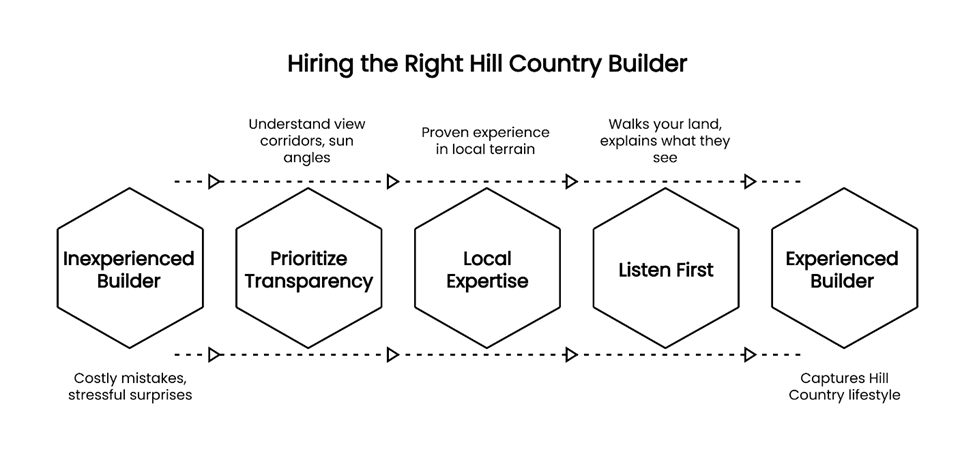
Hiring a custom home builder in the Texas Hill Country means selecting a builder with proven experience in local terrain, views, codes, and costs. This definition matters because building here isn't like building in a subdivision outside Dallas or Houston.
The Texas Hill Country, characterized by rugged limestone and granite hills, spring-fed rivers, and elevated plateaus stretching west of Austin and north of San Antonio, presents unique challenges that separate experienced local builders from those who simply work "in the area." Your lot likely has slope. It definitely has a view worth preserving. The limestone and granite bedrock can require careful foundation planning. You'll deal with specific HOA and architectural review board (ARB) guidelines if you're in a gated community around Lake Travis, Lake LBJ, or Horseshoe Bay. Many properties require septic systems and wells rather than city utilities. Some lots have rock that needs to be blasted before you can pour a foundation.
These aren't minor details. They directly impact your timeline, your budget, and whether your finished home captures the Hill Country lifestyle you're building for in the first place.
For families afraid of choosing the wrong builder, a clear, Hill Country-specific hiring process is the key to avoiding costly mistakes and stressful surprises. Why this matters right now: the difference between a builder who understands view corridors and sun angles versus one who doesn't can mean the difference between waking up to that sunrise you fell in love with and staring at a wall because the bedroom faces the wrong direction.
The smart approach prioritizes transparency and local expertise over the lowest bid. Budget builders often win on price by making assumptions that don't account for Hill Country realities. Design-focused builders sometimes prioritize aesthetics without understanding the practical challenges of your specific lot. Production builders bring volume efficiency but rarely adapt to the unique characteristics that make custom homes in this region special.
You need a builder who listens first, walks your land with you, and explains what they see before they quote a number.
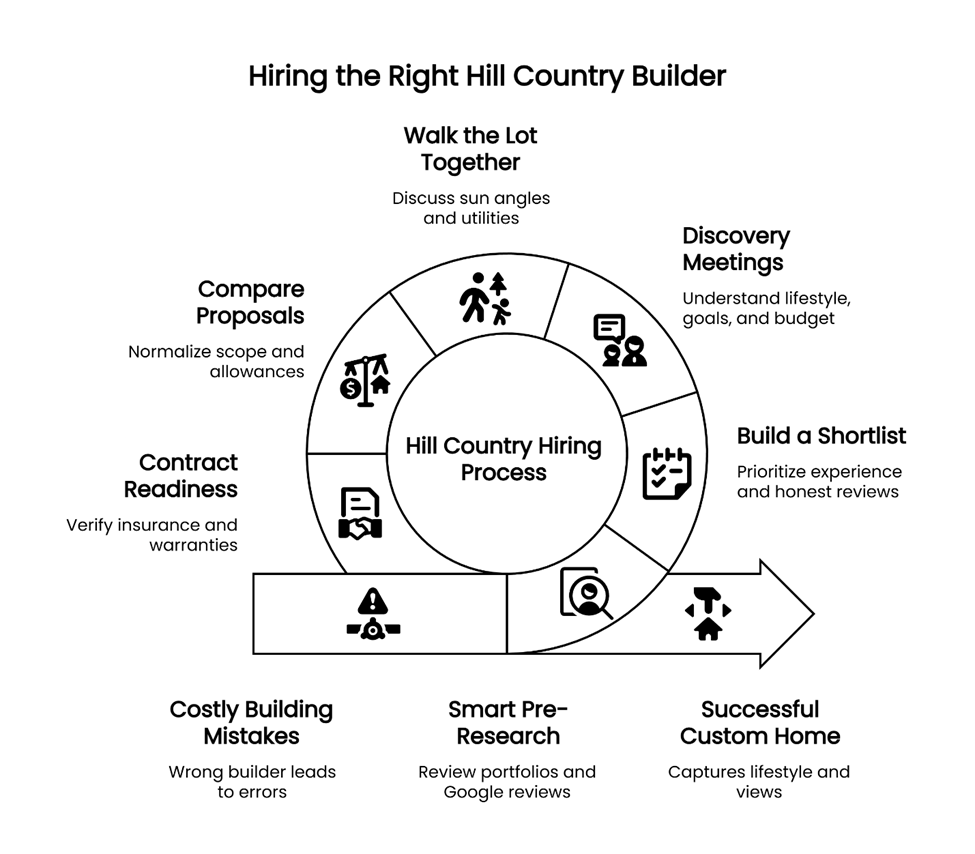
Step 1: Do Smart Pre-Research (1–2 Hours)
Start with focused research rather than trying to evaluate every builder in Central Texas. Give yourself one to two focused hours to build an initial understanding of what's possible.
Look at builder portfolios with specific questions in mind. Do their completed homes reflect the architectural style you envision? Are they building in communities similar to yours? When you see photos of their work, can you picture yourself living in those spaces?
Google Reviews and Google Maps give you unfiltered feedback from actual clients. Pay attention to patterns rather than single complaints. If multiple reviews mention budget surprises, that's a signal. If several people talk about clear communication and staying on schedule, that tells you something too.
Confirm the builder's service area matches your location. A builder based in Austin might list "Texas Hill Country" as a service area, but if they've never built in Spicewood or don't understand the specific requirements of Horseshoe Bay's gated communities, the geographic match doesn't mean much.
Check their website for process clarity. Do they explain how they work, or do they just show pretty pictures? Builders confident in their process typically share it openly. You're looking for someone who demystifies custom home building rather than treating it like a secret formula.
At this stage, you're not making decisions. You're simply learning what good looks like and identifying 3-5 builders worth deeper investigation. Consider reviewing examples of completed work to understand different approaches to Hill Country home design.
Step 2: Build a Shortlist (2–4 Builders)
Narrow your research to a focused shortlist of two to four builders. Interviewing ten builders doesn't make you more informed—it makes you confused. You want enough options to compare but few enough to evaluate meaningfully.
Your shortlist criteria should include:
Local experience matters more than company size. A builder who's completed twenty custom homes around Lake Travis or along the Highland Lakes chain understands the permitting process, knows which local subcontractors do quality work, and has relationships with suppliers who can source materials efficiently. They've dealt with LCRA regulations if you're building near the water. They know which HOAs require stone exteriors and which allow more flexibility.
Style alignment comes next. If you love clean, modern lines and the builder's portfolio shows nothing but traditional Hill Country stone and timber, you're probably not a great match. Look for builders whose aesthetic sensibility aligns with your vision, even if your specific home will be unique.
Review clarity and honesty stand out. When you read reviews, do clients talk about feeling informed throughout the process? Do they mention the builder proactively addressing concerns? Or do you see patterns of surprise costs and poor communication?
Process transparency should be evident. The best builders share their methodology openly. They explain the stages of construction, how they handle changes, and what decisions you'll need to make at specific points. If you can't find clear information about their process on their website or in initial conversations, that's a yellow flag.
Don't add builders to your shortlist just because someone recommended them. Personal recommendations matter, but you need to verify that the builder's approach, communication style, and expertise match your specific needs. Your best friend's builder might have been perfect for their lakefront contemporary but completely wrong for your hilltop ranch-style home.
Step 3: Discovery Meetings (What "Good" Feels Like)
Discovery meetings reveal how a builder thinks and whether you can work together through the inevitable challenges of a custom build. This isn't a sales pitch you're evaluating—it's a working relationship you're test-driving.
A great discovery meeting feels like a conversation, not a presentation. The builder asks questions about your vision, your timeline, your budget, and how you plan to use the space. They listen more than they talk. They take notes. They might sketch ideas or ask to see any inspiration photos you've collected.
A strong discovery meeting typically covers three essential areas:
Your family's goals and lifestyle. How will you use the home? What are your must-haves versus nice-to-haves? What's your realistic budget range? The builder should understand what you're trying to create before suggesting how to build it.
Your land's specific realities. What are the slope challenges, access constraints, utility options, HOA requirements, and view opportunities? The conversation should acknowledge what makes your particular lot unique.
The builder's process and approach. How do they move from vision to final plans? What's their timeline for design, selections, permitting, and construction? Who will you communicate with throughout the build?
You should hear the builder acknowledge the specific realities of your situation. If you mention your lot has significant slope, they should discuss how that affects foundation work and driveway access. If you're building in a gated community, they should reference HOA and ARB requirements without you having to prompt them. This demonstrates working knowledge, not theoretical understanding.
Pay attention to how they discuss budget. Experienced builders in this market will give you a general range based on your goals, but they won't lock into specific numbers before understanding your land and seeing complete plans. If someone quotes you a precise per-square-foot price in the first meeting, be cautious. Hill Country custom builds have too many variables for that level of certainty upfront.
Communication style matters as much as technical knowledge. Do they explain things in plain language? When you ask a question, do they give direct answers or dodge with industry jargon? Can you picture calling this person when you have a concern six months into the build?
The builder should also explain their process clearly during this meeting. How do they handle design? Do they work with specific architects, or do they collaborate with yours? What's their approach to scheduling? How do they manage changes during construction? Understanding the building process before you commit prevents confusion later.
Red flags in discovery meetings include high-pressure tactics, reluctance to provide references, vague answers about previous projects, or dismissive responses to your concerns. Trust your instincts. If something feels off in this initial meeting, it rarely improves during the stress of actual construction.
Step 4: Walk the Lot Together
The on-site visit separates builders who truly understand Hill Country custom homes from those who simply work in the area. This isn't a formality—it's where you learn whether the builder sees what you see and understands challenges you haven't even considered yet.
Schedule lot walks with your top two or three candidates. The best time is mid-morning, when you can observe sun angles and natural light patterns. Bring any preliminary sketches or plans if you have them, but don't worry if you're starting from scratch.
Watch what the builder notices without prompting. Do they observe where the sunrise and sunset will hit the property? Do they point out the best view corridors and suggest how to orient the home to maximize them? Do they identify potential drainage issues or areas where rock might complicate excavation?
An experienced Hill Country builder will discuss practical considerations specific to your land. They'll talk about driveway placement and grade. They'll mention utility access points and whether you'll need a well and septic system. If you're in a community with restrictions, they should reference setback requirements and any architectural guidelines that will affect your design options.
The builder should also help you visualize the home's footprint on the land. Some will use stakes and string to roughly outline where the house might sit. This physical walkthrough helps you understand how the structure will relate to the natural features of your property.
Key observations an experienced builder will make:
Sun paths and prevailing breezes. They'll note morning versus afternoon sun, where shade can be preserved or created, and how to orient outdoor living spaces to feel comfortable most of the year.
View corridors and privacy. The best Hill Country homes frame long views—over Lake Travis, across canyon ridges, toward Lake LBJ and the Highland Lakes, or out to open ranchland—while screening less desirable sightlines. A thoughtful builder will talk in terms of view "cones" and key angles, not just "big windows."
Slope, access, and construction logistics. Driveway alignment, parking, temporary construction access, and staging areas matter on tight, sloped, or waterfront lots. These affect both cost and daily convenience during the build.
Utilities, wells, and septic realities. While final engineering is always handled by qualified professionals, a seasoned builder can usually point out likely well locations, septic areas, and utility runs during the walk, and can explain how they might influence the site plan.
HOA and architectural review context. Around lakes and in communities like Horseshoe Bay, local rules may govern roof height, dock design, materials, and setbacks.
Ask specific questions during the lot walk:
Where would you recommend placing the home to capture the best views while managing sun exposure?
What challenges do you see with this particular lot, and how would you address them?
Are there any surprises in the topography or soil that might affect the budget or timeline?
How would you approach the driveway and any necessary retaining walls?
Pay attention to whether the builder collaborates with you or lectures at you. The best builders treat the lot walk as a shared exploration. They want to understand what drew you to this specific piece of land and how you envision living here.
For additional perspective on what to look for when evaluating Hill Country lots, consider reviewing guidance on selecting the perfect lot in Spicewood, which covers many considerations that apply across the region.
Step 5: Compare Proposals & Pricing the Right Way
Builder proposals arrive, and suddenly you're comparing documents that look completely different. One lists a single number. Another breaks down every line item. A third talks about allowances and contingencies. How do you evaluate them fairly?
Start by understanding two fundamental pricing structures. Fixed-price contracts specify a total cost for defined work. You know what you're paying, and the builder absorbs cost overruns if they estimate incorrectly. Cost-plus contracts charge you for actual costs plus a percentage or fee. You have more flexibility to make changes, but you also take on more financial risk if costs exceed estimates.
Neither approach is inherently better. Fixed-price contracts work well when you have detailed, complete plans and don't anticipate many changes. Cost-plus arrangements make sense if you're still refining design details or want maximum flexibility during construction. The key is understanding which structure you're evaluating and what protections exist in each scenario.
Allowances deserve careful attention. These are budget placeholders for selections you'll make later—things like plumbing fixtures, lighting, flooring, and appliances. Builders include allowances because you can't specify every finish choice before construction begins. The challenge is that allowances vary dramatically between proposals.
One builder might include $15,000 for plumbing fixtures while another allocates $8,000 for the same scope. Neither is necessarily wrong, but you need to understand what each allowance covers and whether it aligns with your taste level. Luxury fixtures blow through modest allowances quickly. If you have champagne tastes, make sure the proposal reflects that reality.
Change orders are formal modifications to the original contract. They happen when you decide to add a feature, upgrade a material, or modify the design after construction begins. Every builder will tell you they try to minimize change orders, but the real question is how they're handled. What's the approval process? How quickly do you receive pricing for proposed changes? Is there a markup on change order work?
The lowest bid creates risk rather than value in Hill Country custom building. A builder who quotes significantly below others has either missed something, plans to make up margin on change orders, or works with subcontractors who cut corners. Any of these scenarios costs you more in the long run—either financially or in quality.
Compare proposals by normalizing for scope and allowances first. If Proposal A includes higher-end allowances than Proposal B, you're not comparing equivalent projects. Adjust the numbers mentally or ask the builders to clarify what equivalent pricing would look like.
Ask these money questions directly:
What specific items do my allowances cover, and what are typical costs for each category?
How do you handle situations where construction reveals unexpected issues, like more rock than anticipated?
What's your payment schedule, and how does it relate to construction milestones?
Are there any costs not included in this proposal that I should budget for separately?
Trust matters more than the specific number. If a builder takes time to explain their pricing logic and helps you understand tradeoffs, they're demonstrating the transparency you'll need throughout construction. If they're defensive about questions or reluctant to provide details, reconsider whether you want that dynamic for the next year of your life.
Step 6: Contract Readiness & Next Steps
You've selected a builder. Now the real planning begins. The contract phase isn't just paperwork—it's where you establish expectations, timelines, and processes that will govern the entire build.
A solid custom home contract covers more than price and completion date. It should specify the scope of work in detail, including materials, construction methods, and quality standards. It defines what happens if timelines slip due to weather, permit delays, or supply chain issues. It explains the change order process, payment schedule, and warranty terms.
Read everything carefully. If something isn't clear, ask. If verbal promises were made during earlier conversations but don't appear in the contract, address that immediately. What's written in the contract is what matters when disagreements arise.
The timeline discussion should be realistic, not optimistic. Weather affects Hill Country construction, especially excavation and foundation work. Permit processing times vary by jurisdiction. Material lead times have become less predictable. A builder who promises unrealistically fast completion is setting you up for disappointment.
Expect the builder to outline major decision points on the timeline. You'll need to select exterior colors and materials before certain stages begin. Interior finishes typically have decision deadlines 8-12 weeks before installation. Understanding when you need to make specific choices prevents last-minute stress and costly delays.
Permitting and HOA approvals happen in parallel with design finalization. If you're building in a community around Lake Travis or in areas with active architectural review boards, the review process can take several weeks. Your builder should manage this process, but understanding the timeline helps you plan realistically.
The builder should also explain what involvement they expect from you during construction. Weekly progress meetings? Daily photo updates? Site visits whenever you want, or scheduled at specific milestones? Clarifying communication expectations now prevents friction later.
Before you sign, verify that the builder carries appropriate insurance coverage. General liability insurance protects you if property damage or injuries occur during construction. While Texas allows employers to opt out of the state worker's compensation system (making it one of the few states where this coverage isn't mandatory), reputable custom home builders typically carry worker's compensation insurance to protect their crews and subcontractors. Ask whether the builder subscribes to worker's comp coverage—it's a strong indicator of their commitment to worker safety and professional operations.
You should also confirm that all specialized trade contractors working on your project hold the proper licenses required by Texas law. While the state doesn't license general contractors or home builders, specific trades do require licensing—including electrical contractors, plumbers, and HVAC technicians. Your builder should work exclusively with properly licensed trade professionals.
Consider asking whether the builder holds professional memberships or certifications. Membership in organizations like the Texas Association of Builders (TAB), the National Association of Home Builders (NAHB), or voluntary certifications such as Graduate Master Builder demonstrate a commitment to industry standards and ongoing education. These aren't legal requirements, but they often correlate with professionalism and quality.
Ask about the warranty structure for both construction quality and major systems. What's covered for the first year? What about structural elements? How does the warranty process work if you discover issues after move-in?
Once the contract is signed, the relationship shifts from evaluation to collaboration. You're now partners in bringing your dream home to life in the Hill Country. The builder you've chosen should make this transition feel like a natural next step, not a sudden change in dynamics.
Red Flags That Say "Keep Looking"
Some warning signs should end your builder evaluation immediately, regardless of how appealing other aspects seem:
High-pressure sales tactics suggest the builder needs your business more than they care about the right fit. Great builders have steady pipelines and turn away projects that aren't good matches.
Vague or evasive pricing discussions indicate either inexperience or intentional lack of transparency. Neither bodes well for budget clarity during construction.
Weak local knowledge about Hill Country building challenges, permit processes, or community-specific requirements means you'll be paying for their education on your project.
Dismissive responses to your questions or concerns signal a relationship dynamic you don't want during the stress of construction.
Reluctance to provide references or allow conversations with recent clients should be an immediate disqualifier. Confident builders connect prospects with past clients readily.
Bad-mouthing competitors suggests insecurity and unprofessionalism. Experienced builders focus on their own strengths rather than attacking others.
Inability or unwillingness to confirm proper insurance coverage and use of licensed trade contractors indicates a casual approach to risk management and legal compliance.
Gut discomfort matters. If something feels off but you can't articulate why, honor that instinct. You'll spend a year working closely with this person. The relationship should feel comfortable from the start.
How Riverbend's Process Aligns (Without the Hard Sell)
At Riverbend Homes, we've refined our approach over nearly three decades of building custom homes in the Texas Hill Country. The process maps naturally to the hiring steps we've outlined here, which is intentional—we designed our methodology around what clients actually need rather than what's convenient for us.
Our Discover phase is that lot walk we described in Step 4. We meet you at your property, explore the land together, and listen to your vision before we talk about drawings or dollars. This on-site conversation shapes everything that follows.
The Design & Budget phase combines Steps 5 and 6 from your hiring process. We work with architects to translate your vision into detailed plans, while simultaneously managing the budget to ensure your investment aligns with your priorities. We pause at the bid-set stage to give you a clear cost picture before finalizing every detail. No surprises.
The Build phase is where our quality-over-quantity commitment becomes tangible. We limit the number of projects we manage simultaneously, which means we're on your site daily. This hands-on approach speeds construction—you're not waiting weeks between critical stages—and ensures every subcontractor meets our standards. We've been building in Spicewood, around Lake Travis and Lake LBJ, and throughout communities like Horseshoe Bay since 1996. This experience shows up in how we handle Hill Country-specific challenges and in the relationships we maintain with the region's best craftspeople.
We're a second-generation, family-owned business. That matters because our reputation is personal. When you see our work around the area, you're seeing homes we stand behind for the long term.
Learn more about our specific approach, but understand that we're sharing this not as a pitch but as an example of what clear process communication looks like. Whether you build with us or choose another Hill Country builder, you deserve transparency from start to finish.
Your Hill Country Builder Hiring Roadmap
The six-step process works best when you can reference it throughout your search. We've created a one-page roadmap that summarizes each stage with specific checkpoints and space for notes.
The Six Steps:
Step 1: Smart Pre-Research
Review portfolios for style alignment and Hill Country experience
Read reviews for communication and budget clarity patterns
Confirm service area matches your community
Identify 3-5 builders for deeper evaluation
Step 2: Build Your Shortlist
Verify local expertise in your specific area
Assess style compatibility with your vision
Evaluate review themes for transparency and follow-through
Confirm process clarity on builder websites
Step 3: Discovery Meetings
Assess listening versus presenting ratio
Evaluate explanation of Hill Country-specific challenges
Gauge communication style and responsiveness
Understand their design and construction process
Step 4: Walk the Lot
Observe what builder notices without prompting
Discuss view optimization and sun angle management
Review practical challenges specific to your land
Evaluate collaboration versus lecture dynamic
Step 5: Compare Proposals
Understand fixed-price versus cost-plus structures
Normalize allowances across proposals for fair comparison
Clarify change order processes and pricing
Ask direct money questions without hesitation
Step 6: Contract & Next Steps
Read contract thoroughly; ask about unclear items
Establish realistic timelines with built-in flexibility
Clarify decision deadlines for major selections
Verify insurance coverage and confirm use of licensed trade contractors
Frequently Asked Questions
How many builders should we interview?
Two to four serious candidates give you enough perspective to compare approaches without creating analysis paralysis. Focus on quality of evaluation rather than quantity of options.
What should a first discovery meeting cover?
Your goals for the home, the land's opportunities and constraints, timeline expectations, budget parameters, and the builder's process from design through completion. A good discovery meeting feels conversational, not transactional.
How do proposals differ between fixed-price and cost-plus structures?
Fixed-price proposals specify total cost for defined work; you gain certainty but sacrifice flexibility. Cost-plus proposals outline estimated costs plus builder fee; you maintain flexibility but accept more budget risk. Both can work well depending on your situation and risk tolerance.
Which Hill Country-specific questions should we ask about land, views, and utilities?
Ask how the builder approaches view optimization and sun angle management, what experience they have with local soil and rock conditions, how they handle utility connections (especially septic and wells), and what they know about your specific community's HOA requirements and permitting processes.
What are early red flags in builder hiring?
High-pressure tactics, vague pricing discussions, weak local knowledge, dismissive responses to questions, reluctance to provide references, bad-mouthing competitors, inability to confirm proper insurance and licensed trade contractors, and any persistent gut discomfort about the relationship.
Ready to start your Hill Country custom home journey?
The anxiety you felt when you opened those dozen browser tabs? You can replace that with confidence by following a clear process and choosing a builder who values transparency as much as craftsmanship.
We'd welcome the opportunity to walk your property and discuss your vision, with no pressure and no obligation. Whether you're looking in Spicewood, around Lake Travis or Lake LBJ, in Horseshoe Bay, or anywhere in the broader Hill Country, understanding your land is the essential first step.
Schedule a Discovery Meeting at Your Property
Call Ben at (512) 468-0240 or contact us online
Riverbend Homes
21413 Vista Estates Drive
Spicewood, TX 78669
Our Editorial Process
Our expert team uses AI tools to help organize and structure our initial drafts. Every piece is then extensively rewritten, fact-checked, and enriched with first-hand insights and experiences by expert humans on our Insights Team to ensure accuracy and clarity.
About the Riverbend Homes Insights Team
Our team brings decades of combined experience building custom homes throughout the Texas Hill Country. We share what we've learned to help families make informed decisions about one of the most significant investments they'll ever make.
Disclaimer: This guide is a comprehensive starting point for understanding the custom home builder hiring process in the Texas Hill Country. Building situations vary significantly based on location, lot characteristics, budget, and design complexity. Consult qualified professionals—including builders, architects, attorneys, and financial advisors—for decisions specific to your situation.