

📌 Key Takeaways
Most custom home budget nightmares aren't bad luck—they're the predictable result of choosing the wrong builder.
Surprise Bills Are a Builder Problem, Not a Luck Problem: Most budget overruns trace back to vague scopes, unrealistic allowances, and rushed estimating at the start—not unforeseeable site conditions.
Low Allowances Win Bids but Wreck Budgets: A tile allowance of $3 per square foot looks attractive on paper until you discover mid-range selections actually cost $7 to $9, turning the "cheaper" proposal into the more expensive reality.
Front-Loaded Planning Prevents Mid-Build Chaos: Builders who walk the lot early, coordinate with engineers and HOAs before contracts are signed, and encourage selections before construction begins dramatically reduce costly change orders later.
Transparent Change Order Processes Protect Families: The right builder provides written descriptions, cost and schedule impacts, and time to decide before any change moves forward—never a surprise invoice after the fact.
Clarity Beats the Lowest Bid: A higher proposal with explained allowances, discussed site complexities, and open budget conversations often costs less in the end than a vague low bid hiding future overruns.
The right builder makes money conversations feel normal, not awkward—and that transparency is the best protection against budget betrayal.
Families researching custom home builders in the Texas Hill Country will gain a strategic framework here, preparing them for the detailed guidance on pricing models, allowance evaluation, and interview questions that follows.
The invoices kept coming.
A Hill Country couple thought they had locked in their budget. The contract looked solid. The builder seemed confident. But three months into construction, the story changed. Extra charges for rock excavation. Upgraded septic requirements the original bid didn't account for. Allowances that barely covered builder-grade fixtures when they had pictured something closer to their Pinterest boards. Each surprise felt like a small betrayal of trust, and the excitement of building their dream home slowly gave way to dread every time the phone rang.
This scenario plays out more often than most people expect. And yet, many of these surprise bills are preventable. The difference usually comes down to one thing: the builder families choose to guide them through the process.
Hiring a custom home builder in the Texas Hill Country is a bit like choosing a guide for a backcountry expedition. Technical skill matters, but what matters more is finding someone who knows the terrain intimately, who talks through the challenges before they become emergencies, and who makes the journey feel manageable rather than overwhelming. The right builder talks about money early, often, and in plain English, so families understand exactly what's included, what might change, and how surprises will be handled before they sign anything.
Why "Surprise Bills" Happen in Hill Country Custom Builds
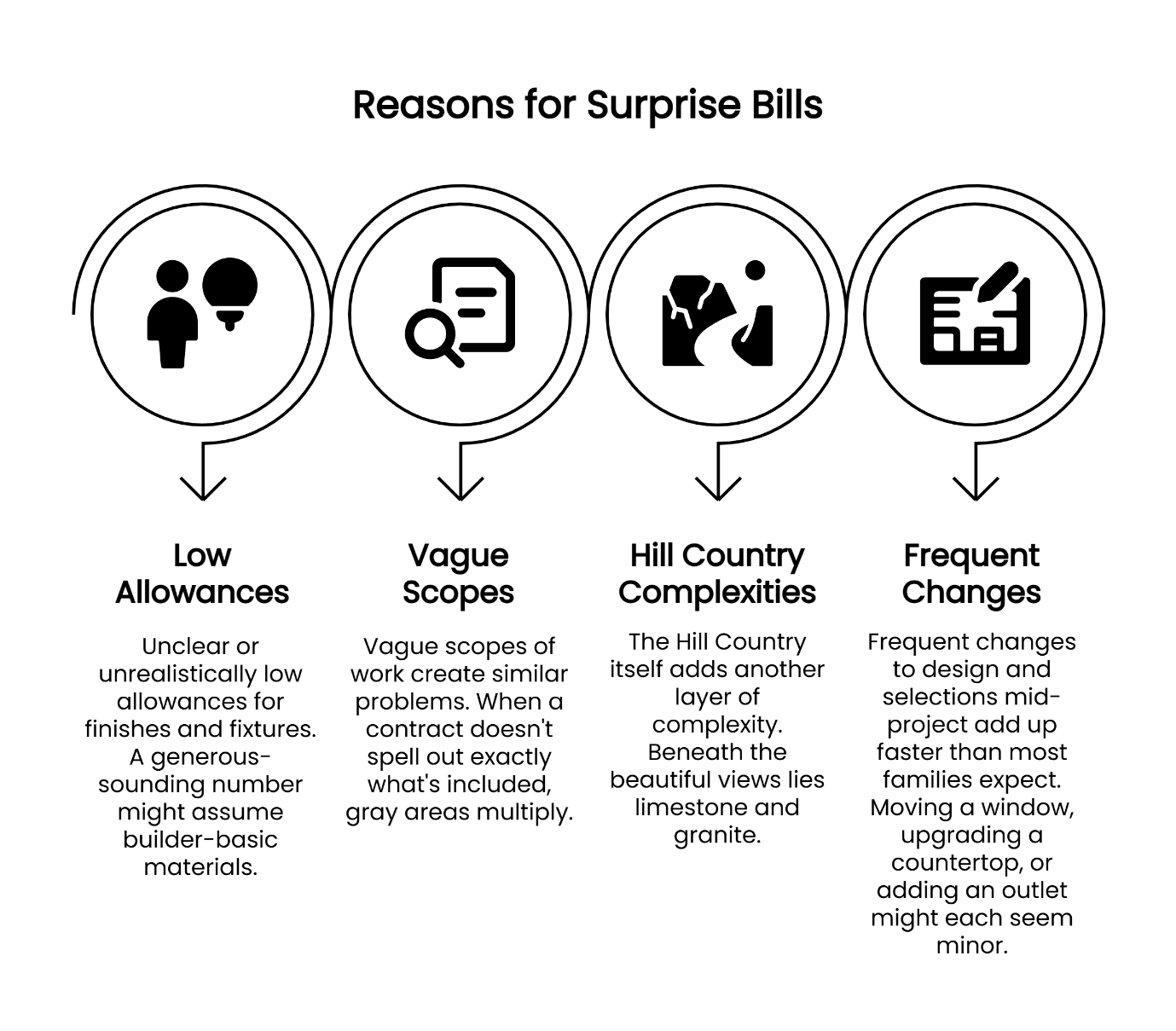
A surprise bill isn't simply an extra cost. It's an unplanned cost that feels unfair or unexpected, one that arrives without warning and disrupts the careful budget families thought they had in place.
In the Hill Country, these surprises tend to cluster around a few common sources. Unclear or unrealistically low allowances for finishes and fixtures sit at the top of the list. A proposal might show a generous-sounding number for lighting or tile, but if that number assumes builder-basic materials while the family is picturing mid-range or upscale selections, the gap becomes painfully obvious at the showroom.
Vague scopes of work create similar problems. When a contract doesn't spell out exactly what's included, gray areas multiply. Is the driveway engineering part of the base price? What about the retaining walls the sloped lot requires? If these details aren't addressed upfront, they become line items later.
The Hill Country itself adds another layer of complexity. Beneath the beautiful views lies limestone and granite that can require expensive excavation. Lots outside municipal services need septic systems, wells, and sometimes lengthy utility runs. HOA architectural requirements in communities around Lake Travis, Lake LBJ, Horseshoe Bay, and Spicewood can mandate specific materials or design features that weren't factored into the original estimate. Firewise requirements, water availability challenges, and access road conditions also affect budgets in ways that catch unprepared families off guard. Each of these elements is manageable when anticipated, but each can wreck a budget when ignored.
Finally, frequent changes to design and selections mid-project add up faster than most families expect. Moving a window, upgrading a countertop, or adding an outlet might each seem minor in isolation. Collectively, they can represent tens of thousands of dollars.
It's Rarely Just "Bad Luck"
When families share horror stories about budgets exploding, the culprit is rarely random misfortune. Most surprises trace back to how the project was priced, explained, and planned at the very beginning. A builder who rushes through the estimating process, glosses over site complexities, or uses vague language around allowances is setting the stage for conflict later.
Some unknowns are genuinely unpredictable. Nobody can see every rock formation beneath the soil until excavation begins. But a good builder warns families about common risks in the region and explains contingency approaches before contracts are signed. The goal isn't to eliminate all uncertainty. It's to make sure both parties understand where uncertainty exists and have a plan for handling it.
How a Trustworthy Hill Country Builder Talks About Money
The right builder makes money conversations feel calm and normal rather than awkward or adversarial. From the first meeting, they ask about budget comfort zones. They walk through what's included in their standard scope versus what would be considered an upgrade. They talk openly about local cost drivers, whether that's the rocky terrain typical of Spicewood, the HOA requirements common in gated Horseshoe Bay communities, or the coordination required with engineers, septic designers, and well specialists.
This kind of transparency isn't just about honesty. It's about respect. Families investing in a Hill Country dream home deserve to understand where their money goes and what trade-offs they're making. A builder who explains these things clearly is treating clients as partners rather than transactions.
Clear, Simple Pricing Models Explained in Everyday Language
Custom home builders generally use one of two broad pricing approaches. Some work with a fixed-price model, where the total cost is established upfront and changes only if the homeowner requests additions or upgrades. Most day-to-day surprises are absorbed by the builder if the scope is clear. Others use a cost-plus model, where the builder charges actual costs plus a set fee or percentage, with final numbers becoming clear as the project progresses. This approach can offer more transparency, but it also means more variability if selections or scope change.
Neither model is inherently better. What matters is whether the builder explains how their approach works in plain language. A trustworthy builder describes how allowances are built, based on the finish level the family actually wants. They explain how unknowns like extra rock or utility complications will be handled. They outline how families will be informed before anything affects their budget. If a pricing conversation leaves families feeling confused or rushed, that's a warning sign worth taking seriously.
Allowances: The Quiet Line Items That Can Wreck a Budget
Allowances are budget placeholders for items that will be fully selected later in the process. They typically cover tile and flooring, lighting and plumbing fixtures, appliances, countertops, and cabinet hardware. These line items appear in a proposal, often looking specific and reassuring. The problem is that allowances can also be used to make a bid appear lower than it really is.
Consider two proposals for the same custom home. Builder A shows a tile allowance of $3 per square foot and an appliance package of $1,500. Builder B, based on the finishes the family described wanting, shows $7 to $9 per square foot for tile and $8,000 for appliances. At first glance, Builder A's total price looks far more attractive. But if the family is picturing quality finishes that match their Hill Country lifestyle, Builder A's allowances might cover half of what they actually need. Builder B, meanwhile, has set numbers based on the real finish level discussed. The "cheaper" bid becomes the more expensive reality.
This is how low allowances and missing costs win jobs on paper but create surprise bills in practice.
How to Spot Realistic vs. Unrealistic Allowances
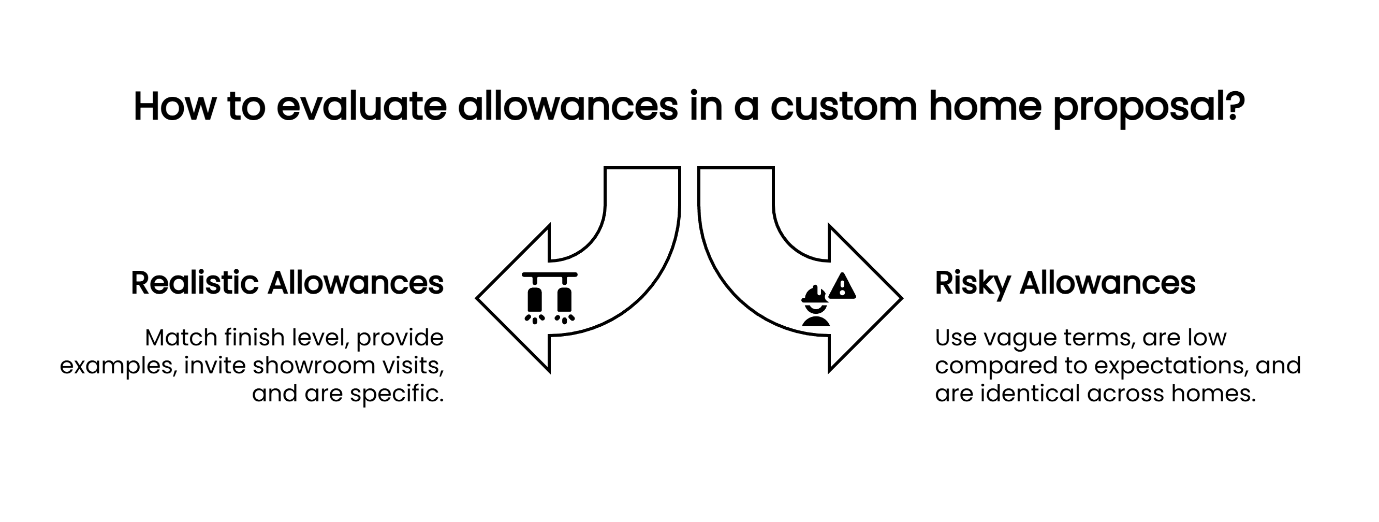
Realistic allowances share certain characteristics. They match the finish level being discussed. If conversations have centered on mid-range to high-end fixtures, the numbers reflect that. The builder provides real-world examples, saying something like, "Most families who build homes like this choose appliances in the $7,000 to $9,000 range." There's an invitation to visit showrooms early so families can see what their allowance actually buys. There's specificity rather than vagueness.
Risky allowances look different. They use terms like "standard fixtures" without explanation. The amounts feel low compared to what one would expect in the home being described. A full lighting package for a large custom home at $2,000, for instance, should raise questions. Allowances that look identical across very different homes or neighborhoods are another warning sign. When numbers seem too good to be true, they usually are.
A simple test helps cut through the confusion: take the allowance numbers and ask, "Would this actually buy the things we're picturing?" If the answer is no, plan for the real cost or choose a builder who budgets more honestly from the start.
Change Orders and Scope Changes: Planning for the "What Ifs"
Change orders are formal adjustments to the original contract. They happen for several reasons. Sometimes homeowners decide to add a feature or upgrade a material. Sometimes hidden conditions emerge, like discovering more rock than expected or drainage issues that weren't visible during planning. Sometimes the family simply changes their mind about a selection after seeing it installed elsewhere.
Change orders aren't inherently problematic. Every custom home involves some adjustments along the way. What separates a stressful experience from a manageable one is the process surrounding those changes.
A Calm, Transparent Change Order Process
With the right builder, change orders feel like informed choices rather than gotchas. A reassuring process follows a clear sequence:
Clear written description. The builder explains what's changing in plain English, with drawings or photos if needed.
Cost and schedule impact. Families see exactly how the change will affect their budget and their move-in timeline before any work begins.
Time to decide. There's a chance to think it over, ask questions, and possibly adjust the scope without high-pressure tactics pushing for an immediate signature.
Written approval before work. Nothing moves forward on that change until the family signs off.
Instead of hearing "We went ahead and..." with an attached invoice, families always know what's happening and why.
How the Right Builder Reduces the Need for Change Orders
Good builders reduce surprise changes by investing time upfront. They encourage solid design decisions and selections before construction begins, so families make big decisions while there's still flexibility. They walk the lot early to talk through site realities, pointing out where rock is likely, where drainage might need attention, or where utility runs could add cost. They're honest about trade-offs and budget implications before the first shovel breaks ground.
Coordination matters too. The right builder works with engineers, septic and well designers, and HOAs early so their requirements are baked into the plan rather than discovered mid-construction. This front-loaded approach means fewer detours during the build. When families have already thought through the major decisions and the builder has already accounted for local conditions, the project proceeds with far less stress.
Money Questions to Ask Before You Choose Your Builder
The following questions can serve as a practical tool during builder interviews. They're designed to be friendly and curious rather than adversarial. The goal is clarity, not confrontation. Families can screenshot these questions or print them to bring along to discovery meetings and lot walks.
Questions About Overall Pricing and Budget Comfort
"Can you walk us through how you structure pricing for a Hill Country home like ours?" This opens the door to understanding their model without demanding a specific answer.
"What range do families like us usually end up in for a home like this, on this type of lot?" Real experience shows in the specificity of the answer.
"How do you help clients stay on budget once construction starts?" A builder's answer reveals whether budget management is reactive or proactive.
Questions About Allowances and Selections
"What kinds of finishes are your standard allowances based on?" Listen for specificity. Vague answers suggest vague allowances.
"Can you share examples of recent projects where clients stayed close to their original allowances?" Past behavior often predicts future performance.
"When do you like clients to make their major selections so allowances don't become a surprise later?" Timing matters more than most families realize.
Questions About Site Conditions and Local Complexity
"What kinds of site or utility surprises do you see most often in this part of the Hill Country?" A builder who knows the region will have ready examples.
"How do you plan for things like rock, septic, wells, and utility runs in your budgets?" The answer shows whether contingencies are built in or whether families are on their own.
"How do HOA or neighborhood architectural requirements typically affect cost on lots like ours?" Local expertise shows in how comfortably this question is answered.
Questions About Changes Once Construction Begins
"How do you handle changes or upgrades after construction starts?" Process matters as much as policy.
"How will you communicate any cost and schedule impacts of changes before we say yes?" Builders who communicate well during interviews tend to communicate well during construction.
"Can you walk us through a recent change order and how you handled it with that client?" Real stories reveal real practices.
These aren't trick questions. They're simply how confident homeowners talk about money. The right builder will answer them with real examples, not defensiveness. For a comprehensive list of questions covering all aspects of the hiring process, families may find value in exploring a broader guide to translating a dream home vision into a functional design plan.
Choosing Peace of Mind Over the Lowest Bid
The lowest bid isn't always the safest path. Hidden costs, unrealistic allowances, and vague scopes can turn what looks like a bargain into a budget nightmare. This doesn't mean families should ignore price. It means they should weigh price alongside clarity, communication, and local expertise.
Picture two families building in the Hill Country. The first chose the lowest bidder, attracted by a number that beat competitors by $40,000. Allowances were thin, the scope was vague, and the lot walk was quick. Eighteen months later, they had spent most of that savings on rock excavation overages, allowance overruns, and change orders they felt pressured to approve. The build felt like a constant fight.
The second family chose a builder whose proposal was higher but whose conversations felt different. Every allowance was explained. Site complexities were discussed during the first lot walk. The change order process was outlined clearly. When a genuine surprise did emerge, involving unexpected drainage work, the builder had already set expectations and the family felt informed rather than ambushed. They finished their home feeling respected and in control.
Both families ended up with a house. Only one ended up with a home that still felt like a dream when the last bill was paid.
Families don't need to become construction experts to protect themselves. They need a builder willing to explain things clearly, one who treats budget conversations as a normal part of the relationship rather than something to rush past. Choosing a builder who talks about money in plain English is as important as choosing one with beautiful photos in their portfolio.
The Hill Country lifestyle that families are investing in, the views, the space, the sense of arrival, deserves a building experience that feels as good as the destination. Use the money questions in upcoming meetings. Pay attention not only to the answers but to how those conversations feel. When the builder who talks about money openly and calmly feels like a trusted local guide on that land, that's the right track. With that kind of partner guiding the process, surprise bills become the exception rather than the expectation.
Disclaimer: This guide is intended as a comprehensive starting point. For decisions specific to your unique situation, we always recommend consulting a qualified professional.
Want more plain-English insights on budgeting and building in the Hill Country? Explore more guides from the Riverbend Homes Insights Team.
Ready to talk through your Hill Country budget with someone who builds here every day? Call Ben at (512) 468-0240 or email ben@riverbend-homes.com to schedule a friendly discovery conversation about your project.
About Riverbend Homes: Riverbend Homes is a custom home builder based in the Texas Hill Country, helping families design and build view-focused, lifestyle-friendly homes around Lake Travis, Lake LBJ, Horseshoe Bay, Spicewood, and surrounding communities.