

📌 Key Takeaways
Your construction contract determines who pays when costs rise—Fixed-Price shifts that risk to the builder, while Cost-Plus leaves you holding the bag.
Contract Type = Risk Owner: Cost-Plus means you pay for every price increase, delay, and inefficiency; Fixed-Price means the builder absorbs typical market swings after signing.
Low Bids Often Hide Incomplete Scope: That cheap estimate usually excludes items you'll need, turning "savings" into expensive change orders with markups attached.
Price-Per-Square-Foot Misleads: This number ignores site prep, septic, wells, and finish quality—only the total contract price with clear inclusions matters.
Vet Allowances Before Signing: Trustworthy builders explain exactly what's covered and what happens if you exceed allowances, so you're not surprised mid-project.
Demand Written Scope Clarity: If it's not written down, it's not real—ask to see what's included, what's excluded, and how change orders get priced and approved.
Budget certainty comes from contract structure, not promises.
Families planning custom homes in the Texas Hill Country will gain clarity on protecting their investment, preparing them for the detailed builder vetting process that follows.
~ ~ ~ ~ ~ ~ ~ ~ ~ ~ ~ ~ ~ ~ ~ ~ ~ ~ ~ ~ ~ ~ ~ ~ ~ ~ ~ ~ ~ ~ ~ ~ ~ ~ ~ ~ ~ ~ ~ ~ ~ ~ ~ ~ ~ ~ ~ ~ ~ ~ ~ ~ ~ ~
It's 6:00 PM on a Sunday evening. You're staring at a spreadsheet labeled "Allowances" and wondering if the granite countertops are actually included—or if that's another surprise waiting to hit your bank account. The numbers don't quite add up. The builder's proposal mentioned "estimated costs," but estimated by whom? And based on what?
This shouldn't be this confusing.
If you're planning a custom home in Spicewood, Horseshoe Bay, or anywhere along Lake Travis, you've likely encountered two contract types: Fixed-Price and Cost-Plus. The difference between them isn't just accounting—it's the difference between sleeping soundly and dreading every phone call from your builder.
Here's the honest truth before we go further: if you're looking for the lowest price-per-square-foot over long-term quality and budget certainty, we're not the right fit. This guide is for families who want to understand how contract structure protects—or exposes—their investment.
Your contract is not paperwork. It is your financial risk plan.
A Fixed-Price contract prevents budget spiraling out of control. It achieves this by shifting the financial risk of material price fluctuations from the homeowner to the builder once the agreement is signed.
Fixed-Price vs. Cost-Plus: The 5-Minute Breakdown
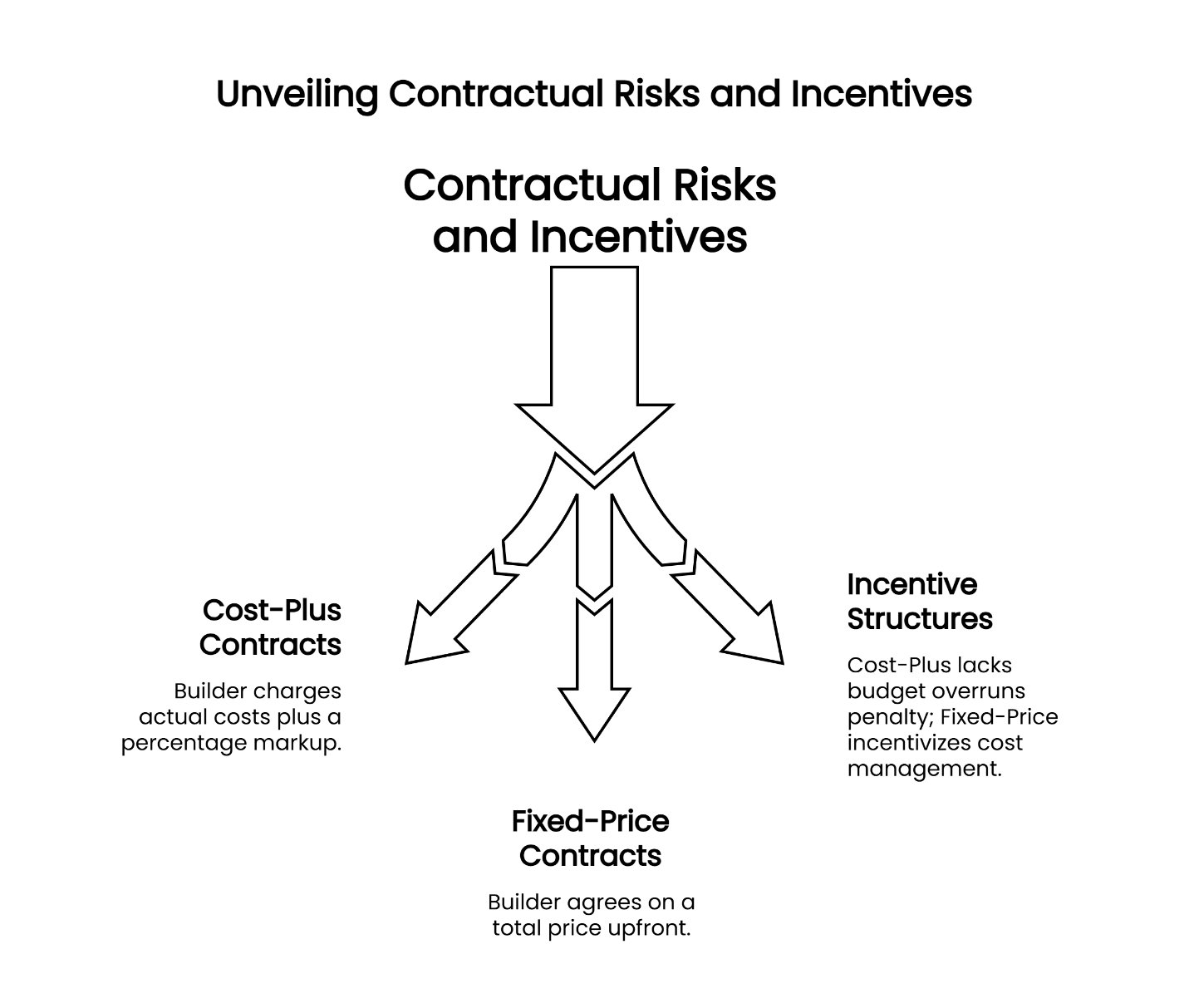
The contract you sign determines one critical thing: who pays when costs rise?
Cost-Plus contracts work like a blank check. The builder charges you for actual material and labor costs, then adds a percentage markup (typically 15-20%) as their fee. Sounds fair on paper. The problem? You bear 100% of the risk for price increases, delays, and inefficiencies. If lumber prices spike mid-project—that's your problem. If the crew takes longer than expected—that's your tab.
Fixed-Price contracts are designed to give you peace of mind, functioning much like an all-inclusive resort. You agree on a total target price upfront, and the builder generally absorbs the risk of standard market fluctuations once the contract is signed. If steel prices experience typical volatility after you've signed, a well-prepared builder usually covers it. If rock excavation takes three extra days on your Bee Cave lot, a thorough builder will have already factored those anticipated site conditions into your original number, severely limiting your exposure to surprises.
The incentive structures couldn't be more different. Under Cost-Plus, there's no penalty for the project running over budget—the builder still gets their percentage. Under Fixed-Price, the builder has every reason to manage costs tightly, because overruns eat into their margin.
Who Bears the Risk? A Side-by-Side Comparison
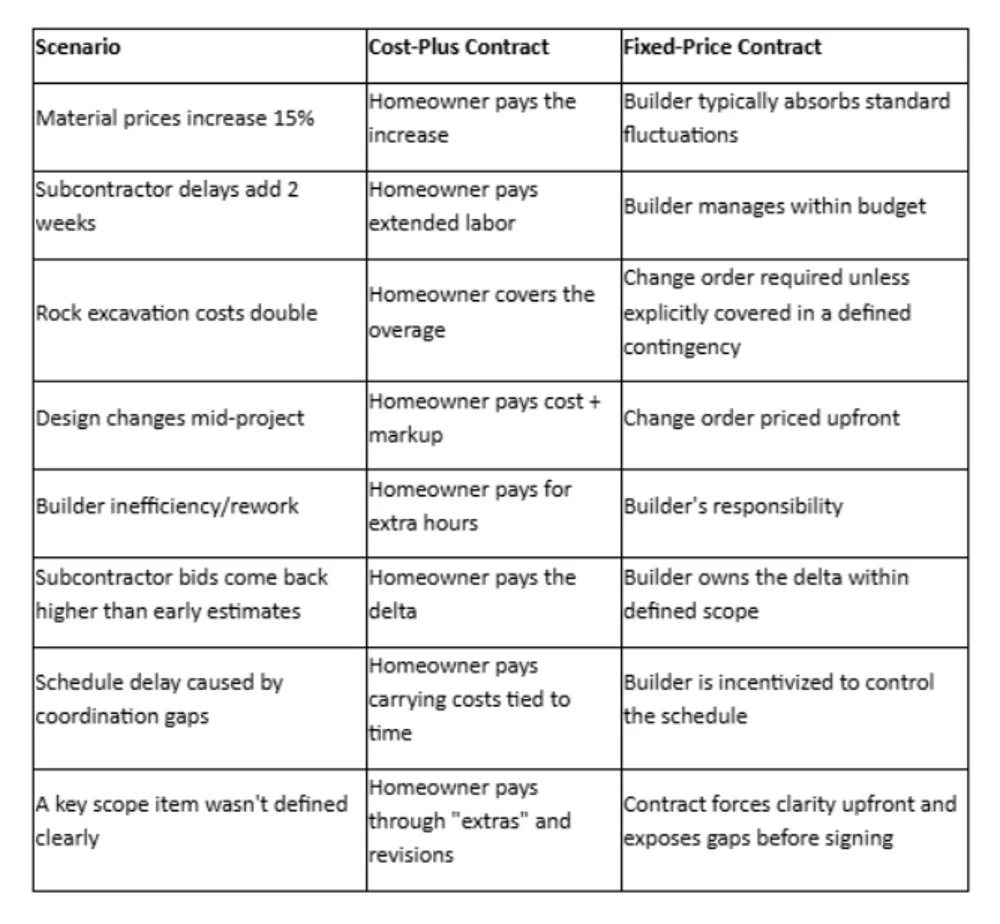
For families building on complex Hill Country terrain—where LCRA watershed regulations add permitting layers and limestone can lurk inches below the surface—the Cost-Plus model becomes especially risky. You're signing up for uncertainty on top of uncertainty.
The "Low-Ball" Bid Myth: Why Cheaper Upfront Costs More Later
Here's a misconception we encounter constantly: "I should get multiple bids and go with the lowest number."
For production homes on flat suburban lots, competitive bidding makes sense. For bespoke luxury homes on sloped Hill Country sites with specific drainage requirements and HOA design standards? Standard bidding fails because "lowest price" usually means "incomplete scope."
That low Cost-Plus bid often excludes allowances you'll actually need. The $200,000 "estimate" becomes $280,000 in reality—plus 18% markup on every overage. The builder who bid $240,000 with realistic allowances suddenly looks like the honest one.
The "Change Order" trap works like this: A Cost-Plus builder submits a lean initial bid to win your business. Once construction starts, every modification—every "oh, we didn't account for that"—triggers a change order. Each change order carries their markup percentage. By project end, you've paid a premium for what was marketed as a discount.
The "Cheap" Bid Reality: In custom building, the lowest bid often reflects incomplete scope. Missing scope doesn't disappear—it comes back as change orders, rework, and hard conversations when you're already committed. In a volatile market, a "low" Cost-Plus bid is actually a liability, not a saving.
As one Riverbend Homes client in Horseshoe Bay put it: "During these times of volatility, they won't leave you hanging." That's not a comment about price—it's about predictability.
Myth vs. Reality: The Price-Per-Square-Foot Trap
The Myth: "I can compare builders by their price per square foot."
The Reality: Price-per-square-foot tells you almost nothing about final cost. It doesn't account for site preparation on sloped lots, septic systems, well drilling, the quality of finishes, or the complexity of your floor plan. A $180/sq ft quote that excludes your kitchen appliances and driveway isn't comparable to a $220/sq ft quote that includes everything. The only number that matters is the total contract price—and whether that number is guaranteed or estimated.
If you're in a phase where you're comparing builders primarily by a number on a sheet, pause. That approach works for simpler projects, not complex luxury sites. If you're looking for a local team that understands what makes the Hill Country different, start with local custom home builders.
How to Vet a Fixed-Price Builder in the Texas Hill Country
Not every builder offering "fixed price" delivers the same protection. Fixed price only protects you if it's built on real scope clarity. Here's how to separate genuine budget security from marketing language.
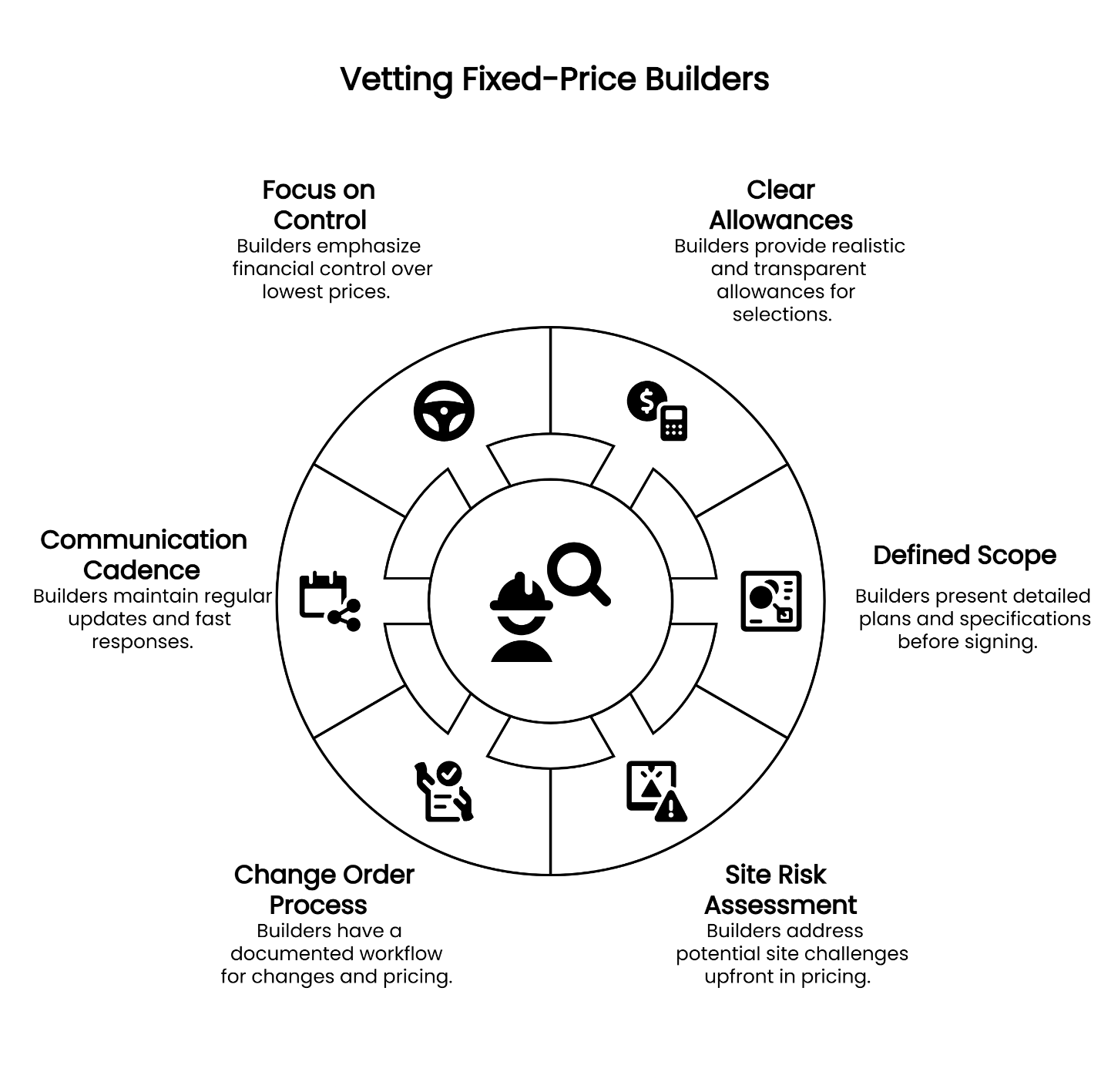
They explain allowances like an adult conversation. A trustworthy Fixed-Price builder provides generous, realistic allowances based on your stated preferences. They'll walk you through selections before signing so you understand what's covered. Vague or suspiciously low allowances signal a Cost-Plus mentality hiding behind Fixed-Price language.
They show you what "scope complete" means. The more complete the plans and specifications before signing, the less room for surprises. You should be able to see exactly what's included and what's excluded—in writing.
They address site risk upfront. Hill Country lots hide surprises. Rock. Springs. Drainage challenges. A genuine Fixed-Price builder has already accounted for likely scenarios in their pricing. They've built on enough Spicewood and Lake Travis properties to know what the land tends to reveal. Rock, drainage, access, utilities, and permitting processes should be part of early conversations—not discoveries after the contract.
They have a clear change-order process. Not "we'll figure it out later," but a documented workflow with pricing and approval before work proceeds. If you change the plan, upgrade finishes beyond allowances, or add scope, you should expect a documented change order with transparent pricing.
They emphasize communication cadence. Transparency isn't just about the contract—it's about communication throughout the build. Weekly updates, schedule visibility, and fast answers reduce the friction that causes delays and cost creep. One Riverbend Homes client described the experience this way: "Ben and Blake have good chemistry and are very approachable and accessible." That kind of communication isn't a feel-good extra—it's a budget control tool.
They don't sell you on the lowest number—they sell you on control. If a builder leans hard on "we're the lowest," it usually means scope is thin. The relief of watching your home take shape exactly as planned comes from knowing where you stand financially at every milestone.
When you find the right builder, the process transforms. As one client described their experience: "From our first discussion, Ben was aligned with our vision and told us that what others said was not possible would be possible."
That alignment—between your vision, your budget, and your builder's commitment—is what Fixed-Price protection actually delivers. This is where the design-build process earns its keep. When design and construction are coordinated, you get pricing feedback while decisions are still easy to adjust. For a deeper look at that accountability loop, read Stop the Finger-Pointing: How Design-Build Delivers Your Custom Home On Budget.
Three Questions for Your Contract Review
Before signing any construction agreement, ask these questions and demand clear answers:
1. "Show me what is explicitly included and explicitly excluded."
If it's not written down, it's not real. What's included in your allowances—and what happens if you exceed them?
2. "How are allowances structured—and what happens when selections exceed them?"
You want transparent overage handling, not mystery invoices.
3. "What's the process for change orders, and when do I see pricing?"
The safest answer is: pricing is presented and approved before work proceeds.
The Path Forward: From Budget Anxiety to Building Confidence
The contract decision isn't really about paperwork. It's about whether you'll spend the next 12 months worrying about phone calls from your builder—or enjoying the process of watching your Hill Country home rise from the foundation up.
As you enter the spring planning phase, locking in your budget matters more than ever. Interest rate shifts can change financing overnight. Material costs fluctuate with global supply chains. A Fixed-Price contract doesn't just protect your current budget—it shields you from market chaos you can't predict or control.
If you're considering managing the build yourself to save costs, we'd encourage you to read about the hidden stress of DIY home building before deciding. The math rarely works out the way people hope.
For families ready to build with transparency and without surprises, the next step is a conversation. Not a sales pitch—a discovery meeting where we walk your lot together, understand your vision, and determine if we're the right fit for each other.
Because your sanctuary deserves to be built on certainty, not estimates.
Stay Informed: Hill Country Building Trends & Tips
Ready for the Next Step? Schedule Your Discovery Meeting
Disclaimer: This article is for informational purposes and reflects general guidance on construction contract types. Specific contract terms, pricing structures, and project requirements vary. We recommend reviewing any construction agreement with appropriate legal and financial advisors before signing.
Our Editorial Process
Our expert team uses AI tools to help organize and structure our initial drafts. Every piece is then extensively rewritten, fact-checked, and enriched with first-hand insights and experiences by expert humans on our Riverbend Homes Insights Team to ensure accuracy and clarity.
By: The Riverbend Homes Insights Team
The Riverbend Homes Insights Team is our dedicated engine for synthesizing complex topics into clear, helpful guides. Riverbend Homes is a proud member of the National Association of Home Builders (NAHB), Texas Association of Builders (TAB), and Hill Country Builders Association (HCBA).