The Secret to Stress-Free Construction: How Single-Source Custom Building Protects Your Vision
📌 Key Takeaways
One team handling both design and construction eliminates the finger-pointing and miscommunication that derail most custom home projects.
Fragmented Teams Create Chaos: When your architect and builder work separately, you become the full-time translator caught between conflicting interpretations and blame-shifting.
Unified Accountability Protects Your Vision: Design-build keeps your approved plans intact because the same people who drew them are responsible for building them correctly.
Field Decisions Stay on Track: When surprises happen during construction, one team balances aesthetics, structure, and cost together instead of defaulting to whatever's fastest.
Ask Who Owns Design Intent: Before signing, confirm one party is accountable if the build team says the plan needs to change—vague answers signal trouble ahead.
Limited Projects Mean Daily Presence: Builders who cap their workload can manage your site every day, catching problems before they become expensive fixes.
One accountable team turns construction from a stressful mediation job into an experience you actually enjoy.
Homeowners planning a custom build in the Texas Hill Country will find a clear framework for evaluating builders here, preparing them for the detailed process overview that follows.
~ ~ ~ ~ ~ ~ ~ ~ ~ ~ ~ ~ ~ ~ ~ ~ ~ ~
The call comes on a Saturday morning. Your friend just finished their custom home—eighteen months late and $200,000 over budget. The worst part? The house looks nothing like the renderings they fell in love with.
"The builder said the architect's design wasn't practical," they explain. "So they 'adjusted' things. By the time we noticed, the framing was done."
This story plays out across the Texas Hill Country more often than it should. Beautiful architectural plans slowly erode during construction. Details get "value engineered" away. The homeowner spends months mediating between professionals who point fingers at each other.
But here's what most people don't realize: this chaos isn't inevitable. It's the predictable result of a fragmented process—and it's entirely preventable.
Why Custom Builds Feel So Stressful Once Construction Starts
Fragmented accountability causes most construction stress, not the complexity of building itself.
In the traditional model, you hire an architect to design your home. Then you take those plans to a separate builder who prices and constructs the project. Sounds reasonable on paper. In practice, it creates a communication nightmare.
The architect draws what they believe is possible. The builder interprets those drawings through their own lens of cost and convenience. When conflicts arise—and they always arise—you're standing in the middle. The architect says the builder isn't following the plans. The builder says the plans aren't buildable. Meanwhile, the framing crew is waiting for an answer, and every delay costs money.
Who signed off on that change? Who's responsible for fixing it? Why does nobody seem to own this problem?
You didn't sign up to manage professionals. You signed up to build a home. Yet the traditional model quietly transforms every homeowner into a full-time project mediator.
This isn't about finding better architects or builders. It's about recognizing that the structure itself creates friction. Separate contracts mean separate agendas. Separate timelines. Separate definitions of success.
What a Stress-Free Build Actually Feels Like
Imagine a different scenario.
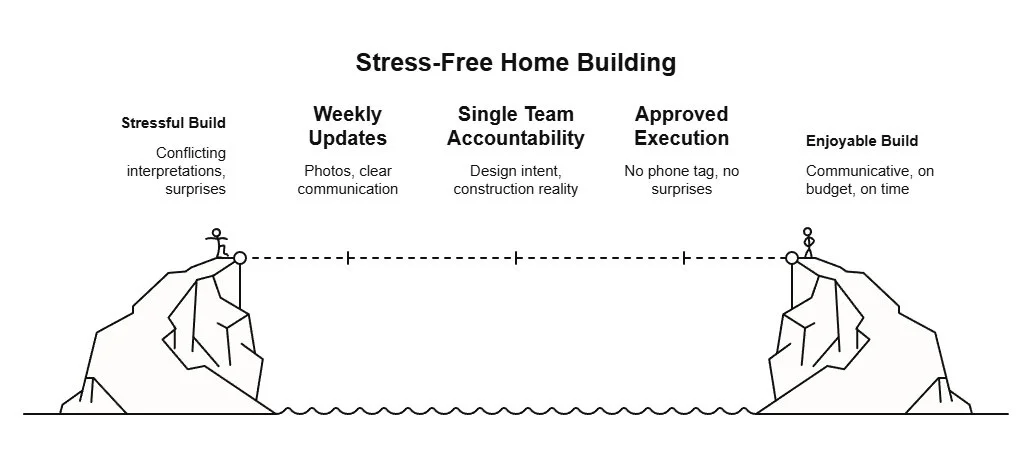
You receive a weekly update with photos showing exactly what happened on site. When a question comes up about a window placement, one team handles it—consulting both the design intent and the construction reality before bringing you a recommendation. You approve. They execute. Done.
No phone tag between separate offices. No conflicting interpretations of the same drawing. No surprises when you visit the site and find something that doesn't match what you approved.
This isn't fantasy. It's what happens when one team carries accountability from the first sketch through the final walkthrough. Riverbend Homes clients describe this kind of experience as communicative, on budget, on time, and even enjoyable—a sharp contrast to the horror stories they'd heard before building. You can read their accounts on the testimonials page.
The emotional shift is significant. Instead of bracing for the next conflict, you actually enjoy watching your home take shape. You trust that the vision you approved will survive contact with reality because the people protecting it are the same people building it.
Stress drops when accountability stops bouncing between separate parties.
What Single-Source Custom Building Means in Real Life
Single-source custom building means the team that designs your home is contractually responsible for constructing it. No handoff. No translation errors. No "that's not our department."
Design-build is the formal industry term. According to the Design-Build Institute of America, this delivery method works because it creates a single point of accountability for quality, cost, and schedule. When problems arise, there's no finger-pointing—just problem-solving. The institute describes design-build as a collaborative, integrated process with benefits such as faster delivery, earlier knowledge of firm costs, and fewer changes, claims, and disputes when executed well. Outcomes can still vary by team and project, but the structural advantages are clear.
For homeowners, single-source building changes the daily experience of construction. Questions get answered faster because decisions don't require coordination between separate companies. Design intent stays intact because the people building understand why specific details matter.
How One Team Protects Your Vision From Sketches to Site Decisions
Design protection isn't about rigid adherence to every line on a drawing. It's about preserving the intent behind those lines when construction realities require adjustments.
Every custom home encounters surprises. Rock appears where soil tests predicted dirt. A window placement conflicts with structural requirements. Material lead times shift. The question isn't whether changes will happen—it's who manages them and with what priorities.
In a fragmented model, field decisions often default to whatever's fastest or cheapest. The builder's crew needs to keep moving. The architect isn't on site. Small compromises accumulate until the finished home feels different from what you approved.
Under unified accountability, the design team and build team share the same goal: executing your approved vision within your approved budget. When field conditions require adaptation, the conversation happens internally before reaching you. The recommendation you receive balances aesthetic intent, structural reality, and cost impact—because one team holds all three responsibilities.
This is how design-build delivers custom homes on budget without sacrificing the details that made you fall in love with the design.
This unified approach is why the initial discovery meeting at your property is so critical. Understanding site feasibility and infrastructure requirements early—before design gets too far ahead—prevents the painful "value engineering" conversations that plague traditional builds. Riverbend Homes stays involved throughout design specifically to maintain vision while keeping projects within budget, pausing at bid-set completeness to estimate final construction costs before permitting begins.
The secret? We listen. From the initial meeting, the conversation covers must-haves, style preferences, space use, and budget—so later reinterpretation becomes far less likely.
5 Signs Your Builder Will Protect the Plan Instead of Reinterpreting It
Not every builder operates the same way. These indicators help distinguish partners who protect your vision from those who might quietly reinterpret it.
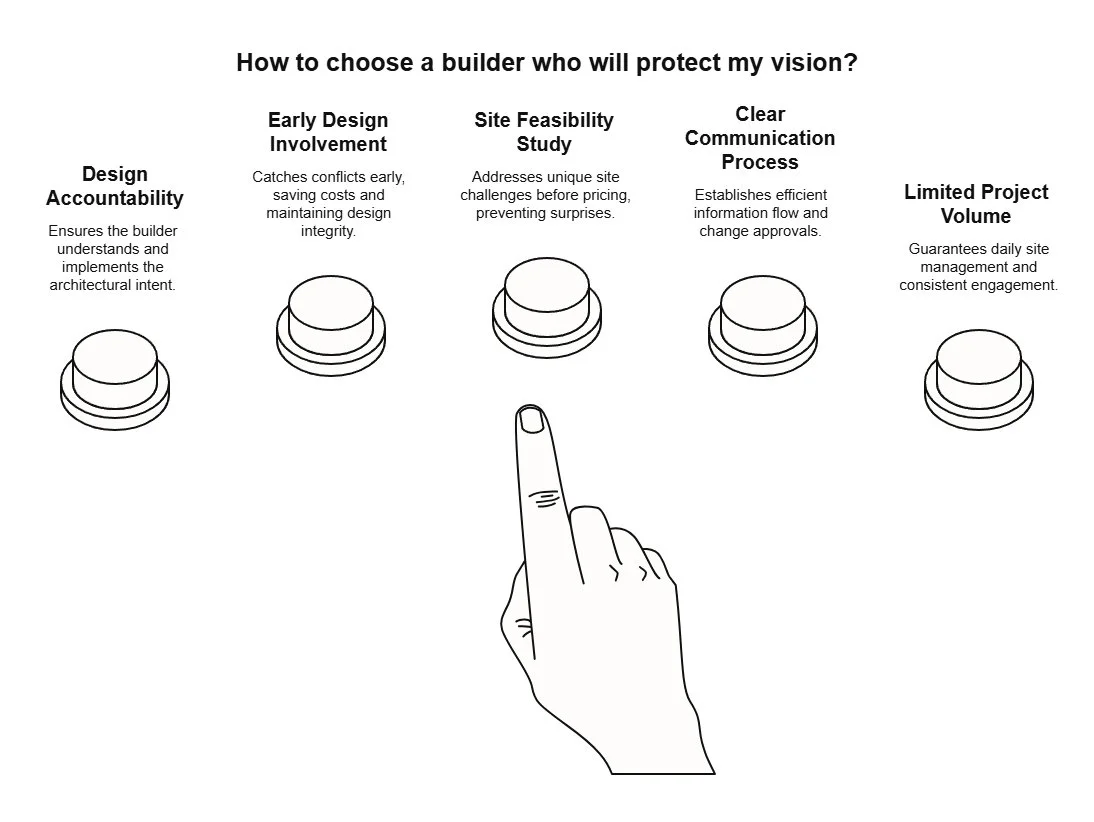
They explain design accountability clearly.
Ask who owns the architectural intent during construction. If the answer involves phrases like "we'll coordinate with your architect" or "that's really between you and the designer," accountability is already fractured. A single-source builder should be able to explain exactly how design decisions carry through to field execution.
They participate actively in design and budgeting before breaking ground.
Builders who only engage after plans are complete have no ownership of the design's buildability. Look for partners who stay involved during design to catch conflicts early, when changes are cheap, not during framing when they're expensive. If budget continuity concerns you, The "Bidding" Myth explains why unified delivery prevents surprises.
They walk your site and discuss feasibility before talking numbers.
Generic square-foot pricing ignores everything that makes your lot unique. Rock, slope, access, utilities—these factors determine what's actually possible and at what cost. A builder who hasn't studied your specific property isn't ready to protect your project.
They can describe their communication process when field questions arise.
Construction generates dozens of small decisions weekly. How does information flow? Who approves changes? How quickly do you hear about issues? Vague answers suggest ad-hoc processes that create gaps.
They limit their project volume.
Builders who overcommit can't provide daily site management. Ask how many projects they run simultaneously and how often someone from their team is physically present on your job site. The Design-Build Institute's best practices emphasize that effective project delivery requires consistent engagement, not periodic check-ins.
A Simple Communication Map: Traditional Build vs. Single-Source Build
The difference between stressful and stress-free often comes down to how information flows.
Traditional Build Communication: In a separated model, you sit at the center of a web. Questions from the builder go to you. You relay them to the architect. The architect responds to you. You translate back to the builder. Multiply this by hundreds of decisions across a twelve-month build. Add subcontractors who report to the builder but may need design clarification. The lines tangle quickly.
When something goes wrong, tracing responsibility requires archaeology. Which conversation contained the miscommunication? Whose interpretation prevailed? Who approved what, and when?
Single-Source Communication: Under unified delivery, the communication map simplifies dramatically. Design questions stay internal. The team resolves conflicts before presenting options. You receive recommendations rather than problems. Your role shifts from translator and mediator to approver and decision-maker.
More handoffs mean more reinterpretation and more homeowner mediation. One accountable team means clearer decisions and less stress.
This streamlined structure is why Riverbend Homes limits project volume—to maintain daily on-site presence and keep communication tight. When the team isn't stretched across too many builds, nothing falls through the cracks.
What to Ask Before You Sign Anything
The right questions reveal whether a builder will protect your vision or leave you mediating between professionals. Consider these before committing:
"Who is accountable if the build team says the plan needs to change?"
The answer should be immediate and specific. If it involves multiple parties negotiating, accountability is already diluted.
"How do you protect the original design intent during construction?"
Listen for process, not promises. What systems ensure that field decisions honor approved aesthetics?
"How involved are you in the design phase before pricing is finalized?"
Builders who only price completed plans have no stake in their buildability. Continuous involvement during design prevents later conflicts.
"How do you handle site-driven realities without breaking the vision?"
Every project encounters surprises. The question is whether adjustments preserve intent or simply expedite construction.
"Who do I call when I have a question during the build?"
One clear answer indicates unified accountability. Multiple contacts suggest fragmented responsibility.
"How many projects are you managing right now, and how often will someone be on my site?"
Volume reveals capacity. Daily presence indicates commitment.
These aren't confrontational questions—they're clarifying ones. Builders who operate under single-source accountability welcome them because the answers showcase their model's strength.
Your Vision Deserves Protection
Building a custom home in the Texas Hill Country should be an experience worth remembering—for the right reasons. The land is beautiful. The possibilities are exciting. The process doesn't have to be painful.
Stress-free construction isn't about finding a builder with a better personality or hoping for good luck. It's about choosing a structure that eliminates preventable friction. One accountable team. Clear communication. Design intent that survives first contact with the job site.
If you're still early in the process—perhaps you've just purchased land or you're comparing approaches—the first 48 hours after buying your lot offer a critical window for smart decisions. Spring is traditionally a popular season when many prospective homeowners accelerate their researching and budgeting for major builds, and making process decisions early means entering the peak construction season with momentum rather than scrambling.
Explore how Riverbend Homes approaches the design-build process, stay informed with Hill Country building insights, or schedule a Discovery Meeting to see how your lot, goals, and constraints would be evaluated in real life.
Disclaimer: This content is educational and reflects general principles of design-build project delivery. Individual project outcomes depend on site conditions, local regulations, and specific contractual arrangements.
Our Editorial Process:
Our expert team uses AI tools to help organize and structure our initial drafts. Every piece is then extensively rewritten, fact-checked, and enriched with first-hand insights and experiences by expert humans on our Insights Team to ensure accuracy and clarity.
By the Riverbend Homes Insights Team
Riverbend Homes has designed and built custom homes in the Texas Hill Country since 1996. As a second-generation family-owned design-build firm, the team focuses on listening closely, staying involved through design and budget decisions, and helping homeowners create distinctive homes without losing control of the process.