

Navigating Allowances: 3 Ways to Maximize Your Integrated Home Design
📌 Key Takeaways
Allowances work best when you treat them as connected budget tools, not separate shopping sprees.
Rank Your Priorities First: Before visiting showrooms, decide which finish categories matter most to your household so you can splurge intentionally and save elsewhere.
Use Credits Strategically: Money saved in one category can shift to another—redirect guest bath savings toward that kitchen upgrade you really want.
Get Budget Feedback Early: Ask your builder how each selection affects your total costs before you commit, not after the order is placed.
Avoid the "Free Money" Trap: Treating allowances as isolated budgets leads to overages that force painful cuts later in the project.
Choose a Process That Tracks Everything: Builders who stay involved during design catch budget drift in real time and prevent surprise bills at the end.
Smart allowance decisions protect your whole home, not just one room.
Homeowners planning a custom build in the Texas Hill Country will gain clarity on finish selections and budget tradeoffs, preparing them for the detailed overview that follows.
~ ~ ~ ~ ~ ~ ~ ~ ~ ~ ~ ~ ~ ~ ~ ~ ~ ~
You finally have the chance to choose the finishes you really want. The countertops. The flooring. That statement light fixture you've been eyeing for months.
But now every decision feels like it could wreck the budget.
You're staring at tile samples in a showroom, and a pit forms in your stomach. Which one of these is going to push us over? The beautiful quartzite countertop seems worth any price in the moment—until you remember the windows, the appliances, the outdoor kitchen you promised your partner.
This tension is real. And it's completely normal.
Fortunately, allowances do not have to function as a guessing game. When they're handled inside an integrated design-build process, they become decision tools that help you protect the overall home while still making meaningful upgrades. The key is treating them as part of your whole-house strategy—not as isolated shopping budgets.
What Allowances Actually Mean in an Integrated Home Design Process
An allowance is a dollar amount set aside in your construction contract for a specific category of finishes or materials—flooring, lighting fixtures, appliances, countertops, tile, or plumbing fixtures. The builder includes this amount in the overall contract price, and you use it to make your selections.
Simple enough on paper.
The problem starts when homeowners treat each allowance as a separate pot of money, disconnected from everything else. They fall in love with selections before understanding what happens if they go over—or what they could gain if they come in under.
An allowance is only functional when you understand its ripple effect on the total project cost.
In an integrated home design approach, your builder stays involved during the design phase specifically to track how finish decisions ripple through the total project cost. This isn't micromanagement. It's protection. When design and construction work as one system, you get real-time feedback instead of surprise bills at the end.
3 Ways to Maximize Your Allowances Without Losing Budget Control
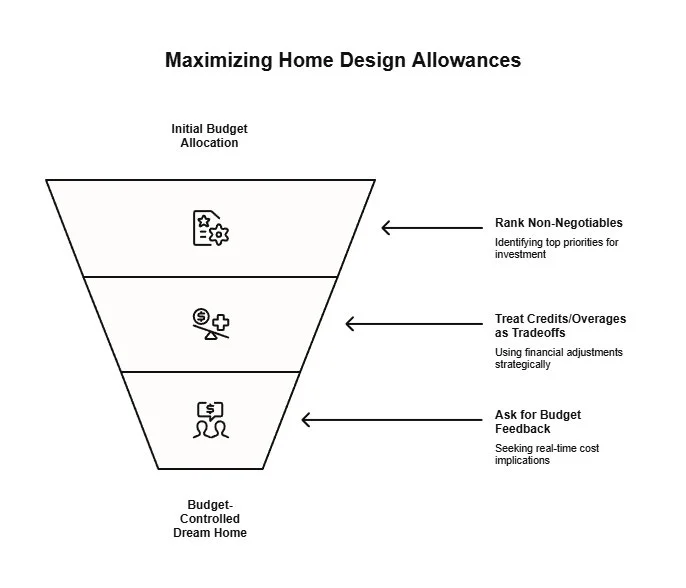
Way 1: Rank Your Non-Negotiables Before You Shop
Before you set foot in a showroom, sit down with your partner or family and identify your top-priority categories. Where do you want to invest? Where can you be more flexible?
Consider ranking these common allowance areas:
Kitchen surfaces and backsplash
Primary bathroom finishes
Windows and exterior doors
Lighting fixtures
Outdoor living features
Flooring throughout the home
Appliances
This isn't about restricting yourself. It's about directing your budget toward what matters most to your household. A couple building a forever home in the Texas Hill Country might prioritize view-facing windows and outdoor living. A family with young children might put durability and kitchen functionality at the top.
The ranking exercise prevents a common trap: spreading your budget so thin across every category that nothing feels special. When you know your non-negotiables upfront, you can be disciplined in lower-priority areas and generous where it counts.
Way 2: Treat Credits and Overages as Whole-House Tradeoffs
Here's where a unified design-build approach becomes essential.
When you come in under an allowance, you typically receive a credit. When you exceed it, you pay the overage. Most homeowners understand this in theory. What they miss is the strategic opportunity.
Credits and overages aren't just accounting adjustments. They're tradeoff levers.
Say you've allocated allowances for both the primary bathroom and the guest bath. You find tile for the guest bath that you genuinely like—and it costs less than the allowance. In a disconnected process, that credit might just disappear into the contract or get applied somewhere arbitrary. In an integrated process, you can redirect those savings intentionally. Maybe that credit helps you upgrade the range hood in the kitchen. Maybe it strengthens your outdoor fireplace budget.
The reverse is also true. If you're about to exceed an allowance on countertops, a builder who's tracking the whole budget can show you the downstream impact before you commit. That transparency lets you make an informed decision rather than discovering the problem months later.
The most expensive item is not always the wrong item. The least expensive item is not always the right one. The goal is not to strip luxury out of the home. The goal is to put budget behind what matters most.
One important note: contract details vary by builder. Credits, overages, and selection handling are not always managed the same way. Ask how savings are applied, how overages are documented, and when updated estimates are shared.
As one Horseshoe Bay homeowner put it, working with the right builder means having "good ideas for making your home match your dreams, while staying within your budget."
Way 3: Ask for Budget Feedback Before Finalizing Selections
The most valuable thing a builder can give you during finish selections isn't a bigger allowance. It's immediate feedback.
Before you finalize any major selection, ask: How does this affect the rest of the budget? A builder operating in an integrated design-build model can answer that question in real time because they're tracking the full project—not just handing off selections to a separate designer or subcontractor.
This is where the design-build approach delivers real value. When one team handles both design and construction, there's no finger-pointing, no delayed cost feedback, and no surprises showing up in change orders.
You want a builder who functions as a financial guide, not just a contractor who builds what's drawn.
"All through the building process Ben was able to stay on budget with only the exception of things we planned to upgrade from the initial contract. He frequently found ways to save us money on our selections. He will also allow you to shop around on your own for money saving deals, which others builders will not allow." — Chris S., Spicewood, TX
The Common Mistake That Makes Allowances Backfire
The most dangerous assumption in custom home building? Treating allowances like free money.
It happens easily. You see an allowance line item for lighting fixtures and think, That's my budget to spend however I want. So you visit showrooms without a whole-house plan. You fall in love with a chandelier before understanding how overages are handled. You make finish choices in isolation, category by category, without asking how one decision affects another.
Then the financial reality becomes unavoidable. The beautiful selections you made individually don't add up to a coherent budget collectively. Suddenly you're facing difficult tradeoffs late in the process—cutting things you care about to cover things you already ordered.
This is why builder process matters as much as the allowance itself. A disciplined process prevents drift. It keeps every selection connected to the larger vision and the real numbers.
How Riverbend's Process Helps Homeowners Stay Flexible Without Losing Control
At Riverbend Homes, the process is built around continuous budget visibility—not end-of-project surprises. The sequence is deliberate: Discover → Design & Budget → Build.
It starts with a Discovery Meeting at your property. This isn't a sales pitch. It's a working session to understand your vision, identify must-haves, discuss architectural style and space usage, and assess site feasibility. Infrastructure realities that affect budget and design get surfaced early, before you're deep into floor plans.
From there, the Design & Budget phase keeps builder involvement active throughout. The goal is to maintain your vision while keeping you in budget. At bid-set completeness, design pauses and a detailed estimate is produced before moving forward. You see where you stand before construction begins—not after.
During the build, Riverbend limits project volume and manages each site daily. That selectivity translates to faster timelines, tighter oversight, and a builder who knows your project inside and out.
The result? Generous allowances, the freedom to shop around for deals, and a partner who helps you redirect savings where they matter most. This is what shopping allowance autonomy looks like when it's paired with clear budget guardrails.
Allowance Planning Checklist for Integrated Home Design
Use this checklist before making selection decisions:
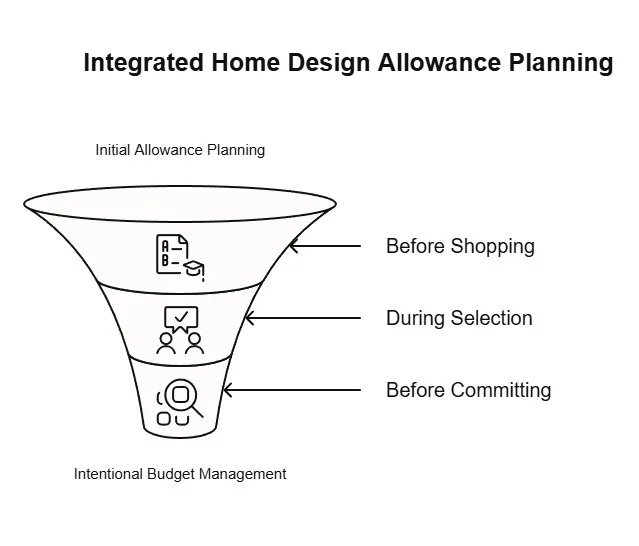
Before You Shop
Have you ranked your finish categories by priority with your household?
Do you know your non-negotiables versus your flexible areas?
Have you asked your builder how credits and overages are handled?
During Selection
Are you getting budget feedback before finalizing each major choice?
Do you understand how this selection affects other categories?
Is the builder tracking the whole-house impact in real time?
Before You Commit
Have you compared your selections against the full allowance picture?
Are planned overages intentional choices, not surprises?
Can you redirect savings from one area to strengthen another?
Bring Your Priorities to the Discovery Meeting
Building a custom home in the Texas Hill Country—whether in Spicewood, Lake Travis, Horseshoe Bay, or the surrounding area—means navigating real site challenges, real budgets, and real decisions. The homeowners who feel most in control are the ones who treat allowances as strategic tools, not isolated shopping trips.
Disciplined decisions create more freedom, not less.
A luxury result and a disciplined budget can coexist. The difference is process.
If you're planning your build, start by organizing your priorities and questions. Understand what matters most to your household. Then find a builder whose process gives you visibility, flexibility, and guidance—not just a number on a spreadsheet.
Explore how Riverbend's design-build process works before you finalize your selections. Review our work to see how other homeowners have brought their visions to life. Or bring your finish priorities and budget questions to a Discovery Meeting and see what integrated home design actually looks like.
If financing is part of your conversation, the CFPB's Loan Estimate explainer offers a solid general reference for comparing loan details. And if long-term design performance matters to you, the DOE's guidance on efficient home design reinforces why a whole-house approach creates better outcomes over time.
Our Editorial Process:
Our expert team uses AI tools to help organize and structure our initial drafts. Every piece is then extensively rewritten, fact-checked, and enriched with first-hand insights and experiences by expert humans on our Insights Team to ensure accuracy and clarity.
By the Riverbend Homes Insights Team
Riverbend Homes has designed and built custom homes in the Texas Hill Country since 1996. As a second-generation family-owned design-build firm, the team focuses on listening closely, staying involved through design and budget decisions, and helping homeowners create distinctive homes without losing control of the process.