

A Home That Fits the Land: View, Access, and Outdoor Living Questions
📌 Key Takeaways
The right custom home starts by reading the land before drawing the floor plan.
Read Land First: The lot should guide the home’s view, entry, outdoor spaces, and budget.
Design Around Daily Life: Family routines should shape where rooms, patios, pools, and guest areas belong.
Protect The View: Great views need smart planning for sun, glare, slope, privacy, and cost.
Plan Access Early: Driveways affect arrival, drainage, parking, trailers, service access, and daily use.
Check Site Limits: Septic, utilities, drainage, county rules, and HOA guidelines can reshape the plan.
Land first = fewer surprises and a home that feels meant to be there.
Families planning custom homes in Spicewood and the Texas Hill Country will gain clearer planning priorities, preparing them for the detailed overview that follows.
~ ~ ~ ~ ~ ~ ~ ~ ~ ~ ~ ~ ~ ~ ~ ~ ~ ~
Picture the morning you wake up in that house for the first time. Maybe it is the light spilling across a Hill Country view before the rest of the family stirs. Maybe it is the sound of guests arriving — tires on gravel, the familiar crunch of a driveway that feels like it was always meant to be there. Or the smell of something on the outdoor grill while children run between the pool and the covered porch.
That picture is clear. The challenge is that the lot still holds a few unknowns, and it is not always obvious which of them could quietly reshape the dream — or the budget — before a single plan is drawn.
A home fits the land when the view, the entry, and the way the family lives all work together. Before drawing plans, homeowners should ask how the property handles arrival, drainage, shade, septic, utilities, view corridors, and daily outdoor use. Most surprises are not unavoidable. They are the product of starting design before the property has been properly read.
As an experienced Spicewood custom home builder, Riverbend Homes — a second-generation family-owned business building in the Texas Hill Country since 1996 — starts every project with a single principle: listen first, then design. The best design questions begin outside, on the land.
Start With the Life You Want to Live on the Land
Before opening a floor plan, it helps to ask a more personal question: how does the family actually live?
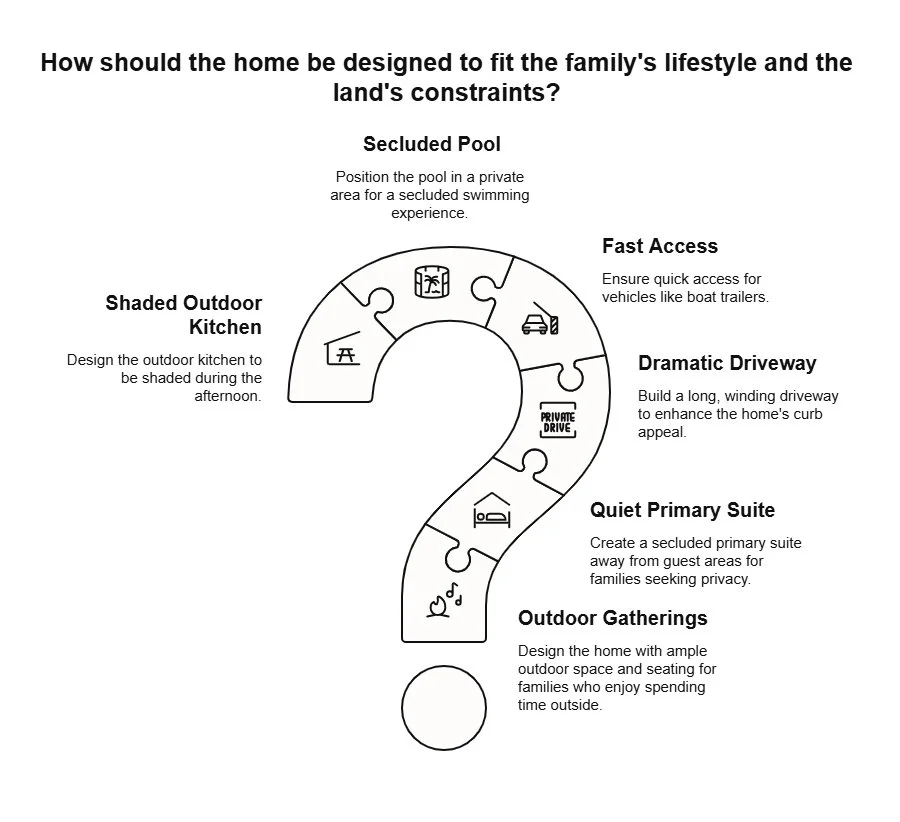
Some families gather outside every evening. Others need a quiet primary suite far from where guests stay. Some want a driveway that builds anticipation before the house comes into view; others need a fast turnaround that works for a boat trailer after a day on Lake Travis. None of those goals is better than another — but they land differently on different lots.
A lot with a dramatic bluff view may put the most beautiful house position at the back of the property, which could mean a longer or more expensive driveway. A lot with natural privacy from cedar and live oak might make the pool feel secluded, or it might shade the outdoor kitchen all afternoon. Constraints are not dream-killers; they are planning inputs. The earlier they are understood, the more of the family's vision they can protect.
Your land is the most critical constraint on your design.
The Lifestyle-to-Site Question List
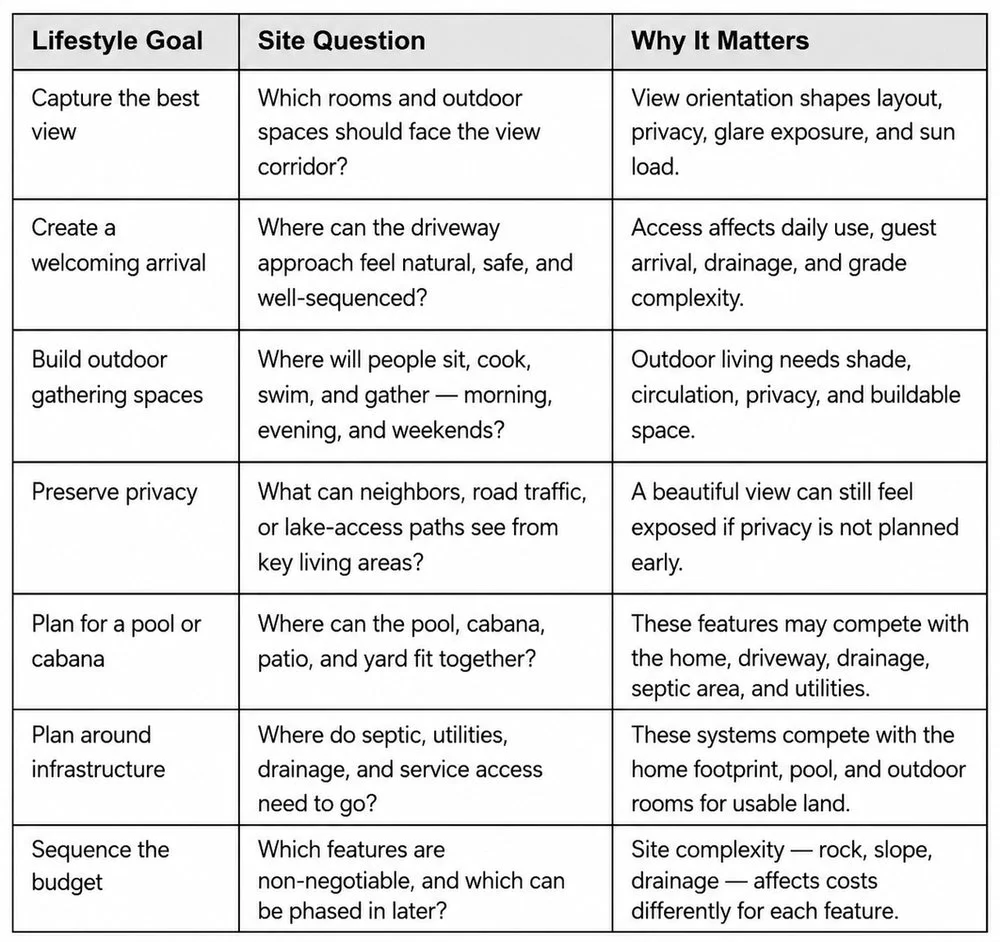
These questions translate broad lifestyle goals into the specific site realities a builder needs to hear. Bring them to any early property conversation.
View Questions: What Will You See, and When Will You See It?
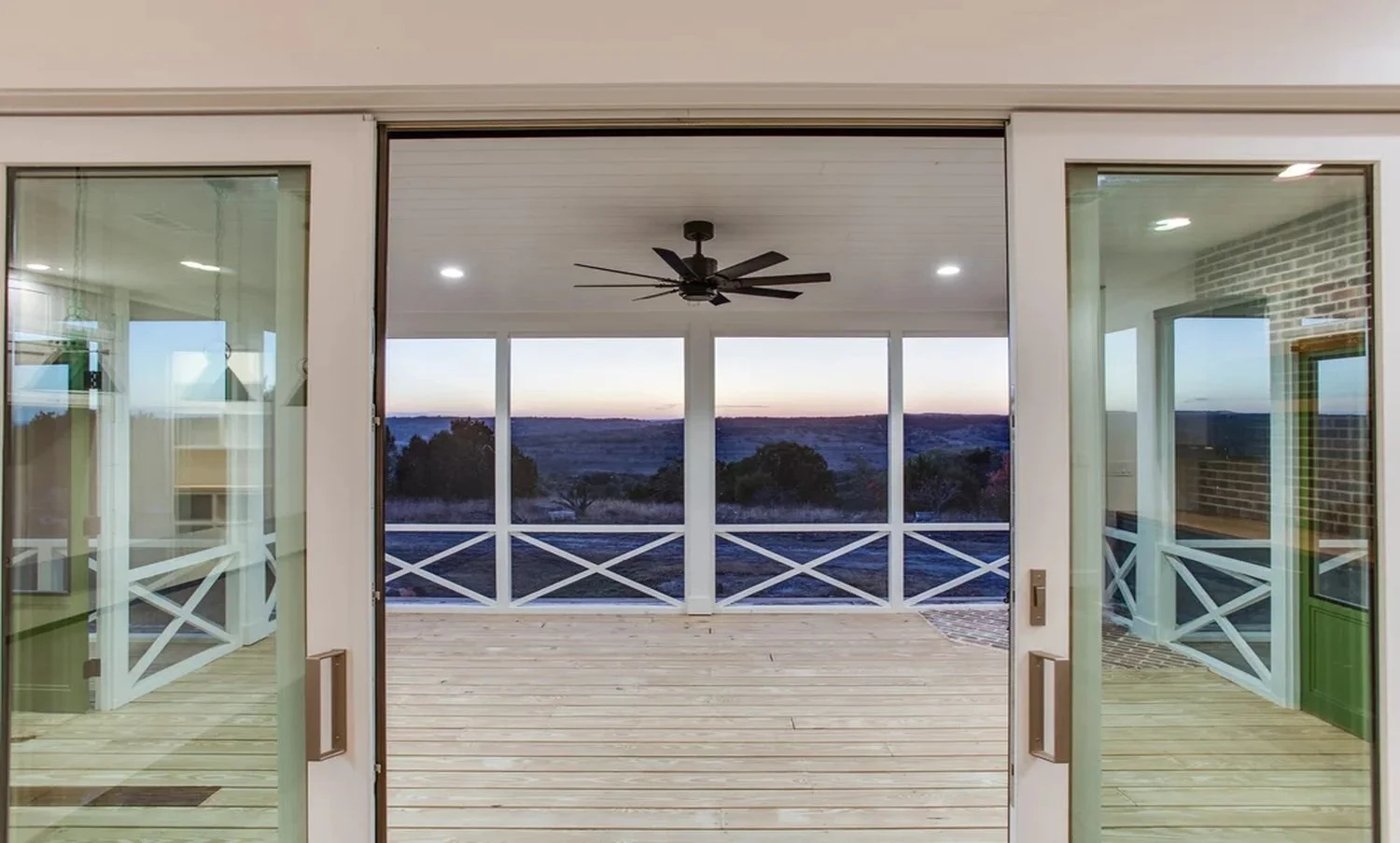
The view is a design input, not just a backdrop. In the Texas Hill Country, views can be the single biggest reason a family chooses a specific lot — distant ridgelines, miles of Lake Travis shoreline, open sky over rolling terrain. That makes view orientation worth more planning weight than it typically receives.
The question is not just where the view is. It is which rooms should receive it, at what time of day, and at what cost to everything else on the lot. If the best view corridor faces east, the primary bedroom captures it at sunrise — which may be exactly right. But a large glass wall in the kitchen facing the same direction can mean significant glare during peak morning use. That is not a reason to abandon the view; it is a reason to design for it intentionally, with overhangs, window placement, and interior orientation working together from the start.
View corridors can also compete with slope. The most dramatic vantage point is often on the highest, steepest ground. Placing the home there for the view may mean more grading and a driveway managing a more complex grade change — costs that are far easier to weigh before the design is emotionally locked. For a closer look at how sightlines and window orientation shape daily livability, Designing for the View: How to Maximize Your Hill Country Landscape in Your Custom Home covers the practical decisions in detail.
Access Questions: How Will the Home Welcome You In?
Arrival is part of how a home feels — and how it functions every single day. The sequence from the road to the front entry, the moment the view opens up, the place where the house finally reveals itself — these are experiences worth designing as deliberately as any interior space.
They are also worth checking against site realities early. Depending on the lot's road frontage, slope, drainage patterns, and road jurisdiction—which in Spicewood can fall under Travis, Burnet, or Blanco County—driveway placement involves specific grade limits, sight distance standards, and drainage requirements. Because permitting processes and governing bodies differ significantly by county, homeowners must identify the specific jurisdiction (e.g., Travis County Development Services for unincorporated Travis County) to understand the requirements for approach angle, positive drainage, and the distinction between county and state road maintenance.
Beyond approach, practical questions matter: room for a guest turnaround, service vehicle access, emergency access, and — for families with boats or trailers — a storage location that does not create a visual problem from the main living area. Can Your Lot Hold the Home, Pool, and Driveway You Want? is useful reading for families working through how much space all of these elements actually require.
Outdoor Living Questions: Where Will Family Life Actually Happen?
In central Texas, outdoor rooms are not seasonal luxuries — they are how homes are actually used for most of the year. That means they need to be planned with the same care as interior spaces, and the land needs to physically support them.
Start with where people will gather at different times of day and during different types of visits. A quiet morning spot near the primary bedroom calls for different placement than an outdoor kitchen anchoring a large weekend gathering. Those two spaces may not want to share the same porch. Then check placement against the competing demands on the land: a pool, covered patio, cabana, screened porch, fire feature, and detached casita together take up meaningful square footage. On lots with septic requirements, drainage swales, or significant slope, the buildable outdoor envelope may be more constrained than the survey suggests.
Afternoon sun in the Hill Country is aggressive from late spring through early fall. A west-facing patio with no shade becomes unusable during exactly the hours most families want to be outside. Roof extensions, pergolas, and mature trees all address this — but they need to be part of the original site plan to work effectively.
Privacy, Noise, and Neighbor Questions
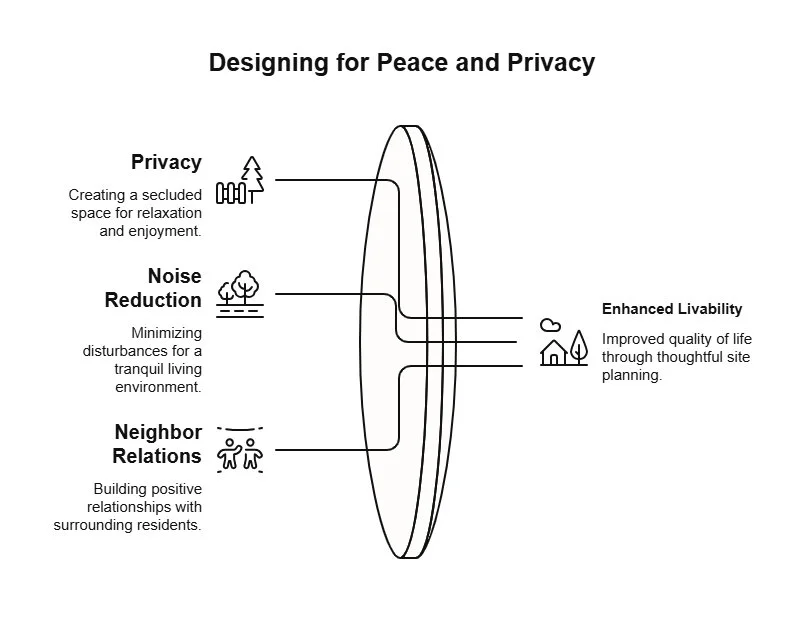
Privacy is a livability question, not a paranoid one. It is simply the difference between a pool area that feels like a genuine retreat and one that feels perpetually observed.
Walking the lot edges and asking what is visible from the road, from neighboring properties, and from any nearby lake-access paths is one of the most underrated early steps in lot planning. Natural vegetation, grade changes, and thoughtful building placement can create genuine privacy — but those design moves need to be identified early, not discovered mid-construction. Where headlights sweep across a bedroom terrace at night, or where road noise reaches a pool area, are real livability factors that thoughtful site planning can address. The question of whether views and privacy pull in opposite directions on a given lot is worth raising directly with the builder from the first conversation.
The Builder Question: Has the Property Been Read Before the Dream Is Drawn?
Site feasibility is a builder-led evaluation of whether the land can support the home a family imagines — encompassing site realities, infrastructure requirements, design implications, and budget risk. There is a version of the custom home process where design happens first — inspired images, floor plan preferences, a target square footage — and the land enters the picture after the plan already feels finished. That version is where expensive surprises live.
Riverbend's process begins with the Discover phase: a Discovery Meeting held at the property itself. Clients bring inspiration images and any saved designs; the builder listens, walks the land, assesses site feasibility, and identifies infrastructure requirements that will affect both design and cost. Understanding the potential and limitations of the space is not the end of the dream — it is how the dream gets built correctly.
The next phase, Design & Budget, keeps the builder involved alongside the architect to maintain both the vision and the budget. When plans reach bid-set completeness, the process pauses: a final construction cost estimate is produced before designs are finalized and permitting begins. Nothing moves past the point where the budget is understood. From there, the Build phase is shaped by financing, permitting, and HOA timelines — factors a builder active in the Hill Country navigates honestly rather than glossing over.
What to Bring to a Site Conversation
A first property conversation is most useful when priorities are clear. That does not mean arriving with plans — it means arriving with organized thinking.
Bring:
A current survey or plat of the property
HOA covenants or architectural guidelines, if available
Any known information about utilities, wells, or existing septic systems
Saved inspiration images — Pinterest boards, magazine clippings, photos from homes toured
A ranked list of must-have priorities: view, pool, privacy, outdoor kitchen, separate primary wing, casita, guest access, or multigenerational space
On the infrastructure side, lots near Lake Travis and the Highland Lakes may fall under the LCRA's On-Site Sewage Facility Program. The permit process can require proposed locations for the house, driveway, septic tank, drain field, and wells to be shown and marked on the property for inspection (LCRA OSSF Permit Steps). Additionally, lots within the Lake Travis watershed may be subject to the LCRA Highland Lakes Watershed Ordinance, which governs land disturbance, stormwater management, and erosion controls in ways that affect where things can be built. A builder who knows these systems can help determine what applies to a specific parcel before site or design investments are made.
For families also thinking through lot selection itself, Survey Papers in Hand: 5 Lot Checks Before Your Dream Home Is Drawn and The First 48 Hours After Buying Your Lot: 5 Smart Steps Before Custom Home Design cover complementary ground.
Stay informed with Hill Country building trends and tips as the planning process continues. When ready to walk the property with a site-first builder, contact Riverbend Homes to schedule a Discovery Meeting. The land has a great deal to say about the home — before the first line is drawn.
Our Editorial Process
Our expert team uses AI tools to help organize and structure our initial drafts. Every piece is then extensively rewritten, fact-checked, and enriched with first-hand insights and experiences by expert humans on our Insights Team to ensure accuracy and clarity.
About the Riverbend Homes Insights Team
The Riverbend Homes Insights Team shares practical guidance for families planning custom homes in Spicewood, Lake Travis, Lake LBJ, Horseshoe Bay, and the Texas Hill Country. Our content draws on Riverbend Homes' property-first design-build process, local building experience, and commitment to helping homeowners make confident decisions before plans move too far ahead of the land.
Beyond the Kitchen Table Sketches: How Custom Home Design-Build Stops Budget Overruns
Custom home budgets blow up when architects and builders work separately. Design-build prevents overruns by calculating costs during design, not after plans are finished.
📌 Key Takeaways
Custom home budgets blow up when design and construction teams work separately—unified design-build keeps costs visible from the start.
Separate Teams Create Surprise Bills: When your architect and builder don't talk until plans are done, you fall in love with a design before anyone checks what it actually costs to build.
Real-Time Cost Checks Prevent Heartbreak: Design-build teams calculate budget impact as you make decisions, not months later when changes are expensive.
Your Lot Hides Costs You Can't See: Rock, slopes, septic systems, and utility access in Hill Country terrain can add tens of thousands—a site walk before design catches these early.
Allowances Should Give You Control: Good contracts let you shop for finishes yourself and keep the savings, rather than locking you into builder-selected materials.
Daily Oversight Speeds Up Your Build: Builders who limit their projects and show up every day finish faster and catch problems before they become budget emergencies.
One team from start to finish means no finger-pointing and no surprise invoices.
Texas Hill Country homeowners planning custom builds will gain budget protection strategies here, preparing them for the detailed process overview that follows.
~ ~ ~ ~ ~ ~ ~ ~ ~ ~ ~ ~ ~ ~ ~ ~ ~ ~
The sketches are spread across the table. Inspiration photos glow on the laptop screen. Maybe there's a Pinterest board with 47 saved images of Hill Country great rooms and outdoor kitchens. The excitement is real. So is the knot in your stomach.
You and your partner have purchased the lot. You've imagined the sunrise view from a future primary suite. You've talked about where the kids will play, where guests will gather, how the house will finally feel like yours. Yet, beneath the anticipation lies a persistent financial anxiety.
That fear is not irrational. It's not a sign of cold feet or poor planning. It's the reasonable response of a thoughtful person facing one of the largest financial commitments of their life—and knowing that custom home projects have a reputation for spinning out of control.
The good news? Budget overruns are not inevitable. They follow a predictable pattern, and that pattern can be interrupted. Understanding where budget problems actually begin—and how a unified custom home design-build approach stops them—is the first step toward building your Texas Hill Country home with both your vision and your financial boundaries intact.
The Kitchen-Table Moment: Why Custom Home Budget Anxiety Starts So Early
Budget anxiety doesn't wait for construction to begin. It starts the moment you realize that the gap between "dream" and "done" is filled with decisions you don't yet know how to make.
If you're researching and budgeting this spring, the timing matters. Late winter through early spring is generally when many homeowners across the Hill Country begin preparing for major construction decisions, making it an ideal time to understand what causes overruns and what helps prevent them.
You may have already encountered a version of this tension. One partner gravitates toward the soaring ceilings and the chef's kitchen. The other keeps circling back to the spreadsheet, wondering how much contingency is really enough. Both concerns are valid. Both people are trying to protect the same thing: a home that works for your family without becoming a source of regret.
The fear isn't really about money. It's about control. Will you be the one making the hard calls, or will those calls be made for you—by contractors who didn't communicate, by site conditions no one anticipated, by a design that looked beautiful on paper but costs significantly more than anyone quoted?
Custom home projects carry an uncomfortable reputation. Stories circulate about budgets that doubled, timelines that stretched into years, and relationships between homeowners and builders that ended in lawyers' offices. Even if you've never personally experienced a build gone wrong, you've probably heard enough cautionary tales to wonder whether the dream is worth the risk.
Here's what those stories often have in common: the budget problem started long before anyone poured concrete. It started when design decisions were made without real-time cost feedback. It started when no one asked hard questions about the lot until permits were already in motion. It started when the architect and the builder operated in separate worlds, each assuming the other would catch the problem.
Why Custom Home Budgets Blow Up Before the House Is Even Built
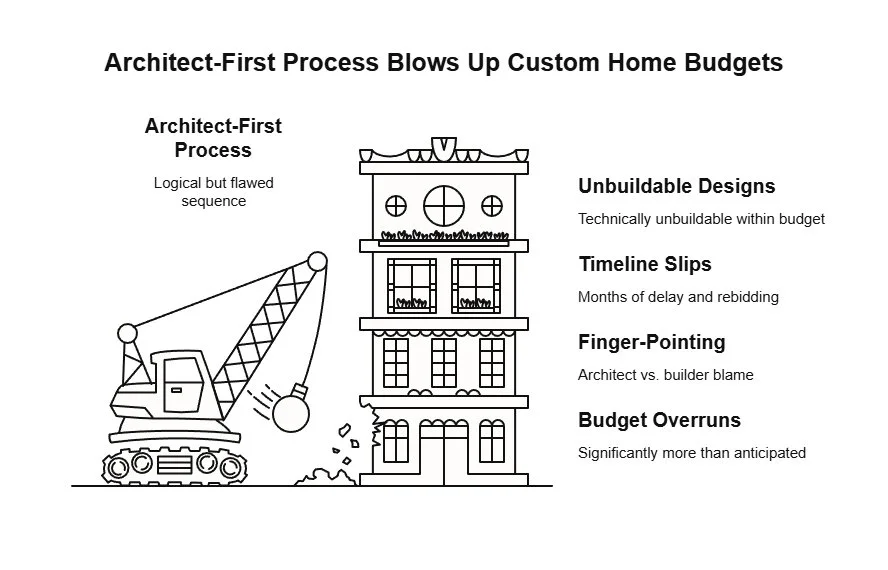
The traditional custom home process follows a sequence that feels logical but contains a structural flaw.
First, you hire an architect. The architect asks about your vision, your lifestyle, your aesthetic preferences. Together, you develop a set of plans. The architect may suggest features you hadn't considered, materials that would elevate the design, spatial arrangements that solve problems you didn't know you had. The plans grow more beautiful and more detailed.
Then, once the design is complete, you take those plans out to bid. Multiple builders review the drawings and submit their estimates. You compare the numbers, select a contractor, and prepare to break ground.
The problem? By the time you receive those bids, you've already fallen in love with the design. You've shown the renderings to friends and family. You've mentally moved into that house. And now a builder is telling you it will cost significantly more than you anticipated—or that certain features can't be built on your lot without expensive modifications.
This is the architect-first, bid-later trap. It's the moment when finger-pointing begins. The architect says the builder is overcharging. The builder says the architect designed something that ignores site realities. You're caught in the middle, trying to figure out who to trust while your budget stretches and your timeline slips.
The root cause is not bad intentions. It's disconnected workflows. When the person designing your home has no accountability for construction costs, and the person building your home had no input during design, misalignment is almost guaranteed. Beautiful ideas get approved without anyone calculating what they'll actually cost to execute. Site conditions—rock, slope, utility access, septic requirements—get discovered after the plans are locked.
Fragmented teams lead to designs that are technically unbuildable within the set budget. The redesign fees, the rebidding process, the months of delay—these are the hidden costs of a workflow that separates imagination from reality.
This is not a criticism of architects or builders as individuals. It's a recognition that the traditional sequence creates structural incentives for problems. And if you're planning to build in the Texas Hill Country, where site conditions are rarely simple, those problems multiply.
What Custom Home Design-Build Actually Means for a Homeowner
Custom home design-build is a unified project delivery system where a single entity assumes responsibility for both architectural design and construction.
That definition sounds straightforward, but the implications are significant. Instead of hiring an architect first and a builder later, you work with one integrated team from the beginning. Design decisions and construction realities stay in the same conversation. The people imagining your home are the same people who will build it—and who are accountable for delivering it within your budget.
Think of it this way: design-build puts the architect and the accountant at the same desk from day one.
When a design idea emerges, someone on the team immediately asks: What will this cost? What does it require from the site? What tradeoffs does it create elsewhere in the budget? Those questions don't wait until the design is finished. They happen in real time, while changes are still easy and inexpensive to make.
For you as a homeowner, this means something practical: you don't fall in love with a plan you can't afford. You don't discover six months into the process that your lot requires $80,000 in retaining walls that nobody mentioned. You don't find yourself choosing between gutting your design or blowing past your budget.
Design-build is not a magic wand. Challenges still arise. Costs still require tradeoffs. But the unified structure means those challenges surface early, when you have options—not late, when you're trapped.
The Design-Build Institute of America has documented that this approach works best when multiple disciplines are convened early and managed within a unified framework. The principle applies whether you're building a commercial facility or a custom home: when design and construction operate as partners rather than separate contractors, accountability stays clear and surprises stay manageable.
For a deeper look at what design-build means in the context of custom homes, Riverbend Homes has published a plain-language explanation that avoids contractor jargon.
Continuous Estimating: The Budget-Protection Engine Most Homeowners Never See
Continuous estimating means that budget impact is calculated throughout the design process, not just at the end. This practice is the real power of design-build—not just organizational, but operational.
Every significant design decision triggers a cost check. Want to add a second primary suite for visiting parents? The team calculates what that does to your total before you commit. Considering a switch from stucco to stone on the exterior? You see the number before the plans are finalized.
This sounds obvious, but it's surprisingly rare in traditional custom home projects. When the architect and builder are separate entities with separate contracts, there's often no mechanism for real-time cost feedback. The architect may not have access to current construction pricing. The builder may not be involved until the design is complete. The homeowner is left hoping that the final bid will somehow match the original vision.
Hope-based budgeting is the opposite of what you need when building a luxury home. You need continuous visibility. You need someone who will tell you the truth while you still have room to adjust.
A well-structured design-build process includes a specific checkpoint: when plans reach what's called "bid-set completeness," the team pauses. Before pushing forward into permitting and final documentation, they calculate a realistic final construction estimate. This is the moment to confirm alignment—or to make changes before costs are locked.
Riverbend Homes builds this pause into every project. The team stays involved throughout design specifically to prevent budget drift. When plans reach the bid-set level, they stop and present a clear estimate. If adjustments are needed, they happen before anyone breaks ground—not after.
National construction-cost research from the National Association of Home Builders confirms that site work represents a meaningful cost category in home construction. That's national context, not a local Texas luxury-home estimate, but it reinforces the same principle: visible finishes are only one part of the financial picture. Early feasibility testing and ongoing estimating matter precisely because costs hide in places most homeowners don't initially see.
This approach won't eliminate every hard decision. Budgets are finite, and tradeoffs are part of any custom build. But continuous estimating ensures that you're making those tradeoffs with full information, not discovering them as unpleasant surprises months into construction.
To understand how this workflow stops the finger-pointing that plagues traditional builds, the linked article explains the accountability structure in more detail.
The Hill Country Reality Check: Rock, Slope, Utilities and Permits Change Everything
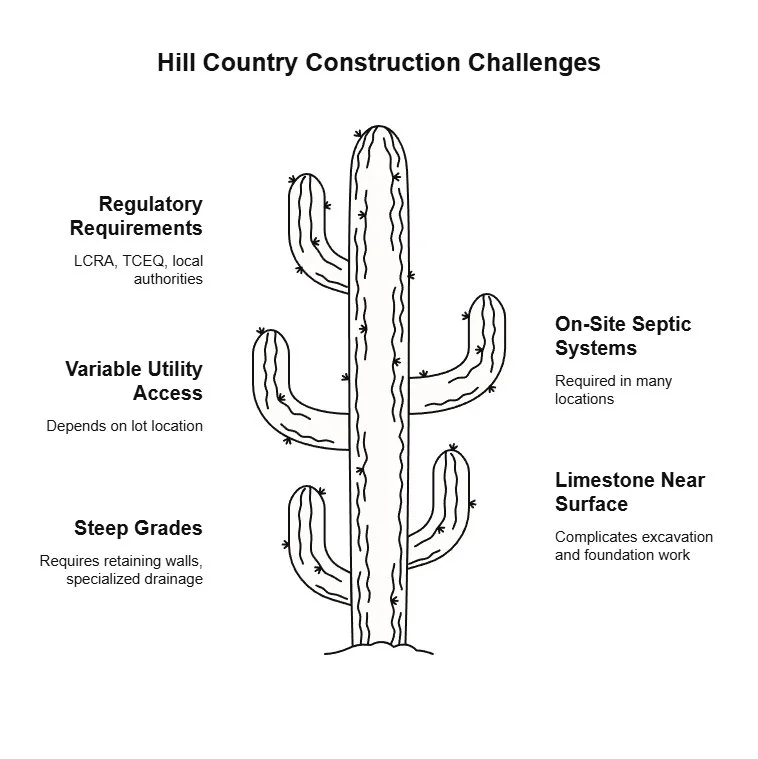
If you've purchased a lot in the Texas Hill Country, you already know the land is not simple. The views are spectacular precisely because the terrain is dramatic. Limestone ridges, steep grades, and irregular topography create the character that draws people to this part of Central Texas.
That same character creates construction realities that must be addressed early—or paid for later.
Slopes above a certain threshold often require retaining walls, stepped foundations, or specialized drainage systems. Limestone near the surface can complicate excavation and foundation work. Utility access varies widely depending on where your lot sits relative to existing infrastructure. And in many Hill Country locations, wastewater handling requires on-site septic systems rather than municipal sewer connections.
These are not reasons to avoid building. They're reasons to understand your site before custom home design locks in assumptions that don't match reality.
Septic planning is a particular concern near Lake Travis and throughout the Highland Lakes region. The Lower Colorado River Authority administers on-site sewage facilities programs for properties within its jurisdiction, regulating facilities within a 2,000-foot zone around the lake. The Texas Commission on Environmental Quality establishes statewide requirements for permits and approved plans, and advises arranging a preconstruction site evaluation by a licensed site evaluator or professional engineer. That evaluation typically includes a lot survey, soil analysis, and other suitability factors. Local authorities may impose additional restrictions beyond state minimums, particularly for lots close to waterways.
None of this is meant as legal or engineering advice. Every site is different, and specific requirements depend on your lot's location, soil conditions, and regulatory context. The point is that these factors affect both design and budget—and that a unified design-build team should be surfacing them early, during the Discovery Meeting, not discovering them after plans are finalized.
When site conditions are understood from the start, they become planning constraints rather than budget emergencies. A retaining wall that's designed into the project from day one is a feature. A retaining wall that gets added after foundation plans are complete is a crisis.
For more detail on how rock and slope impact custom builds in this region, the linked resource covers what to expect and how to plan accordingly.
From Discovery Meeting to Buildable Plan: How the Process Protects the Budget
A well-structured design-build process follows a clear sequence, and each phase serves a budget-protection function.
Discovery: Surface Reality Before Attachment
The process begins with a Discovery Meeting—not in an office, but on your property. Walking the lot together allows the team to assess site conditions firsthand: where the views are strongest, how the land slopes, where utilities connect, what infrastructure requirements will affect both design and budget.
This meeting is also the time to understand your vision. What are your must-haves? Do you have a preferred architectural style? How will you actually use the space? What's your budget for the project? The goal is alignment: making sure the team understands both what you want and what the site will support.
Riverbend Homes treats this Discovery Meeting as the essential first step. The team evaluates feasibility, identifies infrastructure needs, and begins connecting your vision to the realities of your specific lot. Problems that would otherwise surface months later get addressed before design work begins.
Design and Budget: Keep Decisions Tied to Costs
Once discovery is complete, the design phase begins—with the builder involved throughout. As plans develop, cost implications are calculated in real time. The team translates saved inspiration images, magazine clippings, or Pinterest boards into a design that fits both the site and the budget.
This is where continuous estimating does its work. Design choices don't outrun financial reality because someone is always asking what each decision costs. When plans reach bid-set completeness, the team pauses to present a realistic final construction estimate. If the number is right, permitting moves forward. If adjustments are needed, they happen now—not after contracts are signed.
Build: Faster Execution Through Daily Management
When construction begins, the unified accountability continues. Because the team that designed your home is the same team building it, there's no translation gap between plans and execution. Questions get answered quickly. Changes get evaluated against the original budget. Progress stays visible.
Riverbend Homes takes on a select number of projects at a time specifically to ensure close involvement. The commitment is to be on-site and managing the build every single day—not juggling dozens of projects with occasional check-ins. For homeowners, this translates to a faster timeline and fewer opportunities for miscommunication.
"Ben made it easy and fun to watch our designs come to life," one Austin-area client noted, describing the experience of staying informed and involved throughout construction.
For a complete walkthrough of this sequence, visit the process page on the Riverbend Homes website.
Budget Control Without Killing the Dream: Allowances, Selections and Autonomy
One of the fears that accompanies budget discipline is the loss of personal taste. If staying on budget means accepting whatever the builder chooses—generic finishes, builder-grade fixtures, no input on materials—then what's the point of building custom?
The right design-build partner understands that budget protection and design autonomy are not opposites. They work together.
Allowances are the mechanism. A well-structured contract includes allowances for categories like flooring, countertops, lighting, and fixtures. These allowances define how much is budgeted for each category, giving you clarity about what's included and what would constitute an upgrade.
But allowances are only useful if they're realistic and if you have genuine flexibility in how you use them. Some builders set allowances so low that overages are inevitable. Others restrict your ability to shop for better deals, requiring you to purchase through their vendors regardless of price.
A transparent design-build firm operates differently. Allowances are set at levels that genuinely support the finish quality appropriate for your project. And if you find a better price on a material you love—because you found a tile supplier running a promotion, or a lighting showroom with discontinued fixtures—you can capture those savings.
"He frequently found ways to save us money on our selections," one Riverbend Homes client reported, describing how the team actively helped identify value without sacrificing quality.
This approach respects your judgment. You're not a passive recipient of whatever the builder decides. You're a participant in the process, making informed choices about where to invest and where to economize—with full visibility into how those choices affect your overall budget.
For more on how shopping allowances work and what questions to ask, the linked article provides practical guidance.
The Budget Protection Checklist: 5 Questions to Ask Before You Approve Design Work
Before you commit to a design or sign a construction contract, these five questions will help you evaluate whether the process is set up to protect your budget—or whether you're walking into a structure that makes overruns likely.
This checklist is designed to be shared. If you and your partner have different priorities—one focused on the vision, one focused on the numbers—these questions give you common ground for evaluating any builder you're considering.
1. Who is responsible for both design decisions and construction budget alignment from day one?
If the answer is split across separate parties with no clear owner, expect gaps.
2. At what point do you stop design work and calculate a realistic final construction estimate?
The right answer should include a clear checkpoint, not just "later."
3. How do you surface site feasibility, rock, slope, utilities, and permit-related costs before final plans are approved?
A beautiful plan is not the same thing as a buildable one.
4. How do allowances work, and can I shop selections independently if I find better value?
This helps you protect both quality and flexibility.
5. How many projects are you actively managing at one time, and who is on site daily during construction?
Capacity discipline matters. Oversight is not a detail. It's part of the value.
These questions are not adversarial. They're clarifying. A builder confident in their process will answer them directly. Evasive responses or frustration at being asked are signals worth heeding.
For additional guidance on evaluating builders and avoiding common pitfalls, the article on how the right builder helps you avoid surprise bills covers what to look for and what to avoid. If you want to understand contract structures more deeply, Fixed-Price vs. Cost-Plus explains the tradeoffs in each approach.
When Design-Build Is the Right Fit for a Budget-Conscious Luxury Project
Design-build is the right fit when you want creativity, but not creative accounting.
Not every homeowner needs this approach. If your lot is flat and simple, your design preferences are standard, and you have deep experience managing construction projects, the traditional approach may work fine.
But if you're building in the Texas Hill Country—where site conditions are rarely straightforward—and if budget clarity matters as much as design creativity, design-build offers something the traditional approach cannot: unified accountability from vision to completion.
This is not about finding the cheapest build. It's about finding the clearest path to a buildable dream. It's about working with a team that will tell you the truth about costs while there's still time to adjust. It's about protecting both your investment and your peace of mind.
The right fit is someone who wants both creativity and boundaries. Someone who values transparency over pleasant surprises. Someone who recognizes that responsible planning is not small thinking—it's the smartest way to protect a significant vision.
Riverbend Homes has operated as a second-generation family-owned Texas Hill Country builder since 1996. The approach is straightforward: listen first, test ideas against site realities early, keep design and budget in the same conversation, and build with daily attention rather than occasional check-ins. For a clearer sense of how the company works and what it values, explore about Riverbend Homes and read what past clients say in the testimonials.
"He will keep you on budget and on time with no surprises," one client summarized after completing their custom home.
If you're in the spring planning phase—researching options, evaluating lots, trying to understand how to move from kitchen-table sketches to buildable plans—the next step is not a commitment. It's a conversation.
See the process to understand how Discovery, Design, and Build connect. When you're ready to talk about your specific lot and vision, schedule a Discovery Meeting to start the conversation on your property.
The dream doesn't have to outrun the budget. With the right structure, the right team, and the right questions, you can build exactly what you imagined—and know what it costs before you commit.
Our Editorial Process:
Our expert team uses AI tools to help organize and structure our initial drafts. Every piece is then extensively rewritten, fact-checked, and enriched with first-hand insights and experiences by expert humans on our Insights Team to ensure accuracy and clarity.
By: The Riverbend Homes Insights Team
The Riverbend Homes Insights Team is our dedicated engine for synthesizing complex topics into clear, helpful guides. While our content is thoroughly reviewed for clarity and accuracy, it is for informational purposes and should not replace professional advice.
Navigating Allowances: 3 Ways to Maximize Your Integrated Home Design
Finish allowances protect your budget when you rank priorities first and redirect savings between categories. Three strategies for choosing luxury finishes intentionally.
📌 Key Takeaways
Allowances work best when you treat them as connected budget tools, not separate shopping sprees.
Rank Your Priorities First: Before visiting showrooms, decide which finish categories matter most to your household so you can splurge intentionally and save elsewhere.
Use Credits Strategically: Money saved in one category can shift to another—redirect guest bath savings toward that kitchen upgrade you really want.
Get Budget Feedback Early: Ask your builder how each selection affects your total costs before you commit, not after the order is placed.
Avoid the "Free Money" Trap: Treating allowances as isolated budgets leads to overages that force painful cuts later in the project.
Choose a Process That Tracks Everything: Builders who stay involved during design catch budget drift in real time and prevent surprise bills at the end.
Smart allowance decisions protect your whole home, not just one room.
Homeowners planning a custom build in the Texas Hill Country will gain clarity on finish selections and budget tradeoffs, preparing them for the detailed overview that follows.
~ ~ ~ ~ ~ ~ ~ ~ ~ ~ ~ ~ ~ ~ ~ ~ ~ ~
You finally have the chance to choose the finishes you really want. The countertops. The flooring. That statement light fixture you've been eyeing for months.
But now every decision feels like it could wreck the budget.
You're staring at tile samples in a showroom, and a pit forms in your stomach. Which one of these is going to push us over? The beautiful quartzite countertop seems worth any price in the moment—until you remember the windows, the appliances, the outdoor kitchen you promised your partner.
This tension is real. And it's completely normal.
Fortunately, allowances do not have to function as a guessing game. When they're handled inside an integrated design-build process, they become decision tools that help you protect the overall home while still making meaningful upgrades. The key is treating them as part of your whole-house strategy—not as isolated shopping budgets.
What Allowances Actually Mean in an Integrated Home Design Process
An allowance is a dollar amount set aside in your construction contract for a specific category of finishes or materials—flooring, lighting fixtures, appliances, countertops, tile, or plumbing fixtures. The builder includes this amount in the overall contract price, and you use it to make your selections.
Simple enough on paper.
The problem starts when homeowners treat each allowance as a separate pot of money, disconnected from everything else. They fall in love with selections before understanding what happens if they go over—or what they could gain if they come in under.
An allowance is only functional when you understand its ripple effect on the total project cost.
In an integrated home design approach, your builder stays involved during the design phase specifically to track how finish decisions ripple through the total project cost. This isn't micromanagement. It's protection. When design and construction work as one system, you get real-time feedback instead of surprise bills at the end.
3 Ways to Maximize Your Allowances Without Losing Budget Control
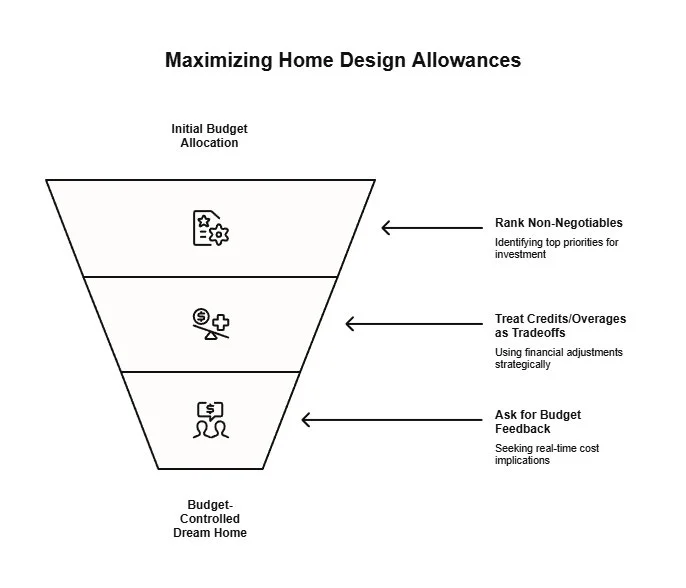
Way 1: Rank Your Non-Negotiables Before You Shop
Before you set foot in a showroom, sit down with your partner or family and identify your top-priority categories. Where do you want to invest? Where can you be more flexible?
Consider ranking these common allowance areas:
Kitchen surfaces and backsplash
Primary bathroom finishes
Windows and exterior doors
Lighting fixtures
Outdoor living features
Flooring throughout the home
Appliances
This isn't about restricting yourself. It's about directing your budget toward what matters most to your household. A couple building a forever home in the Texas Hill Country might prioritize view-facing windows and outdoor living. A family with young children might put durability and kitchen functionality at the top.
The ranking exercise prevents a common trap: spreading your budget so thin across every category that nothing feels special. When you know your non-negotiables upfront, you can be disciplined in lower-priority areas and generous where it counts.
Way 2: Treat Credits and Overages as Whole-House Tradeoffs
Here's where a unified design-build approach becomes essential.
When you come in under an allowance, you typically receive a credit. When you exceed it, you pay the overage. Most homeowners understand this in theory. What they miss is the strategic opportunity.
Credits and overages aren't just accounting adjustments. They're tradeoff levers.
Say you've allocated allowances for both the primary bathroom and the guest bath. You find tile for the guest bath that you genuinely like—and it costs less than the allowance. In a disconnected process, that credit might just disappear into the contract or get applied somewhere arbitrary. In an integrated process, you can redirect those savings intentionally. Maybe that credit helps you upgrade the range hood in the kitchen. Maybe it strengthens your outdoor fireplace budget.
The reverse is also true. If you're about to exceed an allowance on countertops, a builder who's tracking the whole budget can show you the downstream impact before you commit. That transparency lets you make an informed decision rather than discovering the problem months later.
The most expensive item is not always the wrong item. The least expensive item is not always the right one. The goal is not to strip luxury out of the home. The goal is to put budget behind what matters most.
One important note: contract details vary by builder. Credits, overages, and selection handling are not always managed the same way. Ask how savings are applied, how overages are documented, and when updated estimates are shared.
As one Horseshoe Bay homeowner put it, working with the right builder means having "good ideas for making your home match your dreams, while staying within your budget."
Way 3: Ask for Budget Feedback Before Finalizing Selections
The most valuable thing a builder can give you during finish selections isn't a bigger allowance. It's immediate feedback.
Before you finalize any major selection, ask: How does this affect the rest of the budget? A builder operating in an integrated design-build model can answer that question in real time because they're tracking the full project—not just handing off selections to a separate designer or subcontractor.
This is where the design-build approach delivers real value. When one team handles both design and construction, there's no finger-pointing, no delayed cost feedback, and no surprises showing up in change orders.
You want a builder who functions as a financial guide, not just a contractor who builds what's drawn.
"All through the building process Ben was able to stay on budget with only the exception of things we planned to upgrade from the initial contract. He frequently found ways to save us money on our selections. He will also allow you to shop around on your own for money saving deals, which others builders will not allow." — Chris S., Spicewood, TX
The Common Mistake That Makes Allowances Backfire
The most dangerous assumption in custom home building? Treating allowances like free money.
It happens easily. You see an allowance line item for lighting fixtures and think, That's my budget to spend however I want. So you visit showrooms without a whole-house plan. You fall in love with a chandelier before understanding how overages are handled. You make finish choices in isolation, category by category, without asking how one decision affects another.
Then the financial reality becomes unavoidable. The beautiful selections you made individually don't add up to a coherent budget collectively. Suddenly you're facing difficult tradeoffs late in the process—cutting things you care about to cover things you already ordered.
This is why builder process matters as much as the allowance itself. A disciplined process prevents drift. It keeps every selection connected to the larger vision and the real numbers.
How Riverbend's Process Helps Homeowners Stay Flexible Without Losing Control
At Riverbend Homes, the process is built around continuous budget visibility—not end-of-project surprises. The sequence is deliberate: Discover → Design & Budget → Build.
It starts with a Discovery Meeting at your property. This isn't a sales pitch. It's a working session to understand your vision, identify must-haves, discuss architectural style and space usage, and assess site feasibility. Infrastructure realities that affect budget and design get surfaced early, before you're deep into floor plans.
From there, the Design & Budget phase keeps builder involvement active throughout. The goal is to maintain your vision while keeping you in budget. At bid-set completeness, design pauses and a detailed estimate is produced before moving forward. You see where you stand before construction begins—not after.
During the build, Riverbend limits project volume and manages each site daily. That selectivity translates to faster timelines, tighter oversight, and a builder who knows your project inside and out.
The result? Generous allowances, the freedom to shop around for deals, and a partner who helps you redirect savings where they matter most. This is what shopping allowance autonomy looks like when it's paired with clear budget guardrails.
Allowance Planning Checklist for Integrated Home Design
Use this checklist before making selection decisions:
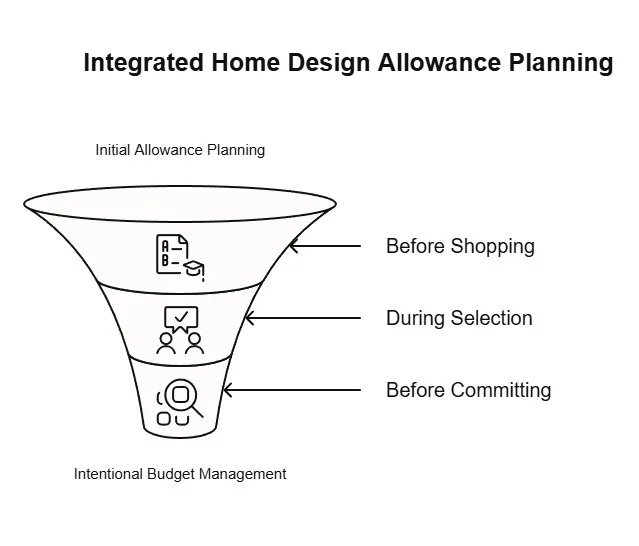
Before You Shop
Have you ranked your finish categories by priority with your household?
Do you know your non-negotiables versus your flexible areas?
Have you asked your builder how credits and overages are handled?
During Selection
Are you getting budget feedback before finalizing each major choice?
Do you understand how this selection affects other categories?
Is the builder tracking the whole-house impact in real time?
Before You Commit
Have you compared your selections against the full allowance picture?
Are planned overages intentional choices, not surprises?
Can you redirect savings from one area to strengthen another?
Bring Your Priorities to the Discovery Meeting
Building a custom home in the Texas Hill Country—whether in Spicewood, Lake Travis, Horseshoe Bay, or the surrounding area—means navigating real site challenges, real budgets, and real decisions. The homeowners who feel most in control are the ones who treat allowances as strategic tools, not isolated shopping trips.
Disciplined decisions create more freedom, not less.
A luxury result and a disciplined budget can coexist. The difference is process.
If you're planning your build, start by organizing your priorities and questions. Understand what matters most to your household. Then find a builder whose process gives you visibility, flexibility, and guidance—not just a number on a spreadsheet.
Explore how Riverbend's design-build process works before you finalize your selections. Review our work to see how other homeowners have brought their visions to life. Or bring your finish priorities and budget questions to a Discovery Meeting and see what integrated home design actually looks like.
If financing is part of your conversation, the CFPB's Loan Estimate explainer offers a solid general reference for comparing loan details. And if long-term design performance matters to you, the DOE's guidance on efficient home design reinforces why a whole-house approach creates better outcomes over time.
Our Editorial Process:
Our expert team uses AI tools to help organize and structure our initial drafts. Every piece is then extensively rewritten, fact-checked, and enriched with first-hand insights and experiences by expert humans on our Insights Team to ensure accuracy and clarity.
By the Riverbend Homes Insights Team
Riverbend Homes has designed and built custom homes in the Texas Hill Country since 1996. As a second-generation family-owned design-build firm, the team focuses on listening closely, staying involved through design and budget decisions, and helping homeowners create distinctive homes without losing control of the process.
Shopping Allowance Autonomy: How to Choose Luxury Finishes Without Losing Budget Control
Finish allowances give budget flexibility, but ask how credits and overages work before falling in love with countertops or tiles you can't afford.
📌 Key Takeaways
Shopping allowance autonomy lets you pick the finishes you actually want while staying on budget—if your builder explains the rules upfront.
Transparency Beats Big Numbers: A generous allowance means nothing if you can't shop outside your builder's preferred vendors or don't know how credits and overages work.
Freedom Needs Structure: You can source finishes anywhere, but only if your builder knows what's coming, when it arrives, and how it fits the construction schedule.
Splurge Where You Live: Kitchen counters, primary bath tile, and main-area flooring deserve your best dollars because you'll see and touch them every day.
Track Spending in Real Time: Small upgrades add up fast—log each selection against its allowance before you fall in love with the next one.
Ask the Right Questions Early: Find out if you can shop independently, how savings flow back to you, and when selections must be final to avoid delays.
Real finish autonomy means curating your home, not just approving a catalog.
Homeowners planning custom builds in the Texas Hill Country will learn how to protect both style and budget here, preparing them for the detailed finish-selection process that follows.
~ ~ ~ ~ ~ ~ ~ ~ ~ ~ ~ ~ ~ ~ ~ ~ ~ ~
The tile samples are spread across the kitchen island. Twelve squares of marble, porcelain, and natural stone catch the afternoon light. This is the moment you've been waiting for—the moment your custom home stops being a floor plan and starts becoming yours.
Then the question surfaces. How much does this actually cost? And what happens if I fall in love with the wrong one?
Finish selection is where custom homes become personal. It's also where budgets can spiral if the allowance process isn't clear. The good news: you don't have to choose between the finishes you love and the financial control you need. The key is understanding how shopping allowances work—and finding a builder who gives you real autonomy within a transparent framework.
Why Finish Selection Feels So Exciting and So Risky
The moment the dream home starts feeling personal
For most of the custom home journey, you're working with abstractions. Site plans, elevations, structural drawings. Important, yes. But not exactly the stuff that makes your heart race.
Finishes are different. When you start choosing countertops for the kitchen, tile for the primary bath, flooring that will stretch through every room you walk through daily—suddenly the home feels real. You're not building a house anymore. You're building your house.
This is the phase where clients in Spicewood, Lake Travis, and across the Texas Hill Country start imagining actual mornings in their new space. The light on the backsplash. The feel of the floor under bare feet. The hardware they'll touch a hundred times a day.
Why many homeowners worry about markups and limited choices
The excitement comes with an edge of anxiety. You've heard the stories. Friends who wanted a specific faucet but were told they had to choose from a narrow catalog. Neighbors who discovered their "luxury" tile allowance wouldn't cover anything they actually liked. Clients who found out—too late—that the builder's preferred vendor charged thirty percent more than what they could have found on their own.
These aren't irrational fears. Many high-end builders do restrict clients to specific showrooms, sometimes with significant markups baked into the pricing. The result is a frustrating disconnect: you're building a custom home, but the finishes feel anything but custom.
What a Shopping Allowance Actually Means in a Custom Home Build
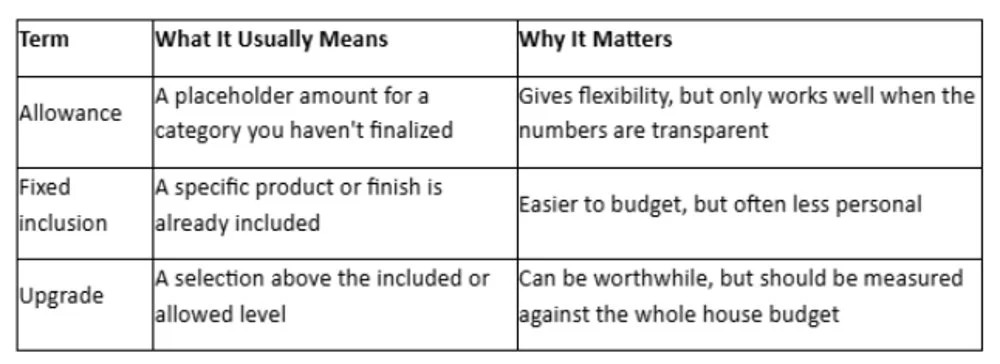
A shopping allowance is a budget placeholder for a category of finishes that hasn't been finalized yet. It's the dollar amount your builder has estimated for that category based on your overall project scope. Understanding this mechanism is the first step toward using it strategically.
Allowance vs. all-inclusive finish pricing
Some builders offer all-inclusive pricing, where finishes are pre-selected and bundled into the contract. You get less decision-making, but also less variability. Other builders use allowance-based pricing, which gives you a set dollar amount and the freedom to choose how to spend it.
Neither approach is inherently better. The question is whether the approach matches how involved you want to be—and whether the builder is transparent about how each model works.
What is usually covered and what is not
Allowances typically cover items that involve personal taste and visible design impact: kitchen and bath fixtures, lighting, flooring, tile, countertops, cabinet hardware, and sometimes appliances. They usually don't cover structural elements, framing, roofing, insulation, or mechanical systems. Those items are priced separately and aren't subject to the same selection process.
Understanding this distinction matters because it sets realistic expectations. Your allowance dollars are meant for the finishes that shape daily experience—not for the bones of the house.
Why transparency matters more than the allowance number alone
A generous allowance means little if you don't understand how it works. Can you shop beyond the builder's preferred vendors? What happens if you come in under budget—do you get a credit, or does the savings disappear? What happens if you exceed the allowance—how are overages handled, and when do you find out?
Builders who explain allowances clearly from the start are signaling something important: they want you to make informed decisions, not discover surprises at closing.
The Problem With Restrictive Showrooms and Builder-Grade Boxes

How limited choices can flatten the design vision
You didn't commission a custom home to end up with the same finishes as every other house in the neighborhood. But restrictive showroom policies can push you exactly there.
When builders limit selections to a single vendor or a narrow catalog, the options start blending together. The countertop choices look similar. The tile formats repeat. The lighting feels safe rather than inspired. The home that was supposed to feel uniquely yours starts feeling like a well-executed template.
Where markups and missed value often happen
Restrictive vendor relationships aren't always about quality control. Sometimes they're about margin. Preferred vendors may offer builders rebates or commissions, which can inflate the price you pay without adding value you receive.
This isn't universal—some vendor relationships genuinely benefit clients through volume pricing or streamlined coordination. But when you're not allowed to compare prices or source independently, it's worth asking why.
Why affluent buyers resent being boxed in
Budget-conscious doesn't mean unwilling to spend. It means unwilling to spend blindly. Affluent buyers building custom homes in places like Horseshoe Bay, Lake LBJ, or the broader Hill Country want to invest in quality. They simply want to know where their money is going—and they want the freedom to direct it toward finishes that actually matter to them.
Being told "you have to choose from this showroom" feels like a constraint that contradicts the entire premise of building custom. This is not just about price. It's about authorship. A custom home should not leave you feeling like a guest in your own selections.
How Shopping Allowance Autonomy Protects Both Style and Budget
Freedom to source the finish you actually want
Shopping allowance autonomy means you're not locked into a single source. If you find the perfect pendant lights at a design market in Austin, you can buy them. If a stone yard in Marble Falls has the exact slab you've been dreaming about, you can source it directly. If an online retailer offers the same faucet for significantly less, you're free to make that call.
This freedom transforms finish selection from a constrained checklist into an actual design process. You're curating your home, not just approving predetermined options.
One Spicewood client described the difference this way:
"He frequently found ways to save us money on our selections. Ben will give you a high end product and generous allowances for choices at a fair price. He will also allow you to shop around on your own for money saving deals, which others builders will not allow." — Chris S., Spicewood, TX
How savings can be reallocated across the house
When you find a better price on flooring, where does that savings go? With some builders, it vanishes into the project margin. With transparent builders, it flows back to you—either as a credit or as additional budget you can redirect elsewhere.
This reallocation creates a virtuous cycle. Savings on one category can fund an upgrade in another. The money you didn't spend on tile might cover the upgraded range hood you actually wanted. The lighting credit might stretch your countertop budget just enough to get the waterfall edge.
Why autonomy still needs builder coordination
Autonomy doesn't mean chaos. Sourcing your own finishes only works if your builder knows what's coming, when it's arriving, and how it integrates with the construction schedule.
The best approach is structured freedom: you have the latitude to shop, but you're doing it within a clear timeline and with ongoing communication. Your builder should know your selections early enough to coordinate installation, avoid delays, and flag any compatibility issues before they become problems.
This is why the design-build process matters. When the same team handles design and construction, they can provide real-time feedback on how your selections affect the schedule and budget—not surprises three months later. Riverbend's process, for example, pauses at bid-set completeness to estimate final construction costs before moving forward. That checkpoint keeps finish decisions tethered to reality.
For a closer look at how that budgeting structure works in practice, the article on continuous estimating explains the mechanics.
Where to Splurge and Where to Stay Practical
Not every finish deserves the same investment. Strategic prioritization lets you allocate allowance dollars where they'll have the greatest impact on your daily experience.
High-visibility finishes that shape daily experience
Some finishes you'll touch, see, or walk on every single day. These are the places where quality and personal taste matter most:
Kitchen countertops and backsplash. You'll prepare meals here, gather here, and notice these surfaces constantly. This is often the single most visible finish decision in the home. Organizations like the Natural Stone Institute offer guidance on selecting and caring for stone surfaces—useful context when evaluating material options.
Primary bathroom tile and fixtures. You start and end every day in this room. The shower tile, the faucet you adjust half-asleep, the vanity you lean against while brushing your teeth—these details register even when you're not consciously noticing them. The NKBA Kitchen & Bath Planning Guidelines provide authoritative standards for layout and fixture placement.
Flooring in main living areas. The floor connects every room. It's the backdrop for furniture, light, and daily movement. Quality flooring in high-traffic areas pays dividends for years.
Lighting in gathering spaces. Light shapes mood. The right fixtures in the kitchen, dining area, and living room elevate the entire atmosphere. For more on this, the article on luxury lighting choices explores how thoughtful lighting design transforms spaces.
Categories where performance matters more than prestige
Some finishes need to work well, but they don't need to carry the design. Utility rooms, closet interiors, and garage spaces rarely benefit from premium finishes. Durable and functional beats expensive and underappreciated.
Similarly, guest bathrooms see less daily use than primary suites. A clean, quality tile works beautifully here without requiring the same investment you'd make in the spaces you use constantly.
A framework for prioritizing
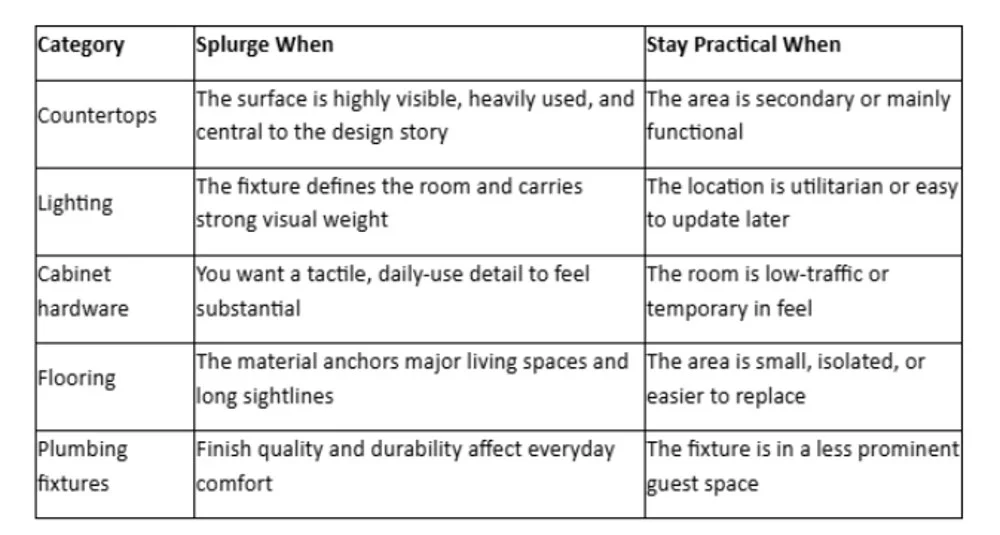
How to avoid overspending in low-impact areas
The risk isn't choosing bad finishes—it's allocating premium dollars to spaces that don't reward them. Before upgrading, ask: How often will I actually see or touch this? Will I notice the difference in six months?
If the answer is "rarely" or "probably not," that's a sign to stay practical and save the splurge for where it counts.
A Smarter Way to Shop Finishes Without Creating Budget Drift

Start with your non-negotiables
Before browsing showrooms or scrolling design sites, identify the three to five finish decisions that matter most to you. Maybe it's the kitchen countertop material, the primary bath tile, and the front door hardware. Maybe it's the wide-plank flooring you've wanted for years.
Starting with non-negotiables focuses your energy and your allowance dollars. Everything else becomes flexible—places where you can make practical choices without feeling like you compromised.
Track selections against allowances in real time
Budget drift happens when decisions accumulate without visibility. You upgrade the faucet, then the cabinet pulls, then the tile—and suddenly you're significantly over allowance without having made any single dramatic choice.
The antidote is real-time tracking. Know your allowance for each category. Log your selections as you make them. Compare running totals against limits before falling in love with the next upgrade.
This is where continuous estimating becomes essential. Builders who stay involved during the design phase can provide ongoing feedback, catching budget drift before it compounds.
Resolve upgrades before they ripple through the whole plan
An upgrade in one area often affects others. Heavier countertops may require reinforced cabinetry. Larger-format tile may need different substrate preparation. High-end fixtures may require specialized installation.
Resolving these ripple effects early prevents late-stage surprises. When your builder knows about upgrades before construction reaches that phase, they can adjust plans, pricing, and schedules accordingly.
This is also where a functional design plan matters. A finish doesn't live alone. It belongs to a room, a sightline, a material palette, and a budget sequence.
What to Ask Your Builder Before You Fall in Love With a Finish
The right questions reveal how much autonomy you'll actually have—and how transparent the process will be.
Can I shop beyond your preferred vendors?
This question cuts to the heart of allowance autonomy. If the answer is "no" or "only with restrictions," you'll want to understand why. Some builders have legitimate coordination reasons; others simply prefer the margin from exclusive vendor relationships. A builder who supports independent shopping is signaling confidence in their own value proposition.
How are credits, overages, and substitutions handled?
Understand the financial mechanics before you start selecting. If you come in under allowance, do you receive a credit? If you go over, when do you find out and how is the overage billed? If you want to substitute a different product after selections are finalized, what's the process and cost?
When do selections need to be finalized to avoid delays?
Timing matters more than most clients realize. Certain finishes have long lead times. Others need to be specified before framing is complete. Missing a selection deadline can delay the entire project. Ask for a selection timeline early so you can shop with purpose rather than scrambling at the last minute.
If one finish changes, what other parts of the plan might move with it?
Upgrades can create ripple effects. Understanding these connections upfront helps you make decisions with full awareness of their downstream impact.
Which categories are easiest to personalize without creating downstream complications?
Some finish categories offer more flexibility than others. Knowing where you have room to explore—and where constraints are tighter—helps you focus your creative energy productively.
Where do you recommend prioritizing budget for the strongest long-term impact?
A good builder has seen hundreds of finish decisions play out over time. Their perspective on where investment pays off most can be invaluable.
These questions do two jobs. They clarify the system, and they reveal whether the builder treats finish autonomy as a real planning tool or as a slogan. For more on evaluating builder transparency, the article on what design-build means provides useful context.
The Best Outcome: A Home That Feels Custom in Every Room
The emotional payoff of intentional finish choices
When you've chosen every finish with intention—weighing options, comparing sources, making real decisions—the completed home carries that investment. You don't just live in the house; you recognize your own judgment in every room.
The countertop isn't just a surface. It's the slab you chose after visiting three stone yards. The lighting isn't just illumination. It's the fixture you found at a design market and knew immediately was right.
This is what personalized luxury actually means: not the most expensive option, but the most intentional one. You're not trying to prove that every room is expensive. You're trying to make every room feel intentional.
Why the right builder makes autonomy feel safe
Freedom without structure creates anxiety. Shopping allowance autonomy works when it's paired with clear allowances, transparent tracking, and a builder who communicates throughout the process.
Another Hill Country client put it simply: "Thank you for your input when she struggled with uncertainty, yet allowing her to make choices on her own." That balance—guidance without control, support without restriction—is what makes finish selection feel empowering rather than overwhelming.
The journey from foundation to finishes involves hundreds of decisions. The finish phase should feel like the payoff for all that planning, not a new source of stress.
As you begin gathering inspiration for your custom home finishes, consider how your builder handles allowances, sourcing, and communication. The answers will shape not just your budget, but your entire experience of creating a home that feels unmistakably yours.
Explore how a design-build firm approaches finish selection—or learn more about what design-build means for homeowners who want both creative control and budget protection.
When your ideas are ready to be tested against real allowances and site realities, a Discovery Meeting is the natural next step.
Our Editorial Process
Our expert team uses AI tools to help organize and structure our initial drafts. Every piece is then extensively rewritten, fact-checked, and enriched with first-hand insights and experiences by expert humans on our Insights Team to ensure accuracy and clarity.
About the Riverbend Homes Insights Team
The Riverbend Homes Insights Team shares practical guidance for homeowners planning custom homes in Spicewood, Lake Travis, Lake LBJ, and the wider Texas Hill Country. Their work combines Riverbend Homes' design-build perspective, local site knowledge, and homeowner-first budgeting philosophy to help clients make confident decisions.
The First 48 Hours After Buying Your Lot: 5 Smart Steps Before Custom Home Design
New lot owners waste thousands designing homes their land can't support. Avoid this by walking your site and following 5 steps before any floor plans.
📌 Key Takeaways
The smartest move after buying your lot isn't designing your dream home—it's understanding what your land can actually support first.
Pause on Floor Plans: Buying designs before you know your lot's slope, utilities, and setbacks often leads to expensive dead ends when the land can't support your vision.
Walk the Site With Purpose: Identify buildable areas, drainage patterns, access points, and utility connections before any design work begins—these shape every decision that follows.
Meet Your Builder on the Land: A discovery meeting at the property connects your ideas to physical reality and surfaces budget-affecting surprises no office meeting can reveal.
Gather Your Priorities First: Bring inspiration photos, must-haves versus nice-to-haves, and honest budget numbers so designers can create plans grounded in what you actually need.
Expect Budget Checkpoints: Good design-build teams pause at key milestones to confirm costs before finalizing plans, protecting you from sticker shock later.
Let the land speak first—floor plans can wait.
New lot owners in the Texas Hill Country will avoid costly false starts by following these steps, preparing them for the detailed planning process that follows.
~ ~ ~ ~ ~ ~ ~ ~ ~ ~ ~ ~ ~ ~ ~ ~ ~ ~
The closing folder is sitting on your kitchen counter. The keys—or at least the survey stakes—are finally yours. After months of searching for the right piece of Texas Hill Country land, you did it.
Now comes the question that catches most new lot owners off guard: What do I actually do next?
The urge to keep momentum is real. You want to see progress. Maybe you've already saved dozens of inspiration photos or bookmarked floor plans that seem perfect. But here's the thing—the smartest move in the first 48 hours isn't about design at all. It's about understanding what your land can actually support before you fall in love with a home that doesn't fit.
In the Hill Country, dreams meet slope, drainage, access, utilities, and budget very quickly. The next five steps will protect your budget, save you from expensive false starts, and set your custom home design on solid ground from day one.
Step 1: Pause Before You Buy Floor Plans
This is the most common early mistake, and it's an expensive one.
Buying floor plans online feels like progress. The designs are beautiful. The prices seem reasonable. And scrolling through options scratches that itch to move forward. But a floor plan purchased in isolation—without knowing your lot's topography, access points, utility availability, or setback requirements—can become a very pretty dead end.
That dream layout might require a foundation your slope can't support. The garage placement might block the best view. The square footage might push past what your budget allows once you factor in the site work this particular piece of land requires.
The risk isn't the plan itself. It's designing backward. When design comes before site understanding, you end up forcing the land to fit the paper instead of letting the land shape a home that actually works.
Floor plans can come later. Right now, the land needs to speak first.
Step 2: Schedule a Site Feasibility Walk

Site feasibility answers a plain question: what will this land actually let you build, and what will it take to get there?
Walking the property with clear purpose means identifying the physical realities that will shape every decision that follows. In the Texas Hill Country, this matters more than in flat suburban subdivisions. Limestone shelves, drainage patterns, steep grades, and mature trees all influence where a home can sit, how foundations get built, and what infrastructure work the budget needs to absorb.
A proper site walk should consider:
Topography and slope — Where are the buildable areas? What requires retaining walls or stepped foundations?
Access and driveway routing — How do vehicles, construction equipment, and eventually you get in and out?
Utility availability — Is water, electric, and sewer or septic accessible, and from where?
Drainage patterns — Where does water flow during heavy Hill Country rains?
Views and orientation — Which direction captures the best light and scenery?
Setbacks and easements — What does the plat or HOA restrict?
For lots near Lake Travis or other Highland Lakes areas, septic permitting can affect both timeline and cost. The LCRA On-Site Sewage Facilities Program inspects and permits on-site sewage systems in parts of the Highland Lakes area, and the Texas Commission on Environmental Quality homeowner guidance helps you identify your permitting authority. Knowing this early prevents surprises later.
This walk doesn't need to answer every question. It needs to surface the questions worth answering before you spend money on design.
For broader lot due diligence, Five Key Factors for Selecting the Perfect Lot in Spicewood, TX is a useful next read.
Step 3: Meet a Design-Build Team on the Property
There's a reason experienced custom home builders want to meet you on the land, not in an office.
A Discovery Meeting held on your actual lot does something a conference room never can: it connects your vision to physical reality in real time. You can point to where you imagine the kitchen windows facing. The builder can show you where the grade drops or where utility access makes more sense. Together, you start seeing what's possible—not in theory, but on this specific piece of ground.
This is where a design-build approach earns its value. When design and construction expertise walk the site together from the beginning, you get immediate feedback on feasibility and budget implications. No waiting months for an architect's vision to collide with a builder's reality check.
The Discovery Meeting also protects your budget. Understanding infrastructure requirements—what the site actually needs before walls go up—prevents thousands of dollars in redesign fees down the road. One property walk can reveal that your lot needs specific foundation work, extended utility runs, or careful tree preservation that would have blindsided a floor-plan-first approach.
Riverbend Homes starts every project this way: on the property, understanding the owner's vision, assessing what the land allows, and surfacing the realities that affect both design and budget. As a second-generation family-owned business that has been designing and building homes in the Texas Hill Country since 1996, the company takes on a selective number of projects and stays involved daily—an approach that keeps site realities and budget alignment connected from the start.
Step 4: Gather the Right Inputs Before Design Starts

A productive first design conversation depends on what you bring to it.
You don't need a finished vision. You need the raw materials that help a design-build team understand how you want to live in this home. The more clearly you can articulate your priorities, the faster the design phase moves—and the fewer expensive changes happen mid-process.
Before your Discovery Meeting, gather:
Inspiration images — Photos from magazines, Pinterest boards, or homes you've visited that capture the feel you want. Even images of what you don't want help.
Must-haves versus nice-to-haves — A primary suite on the main floor might be non-negotiable. A wine cellar might be flexible. Know the difference.
How you'll use the space — Do you work from home? Host extended family? Need a separate casita for guests or aging parents?
Architectural style preferences — Hill Country modern, traditional Texas ranch, something else entirely?
Budget boundaries — Not a vague range, but the real number you're working with. Establishing strict financial parameters upfront keeps the design grounded in reality.
This preparation isn't busywork. Builders who listen well—and the good ones do—use these inputs to translate your priorities into designs that fit both your life and your land.
Step 5: Understand What Happens Next in Design & Budget
Knowing the road ahead reduces anxiety.
After the Discovery Meeting, a design-build process typically moves into what's often called the Design & Budget phase. This is where your inspiration images and must-haves become actual plans—and where cost reality meets creative ambition.
A well-run design-build process keeps the builder involved throughout design, not just at the end. That continuous involvement means you get real-time budget feedback as decisions are made, rather than sticker shock when final bids arrive. Riverbend stays involved through Design & Budget specifically to help keep the design aligned with budget before the project moves into the build phase.
Most design-build teams pause at what's called "bid-set level of completeness"—the point where plans are detailed enough to produce accurate cost estimates. You'll review that estimate before anyone finalizes drawings or pulls permits. This checkpoint exists specifically to protect you from the budget surprises that plague separated architect-then-builder approaches.
Once designs and budget align, permitting begins, financing finalizes, and construction has a clear start date. The process moves faster than you might expect when the foundation is solid.
For a broader regional planning view, Building Without Regret: The Complete Guide to Luxury Custom Homes in the Texas Hill Country expands on how site realities and budget alignment work together. And for general guidance when comparing professionals, the FTC's contractor hiring tips offer a helpful consumer resource.
New Lot Next Steps Checklist
Use this checklist to stay on track in the first 48 hours and beyond:
Do not buy floor plans yet — Design should follow site understanding, not the other way around
Schedule a site feasibility walk — Identify topography, access, utilities, drainage, and buildable areas
Review what the land may require before design gets serious
Book a Discovery Meeting on the property — Meet your design-build team where the home will actually stand
Gather inspiration photos and must-haves — Clarify how you want to live in this home
Write down budget boundaries before design starts — Honest numbers prevent painful surprises
Ask what site conditions may affect design and cost — Infrastructure requirements vary by lot
This list is simple to share with a spouse or partner. The best decisions happen when everyone sees the same path forward.
Start With the Land So the Design Can Be Real
You bought this lot because something about it felt right. Maybe it was the view, the privacy, the proximity to the water, or simply the sense that this is where your next chapter belongs.
That feeling is worth protecting.
True progress doesn't come from forcing a pre-packaged layout onto your new property. It comes from letting the site's unique physical realities dictate the blueprint from day one.
Start with the site. Meet your team on the property. Let the land shape the vision.
The floor plans can wait. The foundation for a great custom home starts with understanding what you're building on. In the first 48 hours, the best momentum is grounded momentum.
To keep learning, explore Hill Country building trends and tips.
Stay Informed: Hill Country Building Trends & Tips — For more guidance on navigating custom home design in the Texas Hill Country, explore additional resources on selecting the right lot and choosing a builder you can trust.
By Riverbend Homes Editorial Team.
Riverbend Homes Group, LLC. is a second-generation family-owned design-build contractor serving Spicewood and the surrounding Texas Hill Country. The company has been designing and building homes in the region since 1996.