


Designing for the View: How to Maximize Your Hill Country Landscape in Your Custom Home
📌 Key Takeaways
The horizon you love isn't just scenery—it's the reason you chose your Hill Country lot, and every design decision should protect and enhance that view.
Site Analysis Drives Floor Plans, Not Vice Versa: Map your property's sightlines and sun paths first, then adapt room placement to capture what the land offers rather than forcing a generic layout onto terrain that won't support it.
Window Orientation Reduces Glare and Cooling Loads: South-facing glass is easiest to shade with overhangs, while east and west exposures demand fins, extended projections, or strategic landscaping to intercept low-angle sun before it creates afternoon heat and glare.
Composition Matters as Much as Size: Mullion placement, sill heights aligned with seating, and proportions that mirror natural landscape rhythms transform a window wall from mere glass into a deliberate frame for the ridge line or valley beyond.
Passive Strategies Keep Views Comfortable Year-Round: Deep overhangs, cross-ventilation, spectrally selective low-E coatings, and shaded outdoor rooms allow you to enjoy panoramic glass without sacrificing comfort or driving up energy costs.
View Decisions Lock Early in the Build Sequence: Siting, finished floor elevations, and glazing specs must be confirmed before structural engineering and framing begin, making early coordination with architects and builders essential to avoid costly redesigns.
Plan with intention, and the view becomes a daily ritual rather than a missed opportunity.
Families planning custom Hill Country homes will find a strategic framework here, preparing them for the detailed design decisions that follow.
When you've chosen your Hill Country lot, you've already made one of the most important decisions—you've selected the horizon you'll wake up to every morning. But here's what separates a home with a view from a home designed for the view: strategic planning that positions every primary room, window wall, and outdoor space to capture what you love while managing the realities of Texas sun, heat, and privacy.
A Hill Country view-first custom home is a site-responsive design that positions primary rooms, window walls, and outdoor living to capture key sightlines while managing sun, heat, and privacy. Think of your lot like a natural amphitheater—the house is the stage, but the star is the horizon; every seat (room) gets a great sightline. Picture stepping into your great room at sunset, where the window wall frames the ridge line like a living painting—glare is tamed and comfort is effortless. This outcome begins with a view map and sun-path study, then translates into floor plan placement, rooflines, overhangs, and glazing specs that balance vistas, comfort, and efficiency.
A View-First Plan Begins with the Site (Not the Floor Plan)
Most people start with a floor plan they love and try to fit it onto their property. That approach often forces compromises that diminish the very views they purchased the land to enjoy. The smarter sequence reverses this: study the site first, identify your best sightlines and solar exposure, then adapt the floor plan to work with—not against—what the land offers.
Map Sightlines & Sun Paths to Choose Primary Room Placement
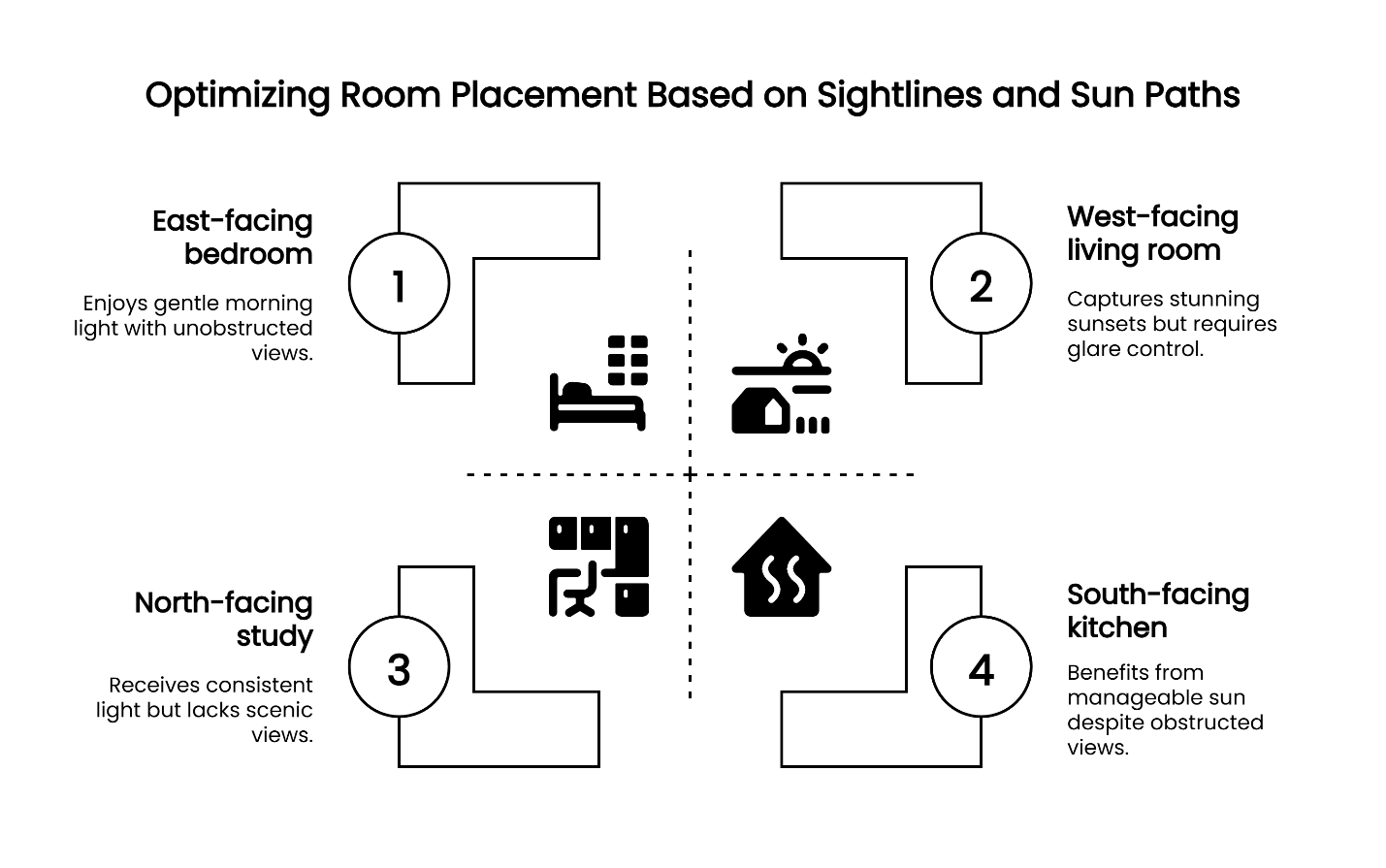
Walk your property at different times of day and mark where the most compelling views reveal themselves. Note which vantage points capture distant ridge lines, which overlook valleys or water features, and where tree canopies might frame—or obstruct—key sightlines. Sketch what the eye wants to see from each location, noting near, mid, and far focal elements: a live oak canopy, a limestone outcrop, a distant ridgeline.
Equally important is tracking the sun's path across your site throughout the day and across seasons. Overlay this solar pattern with your view corridors to understand where morning light enhances a vista and where afternoon sun might create glare. Window orientation reduces glare and cooling loads. South-facing glass receives consistent, manageable sun that's easier to shade with properly sized overhangs. West-facing windows, however, catch low-angle afternoon sun that creates intense glare and heat gain—exactly when your home is already warmest. East exposures bring gentle morning light but require thoughtful shading by mid-morning in summer months.
Once you understand these patterns, you can position your great room, primary bedroom, and other key spaces where views and comfort align naturally. Texas Hill Country custom home builders who prioritize this site-first approach often discover opportunities that generic plans would miss entirely.
Set Grade, Approach, and Entry Moments to "Reveal" the View
How you enter the home shapes the first impression and sets up the visual narrative. This is what designers call arrival sequencing—the deliberate choreography of how the landscape unfolds as you approach and enter. Rather than placing the front door where it offers an immediate, full view, consider creating a sequence that builds anticipation. An entry that opens to a transitional foyer or hallway, then releases into a great room with a dramatic window wall, makes the reveal more impactful.
Grade and topography work together here. If your lot slopes, you might enter at a mid-level and step down into main living spaces that open to the view, or enter from below and step up to capture elevated sightlines. Adjust finished floor elevation and driveway approach so the landscape unfolds rather than bursts at the threshold. The key is using the natural contour to enhance, rather than fight, the visual experience.
Respect HOA & Topography Constraints While Preserving Corridors
Siting along contour preserves view corridors and privacy. Many Hill Country neighborhoods have setback requirements, height restrictions, and architectural review standards that influence where and how you can build. Rather than viewing these as obstacles, treat them as parameters that help define your strategy.
Topography introduces its own constraints—steep slopes may limit where you can build cost-effectively, while mature trees worth preserving can narrow your options. The goal is to identify view corridors that remain viable after accounting for these factors, then position the home to maximize those unobstructed sightlines. Sometimes this means angling the house slightly off the lot lines or shifting the footprint to work around a cluster of protected oaks. Low, linked pavilions typically protect views better than a single bulky mass.
For guidance on turning these site realities into a buildable plan, explore how to translate your dream home vision into a functional design plan.
Orientation, Glare & Heat: Comfort Makes the View Livable
A window wall that's unbearable to sit near for half the day isn't truly capturing the view—it's wasting it. Comfort and visual access must work together, which means managing solar heat gain and glare through strategic orientation, shading, and glass selection.
Why Window Direction, Overhangs, and Glass Specs Control Glare
Direct sun creates two problems: excessive heat and glare that makes screens unreadable and seating uncomfortable. The solution isn't to avoid windows on certain exposures—it's to design the right combination of orientation, shading, and glazing performance for each exposure.
Overhang design enables passive comfort on east/west glazing. Deep overhangs work exceptionally well on south-facing glass because the sun's high summer angle allows the overhang to block direct rays while the lower winter sun penetrates for natural warmth. East and west windows require different strategies since the sun approaches from a lower angle at those times of day. Extended overhangs, vertical fins, or even strategic landscaping can intercept that low-angle light before it floods the interior. For detailed guidance on sizing and positioning these solar control devices, the National Institute of Building Sciences offers comprehensive fundamentals on shading strategies that apply directly to Hill Country conditions.
The U.S. Department of Energy provides detailed guidance on passive solar design principles, including overhang sizing calculations based on latitude and window orientation, which is particularly relevant for managing Texas Hill Country's intense summer sun.
Cross-Breezes, Overhangs, and Shade: Passive Comfort Wins
Mechanical cooling is essential in Texas, but passive strategies reduce how hard your HVAC system works. Positioning operable windows to capture prevailing breezes—typically from the southeast in this region—creates natural ventilation that makes indoor spaces more pleasant during moderate weather.
Combining these breezes with effective shading keeps indoor temperatures more stable. Overhangs, as mentioned, prevent direct sun from hitting glass. But don't overlook the impact of exterior shading—pergolas, covered porches, and even shade trees positioned on the west and southwest sides of the home can dramatically reduce afternoon heat gain. Shaded verandas and deep porches cool adjacent rooms while preserving the primary sightlines through strategic placement.
When to Use Low-E Coatings and Performance Glazing

Not all glass performs the same. Standard clear glass allows significant heat transfer, which works against you on exposures with intense sun. Low-emissivity (low-E) coatings reflect infrared heat while allowing visible light through, reducing cooling loads without darkening the view. Spectrally selective coatings represent an advanced variation that offers even finer control over which wavelengths pass through.
For west-facing window walls or any glazing that receives prolonged direct sun, specifying low-E glass with a low solar heat gain coefficient (SHGC) makes a measurable difference in comfort. The tradeoff is cost—performance glazing adds to the budget—but it's often the difference between a window wall you avoid during afternoons and one you can enjoy all day. For a comprehensive overview of how different coatings and glass types perform, the U.S. Department of Energy's guide to energy-efficient windows explains the technical specifications in practical terms.
Compose the Window Wall: Frame a Living Landscape
Once orientation and shading are resolved, the next decision is how to compose the window itself. The goal isn't just to maximize glass area—it's to create a frame that directs the eye to what matters most while maintaining proportions that feel intentional rather than haphazard.
Mullion Strategy & Proportions for "Picture-Frame" Vistas
Large expanses of uninterrupted glass create the most dramatic views, but they also introduce structural and cost considerations. Mullions—the vertical and horizontal members that divide window units—are often necessary for span and structural support, but their placement affects how you perceive the view.
Horizontal mullions at seated eye height (roughly 42–48 inches from the floor) can interrupt sightlines when you're sitting. If your budget allows, minimizing or eliminating mullions at this height keeps the view clean. When mullions are necessary, spacing them to align with natural break points in the landscape—such as the horizon line or the transition between foreground and distant hills—makes them feel less intrusive. Favor fewer, larger panes where feasible, and align verticals with existing visual rhythms like tree trunks or porch posts so the structure feels deliberate rather than arbitrary.
Consider how modern versus traditional architectural styles influence window proportions and mullion strategies, especially for lakefront or hillside properties where framing the view is central to the design.
Sill Heights & Seating Alignments That Cue the Eye
Sill height—the distance from the floor to the bottom of the window—determines what you see from various positions. Standard residential windows often have sills at 36 inches or higher, which works fine for standing views but cuts off the landscape when seated.
Lowering the sill to 18–24 inches allows you to enjoy the full view from a sofa or dining chair. For spaces where you'll spend significant time seated—living rooms, breakfast nooks, primary bedrooms—this adjustment makes a tangible difference in how you experience the space. In lakeside custom homes, consider a reading ledge or built-in seating at the glass line to make the panorama feel inhabitable, not just observed. Just ensure the lower sill height doesn't compromise privacy or create safety concerns if the window is near a drop-off.
Align furniture placement with these sightlines. Position seating to face the primary view rather than forcing people to twist or crane their necks. When the architecture and furniture work together, the view becomes a natural focal point rather than something you have to work to appreciate.
Privacy & Neighbors: Angle Solutions That Keep the View
Hill Country lots vary in size and proximity to neighbors. Even on larger parcels, you may have sightlines that capture both your desired vista and a neighbor's home or patio. Rather than sacrificing the view or adding heavy window treatments, consider angling the window wall slightly away from the intrusive sightline.
A subtle shift—rotating the wall just 10 to 15 degrees—can redirect the primary view toward open landscape while maintaining privacy. Strategic landscaping, such as a row of native grasses or a cluster of evergreen shrubs, can also screen specific problem areas without obstructing the broader vista. The goal is selective filtering: keep what you want, obscure what you don't, and maintain a sense of openness.
Outdoor Living That Extends the View (Without Heat Penalty)
Your view doesn't stop at the glass. Thoughtfully designed outdoor spaces extend sightlines and create additional vantage points for experiencing the landscape. The challenge is doing this without creating spaces that are too hot, too exposed, or too uncomfortable to actually use.
Position Porches, Pool, and Dining for Shade + Sightline
Covered porches and patios should be positioned to capture the view while providing relief from direct sun. A porch on the west side of the home, for example, needs substantial depth or a secondary structure like a pergola to create usable shade during late afternoon hours.
Pools and outdoor dining areas benefit from being oriented to face the best vistas, but they also need consideration for sun exposure and prevailing winds. A pool deck that's fully exposed to afternoon sun will be uncomfortable for lounging. Positioning the pool perpendicular to the horizon allows the water to reflect the sky without creating glare toward interior spaces—a subtle orientation choice that enhances both the view from inside and the experience of being in the pool. Outdoor dining terraces work best in partial shade with just enough openness to keep the panorama intact.
For detailed strategies on creating seamless indoor-outdoor transitions that enhance rather than compromise comfort, review integrating outdoor living spaces in custom homes.
Guardrail Heights, Railing Types, and View Preservation
If your lot has elevation changes, code-required guardrails become part of the view composition. Standard guardrails at 42 inches can obstruct sightlines when you're seated on a deck or patio. Where possible, use cable railings, tempered glass panels, or slim vertical bars that maintain safety while minimizing visual interruption.
The goal is to meet structural and safety requirements without creating a visual barrier that defeats the purpose of the elevated deck. When designed thoughtfully, railings become a subtle frame rather than an obstruction.
Night Lighting for Depth & Safety Without Glare
Exterior lighting serves two purposes: safety and ambiance. Path lights, step lights, and low-level accent lighting make outdoor spaces functional after dark. But poorly positioned lights create glare that reflects off windows and obscures the view you've worked so hard to capture.
Use shielded, downward-facing fixtures that illuminate walking surfaces without creating bright spots that compete with the landscape. Accent lighting on key landscape features—a specimen tree, a stone outcropping—adds depth and draws the eye beyond the immediate foreground. This layered approach prevents windows from becoming mirrors at night, maintaining visual connection to the landscape even after sunset. The result is a layered nighttime view that feels intentional rather than washed out by floodlights.
For guidance on layering interior and exterior lighting to enhance rather than compete with views, see luxury home lighting design tips and trends.
Budget & Build Factors: What Affects Cost and Timing
View-forward design introduces specific cost and schedule considerations. Understanding these early helps you make informed tradeoffs and avoid surprises during construction.
Structural Spans, Soils & Hillside Loads That Shape Feasibility
Large window walls require structural support that can span wider openings without intermediate posts or columns. Steel beams, engineered lumber, or reinforced concrete lintels add cost but are often necessary to achieve uninterrupted views. The wider the span, the more substantial—and expensive—the structural solution becomes.
Hillside lots introduce additional complexity. Soils on slopes may require deeper foundations, retaining walls, or specialized drainage systems to manage water runoff and prevent erosion. These factors don't eliminate view-first design, but they do influence the budget and the engineering required to make it feasible. "Riverbend listened and brought our vision to life—beyond what we imagined," notes Christine G. in her Google review, highlighting the importance of working with builders experienced in navigating these site-specific challenges.
Permits/HOAs That Influence Placement & Glass Area
Local building codes regulate setbacks, height limits, and structural requirements. Homeowners' associations often add architectural review standards that govern materials, colors, roof pitch, and overall aesthetic. Some HOAs limit glass area as a percentage of total wall area or restrict specific window styles.
Understanding these requirements upfront prevents costly redesigns after you've committed to a concept. The permit and approval process takes time—sometimes several weeks or months depending on jurisdiction and HOA responsiveness—so factor this into your schedule.
Sequencing: When View Decisions Must Be Locked to Stay on Schedule
Certain decisions must be finalized early to keep the build moving smoothly. Siting and orientation need to be confirmed before foundation work begins, as these establish the finished floor elevations and view corridors that drive all subsequent choices. Window and door specifications, including sizes, glass performance, and framing details, should be locked before framing starts since last-minute changes create delays and add cost. Exterior shading devices—overhangs, trellises, pergolas—need early coordination with roof and façade packages to avoid redesigns.
Understanding the critical milestones where view-related decisions become locked helps you prioritize what to finalize first. For a comprehensive breakdown of how these decisions fit into the overall building timeline, review key milestones in your custom home journey.
Conclusion: Turn Your Favorite Horizon Into a Daily Ritual
You didn't choose the Hill Country for its convenience or its mild climate—you chose it for what you see from your property. A view-first design ensures that what drew you to the land remains the centerpiece of your daily experience, not something you appreciate only in passing.
This approach requires planning, tradeoffs, and attention to details that generic floor plans ignore. But when you step into your completed home and the window wall frames exactly what you envisioned, when you can sit comfortably on a summer afternoon without squinting or overheating, when your outdoor spaces extend rather than interrupt the sightline—that's when the investment in thoughtful design proves its worth.
The horizon you loved on your first site visit becomes the backdrop to your morning coffee, your evening conversations, and the countless small moments that define home. That transformation from a piece of land to a carefully framed daily ritual is what site-responsive design delivers.
Resources
Integrating Outdoor Living Spaces in Custom Homes — extending view lines outdoors
Modern vs. Traditional: Choosing the Right Architectural Style for Your Lakefront Home — massing and façade choices that affect view framing
Luxury Home Lighting: Design Tips and Trends — nighttime layering to preserve sightlines without glare
From Foundation to Finishes: Key Milestones in Your Custom Home Journey — when view decisions lock in the schedule
How to Translate Your Dream Home Vision into a Functional Design Plan — turning "must-see" views into plan constraints
Our Editorial Process
Our expert team uses AI tools to help organize and structure our initial drafts. Every piece is then extensively rewritten, fact-checked, and enriched with first-hand insights and experiences by expert humans on our Insights Team to ensure accuracy and clarity.

Five Key Factors for Selecting the Perfect Lot in Spicewood, TX
📌 Key Takeaways:
Choosing land in Spicewood means evaluating what you can't see in listing photos—the infrastructure realities that determine both what you can build and what it will cost.
Slope Dictates Spending: Steep grades, rock layers, and long driveways translate directly into grading costs, retaining walls, and foundation complexity before construction even begins.
Utilities Aren't Guaranteed: Well depth, septic feasibility, and electrical service distance vary dramatically from lot to lot, turning seemingly similar parcels into vastly different budget scenarios.
The Build Envelope Shrinks Fast: Setbacks, easements, HOA rules, and multi-county regulations can reduce your usable space significantly, making that one-acre lot feel much smaller once you account for what you actually can't touch.
Environmental Factors Shape Livability: Floodplains, wildfire zones, sun exposure, and prevailing winds aren't just safety concerns—they determine whether your outdoor spaces will actually be comfortable to use year-round.
A Pre-Purchase Assessment Prevents Regret: Walking the property with an experienced builder before you buy reveals the constraints and cost drivers that photos and plat maps don't show, giving you the power to negotiate, adjust your plan, or keep shopping.
Prepared means confident—and confident buyers avoid the expensive surprises that derail timelines and budgets.
Families and couples relocating to the Texas Hill Country for Lake Travis access and a quieter lifestyle will find a practical evaluation framework here, preparing them for the detailed Spicewood-specific guidance that follows.
You've found a property listing that looks promising. The photos show rolling hills, maybe a glimpse of Lake Travis in the distance. The price feels right. But here's what most people don't realize until it's too late: the lot you choose will determine not just what you can build, but how much it will cost and how long it will take.
In Spicewood, where properties can span multiple counties and terrain varies dramatically from one parcel to the next, understanding the difference between a buildable lot and a budget-friendly lot becomes critical. Before you sign that purchase agreement, you need to evaluate five factors that will either support your vision or force you to compromise on features you assumed were non-negotiable.
At Riverbend Homes, we've been building custom homes in the Texas Hill Country since 1996. Our Discovery Meeting process starts with walking your property—ideally before you buy—to assess these exact factors. This early evaluation helps align your budget with reality and prevents the kind of costly surprises that can derail a project before it even begins.
Factor 1: Topography, Access & Buildability

The shape and slope of your land will influence nearly every aspect of your build. A lot that looks flat in photos might actually have a 15% grade, which means significant cut-and-fill work, retaining walls, and a more complex foundation design.
Slope and Grading Challenges
Spicewood lots often feature natural elevation changes that create those stunning Hill Country views. However, steep slopes require careful planning. If your driveway needs to climb more than 10-12%, you'll need switchbacks or additional grading. A long driveway—especially one that winds through rock—represents a significant infrastructure investment. Depending on the driveway's length, the severity of the grade, soil conditions, and your choice of surface material, costs can vary widely. For driveways extending several hundred feet through challenging terrain, expenses can range from moderate to substantial before you've even broken ground on the house itself.
The amount of cut and fill required to create a level building pad directly impacts your foundation budget. Excessive cutting can expose bedrock, requiring specialized equipment and additional time. Fill operations need proper compaction and engineering to ensure stability. Both scenarios cost more than building on naturally level terrain.
Rock Outcrops and Soil Conditions
The Hill Country is known for its limestone bedrock. Some lots have shallow soil over solid rock, which affects everything from septic system placement to landscaping potential. If you're planning a pool, you need to know how deep the rock layer sits. When extensive rock excavation or blasting becomes necessary for a pool installation, costs can start at several thousand dollars and increase significantly depending on the amount and hardness of the rock encountered. The "rock factor" is one reason why getting a site assessment before committing to a purchase is so valuable.
Rock also influences your foundation options. A slab-on-grade foundation is straightforward on stable soil, but if you're building on a slope with exposed rock, you might need a pier-and-beam system or extensive site work to create a stable pad.
Driveway and Garage Placement
The entry point to your property determines where your driveway can realistically go, which in turn affects garage placement and the home's orientation. A long, winding driveway might be scenic, but it also means more concrete or gravel, more grading, and potentially more drainage infrastructure.
Garage placement matters more than most people realize. If the natural entry point forces your garage to face the afternoon sun, you'll have a hot garage. If the only feasible driveway leads to the side of the lot where you wanted your main view, you're already making compromises.
Tree Preservation Opportunities
Mature trees add character and shade, but they also create constraints. Protected oak trees require specific clearances during construction. A beautiful grove in the center of your planned building envelope might force you to reconfigure the entire floor plan.
During a Discovery Meeting, we walk the property to identify these constraints early. We look at where the natural building envelope exists based on topography, access, and tree locations. This assessment helps us understand what's feasible and what might require significant workarounds that affect your budget. As one client put it, our craftsmanship and quality is "head and shoulders above the rest."
Texas Hill Country custom home builders know that successful projects start with honest site evaluation, not wishful thinking about what might be possible.
Factor 2: Utilities & Infrastructure (Water, Septic, Power, Internet)

Infrastructure planning is where good intentions meet hard reality. Unlike urban subdivisions with utilities at the street, most Spicewood lots require individual systems for water and wastewater. Getting power to your build site and ensuring reliable internet adds another layer of complexity.
Water Supply: Well or Rainwater Collection
Many Spicewood properties rely on private wells. Well depth varies significantly across the Hill Country—you might hit water at 300 feet or need to drill 600 feet or more, depending on your specific location and the geological characteristics of your parcel. Deeper wells mean higher drilling costs and more expensive pumps. Before purchasing, consider requesting well logs from neighboring properties to estimate likely depth, though these provide guidance rather than guarantees for your specific site.
Rainwater collection is another option, particularly for lots where well yields are uncertain. A properly designed rainwater system with adequate storage can serve a household's needs, but it requires careful planning for roof size, gutter systems, and storage tank capacity. You'll also need a backup plan for extended dry periods.
Septic System Feasibility
Your septic system depends entirely on soil conditions. The county will require a percolation test to verify that the soil can absorb wastewater at an adequate rate. Some lots have shallow soil over bedrock, making conventional septic systems impossible. In those cases, you might need an aerobic system, which costs more upfront and requires ongoing maintenance.
Setback requirements are equally important. Your septic field must be a minimum distance from the house, property lines, wells, and any water features. On a smaller lot or one with challenging topography, finding adequate space for both the house and a compliant septic field can be difficult. Travis County's On-Site Sewage Facilities page provides detailed information about local permitting requirements and can help you understand what to expect during the approval process.
Electrical Service and Transformer Placement
Getting power to a rural lot often means working with Pedernales Electric Cooperative or a similar provider. The distance from the nearest transformer to your building site determines the cost of running electrical service. The farther you are from existing infrastructure, the more significant the expense becomes. In cases where service must be extended over considerable distances—particularly when running lines underground through rocky terrain—connection costs can become a major budget item. Contact the utility provider early with your specific property information to get an accurate estimate rather than being surprised later.
Transformer placement also affects your site plan. Utilities typically need easement access, which might cut through your planned yard or driveway. Understanding these constraints before you design your home prevents expensive relocations later.
Internet Connectivity
Reliable internet has become non-negotiable for most families, especially those working remotely. Spicewood has varying levels of coverage. Some areas have fiber access, others rely on fixed wireless providers, and some locations might only support satellite internet.
Before purchasing, verify what's actually available at the property, not just what providers list as serving the general area. A lot that requires satellite internet might not meet your needs if you're running a business from home or have kids who need reliable connectivity for school.
Getting these infrastructure elements aligned early—during our Discovery Meeting process—means we can budget accurately from the start. We've seen too many projects stall because buyers assumed utilities would be straightforward, only to discover rock layers preventing septic installation or electric service requiring significant line extensions.
Factor 3: Regulations, HOA & the Build Envelope
Every lot comes with constraints, even if it looks wide open. Understanding setbacks, easements, HOA restrictions, and county regulations before you buy will save you from discovering that your dream floor plan doesn't fit the allowable building envelope.
Setbacks and Easements
Setbacks are the required distances between your home and the property lines. Front, side, and rear setbacks vary by county and can be 25 feet or more in some cases. These rules shrink your usable space, especially on smaller lots.
Easements create additional restrictions. Utility easements give providers access to maintain power lines or water infrastructure. Drainage easements preserve natural water flow paths across your property. You can't build structures in easement areas, and sometimes you can't even landscape them significantly.
On paper, a one-acre lot sounds spacious. After accounting for setbacks, easements, septic field placement, and driveway access, your actual building envelope might be much smaller than expected.
Multi-County Nuances Around Spicewood
Spicewood sits at the intersection of Travis, Burnet, and Blanco counties. Which county your lot falls under determines which building codes, permit processes, and septic regulations apply. Some counties require engineered plans for septic systems; others have less stringent requirements but longer approval timelines.
If you're comparing two similar lots in different counties, the regulatory environment might influence which one offers a smoother path to breaking ground. Local knowledge matters here—our team has been navigating these jurisdictional differences for decades.
HOA Restrictions in Gated Communities
Some Spicewood properties sit within gated communities that have architectural review boards. These HOAs might dictate minimum square footage, exterior materials, roof pitch, or even color palettes. Some restrict metal roofs, require stone or brick on a certain percentage of the exterior, or mandate specific landscaping approaches.
If you have a strong vision for a modern home with clean lines and standing-seam metal, make sure the HOA allows it before you fall in love with the lot. Reviewing HOA documents before purchase prevents heartbreak later when you discover your preferred design won't be approved.
Impervious Cover and Height Limits
Many Hill Country lots have impervious cover limits—maximum percentages of the property that can be covered by structures, driveways, patios, and other non-permeable surfaces. This limit affects how large your home can be and how much outdoor hardscaping you can include. A pool with surrounding decking counts toward this limit.
Height restrictions are common near lakes or in areas trying to preserve viewsheds. If your design includes a second story, verify that it complies with local height ordinances.
Working with design and build contractors who understand these regulatory layers means we can design within the constraints from day one, rather than redesigning after you've fallen in love with a plan that won't be approved.
Factor 4: Environmental Realities & Risk
Beyond regulations, natural environmental factors will shape your daily experience in the home. Understanding flood risk, wildfire exposure, sun patterns, and prevailing winds helps you orient the house to maximize comfort and minimize long-term concerns.
Floodplain and Water Flow
Even properties that don't look like they're near water can have floodplain designations or drainage issues. FEMA's Flood Map Service Center lets you check flood zones for your specific lot, especially important if it's near Bee Creek or other waterways that feed Lake Travis. Building in a floodplain requires flood insurance and might limit your foundation options.
Beyond official floodplains, observe natural drainage patterns. Where does water flow during heavy rain? Low-lying areas might collect water, making them poor locations for septic fields or crawl spaces. During your site visit, look for erosion patterns or vegetation that suggests seasonal water accumulation.
Wildfire Risk and Defensible Space
The Hill Country's beauty comes with wildfire risk, particularly in areas with dense cedar and oak. Properties in the Wildland-Urban Interface (WUI) benefit from defensible space planning—creating zones around the home with reduced fuel loads and fire-resistant landscaping.
This doesn't mean clearing every tree. It means strategic thinning, removing dead brush, and choosing fire-resistant materials for the home's exterior. Metal roofs, fiber cement siding, and tempered glass windows all improve your home's resilience.
Oak Wilt Management
Oak wilt is a fungal disease that kills oak trees and spreads through root grafts between nearby trees. Spicewood's abundant live oaks are susceptible. If you're planning construction during February through June—the highest-risk period for oak wilt transmission—you'll need to follow specific guidelines for pruning or removing oaks.
Preserving mature oaks adds value and character, but it requires planning around their root zones and avoiding compaction from heavy equipment.
Sun Path, Prevailing Winds, and Privacy
The home's orientation affects energy efficiency and livability. In the Hill Country, summer sun from the west can make rooms unbearably hot in the afternoon. Strategic placement of windows, covered patios, and shade trees makes a significant difference.
Prevailing winds typically come from the south and southeast. Positioning outdoor living spaces to catch these breezes improves comfort during the long Texas summers. If you're planning a pool, consider how sun exposure will affect water temperature and algae growth.
Privacy is another consideration, especially in areas where lot sizes are shrinking. If the neighboring lot is undeveloped, imagine where a future home might be built. Will it overlook your backyard or pool area? Strategic placement of your home on the lot—and planning for future privacy landscaping—addresses this before it becomes a problem.
These factors directly tie into creating the kind of indoor-outdoor living spaces that make Hill Country homes so appealing. Getting the site orientation right from the start means your outdoor spaces will actually be enjoyable to use year-round.
Factor 5: Lifestyle, Views & Neighborhood Fit
The practical factors we've covered determine buildability and cost. This final factor addresses why you're choosing Spicewood in the first place—the lifestyle, scenery, and community you want to be part of.
Framing Lake Travis and Hill Country Views
View lots command premium prices for good reason. A well-placed home can frame Lake Travis, capture Hill Country sunsets, or look out over rolling terrain dotted with oaks. But views require careful planning.
The best view might be from the back corner of the lot, which means orienting your main living spaces to face that direction. If the natural building envelope is in the center of the property, you might need a second-story to capture the view—which brings us back to height restrictions and budget implications.
Consider how the view will change with seasons. That neighbor's deciduous trees might block your lakefront view six months of the year. Future development on adjacent lots could obstruct sightlines you're counting on.
Noise, Traffic, and Future Development
Spicewood offers a quieter pace than Austin, but proximity to Highway 71 or busier local roads affects your sense of seclusion. Visit the property at different times of day to understand traffic patterns and noise levels.
Look at surrounding lots. Are they developed or vacant? If they're vacant, what's the likelihood they'll be built on soon? A currently private lot might feel very different once neighbors move in. Understanding the development trajectory of the area helps set realistic expectations.
Proximity to Spicewood's Lifestyle Amenities
Part of Spicewood's appeal is the balance between seclusion and accessibility. The area offers wineries, breweries, Krause Springs, Pedernales Falls State Park, and quick lake access. But not all Spicewood lots offer equal convenience to these amenities.
If visiting wineries or launching a boat on weekends is part of your vision, consider drive times to your priority spots. A lot that's 20 minutes from the lake might not support the lakefront lifestyle you're imagining, even if it's technically in Spicewood.
For families, school district boundaries and commute times to Austin matter. Lake Travis ISD serves much of the area and has a strong reputation, but verify which schools your specific lot feeds into. If someone in the household will commute to Austin daily, test the drive during rush hour—not just on a quiet Saturday.
Think of this like choosing the foundation for your story. The plot you select determines what chapters you can write later. A lot with challenging topography might mean you can't have both a pool and a guest casita. A lot without adequate view corridors might mean sacrificing those Hill Country sunsets you envisioned from your primary suite. Understanding these trade-offs before purchase—rather than after you're under contract—keeps your project aligned with your true priorities.
What a Riverbend Discovery Meeting Covers (On Your Property)
The Discovery Meeting is where vision meets reality. We meet you at the property to understand what you're trying to build and to evaluate whether the lot will support it within your budget.
Vision Intake: Your Must-Haves and Design Preferences
We start by listening. What are the non-negotiables for your home? How do you plan to use the space? Do you need a home office, a workshop, space for multi-generational living? Are you drawn to modern Hill Country design, traditional ranch style, or something in between?
Understanding your lifestyle goals shapes everything else. If you're building a retirement home where you'll host grandchildren every weekend, that requires different spaces than a primary residence for a couple working remotely.
The Lot Walk: Identifying Constraints and Opportunities
With your vision in mind, we walk the property together. We're looking at topography, noting where rock outcrops or drainage patterns might complicate construction. We're identifying the most logical building envelope based on access, setbacks, and views.
We discuss tree locations and which ones you want to preserve. We talk about where the driveway will need to enter, which direction the home should face, and how to position outdoor living areas to maximize comfort and privacy.
This isn't a formal survey—that comes later—but it's an experienced assessment of what's feasible. We've built enough custom homes in Spicewood to recognize the patterns that lead to smooth projects versus ones that encounter constant obstacles.
Early Budget Drivers and Trade-Offs
Based on what we observe, we can flag the big-ticket infrastructure items. If we see that the transformer is a significant distance from the ideal building site, that's a known cost factor. If the lot requires significant retaining walls or a septic system in challenging soil, those realities will affect your budget.
This conversation is about trade-offs. If the budget is fixed and the lot has expensive infrastructure needs, we might need to adjust square footage or finishes. If the design is non-negotiable, we'll need to ensure the budget accommodates the site's realities.
Confidence to Proceed (Or Keep Shopping)
The Discovery Meeting gives you the information needed to make a confident decision. Sometimes we'll identify dealbreakers—a lot where septic simply won't work, or where infrastructure costs consume too much of the budget. In those cases, we've saved you from a costly mistake.
Other times, we'll confirm that the lot is a great fit and that your vision is achievable within the parameters you've set. Either way, you're making an informed choice rather than hoping everything will work out.
Our selective project load means we're on-site daily managing every build, which translates to faster timelines than many luxury home builders near me can offer. But it also means we're honest upfront about what's realistic. We don't take on projects where the lot fundamentally doesn't support what the client wants to build.
"He will keep you on budget and on time with no surprises. He will also allow you to shop around on your own for money saving deals, which other builders will not allow. We are delighted more than words can describe with our new custom home!"
— Chris S., Spicewood, TX (Google Reviews)
Resources
Before moving forward with your lot purchase, consider these additional resources that can help you understand the broader custom home process:
Next Steps
If you haven't purchased land yet, start by reviewing our available homes and homesites. We occasionally have spec projects underway or lots we can recommend that we know will support efficient builds.
If you have a property under contract or are evaluating specific parcels, contact us before you finalize the purchase. A Discovery Meeting now can prevent expensive surprises later and ensure the lot you choose will actually deliver the home you're envisioning.
The right lot in Spicewood, TX sets the stage for everything that follows. Choose smart now, build faster later, and end up with a home that fits both your vision and your budget.
Let's Talk
(512) 468-0240
ben@riverbend-homes.com
Riverbend Homes
21413 Vista Estates Drive
Spicewood, TX 78669
Frequently Asked Questions
Is Spicewood a good fit for families or retirees?
Both. Spicewood attracts families looking for Lake Travis ISD schools, outdoor recreation, and a quieter pace than Austin. It's equally popular with retirees who want Hill Country scenery, access to wineries and the lake, and a strong sense of community. The area supports multiple lifestyles depending on which part of Spicewood you choose.
How early should I involve a builder while shopping for lots?
Before you buy. A Discovery Meeting on a property you're considering can identify constraints or opportunities that affect both your design and your budget. Many buyers assume every lot is equally buildable, but infrastructure costs and site challenges vary dramatically. Involving us early prevents purchasing a lot that won't support your vision—or that will cost far more to develop than you anticipated.
Do you build outside Spicewood?
Yes. We serve the broader Hill Country, including Lake Travis, Horseshoe Bay, Bee Cave, Marble Falls, and surrounding areas. Our focus is on clients who value the Hill Country lifestyle and want a builder with deep local knowledge.
How long will my project take?
Our selective workload and daily on-site management approach typically results in faster builds than many clients expect. Timelines depend on design complexity, permitting requirements, and site conditions, but our commitment to managing a limited number of projects at once means your build gets the attention it needs to move efficiently. We discuss realistic schedules during the Discovery Meeting once we understand your specific project.
Can Riverbend help with design and budget?
Yes. We work closely with architects and designers throughout the process. Our involvement during the design phase ensures that plans stay aligned with your budget. We pause at the bid-set stage—when plans are complete enough to cost accurately—to provide a detailed budget before finalizing construction drawings. This checkpoint prevents the common scenario where clients fall in love with a design they can't afford to build.
Our Editorial Process
Our expert team uses AI tools to help organize and structure our initial drafts. Every piece is then extensively rewritten, fact-checked, and enriched with first-hand insights and experiences by expert humans on our Insights Team to ensure accuracy and clarity.

From Foundation to Finishes: Key Milestones in Your Custom Home Journey
📌 Key Takeaways
Building a custom home becomes predictable and stress-free when you understand the milestone checkpoints that protect your timeline and budget.
Milestones Are Quality Gates, Not Just Progress Reports: Each checkpoint confirms work meets standards before the next phase begins, preventing costly corrections after walls are closed or systems are installed.
Early Decisions Lock In Success: Appliance specifications must be approved before framing starts, plumbing fixtures before tile layouts are set, and lighting plans before insulation—missing these windows creates expensive change orders.
Transparency Replaces Anxiety: A structured process with regular photo updates and clear next-step triggers transforms uncertainty into anticipation, especially for remote buyers monitoring progress.
Pre-Construction Planning Prevents Construction Problems: Converting vision into buildable plans with locked budgets and secured permits eliminates the surprises that derail schedules and inflate costs.
Quality Control Happens at Checkpoints, Not at the End: Issues caught at the right milestone are straightforward fixes; problems discovered after subsequent work begins require extensive corrections that impact both schedule and budget.
Structured milestones transform custom building from a stressful unknown into a guided journey with predictable outcomes.
A milestone is a planned checkpoint that confirms quality, budget, and readiness to advance to the next phase. Think of your build as a guided expedition with set basecamps that make the journey safe and predictable. Imagine staying excited and creatively involved—without stress—because you always know what just finished, what's next, and who owns it. Choose a custom home builder known for a transparent, milestone-driven process; it's what keeps quality high and surprises low.
What Counts as a "Milestone" in a Custom Build?
Milestones are pre-defined approvals or completions that unlock the next step and release decisions, budget, or work. For example, completing the foundation (inspection passed plus invoice cleared) triggers framing start and the first scheduled site walk. Each checkpoint serves as both a quality gate and a communication touchpoint between you and your builder.
The milestone approach prevents costly rework by ensuring each phase meets standards before the next begins. This systematic progression protects both your timeline and budget from the cascading delays that can occur when issues aren't caught early.
Pre-Construction Milestones (Before Dirt Moves)

These milestones convert vision into a buildable, budget-controlled plan and secure permissions to begin. After permit approval and pre-start meeting, the project receives a green light to schedule excavation.
Discovery & Vision Alignment
This initial phase establishes the foundation of your entire project. Your builder conducts a thorough site evaluation while documenting your needs, preferences, and lifestyle requirements. Site challenges like slope, drainage, or utility access get identified and planned for rather than discovered mid-construction.
Architectural Design Freeze
Finalizing architectural plans represents a critical decision gate. Changes after this point typically impact both schedule and budget significantly. Texas Hill Country custom home builders often emphasize the importance of thorough review at this stage because structural modifications during construction can be exponentially more expensive.
Budget Finalization & Selections
Material and fixture selections lock in during this phase. Smart builders provide allowances for major categories while requiring specific product approvals before ordering. This approach gives you flexibility within defined parameters while protecting the overall budget from scope creep.
Permits, HOAs & Start Authorization
Navigating local regulations varies significantly across jurisdictions in areas like Spicewood, Lake Travis, and Horseshoe Bay. Your builder handles permit applications and HOA approvals, but this milestone can't be rushed. Weather delays at this stage are better than permit issues mid-construction.
Construction Milestones (On Site)

Each on-site milestone confirms quality and readiness to close walls, protect the structure, and proceed to finishes. For example, rough-in inspection passed leads to insulation scheduling; drywall only begins after insulation inspection approval.
Foundation Complete
The foundation sets the literal groundwork for everything that follows. This milestone includes not just the concrete work, but also waterproofing, drainage systems, and any under-slab utilities. Foundation inspection approval is typically required before any vertical construction can begin.
Framing & Sheathing Complete
The home's skeleton takes shape during this phase. Framing inspection verifies structural integrity, proper connections, and code compliance. Many builders schedule a walkthrough at this stage because it's the last time you'll easily see the structure's bones.
MEP Rough-ins + Inspections
Mechanical, electrical, and plumbing rough-ins happen simultaneously once framing passes inspection. This phase requires careful coordination because these systems must work together without conflicts. Rough-in inspections are particularly critical—corrections after walls are closed become significantly more complex and expensive.
Insulation & Drywall
Insulation installation and inspection must occur before drywall installation begins. This sequence is non-negotiable in most jurisdictions. The drywall phase transforms the space from construction site to recognizable rooms, making it an exciting milestone for homeowners.
Exterior Envelope Weather-tight
Achieving a weather-tight envelope protects the interior work from weather damage. This milestone includes roofing, siding, windows, and exterior doors. Many builders won't schedule interior finishes until this protection is complete.
Interior & Exterior Finishes Underway
Finish work represents the transition from construction to craftsmanship. Flooring, cabinetry, painting, and trim work happen during this phase. Coordination becomes crucial as multiple trades work simultaneously in the same spaces.
Quality, Handover & Peace-of-Mind Milestones
These cap the project, document quality, and transition you into a supported homeowner experience. At warranty orientation, you review systems, maintenance, and service request steps.
Cabinetry & Trim Sign-off
Custom cabinetry and finish carpentry require careful inspection before final acceptance. This milestone ensures all doors operate properly, drawers slide smoothly, and trim joints meet the agreed-upon standards. Issues identified here are much easier to address than after final cleaning and move-in.
Paint & Fixtures Verification
Final paint touch-ups and fixture installation complete the aesthetic vision of your home. This phase includes verification that colors match approved samples and all fixtures operate correctly. Light fixture placement and switch operations get thoroughly tested during this milestone.
Final Clean + Blue-Tape Walkthrough
The blue-tape walkthrough represents your opportunity to identify any remaining issues before final completion. Items get marked with blue tape for the punch list, creating a clear record of what needs attention. This systematic approach ensures nothing gets overlooked in the excitement of near-completion.
Punch List Completion & Certificate of Occupancy
Punch list completion addresses all items identified during the blue-tape walkthrough. The Certificate of Occupancy represents official approval that the home meets code requirements for habitation. No quality custom home builder will hand over keys without this essential document.
Warranty Orientation & First-30-Day Check-in
Warranty orientation covers system operations, maintenance requirements, and warranty procedures. This educational session helps you understand your new home's systems and establishes clear communication channels for any future needs. The 30-day check-in addresses any minor issues that emerge after you've lived in the space.
Owner Involvement & Decision Gates
Time-bound decisions protect budget and schedule integrity. For example, approving appliance specifications before framing ensures rough-ins match and avoids costly rework.
Owner decision required: Certain milestones cannot proceed without timely homeowner input. Material selections often have lead times that make last-minute changes impossible without schedule delays. Your builder should provide clear decision deadlines tied to construction phases.
Appliance selections deserve particular attention because rough-in requirements vary significantly between brands and models. Gas line sizing, electrical requirements, and ventilation needs must be confirmed before walls close. Change orders after rough-in installation can be both expensive and time-consuming.
Color and finish selections follow a similar timeline. Paint colors can usually be adjusted relatively late in the process, but tile selections and cabinet finishes typically need confirmation much earlier due to manufacturing and delivery requirements.
How Riverbend Keeps the Journey Enjoyable (and On-Budget)
A structured, transparent process reduces anxiety and keeps costs predictable. Regular milestone walk-throughs and proactive updates replace uncertainty with anticipation.
Our approach centers on proactive communication and documentation at each milestone. Rather than waiting for you to ask for updates, we provide regular progress reports tied to specific completion criteria. This approach helps you stay connected to the process without needing to be on-site daily.
"A builder with integrity that values the customers opinions and needs for the project. It was a great experience working with Riverbend Homes and we love our home." ~ Chris C., Horseshoe Bay, TX
Budget protection happens through careful scope management at each milestone. Changes are certainly possible, but they're evaluated against their impact on both timeline and cost before implementation. This transparency helps you make informed decisions about modifications during construction.
"Ben will give you a high end product and generous allowances for choices at a fair price. He will keep you on budget and on time with no surprises. This was our 3rd new build and first custom home so we had a good amount of knowledge of the home building process." ~ Chris S., Spicewood, TX
The milestone approach also enables better quality control. Issues caught at the appropriate checkpoint are typically straightforward to address. Problems discovered after subsequent work has begun often require more extensive corrections that impact both schedule and budget.
Milestone Roadmap Reference
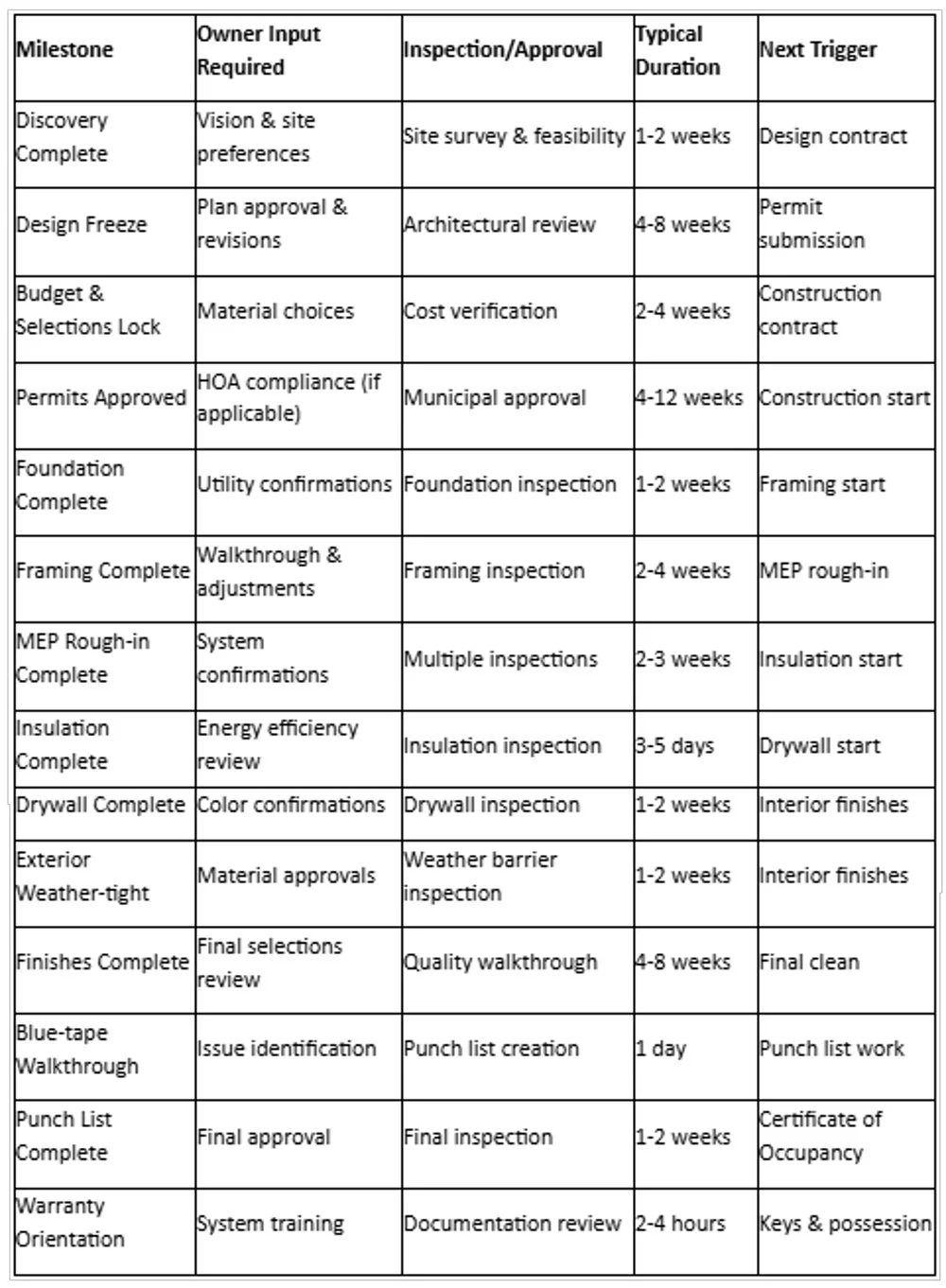
Frequently Asked Questions
What is the typical order of inspections in a custom build?
Inspections commonly occur after foundation work, after framing and MEP rough-ins, and at final completion. Names and exact sequence vary by municipality; your builder schedules the required checks with the authority having jurisdiction. For background on model codes and building safety, see the International Code Council.
When do I need to lock in appliance and fixture selections?
Before rough-ins are finalized. Appliances should be approved before framing; plumbing and lighting fixtures before insulation. Early decisions prevent field changes and delays.
What happens during a blue-tape walkthrough?
The home is cleaned, then surfaces and details are reviewed in good lighting. Items requiring adjustment are marked with blue painter's tape, documented, and scheduled for completion. This creates a clear, shared record of final items before closing.
How is a punch list created and closed?
The punch list compiles items from site walks and the blue-tape session. Trades address each item, the builder verifies completion, and any remaining issues are documented for warranty follow-up.
What's included in a warranty orientation?
System locations, shutoffs, filter sizes, maintenance intervals, and how to submit service requests. The goal is a smooth start to ownership with support during the first month. For general homeowner education resources, NAHB's consumer section offers helpful guidance.
Ready to start your custom home journey?
Explore our process to see how we guide families through each milestone with transparency and care.
Contextual Disclaimer This article shares general information about custom home-building milestones in Central Texas. It is not legal, code, or financial advice. Permits, inspections, and HOA requirements vary by jurisdiction; always confirm specifics for your property and municipality.
Our Editorial Process
Every Insights article is developed by the Riverbend Homes Insights Team using first-hand project experience from active builds in the Texas Hill Country. Drafts are checked for clarity, accuracy, and local relevance, and reviewed by a senior builder or project manager prior to publication. We update content when processes, codes, or best practices change and welcome reader feedback via our Contact page.
By Riverbend Homes Insights Team — Riverbend Homes Group, LLC is a custom home builder based in Spicewood, serving the Texas Hill Country, including Lake Travis, Lake LBJ, Bee Cave, and Horseshoe Bay. The Insights Team distills lessons from project management, selections, and homeowner education to help you plan and build with confidence.

Luxury Home Lighting: Design Tips and Trends
📌Key Takeaways
Layered Illumination Strategy: Luxury lighting employs three distinct types—ambient for overall room illumination, task for specific functional needs, and accent for highlighting architectural features—creating sophisticated depth that single-source lighting cannot achieve.
Smart Integration Requirements: Advanced control technologies and smart home systems require careful coordination with electrical planning during construction, allowing customized lighting scenes that adjust throughout the day for both daily routines and special entertaining occasions.
Architectural Element Focus: High-end fixtures emphasize craftsmanship, materials, and design sophistication, serving as architectural elements that complement your home's overall aesthetic rather than simple functional additions.
Early Planning Critical: Lighting coordination must begin during the initial design phase, before construction starts, ensuring proper electrical infrastructure and structural support while preventing costly modifications later in the building process.
Professional Expertise Essential: Qualified luxury home builders demonstrate experience with lighting design coordination, advanced control system installation, and established relationships with lighting professionals, distinguishing quality construction teams from standard residential contractors.
These principles enable productive discussions with construction professionals and support informed decision-making about permanent installations that enhance your home's sophistication for decades.
Quality lighting transforms houses into homes. For affluent homeowners in Spicewood, Texas, considering luxury construction or renovation, lighting represents far more than simple illumination—it defines the character and sophistication of your entire living space.
Understanding luxury lighting design principles becomes essential when planning discussions with construction professionals. This knowledge enables informed decisions about permanent installations that will enhance your home's quality for decades to come.
Understanding Luxury Lighting Fundamentals

Luxury lighting differs significantly from standard residential approaches through layered illumination strategies. Professional designers typically employ three distinct lighting types: ambient lighting provides overall room illumination, task lighting serves specific functional needs, and accent lighting highlights architectural features or artwork.
[ILLUSTRATIVE EXAMPLE]
Consider a formal dining room where ambient lighting creates warmth for entertaining, task lighting illuminates the dining table, and accent lighting showcases a beautiful piece of art. This coordinated approach creates depth and visual interest that single-source lighting cannot achieve.
[END EXAMPLE]
High-end lighting systems often incorporate advanced control technologies. Smart home integration allows customized lighting scenes that adjust throughout the day, supporting both daily routines and special entertaining occasions. These systems require careful coordination with electrical planning during construction, particularly when working with luxury home builders who understand sophisticated installation requirements.
Quality fixtures represent another distinguishing factor. Luxury lighting emphasizes craftsmanship, materials, and design sophistication. Think of materials like hand-blown Murano glass, forged bronze, natural alabaster, or rock crystal, which transform a fixture into a work of art rather than simple functional additions. These premium materials age beautifully and create unique light patterns that mass-produced fixtures simply cannot replicate.
Natural light integration plays a crucial role in luxury lighting design. Professional approaches consider how artificial lighting works with natural daylight patterns, creating seamless transitions throughout the day.
+-------------------------------------------------------------------------------------------------------+
💡 Quick Takeaways
Layered Approach: Luxury lighting combines ambient, task, and accent lighting for sophisticated results
Advanced Control: Smart systems provide customized lighting scenes for different occasions
Quality Materials: Hand-blown glass, forged metals, and natural stones create fixtures as architectural art pieces
+-------------------------------------------------------------------------------------------------------+
Current Trends in Luxury Home Lighting
Contemporary luxury lighting embraces both technological innovation and timeless design principles. LED technology has revolutionized high-end lighting by offering energy efficiency without compromising light quality. Modern LEDs provide color temperature control, allowing warm, cool, or neutral lighting based on preference and time of day.
Statement lighting pieces continue gaining popularity in luxury homes. Dramatic chandeliers crafted from materials like Venetian crystal or hand-forged iron, artistic pendant lights featuring blown glass or carved stone, and custom-designed fixtures in brushed platinum or antiqued brass serve as focal points that define room character. These pieces require structural planning to ensure proper support and positioning.
Architectural lighting integration represents another significant trend. Built-in solutions such as cove lighting, recessed fixtures, and linear LED systems create clean, uncluttered aesthetics. This approach requires early coordination with architectural planning to achieve seamless integration.
Outdoor lighting receives increasing attention in luxury home design. Professional landscape lighting extends living spaces beyond interior walls, creating dramatic nighttime views and supporting outdoor entertaining. These systems require coordination with landscaping and electrical infrastructure planning.
Color-changing capabilities through tunable white and RGB technologies allow homeowners to adjust lighting for different moods and occasions. Holiday lighting, seasonal adjustments, and special event customization become possible through advanced control systems.
+-------------------------------------------------------------------------------------------------------+
💡 Quick Takeaways
LED Innovation: Modern technology provides energy efficiency with superior light quality control
Statement Materials: Venetian crystal, hand-forged metals, and carved stone create dramatic focal points
Architectural Integration: Built-in lighting creates sophisticated, uncluttered aesthetics
+-------------------------------------------------------------------------------------------------------+
Professional Planning and Implementation Considerations

Luxury lighting design requires early coordination during the construction planning process. Electrical infrastructure, structural support for fixtures, and control system integration must be addressed before construction begins. This planning prevents costly modifications later in the building process.
Working with qualified luxury home builders who understand sophisticated lighting requirements becomes essential. These professionals coordinate with lighting designers to ensure proper implementation of complex systems. A luxury home builder's expertise in advanced lighting distinguishes quality construction teams from standard residential contractors, particularly when high end home builders possess the specialized knowledge required for premium installations.
Budget considerations for luxury lighting extend beyond fixture costs. Professional design consultation, specialized electrical work, and advanced control systems represent significant investment components. Premium materials like hand-cut crystal, artisan-blown glass, and custom metalwork command higher prices but deliver lasting beauty and functionality. Quality luxury home builders provide transparent pricing that reflects the complexity of luxury lighting implementation.
Timeline coordination affects lighting success. Fixture selection, electrical planning, and installation must align with construction schedules. Experienced builders manage these timelines to prevent delays and ensure proper integration with other construction elements.
Maintenance and service access require planning consideration. Luxury lighting systems need periodic maintenance, and professional installation ensures accessibility for future service needs.
When evaluating builder expertise, homeowners should ask about lighting design experience, control system capabilities, and coordination processes with lighting professionals. These discussions reveal builder qualifications for sophisticated lighting implementation.
+-------------------------------------------------------------------------------------------------------+
💡 Quick Takeaways
Early Planning: Lighting coordination must begin before construction starts
Professional Expertise: Qualified builders understand sophisticated lighting implementation requirements
Investment Scope: Luxury lighting costs include design, electrical work, premium materials, and control systems
+-------------------------------------------------------------------------------------------------------+
Understanding these luxury lighting principles enables productive discussions with construction professionals and supports informed decision-making about permanent installations. Quality lighting design requires professional expertise, but educated homeowners contribute to better outcomes through informed participation in the planning process.
Frequently Asked Questions
When should lighting planning begin in construction projects?
Lighting planning should start during the initial design phase, before construction begins. Early coordination ensures proper electrical infrastructure and structural support for sophisticated fixtures.
How does luxury lighting differ from standard residential lighting?
Luxury lighting employs layered illumination strategies, advanced control systems, and high-quality fixtures crafted from premium materials like Murano glass, forged bronze, and natural stone that serve as architectural elements rather than simple functional additions.
Frequently Unasked Questions
What construction coordination does lighting planning require?
Lighting planning requires coordination between electrical work, structural support for fixtures, control system installation, and integration with architectural features. This coordination prevents costly modifications during construction.
What qualifications indicate lighting expertise in builders?
Qualified builders demonstrate experience with lighting design coordination, advanced control system installation, and established relationships with lighting professionals. They provide detailed timelines and transparent pricing for complex lighting implementations.
Illuminate Your Dream Home with Timeless Luxury
At Riverbend Homes, we understand that luxury lighting isn’t just about brightness—it’s about brilliance. We build custom homes throughout the Texas Hill Country with a focus on thoughtful lighting design that enhances both form and function.
When you choose Riverbend Homes, you're choosing craftsmanship, coordination, and a legacy of excellence.
Ready to bring your vision to light? Contact us today to start planning your luxury custom home with lighting that truly sets it apart.
Prefer to explore more first? Browse our portfolio and discover how thoughtful design transforms everyday living into an elevated experience.

Luxury Home Building Mistakes to Avoid
Key Takeaways
Material Selection Matters: Spicewood's unique climate (scorching summers, occasional freezes, high humidity) demands materials that balance aesthetics with performance for longevity in Hill Country conditions. The local limestone composition also creates unique foundation and drainage considerations.
Builder Expertise Is Critical: True luxury builders bring specific Hill Country experience, established quality control systems, and specialized knowledge of premium materials. Verify completed Spicewood projects and how they handle local challenges rather than assuming high prices guarantee quality.
Site-Specific Design Required: Each Spicewood property has unique topography, vegetation, and orientation that should guide home placement. Thorough site analysis ensures your home capitalizes on natural features like views and sunlight while addressing drainage patterns.
Infrastructure Planning Prevents Costly Retrofits: Luxury amenities require sophisticated mechanical systems that exceed standard residential specifications. HVAC, electrical, water systems, and technology infrastructure must be properly sized during the design phase.
Building your luxury home in Spicewood represents both a significant financial investment and an emotional commitment to creating your legacy property. Partnering with experienced builders who understand the region's unique challenges helps protect both your investment and vision.
Those rolling hills of Spicewood. God, they're something else. A backdrop that makes you catch your breath—but these same stunning landscapes? They'll throw curveballs at you during construction that can turn your dream home into a money pit.
Building here isn't like building anywhere else. Not even close.
The Hidden Costs of Luxury Home Mistakes

When you're pouring money into premium construction on Spicewood's distinctive terrain, mistakes aren't just annoying—they're financial sinkholes. Beyond the immediate hit to your wallet, errors can undermine your home's structural integrity, slash its resale value, and create maintenance headaches that never seem to end.
Worse still? That gut-punch feeling when you realize your vision has been compromised after investing so much time and money.
Even if you've built before—even if you're an executive or entrepreneur who makes killer business decisions daily—the rules change in Spicewood. The Hill Country doesn't care about your resume. It has its own demands.
Material Selection Missteps
Texas Hill Country weather isn't playing around. The scorching summers that make you question your life choices. Those occasional freezes that catch everyone off guard. Humidity levels that fluctuate from desert-dry to practically tropical. This climate cocktail creates specific demands on building materials that might perform perfectly elsewhere but fail spectacularly here.
Choosing Inappropriate Materials for Spicewood Conditions
So many luxury homeowners make the same critical error: picking materials because they look amazing in a magazine spread rather than how they'll hold up in our brutal conditions. Cedar siding or redwood might look stunning initially, but watch what happens when our humidity plays yo-yo with them. They'll expand, contract, warp—transforming your elegant exterior into a maintenance nightmare.
And that gorgeous natural stone that looked perfect in the catalog? Under our intense Texas sun, it might develop discoloration faster than you can say "expensive mistake."
The limestone that dominates Spicewood isn't just pretty—it's complicated. Formed from ancient sea beds millions of years ago, this relatively soft sedimentary rock affects everything from your foundation to water movement across your property. Materials that shine in other luxury markets often crash and burn when confronting our unique soil chemistry and topography.
Prioritizing Aesthetics Over Performance and Longevity
Look, I get it. When you're building your dream home, you want it to be stunning. But picking materials solely based on their visual appeal is like buying a sports car without checking if it has an engine.
High-end materials that can't withstand Spicewood's climate become expensive problems rather than valuable investments. The fancy imported tile that cracks during our first freeze. The exotic wood that warps in our summer heat. The designer paint that bubbles and peels in our humidity.
The materials that truly deliver value combine jaw-dropping aesthetics with proven resilience in similar conditions. Builders who understand our local environment can help identify options that maintain their beauty while standing up to everything the Hill Country throws at them.
+-------------------------------------------------------------------------------------------------------+
💡 Quick Takeaways
Climate Challenges: Spicewood's brutal temperature swings and humidity fluctuations demand materials that can take a beating and keep looking good.
Local Knowledge Matters: Builders who've weathered Hill Country conditions can recommend materials that won't fail when things get rough.
Balance Is Essential: The smartest material selections blend head-turning beauty with battle-tested performance in our unforgiving environment.
+-------------------------------------------------------------------------------------------------------+
Builder Selection Errors

The gap between a builder who talks luxury and one who actually delivers it becomes painfully obvious once construction begins. This difference doesn't just affect your experience during the build—it defines your satisfaction with the final result for decades to come.
Confusing High Price with High Quality Craftsmanship
One mistake that'll cost you: assuming any builder with a fancy showroom and premium rates automatically delivers superior work. Reality check: true luxury construction requires specialized knowledge, rock-solid quality control systems, and extensive experience with high-end materials and finishes.
When evaluating potential builders, look beyond the slick marketing materials and impressive portfolio photos. Ask to see completed luxury projects specifically in Spicewood. Walk through them. Touch things. Open cabinets. Look behind the curtain.
Ask pointed questions about their quality verification process. Builders who truly deliver excellence implement multi-layered oversight systems:
Regular inspections by experienced project managers who've seen it all
Specialized trade partner oversight that doesn't accept "good enough"
Third-party inspections at critical phases when problems can still be fixed
Detailed documentation of systems before walls close them up forever
Pay attention to how they handle unforeseen challenges too. Their problem-solving approach tells you everything about their commitment to exceptional results.
Failing to Verify Specific Hill Country Experience
Spicewood's unique topography creates building challenges you won't find elsewhere—even within Texas. Those sloping lots that provide incredible views? They require foundation expertise that flat-land builders simply don't have. The drainage considerations? Completely different from other regions.
Builders without specific Hill Country experience will struggle with these challenges. That means costly modifications mid-construction or—worse—structural issues that emerge years later when warranties have expired.
When searching for luxury home builders near me in Spicewood, verify that potential builders have successfully completed luxury projects on terrain similar to your lot. Make sure they understand how local conditions affect everything from foundation design to water management. Because they will.
+-------------------------------------------------------------------------------------------------------+
💡 Quick Takeaways
Verify, Don't Assume: Tour completed Spicewood luxury homes and speak with previous clients about their real experience—not the marketing version.
Experience Specificity: Hill Country terrain creates unique challenges that demand builders with local expertise, not just general luxury credentials.
Quality Systems Matter: The best luxury builders implement comprehensive oversight that catches problems before they become disasters.
+-------------------------------------------------------------------------------------------------------+
Design and Planning Oversights
Your Spicewood dream home starts with thoughtful design that works with—not against—the natural environment while supporting your lifestyle. But oversights during this critical phase lead to disappointment, compromised functionality, and expensive fixes later.
Inadequate Consideration of Lot Characteristics and Orientation
Each Spicewood property tells its own story through topography, vegetation, and orientation. Failing to design your home to capitalize on these natural features means missed opportunities for stunning views, natural lighting, and harmony with the surrounding landscape.
Experienced luxury house builders nearby conduct thorough site analyses before drawing a single line, evaluating factors like:
Solar exposure throughout the year
Prevailing wind patterns that can cool or heat your home
Natural drainage that can work for you or against you
View corridors that might disappear with seasonal changes
This information guides placement decisions that enhance energy efficiency, comfort, and your connection to those gorgeous Hill Country surroundings you're paying a premium for.
Insufficient Attention to Mechanical Systems for Luxury Amenities
The sophisticated amenities that make luxury homes worth their price tag—from wine cellars to home theaters, indoor pools to smart home integration—need carefully designed mechanical systems. These often exceed standard residential specifications, and overlooking these requirements leads to inadequate performance and costly retrofits.
A quality luxury home builder near me anticipates these needs during design, ensuring HVAC systems, electrical capacity, water infrastructure, and technology backbones are sized and configured appropriately. This foresight prevents the disappointment of amenities that don't function as expected and protects your substantial investment.
I've seen wine collections ruined by inadequate temperature control. Home theaters with electrical systems that can't handle the load. Automation systems that glitch because the infrastructure wasn't planned properly. These aren't just annoyances—they're expensive failures that diminish your enjoyment and your home's value.
+-------------------------------------------------------------------------------------------------------+
💡 Quick Takeaways
Site-Specific Design: Your property's unique characteristics should drive decisions about house placement, orientation, and features.
Infrastructure Planning: Luxury amenities need sophisticated systems that must be properly designed from the start—not as afterthoughts.
Future-Proofing: Thinking ahead about lifestyle changes and technological advances prevents costly modifications down the road.
+-------------------------------------------------------------------------------------------------------+
Conclusion
Building your Spicewood luxury home isn't just a financial investment—it's an emotional commitment to creating your legacy property. By sidestepping these common mistakes in material selection, builder choice, and design planning, you protect both your investment and your vision.
The most successful Hill Country luxury homes emerge from partnerships with builders who understand this region's unique challenges and opportunities. They bring not just construction knowledge, but genuine appreciation for creating exceptional homes that enhance their owners' lives while standing up to everything Texas can throw at them.
The difference between disappointment and delight isn't just in the dollars spent—it's in the decisions made before the first foundation is poured.
Frequently Asked Questions (FAQ)
Q: How do I verify a builder's authentic luxury home experience in the Spicewood area?
A: Request specific examples of luxury homes they've completed in the Hill Country, especially on terrain similar to yours. Tour these properties if possible, chat with previous clients about their experience, and dig into how the builder handled local regulations and terrain challenges. Look for consistency in quality across multiple projects, not just their showcase homes.
Q: What questions should I ask potential builders about their experience with Hill Country terrain challenges?
A: Ask detailed questions about their approach to foundation design on sloping lots, water drainage management, limestone substrate adaptations, and erosion control strategies. Find out how they position homes to maximize views while protecting privacy, and how they integrate structures with the natural landscape. Their answers will reveal whether they truly understand our unique environment or are just telling you what you want to hear.
Frequently Unasked Questions (FUQ)
Q: How do building material requirements differ for luxury homes in Spicewood compared to other upscale areas?
A: Spicewood's combination of Hill Country climate extremes—from scorching summers hitting 95°F to occasional freezes dropping to 41°F—plus humidity fluctuations between 59% and 74% creates unique demands on materials. August is typically the warmest month with highs around 95.5°F, while January brings the coldest temperatures with lows averaging 41.9°F. Materials must withstand these conditions while maintaining their aesthetic appeal, often requiring different selections than coastal or northern luxury markets.
Q: What oversight systems should be in place to ensure quality control throughout the luxury building process?
A: Reputable luxury builders implement multi-layered quality verification including regular inspections by experienced project managers, specialized trade partner oversight, third-party inspections at critical phases, and detailed documentation of all building systems before enclosure. Look for builders who can explain their specific quality control protocols beyond generic assurances of "attention to detail." The best builders welcome scrutiny because they're confident in their processes.
Build Boldly, Live Beautifully—Without the Costly Surprises
At Riverbend Homes, we’ve spent years mastering the art and science of building luxury custom homes in the Texas Hill Country—including the rugged terrain of Spicewood. Our deep local expertise means we don’t just build beautiful homes—we build homes that last, perform, and elevate your lifestyle from the ground up.
When you partner with Riverbend Homes, you’re not just hiring a builder—you’re gaining a trusted team who knows how to turn your vision into a legacy property while avoiding the common (and costly) missteps unique to this region.
📞 Ready to take the next step?
Contact us today to start a conversation about your dream home in Spicewood or anywhere across the Hill Country. Let’s build something extraordinary—together.
👉 Want more inspiration and insights?
Browse our site to explore completed projects, design ideas, and tips for building with confidence in the Hill Country.