

Before the Floor Plan: A Site-First Guide to What Your Spicewood Lot Can Really Support
📌 Key Takeaways
The best floor plan starts with the land, because Spicewood lots decide what can be built well.
Read Land First: Test the lot before design so slope, rock, drainage, and access guide smart choices.
Check Septic Early: Septic placement can shape the home, pool, driveway, and outdoor living plan.
Know Local Rules: County, HOA, utility, and permit rules can change from one Spicewood lot to another.
Protect The Budget: Early site review helps turn hidden land problems into planned design and cost choices.
Match Dream To Site: Views, privacy, pools, and patios work best when tested against the whole property.
Land-first planning keeps the dream strong by making it real.
Families planning a custom Spicewood home will gain clearer first steps here, preparing them for the detailed overview that follows.
~ ~ ~ ~ ~ ~ ~ ~ ~ ~ ~ ~ ~ ~ ~ ~ ~ ~
Survey papers in hand, you are standing on a piece of Spicewood land that feels exactly right. The distant Hill Country views, the space, the quiet — it all lines up with the vision. Maybe the lot was found after months of searching. Maybe it was inherited from family who understood what this land could become. Maybe it is still under evaluation, waiting for a final decision about whether to commit.
You may already picture the house from the road: the driveway curving toward the entry, the pool sitting just beyond the main living area, the outdoor kitchen facing the view, and the rooms arranged around how your family wants to live. That excitement is a good thing. It gives the project direction.
But in any of those situations, the same practical question sits underneath the excitement: what will this land actually let us build well?
That question deserves a serious answer before a floor plan gets drawn in ink.
Start With the Land: Why the Lot Comes Before the Floor Plan
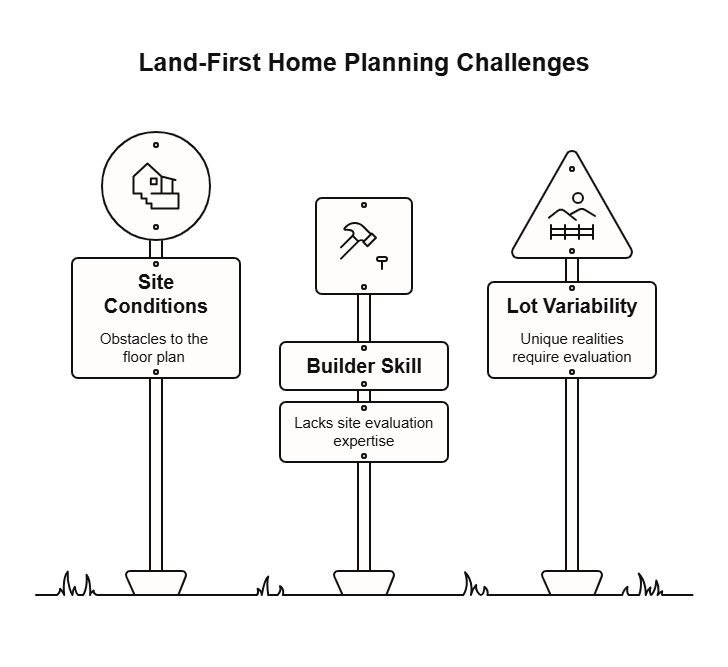
The conventional starting advice for custom home planning is familiar: gather inspiration images, sketch rough floor-plan preferences, and work out how many bedrooms the family needs. That is a reasonable beginning. It surfaces priorities, gives a designer something to respond to, and makes the first builder conversation feel less abstract.
But it runs into a problem once the land itself starts having opinions.
When a family falls in love with a specific floor plan before the property has been read, site conditions that challenge that plan begin to feel like obstacles rather than inputs. A slope that would have shaped the design quietly at month one becomes a budget variable at month six. A septic field requirement that could have guided outdoor living placement now conflicts with the pool location that feels emotionally settled. The conventional starting advice is not wrong; it simply runs ahead of the land.
There is a third challenge that matters just as much: not every builder who can construct a beautiful Hill Country home can also evaluate a difficult Hill Country lot well. Building skill and site-reading skill are not the same thing. A builder who walks a Spicewood property and focuses only on what the client wants to build — without translating what the terrain, infrastructure, drainage, and jurisdictional context will require — leaves the family to discover those realities later, at higher cost and under greater emotional pressure.
Often called the Gateway to the Hill Country, Spicewood offers some of the most striking terrain in Central Texas: distant views, limestone topography, proximity to Lake Travis, and the kind of space that closer Austin communities simply cannot offer. That same physical character means Spicewood lots are rarely flat, rarely simple, and rarely interchangeable. The land-to-design fit — the degree to which a property's physical and regulatory realities align with the home a family envisions — varies from lot to lot in ways only a property-based evaluation can reveal.
The land is the blueprint before the blueprint. A builder who understands how to read both the vision and the property is the professional most capable of protecting the dream from the surprises that shape too many custom home experiences.
What Site Feasibility Really Means for a Spicewood Luxury Lot
What site feasibility means: A builder-led evaluation of whether a specific lot can support the desired custom home — accounting for site realities such as slope, rock, drainage, and access; infrastructure requirements including utilities, septic, and driveway; design implications covering home placement, build envelope, and view orientation; and budget risk. It is the land's reality check before the dream gets drawn in ink.
Feasibility is not a single inspection. It is four interconnected layers of evaluation, each of which can affect the others.
Site realities: slope, rock, drainage, and access
The physical characteristics of a lot shape what can responsibly be built on it. Hill Country terrain is beautiful precisely because of its variation — limestone outcroppings, natural grade changes, seasonal drainage channels, mature tree cover. That variation also means no two lots sit the same way beneath a floor plan. Slope affects foundation complexity, driveway approach, outdoor living placement, and retaining requirements. Rock depth and hardness affect excavation, utility installation, and septic siting options. How water moves across the lot during heavy rainfall affects where the home can sit comfortably and safely over time.
For lots near the Lake Travis area, topography adds specific considerations around slope, rock, and foundation design that are worth understanding early. Navigating Lake Travis Topography goes deeper on how those conditions affect custom builds in this part of the Hill Country.
Infrastructure requirements: utilities, septic, driveway, and service access
Infrastructure requirements are the services a home needs to function: water, electricity, internet, gas where applicable, wastewater management, and road access that can serve both construction activity and daily life for decades. In Spicewood, many properties rely on on-site sewage facilities (OSSF) rather than municipal sewer. The Texas Commission on Environmental Quality provides homeowner guidance on OSSF systems, including how to identify the applicable permitting authority. For lots near Lake Travis and the Highland Lakes, the LCRA administers its own On-Site Sewage Facilities program within defined setback zones near the water. For properties within unincorporated Travis County, the Travis County Residential OSSF Permit process governs septic installation and approval.
Driveway access carries its own early-stage requirements. Where a new driveway connects to a county-maintained road, a Travis County Residential Driveway Permit may be required. The geometry of that driveway — how it enters the lot, how it grades, what construction traffic will navigate — affects home siting in ways that are far cheaper to resolve before architectural plans exist than after.
Design implications: home placement, build envelope, and view orientation
Once site realities and infrastructure demands are understood, they define the build envelope: the portion of the lot where the home can actually be placed after setbacks, easements, terrain, access paths, and utility locations are factored in. The build envelope is not always obvious from the survey plat, and it frequently surprises families who assumed they had more flexibility than the land actually allows.
View orientation is the process of identifying which sight lines and natural features are worth designing around — and what tradeoffs that orientation creates with sun exposure, thermal load, privacy, and the positions of outdoor features. A home oriented to capture the best Hill Country vista may face the western sun in ways that increase cooling demand or create afternoon glare in primary living areas. Resolving that tradeoff is simpler before window placement is locked.
Budget implications: why early unknowns become late stress
Site conditions discovered after design investment tend to be expensive to address. Extended utility runs, engineered retaining walls, steep-site foundation designs, and unexpected septic complexities are budget variables that can fundamentally reshape what is possible when they surface late. The goal of a site-first approach is not to eliminate these complexities — some are simply part of building on Hill Country terrain — but to understand them before they arrive as surprises.
Jurisdiction note for Spicewood-area lots: Sections of Spicewood can fall under Travis, Burnet, or Blanco County depending on the specific property. HOA requirements, utility service territories, permitting pathways, and development oversight can therefore differ from one lot to the next. Travis County Development Services handles development in unincorporated Travis County areas, including floodplain management and construction inspections. However, project oversight may also involve Municipal Utility Districts (MUDs), Emergency Service Districts (ESDs), or city Extraterritorial Jurisdictions (ETJs) depending on the specific lot’s location. Verifying what applies to the specific lot is the first practical step, not an assumption to carry forward.
The Hidden Lot Conditions That Can Change the Dream
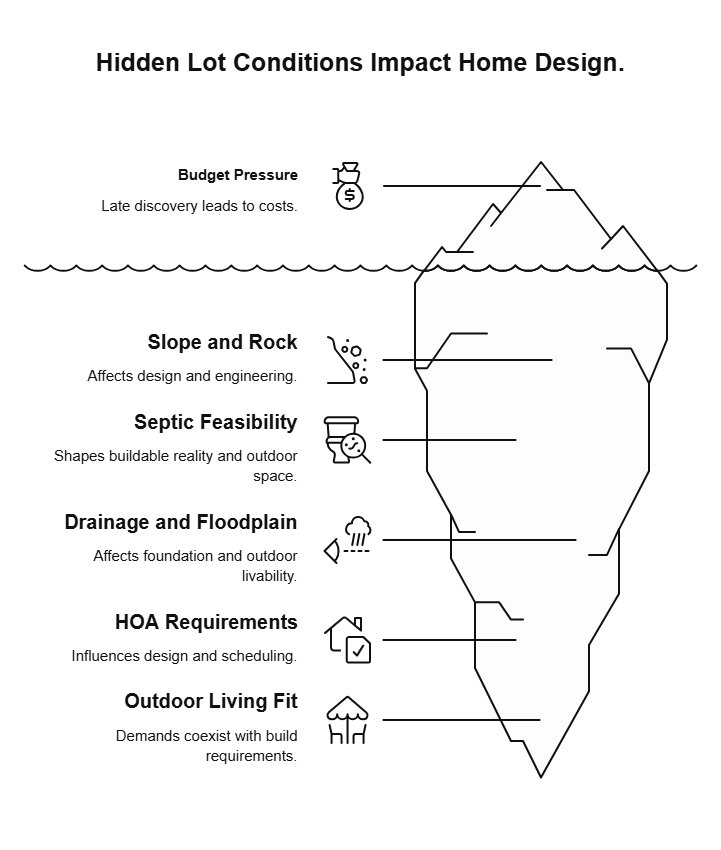
Discovered early, site conditions are design inputs. Discovered late, they are budget pressure. The difference between those two outcomes is almost entirely a function of when the conversation happens.
Slope and rock interact with nearly every major design decision on a Hill Country lot. A steeply graded site can produce beautiful elevated living areas and also require significant engineering to make the outdoor spaces usable. What the terrain gives in drama, it sometimes asks back in complexity. This is not a reason to avoid sloped lots — many of Spicewood's most compelling properties carry significant grade change. It is a reason to read the slope honestly before a floor plan assumes it away.
Septic and wastewater feasibility shapes more of a lot's buildable reality than most homeowners anticipate before the process begins. Where the OSSF system can be sited affects home placement, outdoor living options, and the area available for a pool or entertaining space. Identifying the permitting authority and understanding soil conditions belongs at the beginning of the design conversation, not near the end.
Drainage and floodplain conditions are equally site-specific on Hill Country terrain. Water behavior during heavy rain affects both foundation design and the long-term livability of outdoor areas. The FEMA National Flood Hazard Layer provides a starting reference for mapped flood zone exposure, though on-the-ground evaluation adds the context that flood maps alone cannot.
HOA requirements and permitting timelines add design and scheduling reality. In communities with active architectural review processes, design decisions may need to clear HOA approval before reaching the permit office. Understanding that timeline early keeps project sequencing from becoming a source of unexpected delay.
What clients who have been through a careful builder-led process often describe in retrospect is something like a concept-to-reality adjustment — the point at which the actual lot, the actual terrain, the finish-out choices, and the material realities of the build begin shaping the design in ways that drawings alone did not predict. Getting ahead of those adjustments, rather than navigating them reactively mid-project, is precisely what property-first evaluation makes possible.
Outdoor living and lifestyle fit — pools, cabanas, covered patios, outdoor kitchens, guest or casita spaces — are spatial demands that must coexist within the build envelope alongside the home, driveway, septic, and drainage requirements. Whether the lot can support those features in the arrangement the family imagines is a question worth settling before architectural drawings begin.
The Site-Readiness Checklist: What to Ask Before Design Begins
The most useful checklist is not the one that gives a homeowner false certainty. It is the one that helps the homeowner ask better questions. Use it as a conversation starter with a qualified builder, not as a substitute for professional site review. Each item connects a property condition to a design, budget, or household-confidence question worth answering before plans are finalized.
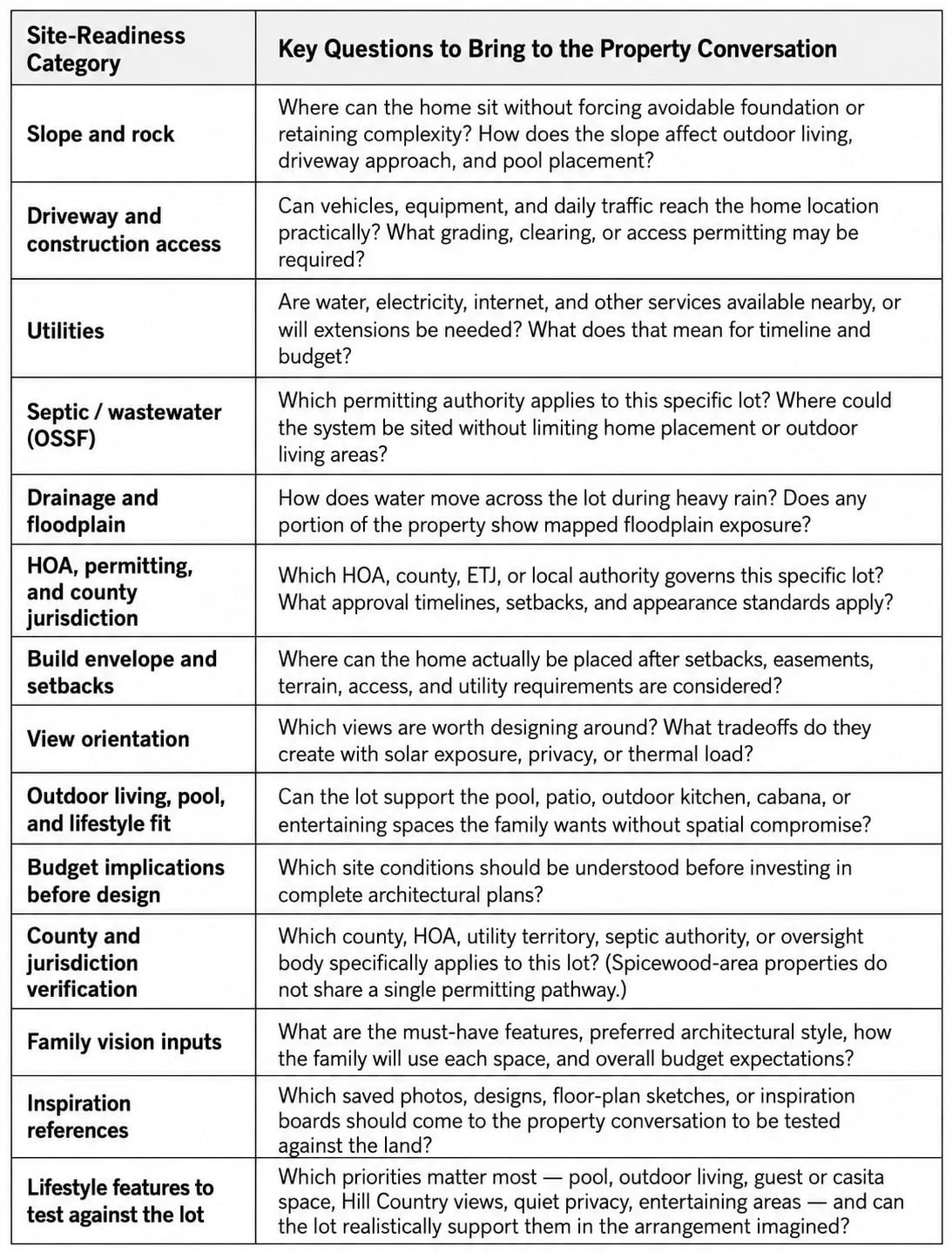
For septic authority questions, TCEQ's homeowner OSSF guidance and, for Lake Travis-area lots, the LCRA's On-Site Sewage Facilities program are the appropriate starting references. Travis County-specific OSSF permitting is handled through the Travis County Residential OSSF Permit process. Floodplain exposure can be checked against the FEMA National Flood Hazard Layer as an initial reference.
How a Property-Based Discovery Meeting Protects the Home You Imagine
One of the things homeowners who have built with Riverbend Homes consistently describe is the experience of being listened to before anything else. Not presented with what is easiest to build. Not redirected away from what they wanted. First, genuinely heard — including in cases where other builders had said the vision was not possible.
That sequencing is deliberate, and it is where the Riverbend Homes building process begins. The Discover phase is a meeting at the property itself. The purpose is to understand the homeowner's vision — what the family must have, the architectural style that fits their sense of home, how they will actually use each space, what the budget envelope looks like — and then to read the land alongside that vision. Where does the slope create opportunity and where does it require planning? What does the site's drainage behavior mean for outdoor living placement? Which infrastructure questions need answers before design begins?
A builder who has spent decades evaluating Hill Country terrain brings something specific to that conversation: the ability to hear what the family wants and translate it against what the land will support — before design momentum carries plans too far ahead of feasibility. Budget discipline and staying on schedule, without surprises that fall outside of planned choices and upgrades, are outcomes that come from this kind of front-loaded site intelligence, not from luck.
Because Riverbend limits the number of active projects it carries at any given time, the team can be on-site every day of the build. That daily presence is not a scheduling preference; it is a quality and continuity mechanism. Site conditions that emerge during construction — and they always do — are caught and addressed by the people who understand both the design intent and the property's physical behavior. It is part of what makes the process feel manageable rather than stressful.
From the Discover phase, the process moves into Design & Budget. The builder stays engaged alongside the designer at every step, keeping the vision buildable and the cost realistic as decisions are made. Plans are developed to bid-set level — the stage of design completeness at which drawings are detailed enough to estimate construction costs accurately, but not yet finalized for permit submission. At that point, the process pauses to produce an estimated final construction budget before design investment advances further. That pause is where the site knowledge from the first conversation earns its return: infrastructure decisions, slope realities, and build envelope constraints already understood mean the estimate reflects the actual lot rather than a hypothetical one.
The final phase, Build, follows with fewer avoidable interruptions precisely because the land was read before the floor plan was locked.
As a Spicewood custom home builder operating in this area since 1996, Riverbend Homes brings familiarity with Hill Country terrain, county permitting contexts, HOA processes, and the infrastructure realities specific to this region. Knowing the land before meeting it on paper is a different kind of preparation — and over time, it shows in results that clients describe as exceeding expectations rather than managing them.
The right first conversation should leave the family more capable, not more pressured.
From Site Feasibility to Budget Confidence
A site-feasibility conversation does not produce a final budget number. It produces better inputs for one. Slope, septic pathway, utility situation, driveway geometry, and build envelope become known quantities rather than unknowns — and known quantities, even challenging ones, can be planned around. Surprises discovered after a design is emotionally fixed cannot.
Those better inputs also enable better tradeoffs. Maybe the view is worth a more complex placement. Maybe the pool should be simplified so the outdoor living area works better. Maybe the driveway, garage, and entry sequence deserve more early attention than expected. Maybe the family's must-have list needs to be ranked before design begins. These are productive questions to carry into design — not reactive ones to answer under pressure mid-project.
The design-build model supports this sequence directly. When the same firm that walks the land stays involved through design, the relationship between site conditions and design decisions remains visible at every step. Cost feedback enters the conversation during design, not after it.
For families evaluating whether a Spicewood lot can support a particular home size, pool arrangement, or outdoor living plan, the most direct path to budget confidence runs through the land — not around it.
What Your Lot Can Support: A Calm Next-Step Framework
Whether the lot was recently purchased, inherited, or is still under evaluation, the following sequence helps bring structure to what can otherwise feel like an overwhelming collection of unknowns. This is guidance for a builder conversation — not a DIY feasibility assessment.
Gather the documents. Collect the survey, plat, available soils information, HOA covenants, and title or deed materials describing the property's easements and encumbrances.
Walk the property with the dream in mind — and write down the unknowns. Where does the slope run? Where does water collect? Where would the driveway naturally enter? What feels uncertain about whether the vision fits?
List the must-have lifestyle features. Home size, pool, driveway approach, outdoor living, guest or casita space, view priorities, privacy goals. Bring inspiration images and floor-plan sketches. They are valuable inputs to the conversation — as long as they are tested against the land before they become fixed intentions.
Identify the questions that could change the design most. Septic feasibility, slope complexity, utility access, drainage patterns, HOA approval scope, and build envelope constraints are the variables most likely to reshape a plan significantly when they surface late.
Verify what applies to this specific lot. Which county? Which HOA? Which utility territory? Which septic permitting authority? In Spicewood-area properties, those answers are not interchangeable from one address to the next.
Schedule a property-based builder conversation before paying for full plans. Use that meeting to separate site conditions that can be accommodated from ones that need to shape the design from the beginning. The First 48 Hours After Buying Your Lot outlines practical early steps worth taking as that process begins.
Spring is a natural moment to start this sequence before design calendars fill and construction activity builds. For those already in the middle of a busy building season, the goal is not urgency — it is clarity before the next commitment.
A Better First Question: Not "What Floor Plan Do We Want?" but "What Will This Land Let Us Build Well?"
Inspiration is a valid starting point. Floor plans, saved images, and style references communicate what the family values, how they want to live, and what the home should feel like. None of that work goes to waste.
What inspiration cannot do is account for the land. It does not know where the slope creates a retaining challenge. It does not know which direction the best view faces or what that means for afternoon sun load. It does not know whether the septic field and the pool can coexist in the arrangement the family imagined. The land knows those things. And a builder with the site-reading experience to translate both the vision and the property honestly — without defaulting to what is easiest to build or what an off-the-shelf floor plan assumes — is the professional best positioned to protect the dream from the avoidable surprises that shape too many custom home experiences.
Starting with site feasibility does not shrink the dream. It grounds the dream in what the land will genuinely support — so that by the time the floor plan is drawn, it has already been tested against the most consequential set of constraints it will ever face.
That shift changes the tone of the entire project. The view becomes part of the plan. The driveway becomes part of the experience. The pool and outdoor living areas are tested as part of the whole property rather than added to it after the fact. The budget conversation becomes more grounded. The design begins as a response to the land rather than a fight against it.
Before the floor plan gets drawn in ink, see how Riverbend's process starts with the land: the Riverbend Homes building process.
When ready to talk through a specific property, contact Riverbend Homes.
Let's bring your dream to life in the Texas Hill Country.
Disclaimer: This guide is for educational planning purposes only. Lot feasibility, septic, floodplain, permitting, utility, HOA, engineering, and budget questions should be confirmed with qualified local professionals and the relevant jurisdiction before design or construction decisions are made.
Our Editorial Process
Our expert team uses AI tools to help organize and structure our initial drafts. Every piece is then extensively rewritten, fact-checked, and enriched with first-hand insights and experiences by expert humans on our Insights Team to ensure accuracy and clarity.
About the Riverbend Homes Insights Team
The Riverbend Homes Insights Team is our dedicated engine for synthesizing complex topics into clear, helpful guides. While our content is thoroughly reviewed for clarity and accuracy, it is for informational purposes and should not replace professional advice.