

A Home That Fits the Land: View, Access, and Outdoor Living Questions
📌 Key Takeaways
The right custom home starts by reading the land before drawing the floor plan.
Read Land First: The lot should guide the home’s view, entry, outdoor spaces, and budget.
Design Around Daily Life: Family routines should shape where rooms, patios, pools, and guest areas belong.
Protect The View: Great views need smart planning for sun, glare, slope, privacy, and cost.
Plan Access Early: Driveways affect arrival, drainage, parking, trailers, service access, and daily use.
Check Site Limits: Septic, utilities, drainage, county rules, and HOA guidelines can reshape the plan.
Land first = fewer surprises and a home that feels meant to be there.
Families planning custom homes in Spicewood and the Texas Hill Country will gain clearer planning priorities, preparing them for the detailed overview that follows.
~ ~ ~ ~ ~ ~ ~ ~ ~ ~ ~ ~ ~ ~ ~ ~ ~ ~
Picture the morning you wake up in that house for the first time. Maybe it is the light spilling across a Hill Country view before the rest of the family stirs. Maybe it is the sound of guests arriving — tires on gravel, the familiar crunch of a driveway that feels like it was always meant to be there. Or the smell of something on the outdoor grill while children run between the pool and the covered porch.
That picture is clear. The challenge is that the lot still holds a few unknowns, and it is not always obvious which of them could quietly reshape the dream — or the budget — before a single plan is drawn.
A home fits the land when the view, the entry, and the way the family lives all work together. Before drawing plans, homeowners should ask how the property handles arrival, drainage, shade, septic, utilities, view corridors, and daily outdoor use. Most surprises are not unavoidable. They are the product of starting design before the property has been properly read.
As an experienced Spicewood custom home builder, Riverbend Homes — a second-generation family-owned business building in the Texas Hill Country since 1996 — starts every project with a single principle: listen first, then design. The best design questions begin outside, on the land.
Start With the Life You Want to Live on the Land
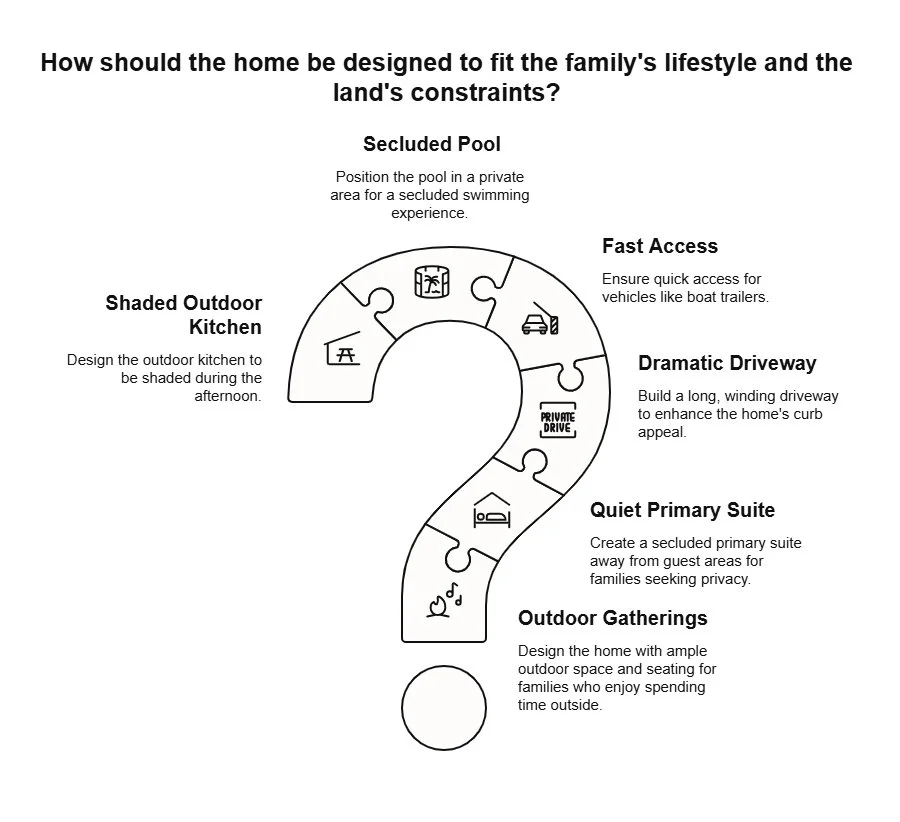
Before opening a floor plan, it helps to ask a more personal question: how does the family actually live?
Some families gather outside every evening. Others need a quiet primary suite far from where guests stay. Some want a driveway that builds anticipation before the house comes into view; others need a fast turnaround that works for a boat trailer after a day on Lake Travis. None of those goals is better than another — but they land differently on different lots.
A lot with a dramatic bluff view may put the most beautiful house position at the back of the property, which could mean a longer or more expensive driveway. A lot with natural privacy from cedar and live oak might make the pool feel secluded, or it might shade the outdoor kitchen all afternoon. Constraints are not dream-killers; they are planning inputs. The earlier they are understood, the more of the family's vision they can protect.
Your land is the most critical constraint on your design.
The Lifestyle-to-Site Question List
These questions translate broad lifestyle goals into the specific site realities a builder needs to hear. Bring them to any early property conversation.
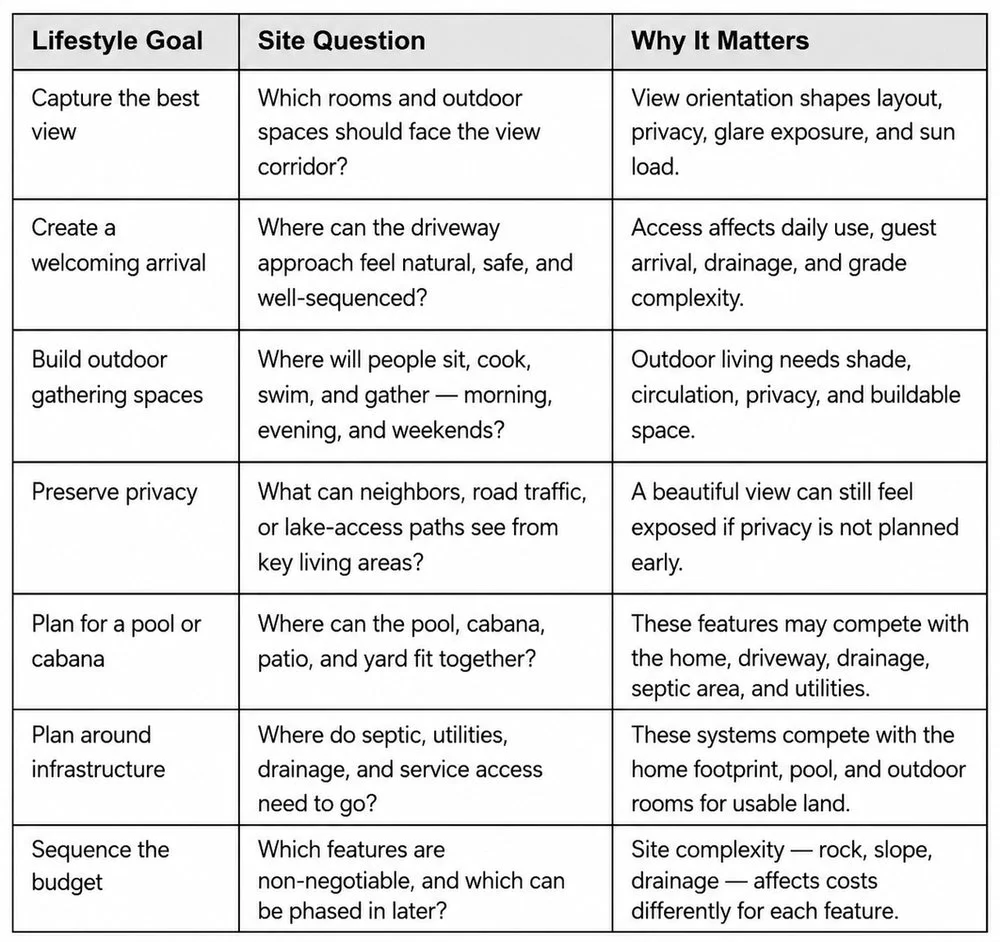
View Questions: What Will You See, and When Will You See It?
The view is a design input, not just a backdrop. In the Texas Hill Country, views can be the single biggest reason a family chooses a specific lot — distant ridgelines, miles of Lake Travis shoreline, open sky over rolling terrain. That makes view orientation worth more planning weight than it typically receives.
The question is not just where the view is. It is which rooms should receive it, at what time of day, and at what cost to everything else on the lot. If the best view corridor faces east, the primary bedroom captures it at sunrise — which may be exactly right. But a large glass wall in the kitchen facing the same direction can mean significant glare during peak morning use. That is not a reason to abandon the view; it is a reason to design for it intentionally, with overhangs, window placement, and interior orientation working together from the start.
View corridors can also compete with slope. The most dramatic vantage point is often on the highest, steepest ground. Placing the home there for the view may mean more grading and a driveway managing a more complex grade change — costs that are far easier to weigh before the design is emotionally locked. For a closer look at how sightlines and window orientation shape daily livability, Designing for the View: How to Maximize Your Hill Country Landscape in Your Custom Home covers the practical decisions in detail.
Access Questions: How Will the Home Welcome You In?
Arrival is part of how a home feels — and how it functions every single day. The sequence from the road to the front entry, the moment the view opens up, the place where the house finally reveals itself — these are experiences worth designing as deliberately as any interior space.
They are also worth checking against site realities early. Depending on the lot's road frontage, slope, drainage patterns, and road jurisdiction—which in Spicewood can fall under Travis, Burnet, or Blanco County—driveway placement involves specific grade limits, sight distance standards, and drainage requirements. Because permitting processes and governing bodies differ significantly by county, homeowners must identify the specific jurisdiction (e.g., Travis County Development Services for unincorporated Travis County) to understand the requirements for approach angle, positive drainage, and the distinction between county and state road maintenance.
Beyond approach, practical questions matter: room for a guest turnaround, service vehicle access, emergency access, and — for families with boats or trailers — a storage location that does not create a visual problem from the main living area. Can Your Lot Hold the Home, Pool, and Driveway You Want? is useful reading for families working through how much space all of these elements actually require.
Outdoor Living Questions: Where Will Family Life Actually Happen?
In central Texas, outdoor rooms are not seasonal luxuries — they are how homes are actually used for most of the year. That means they need to be planned with the same care as interior spaces, and the land needs to physically support them.
Start with where people will gather at different times of day and during different types of visits. A quiet morning spot near the primary bedroom calls for different placement than an outdoor kitchen anchoring a large weekend gathering. Those two spaces may not want to share the same porch. Then check placement against the competing demands on the land: a pool, covered patio, cabana, screened porch, fire feature, and detached casita together take up meaningful square footage. On lots with septic requirements, drainage swales, or significant slope, the buildable outdoor envelope may be more constrained than the survey suggests.
Afternoon sun in the Hill Country is aggressive from late spring through early fall. A west-facing patio with no shade becomes unusable during exactly the hours most families want to be outside. Roof extensions, pergolas, and mature trees all address this — but they need to be part of the original site plan to work effectively.
Privacy, Noise, and Neighbor Questions
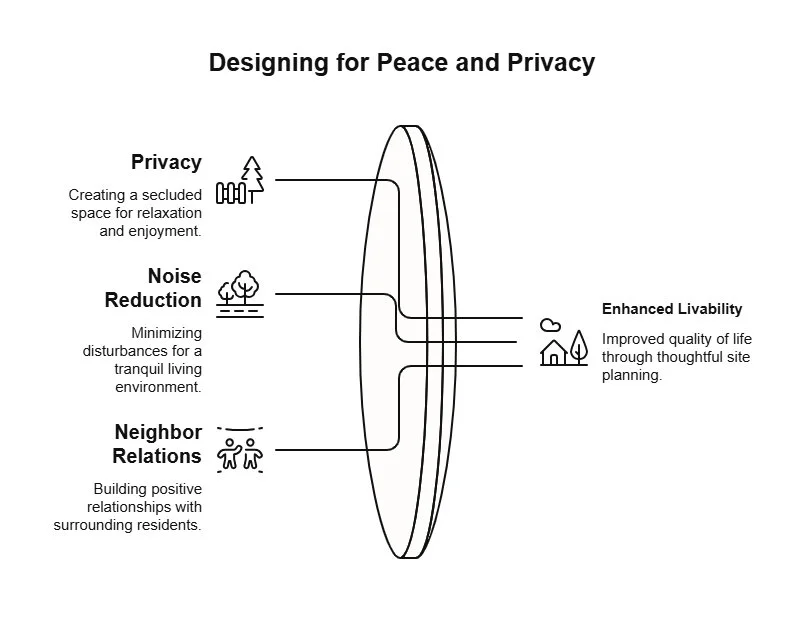
Privacy is a livability question, not a paranoid one. It is simply the difference between a pool area that feels like a genuine retreat and one that feels perpetually observed.
Walking the lot edges and asking what is visible from the road, from neighboring properties, and from any nearby lake-access paths is one of the most underrated early steps in lot planning. Natural vegetation, grade changes, and thoughtful building placement can create genuine privacy — but those design moves need to be identified early, not discovered mid-construction. Where headlights sweep across a bedroom terrace at night, or where road noise reaches a pool area, are real livability factors that thoughtful site planning can address. The question of whether views and privacy pull in opposite directions on a given lot is worth raising directly with the builder from the first conversation.
The Builder Question: Has the Property Been Read Before the Dream Is Drawn?
Site feasibility is a builder-led evaluation of whether the land can support the home a family imagines — encompassing site realities, infrastructure requirements, design implications, and budget risk. There is a version of the custom home process where design happens first — inspired images, floor plan preferences, a target square footage — and the land enters the picture after the plan already feels finished. That version is where expensive surprises live.
Riverbend's process begins with the Discover phase: a Discovery Meeting held at the property itself. Clients bring inspiration images and any saved designs; the builder listens, walks the land, assesses site feasibility, and identifies infrastructure requirements that will affect both design and cost. Understanding the potential and limitations of the space is not the end of the dream — it is how the dream gets built correctly.
The next phase, Design & Budget, keeps the builder involved alongside the architect to maintain both the vision and the budget. When plans reach bid-set completeness, the process pauses: a final construction cost estimate is produced before designs are finalized and permitting begins. Nothing moves past the point where the budget is understood. From there, the Build phase is shaped by financing, permitting, and HOA timelines — factors a builder active in the Hill Country navigates honestly rather than glossing over.
What to Bring to a Site Conversation
A first property conversation is most useful when priorities are clear. That does not mean arriving with plans — it means arriving with organized thinking.
Bring:
A current survey or plat of the property
HOA covenants or architectural guidelines, if available
Any known information about utilities, wells, or existing septic systems
Saved inspiration images — Pinterest boards, magazine clippings, photos from homes toured
A ranked list of must-have priorities: view, pool, privacy, outdoor kitchen, separate primary wing, casita, guest access, or multigenerational space
On the infrastructure side, lots near Lake Travis and the Highland Lakes may fall under the LCRA's On-Site Sewage Facility Program. The permit process can require proposed locations for the house, driveway, septic tank, drain field, and wells to be shown and marked on the property for inspection (LCRA OSSF Permit Steps). Additionally, lots within the Lake Travis watershed may be subject to the LCRA Highland Lakes Watershed Ordinance, which governs land disturbance, stormwater management, and erosion controls in ways that affect where things can be built. A builder who knows these systems can help determine what applies to a specific parcel before site or design investments are made.
For families also thinking through lot selection itself, Survey Papers in Hand: 5 Lot Checks Before Your Dream Home Is Drawn and The First 48 Hours After Buying Your Lot: 5 Smart Steps Before Custom Home Design cover complementary ground.
Stay informed with Hill Country building trends and tips as the planning process continues. When ready to walk the property with a site-first builder, contact Riverbend Homes to schedule a Discovery Meeting. The land has a great deal to say about the home — before the first line is drawn.
Our Editorial Process
Our expert team uses AI tools to help organize and structure our initial drafts. Every piece is then extensively rewritten, fact-checked, and enriched with first-hand insights and experiences by expert humans on our Insights Team to ensure accuracy and clarity.
About the Riverbend Homes Insights Team
The Riverbend Homes Insights Team shares practical guidance for families planning custom homes in Spicewood, Lake Travis, Lake LBJ, Horseshoe Bay, and the Texas Hill Country. Our content draws on Riverbend Homes' property-first design-build process, local building experience, and commitment to helping homeowners make confident decisions before plans move too far ahead of the land.