

Keep the Dream on Budget: Why Design Needs Cost Feedback Before Plans Are Final
📌 Key Takeaways
Cost feedback protects a custom home dream before design choices become expensive surprises.
Price Before Final Plans: Early cost checks help families adjust the design before they feel locked in.
Use The Bid-Set Pause: A bid-set pause gives enough detail to estimate costs while changes still feel manageable.
Watch Quiet Cost Drift: Windows, rooflines, driveways, pools, and site work can raise costs faster than expected.
Start With The Land: A site walk helps uncover slope, utilities, drainage, access, and other budget-sensitive details.
Track Allowances Closely: Clear allowance tracking keeps finish choices tied to the full project budget.
Budget feedback does not shrink the dream; it makes the dream safer to build.
Custom home buyers in the Texas Hill Country will gain clearer budget confidence, preparing them for the detailed overview that follows.
~ ~ ~ ~ ~ ~ ~ ~ ~ ~ ~ ~ ~ ~ ~ ~ ~ ~
Custom home design needs cost feedback before final plans because design choices can quietly shift the total construction cost before anyone notices. When a builder stays involved during design and pauses at bid-set completeness, the homeowner can review estimated construction costs, adjust the plan if needed, approve the budget, and move into final design with genuine confidence — not guesswork.
The Dream Feels Real Before the Budget Does
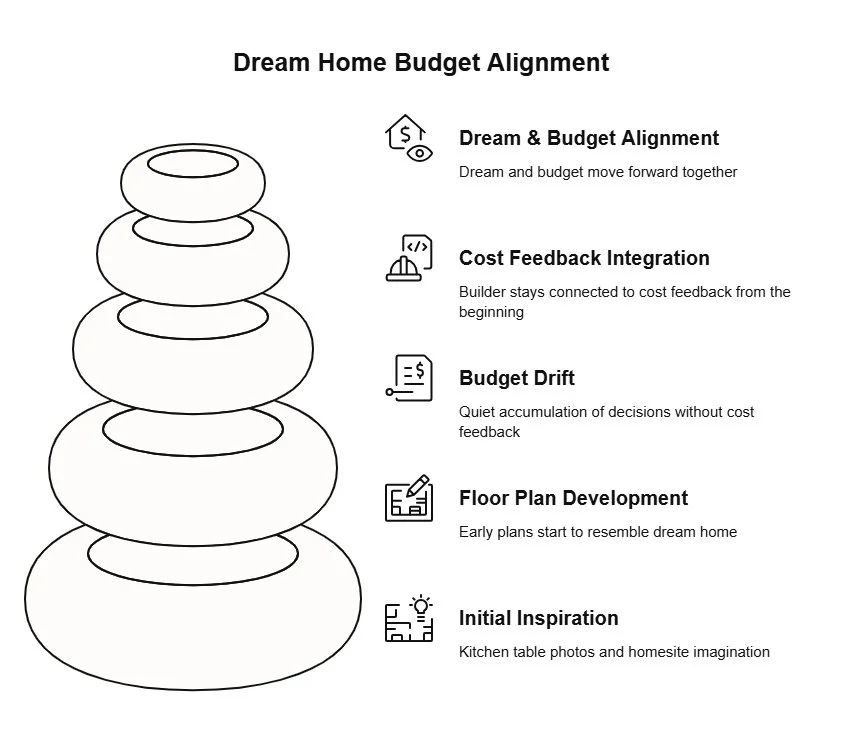
It may start around the kitchen table, with inspiration photos spread out between family members. It may happen while standing on a Spicewood homesite, imagining where the kitchen view should face, where the pool might sit, or how the driveway should approach the home. It may happen when an early floor plan finally starts to look like the place where holidays, quiet mornings, and family visits could unfold.
That stage should feel exciting. The home is still flexible.
It is also the stage where the budget can begin to drift.
The problem is not one bad decision. It is the quiet accumulation of beautiful decisions without whole-project cost feedback. A larger window package, a more complex roofline, a longer driveway, a pool cabana, upgraded finishes, and added outdoor living space may each feel reasonable on their own. Together, they can move the project further than the household expected.
That is why cost feedback belongs inside the design process, not after final plans are complete.
The families who build their dream homes in Spicewood, Lake Travis, and the Texas Hill Country without late-stage budget surprises are rarely the ones who spent less. They are the ones whose builder stayed connected to cost feedback from the beginning, so the dream and the budget moved forward together. The Riverbend process integrates this vision into a disciplined financial framework.
What Design and Budget Alignment Means in a Custom Home Build
Design and budget alignment means keeping design decisions connected to cost feedback so the home vision stays feasible before permitting and construction. The builder stays involved during design, the budget is not treated as an afterthought, and the household receives cost estimates before final plans harden. The goal is not to shrink the dream — it is to protect it.
When shaping a dream home, a homeowner wants cost feedback before the design is finalized so they can protect the vision without losing control of the budget. A budget-aware design process helps answer questions such as:
Is the home being designed around the family's highest priorities?
Has the property been walked and reviewed before architectural overcommitment?
Are site feasibility and infrastructure requirements part of the budget conversation?
Is the design detailed enough to support a useful construction-cost estimate?
Are allowances being treated as active budget tools rather than placeholders?
Does the family have a chance to approve the budget before final design and permitting?
That is the core purpose of design and budget alignment: to protect the home vision from late-stage surprises.
Why Final Plans Are Too Late for the First Serious Cost Conversation
The standard advice is straightforward: finish the design, then price the build. On the surface, this sequence seems efficient. In practice, it transfers a significant amount of financial risk to the family — quietly, and at exactly the wrong moment.
By the time plans are final, the family may already feel attached to the home. The kitchen view has meaning. The guest suite has a purpose. The pool, porch, and outdoor spaces are part of the imagined lifestyle.
Design decisions accumulate throughout the process. Every choice that gets approved — ceiling heights, structural spans, the outdoor living configuration, the window-to-wall ratio, the driveway grade, the pool placement — adds weight to the total project cost. Each choice, in isolation, seems manageable. Collectively, the cost impact stays invisible until it is not.
Emotional commitment also deepens with every design iteration. By the time a family has reviewed three rounds of floor plans and started imagining their furniture in each room, they have invested far more than time. Asking them to scale back at that stage is not a budget conversation. It is a loss.
A roofline simplification may feel like the home is being watered down. Reducing glass may feel like giving up the view. Reworking outdoor living may feel like losing the heart of the plan. When early cost feedback is part of design, the family makes clear, calm tradeoffs before the design becomes rigid.
This is especially important for a custom home in the Texas Hill Country because the land itself often affects the design. A view lot, acreage parcel, sloped site, long driveway, outdoor living plan, or Lake Travis-area property may create practical questions that are not visible from a floor plan alone. Budget confidence is created during design, not after plans are finalized.
The Design-Budget Checkpoint Map
The most useful custom home budgeting conversation is not a single meeting at the end. It is a sequence of checkpoints that keep the dream and the budget moving together.
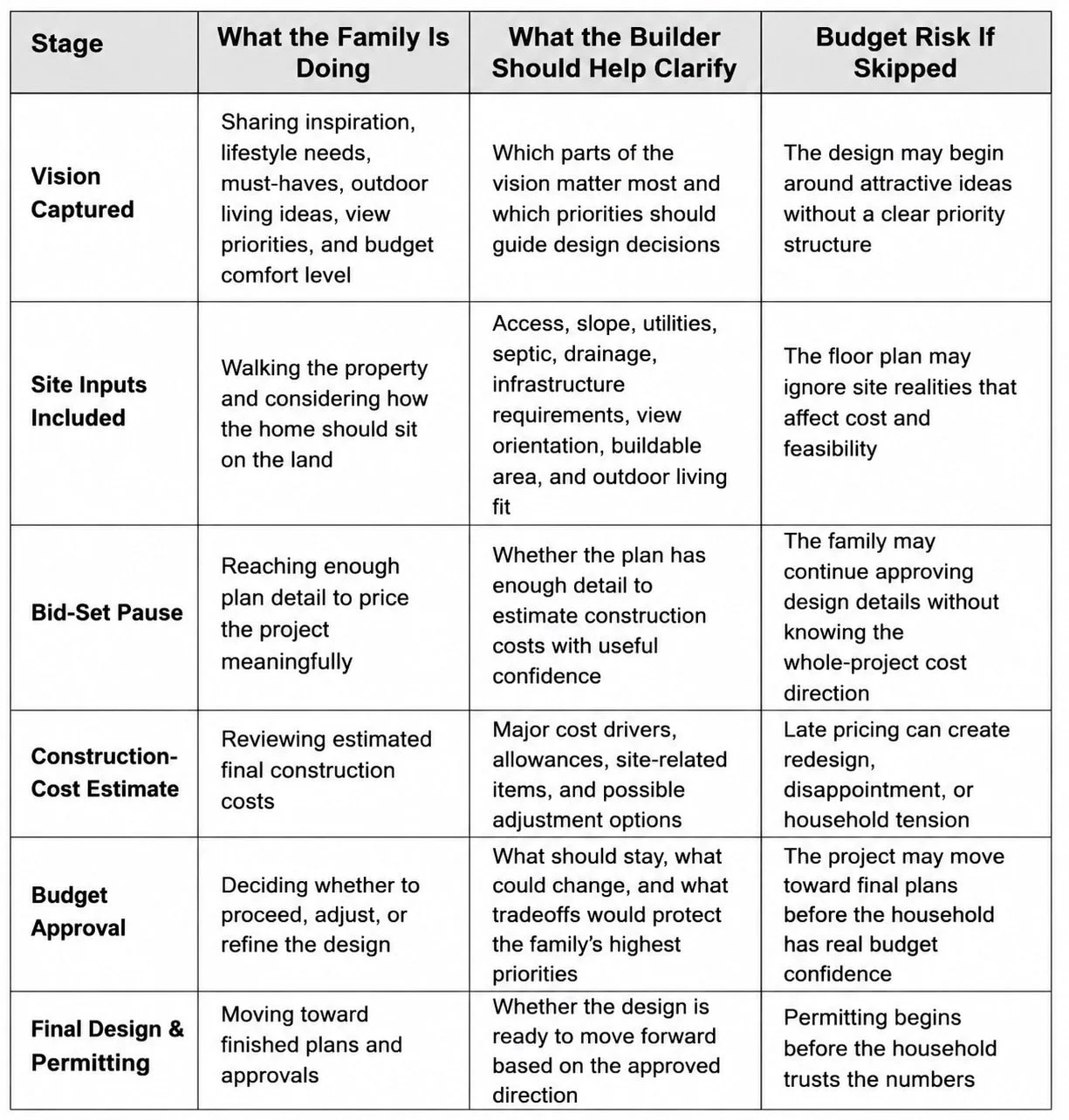
A bid-set is the level of plan completeness at which the builder can pause and estimate final construction costs meaningfully — not a rough ballpark based on square footage, but a grounded estimate based on the actual design, the actual site, and the actual selections being considered. It is not simply a rough sketch, and it is not necessarily the final construction document set. It is the pause point where the design is clear enough to price, while still flexible enough to adjust.
That pause is not a delay. It is a decision-protection point. NAHB's 2024 Construction Cost Survey found that, in its national sample, construction costs represented 64.4% of the average sales price and finished lot costs 13.7%. That is a national survey, not a Spicewood project estimate — but it illustrates why cost feedback deserves attention early, not after plans are finalized.
Once budget approval is given, design continues into its final form and permitting begins. The family moves forward not on hope, but on confirmation.
Where Budget Drift Quietly Enters the Design
Budget drift is not a single line item. It is a pattern of small additions, each individually justified, that together produce an estimate the original budget did not anticipate. These are the categories where it most commonly appears in Texas Hill Country custom home projects.
Layout complexity. Open floor plans with long structural spans, vaulted ceilings, or multi-level configurations require more material and engineering than simpler layouts. A custom layout may also need separate wings, extra corners, or special transitions to support a family's lifestyle. The visual drama of a great room with soaring ceilings is real. So is its effect on the structural budget.
Foundation and site-related work. On Hill Country terrain, slope changes the math significantly. A lot with meaningful grade may require retaining walls, stepped foundations, or substantial grading and drainage work before a single wall goes up. None of that is visible from a floor plan — it is only visible from a site walk.
Driveway length, access, and grading. A long private driveway on a Spicewood or Lake Travis acreage lot is not a landscaping line item. It is a real construction cost with implications for grading, base material, drainage culverts, and construction-site access.
Windows, doors, and view-driven glass. On a Hill Country or Lake Travis view lot, glass placement matters. Expansive glass walls, specialty window systems, or large sliding door assemblies carry costs that are easy to underestimate when they appear as simple rectangles on a floor plan. Glass is also a thermal factor, which affects HVAC design and cost.
Rooflines and architectural complexity. A straightforward roofline is one of the most cost-efficient structural decisions in custom home design. Complex intersecting rooflines, dramatic pitch changes, or architectural features that create difficult framing geometry move the budget quickly — often without the family realizing it during design review.
Outdoor living, pools, patios, and cabanas. Texas Hill Country homes often include substantial outdoor living areas, and for good reason. But a covered outdoor kitchen, pool and spa, cabana, fire feature, and connecting patio can add real cost to a project whose interior budget was already fully allocated. Because these spaces affect site planning and construction scope, they should be part of the early budget conversation.
HOA, permitting, and timing dependencies. On many Spicewood and Lake Travis lots, HOA architectural review, permitting timelines, and construction loan draw schedules are cost and schedule drivers, not administrative formalities. HOA approval processes can add weeks to a project timeline. Permitting requirements vary by jurisdiction and can affect what is buildable.
Utility, septic, and infrastructure requirements. Every lot carries infrastructure requirements: water well or municipal connection, septic system placement and type, electrical service, propane or natural gas, drainage strategy. On rural acreage or constrained properties, these costs can be substantial and must be understood before design begins in earnest.
Finish allowances and selection decisions. Allowances are often misunderstood. An allowance is a budgeted amount for a category that may not be fully selected yet — tile, lighting, plumbing fixtures, appliances, flooring, or cabinetry. Allowances can be helpful because they let design and planning move forward before every selection is final. But they need discipline. If the allowance is too vague, or if updates are not communicated clearly, the family may discover overages late. The goal is not to pressure the family toward less. It is to make sure finish choices carry visible cumulative impact. For a deeper look, Navigating Allowances: 3 Ways to Maximize Your Integrated Home Design and Shopping Allowance Autonomy: How to Choose Luxury Finishes Without Losing Budget Control are both worth reading before selections begin.
None of these categories is a reason to scale back the vision. Each is a reason to make sure cost feedback is present while the vision is still being shaped — not after it has become emotionally fixed.
A Practical Example: When Every Idea Is a Good Idea
Consider a family planning a custom home on acreage near Spicewood. They want the main living area aimed toward a view, a pool near the covered patio, a separate primary wing, a guest space for visiting family, and a driveway that feels private from the road.
None of those ideas is careless. Each one supports the life the family wants.
But together, they touch many budget-sensitive parts of the project: home orientation, grading, foundation, driveway access, roofline, exterior openings, outdoor living, pool location, drainage, utilities, and finish allowances.
Without cost feedback during design, the family may keep saying yes to good ideas without seeing the combined effect.
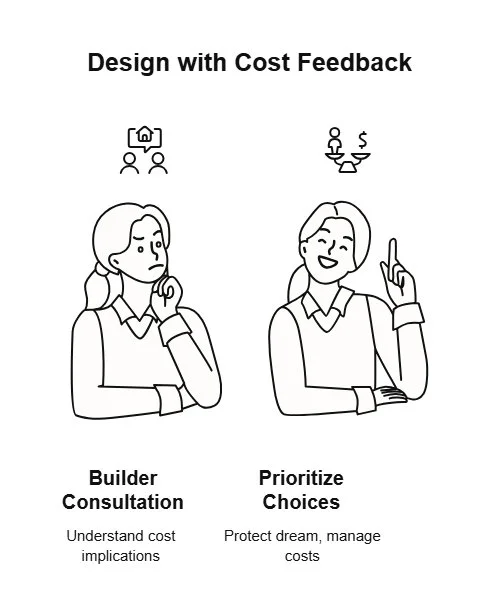
With cost feedback during design, the conversation becomes more useful. The builder can help the household understand which choices protect the dream, which choices carry the most cost sensitivity, and where adjustments may preserve the most important parts of the vision.
That is the difference between restriction and relief.
How Riverbend Homes Keeps the Design Creative Without Letting the Budget Disappear
"Ben was able to stay on budget with only the exception of things we planned to upgrade from the initial contract. This was minimal for a home in this price range, which is not at all what other people we know have experienced. He frequently found ways to save us money on our selections." — Christine G., Riverbend Homes client
The Riverbend process is built around a straightforward conviction: budget confidence is created during design, not after. That belief shapes every stage of how a project moves forward.
The Discovery Meeting begins at the property. The Riverbend Homes building process starts with a meeting at the actual lot — not at a desk, not over floor plans. Riverbend listens first. The conversation covers the family's vision, lifestyle needs, and inspiration ideas alongside the specific realities of the site: slope, access, views, drainage, utilities, setbacks, and infrastructure requirements. That listening posture is the Riverbend Difference — understanding what the family wants before offering a single recommendation, because a custom home is the foundation for family memories, not merely a structure.
The goal of that first conversation is not to produce a design. It is to make sure the design that follows is grounded in what the property can actually support — and what that support will cost.
Builder involvement continues through design. Riverbend stays involved as design develops, not to restrict the creative process but to keep the vision feasible. When a design choice carries cost implications — a roofline detail, a window package, an outdoor living configuration — that information remains visible to the household while it can still shape the decision. For more on why this unified accountability matters, Beyond the Kitchen Table Sketches: How Custom Home Design-Build Stops Budget Overruns explores how the design-build approach prevents the cost surprises that separated contracts create.
The bid-set pause creates the cost checkpoint. Once plans reach bid-set completeness, Riverbend pauses design development and prepares an estimated final construction cost. The household reviews that estimate, understands where the project stands, and approves the budget before final plans are drawn and permitting begins. This is the concrete process moment where budget confidence is created — not assumed.
Riverbend takes on a select number of projects at a time. That selectivity is not a constraint — it is what makes daily on-site involvement possible. It means every project gets the attention it deserves, and builds move faster than they typically do with builders juggling too many sites simultaneously. Riverbend Homes is a second-generation family-owned builder that has designed and built homes in the Texas Hill Country since 1996, serving Spicewood alongside Lake Travis, Horseshoe Bay, Lake LBJ, and the wider Hill Country region.
Understanding the AIA's framework for design phases — schematic design, design development, and construction documents — can help homeowners understand where cost estimating typically occurs in traditional architect-led processes. The AIA's resource on defining basic services provides useful context. The key distinction in a design-build model is that cost feedback is integrated throughout, rather than appearing only after construction documents are complete.
Questions to Ask Your Builder Before Plans Are Final
A homeowner does not need to become a builder to ask better questions. The goal is to understand whether the builder has a real process for connecting design decisions to cost feedback — or whether that feedback arrives too late to protect the household's vision.
At what point in the design process do you provide cost feedback? The answer should describe a specific stage during design — not a number delivered after plans are complete.
Do you stay involved during design, or do you wait until plans are finished to price the build? A builder who waits until final plans is a builder who may deliver a surprise.
What level of plan detail do you need before estimating final construction costs? Understanding what "bid-set completeness" means to this specific builder clarifies when the cost checkpoint will actually occur.
Which site conditions or infrastructure requirements must be understood before your cost feedback is meaningful? A builder with real site-first experience will have a specific answer — slope, access, utilities, septic, drainage, and HOA or permitting requirements are the starting points.
How do you account for HOA architectural review, permitting timelines, and financing draw schedules before final plans? These factors affect both cost and schedule. A thorough answer signals a builder who plans ahead.
How are allowances set, and how do we track whether our selections are staying within them? A builder with allowance discipline can explain specifically how allowances are established, communicated, and updated throughout the project.
How do allowances change when selections evolve, and how will we know if choices are moving the total budget? The goal is transparency before selections are finalized, not a reconciliation conversation afterward.
How do you prevent attractive design choices from accumulating into a budget surprise? A process-oriented builder will describe a specific mechanism — not a vague commitment to staying in touch.
How do you keep both the vision and the budget visible during design? This verifies whether your builder utilizes an integrated design-build fiscal model.
What happens to the design and the budget before permitting begins? The answer should include a budget approval step — not just a design sign-off.
The FTC's guidance on home improvement contracts is a useful reference for any homeowner evaluating written estimates, scope clarity, and contract terms — a helpful baseline before signing anything. For further context on how contract type shapes budget risk, Fixed-Price vs. Cost-Plus: Which Contract Protects Your Custom Home Budget explains the tradeoffs clearly.
For a broader introduction to how design-build differs from the traditional architect-then-builder model, What is Design-Build? The Simple Explanation for Custom Homeowners is a useful starting point.
Financing and Timing Should Not Be Ignored
Not every homeowner uses the same financing path, and financing details vary by lender, household, and project. Still, construction financing, permitting, HOA review, and start-date timing can affect the planning sequence.
Riverbend's process notes that several factors influence the construction start date — financing, permitting, and HOA requirements among them. That is another reason design-budget alignment matters. If the household moves toward final plans without cost feedback, later budget adjustments can create timing friction. If cost feedback is built into design earlier, the family has a clearer basis for the next set of conversations and fewer surprises when those conversations happen.
For homeowners using construction financing, the Consumer Financial Protection Bureau's resources on mortgage disclosure rules can be a useful general reference. Project-specific financing questions should be discussed with qualified lending and financial professionals.
Budget Feedback Should Feel Like Relief, Not Restriction
Budget confidence is not only mathematical. It is relational. A family building a custom home is trusting the builder with one of the most personal and expensive decisions they may ever make. The home is not just a structure — it is the foundation for family memories, a reflection of personal style, and a long-term investment in how the household wants to live.
That level of trust requires listening, clear communication, process discipline, and the willingness to pause before the design outruns the budget. Clients who have built with Riverbend consistently describe the process as more fun and more rewarding than they expected — not because the project was simple, but because the process kept them informed, involved, and confident that the builder understood both the vision and the responsibility it carried.
A dream home does not become less special because it receives cost feedback during design. It becomes more trustworthy. The household that knows its construction estimate — before final plans are drawn, before permitting is filed, before emotional momentum makes adjustments feel like losses — is the household that moves through the build with real confidence. They have made genuine decisions, not provisional ones.
Budget feedback is not where the dream gets smaller. It is where the dream becomes safer to build.
When the design, the land, and the budget are part of the same ongoing conversation, the choices made along the way carry real weight. They stick. And the home that results reflects what the family actually decided — not what got locked in before the numbers were visible.
See how Riverbend's process protects the vision before final plans.Explore the Riverbend building process
Ready to think through what your lot can support?Explore what it means to build a custom home in Spicewood
When the household is ready for a property-first conversation, contact Riverbend Homes.
FAQs
What is design and budget alignment in custom home building?
Design and budget alignment means keeping design decisions connected to cost feedback as the home is developed. The purpose is to help the homeowner protect the vision before plans are final, permitting begins, or major decisions become harder to change.
When should cost feedback happen during custom home design?
Cost feedback should happen before final plans. A useful checkpoint is the bid-set stage, when the design is detailed enough to estimate construction costs meaningfully but still flexible enough for thoughtful adjustments.
What is a bid-set pause?
A bid-set pause is the point where plan development stops long enough for the builder to estimate likely final construction costs. It gives the homeowner a clearer budget picture before moving into final design and permitting.
Why is late pricing risky for a custom home?
Late pricing can create emotional and practical stress because the family may already be attached to the design. If the estimate arrives after plans feel final, necessary adjustments may feel like losses rather than normal design decisions.
How can homeowners keep allowances from causing budget surprises?
Homeowners can ask what each allowance covers, how selections are tracked, how credits and overages are handled, and when the budget is updated. Allowance discipline helps finish choices stay connected to the full project budget.
Related Reading
Beyond the Kitchen Table Sketches: How Custom Home Design-Build Stops Budget Overruns
What is Design-Build? The Simple Explanation for Custom Homeowners
Fixed-Price vs. Cost-Plus: Which Contract Protects Your Custom Home Budget
Navigating Allowances: 3 Ways to Maximize Your Integrated Home Design
Shopping Allowance Autonomy: How to Choose Luxury Finishes Without Losing Budget Control
Stop the Finger-Pointing: How Design-Build Delivers Your Custom Home On Budget
How to Translate Your Dream Home Vision into a Functional Design Plan
Every custom home and homesite is different. Cost, feasibility, permitting, financing, and construction details depend on the property, design, selections, jurisdiction, and project scope. Use this article as a planning guide, not as a final estimate or professional engineering, legal, or financial advice.
Our Editorial Process
Riverbend Homes content is created to help Texas Hill Country homeowners make clearer, calmer custom-home decisions. The editorial process begins with Riverbend's documented building process, local experience, client-facing materials, and verified internal resources. Drafts are reviewed for practical accuracy, plain-language usefulness, local relevance, and alignment with Riverbend Homes' site-first approach before publication.
By Riverbend Homes Editorial Team
Riverbend Homes is a second-generation family-owned custom home builder serving Spicewood, Lake Travis, Horseshoe Bay, Lake LBJ, and the Texas Hill Country. Since 1996, Riverbend Homes has focused on listening closely, building selectively, staying involved on site, and helping families turn custom-home visions into well-planned homes.